
Do I Need an Electric Nail File for My Baby? A Practical Safety Guide

If you are nervous about trimming tiny baby nails, you are not alone. Baby fingernails can grow fast, feel surprisingly sharp, and sit very close to delicate skin. That can make ordinary nail clippers look much more intimidating than they normally would.
So, do I need an electric nail file for baby nail care? Usually, no. An electric file is optional rather than essential. A fine manual emery board, baby nail scissors, or baby nail clippers can also work well.
An electric baby nail file can still be useful if you want more control or worry about accidentally clipping skin. The important part is choosing a gentle tool and using it correctly.
This guide explains the benefits, drawbacks, safety concerns, alternatives, and signs that a baby’s nail problem needs medical attention.
Quick Answer
No, you do not need an electric nail file for your baby. A fine emery board or baby nail clippers can safely keep nails short. However, a baby-specific electric nail file may make the job easier if you are nervous about clipping. Use low speed, light pressure, and only file the nail itself.
Why Baby Nails Need Regular Care
Baby nails are thin, soft, and often surprisingly sharp. Some newborns even arrive with nails long enough to scratch their faces.
Keeping the edges smooth reduces accidental scratches without requiring the nails to be extremely short.
The American Academy of Pediatrics’ baby nail-trimming guidance recommends trimming or filing nails when a baby is asleep and less likely to move suddenly. It also suggests smoothing rough edges with an emery board.
The main challenge is not that baby nails are difficult to shorten. It is that the nail is tiny and the fingertip skin sits very close to it.
That is where an electric baby nail file can feel reassuring.
What Is an Electric Baby Nail File?
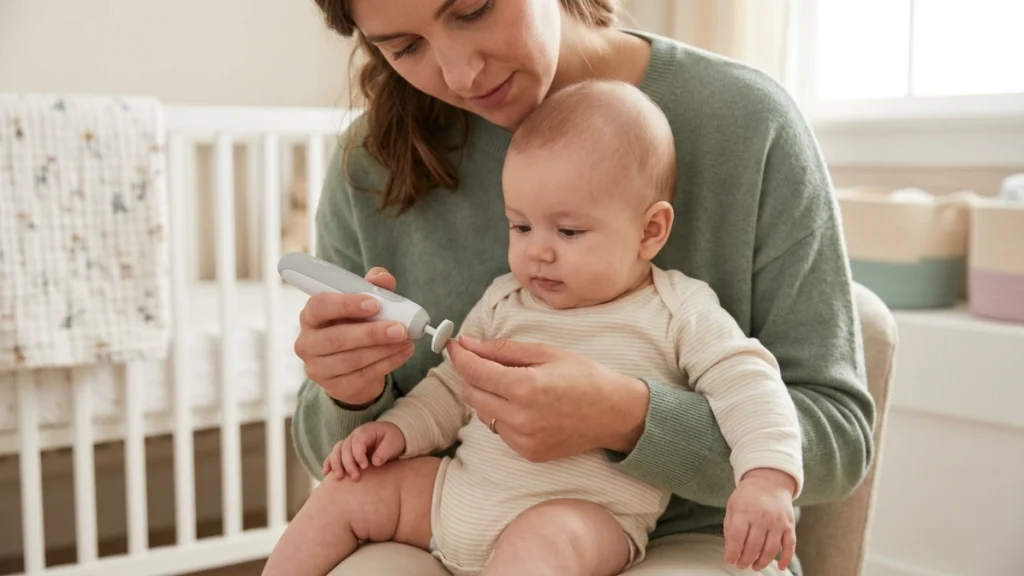
An electric baby nail file is a small powered grooming tool made to gently smooth a baby’s fingernails or toenails.
Most models use a rotating filing pad rather than a cutting blade. Many include several filing pads with different levels of roughness.
A typical baby nail grinder may offer:
- Low-speed rotation
- Soft filing pads
- Multiple speed settings
- A small LED light
- Forward and reverse rotation
- Replaceable filing discs
- Battery or rechargeable operation
These are very different from professional electric nail drills used for acrylic, gel, or salon services.
Never use a powerful salon e-file on a baby’s nails. Baby nails and surrounding skin are far too delicate for that type of equipment.
Do You Actually Need an Electric Nail File for Baby Nails?
For most families, an electric nail file is a convenience, not a requirement.
The NHS recommends several acceptable approaches to baby nail care, including special baby nail clippers, small round-ended safety scissors, or a fine emery board. It also recommends working when the baby is asleep or relaxed to reduce sudden movement. You can read the NHS guidance on cutting a baby’s nails for further guidance.
An electric file becomes attractive mainly because it removes the cutting action.
Instead of trying to position a blade between the nail and fingertip, you gradually smooth the nail down.
You May Prefer an Electric File If:
- You are very nervous about nail clippers.
- Your baby moves frequently during nail care.
- Sharp nail edges appear often.
- You prefer removing tiny amounts of nail at a time.
- You find it difficult to see where the nail ends.
- You want a tool that can smooth corners gently.
You Probably Do Not Need One If:
- A manual emery board works well for you.
- Your baby stays calm while nails are trimmed.
- You are comfortable using baby nail scissors or clippers.
- You only need occasional smoothing.
- You want the simplest and least expensive option.
There is no health advantage to owning an electric file simply because it is powered.
The safest tool is usually the one you can control confidently and gently.
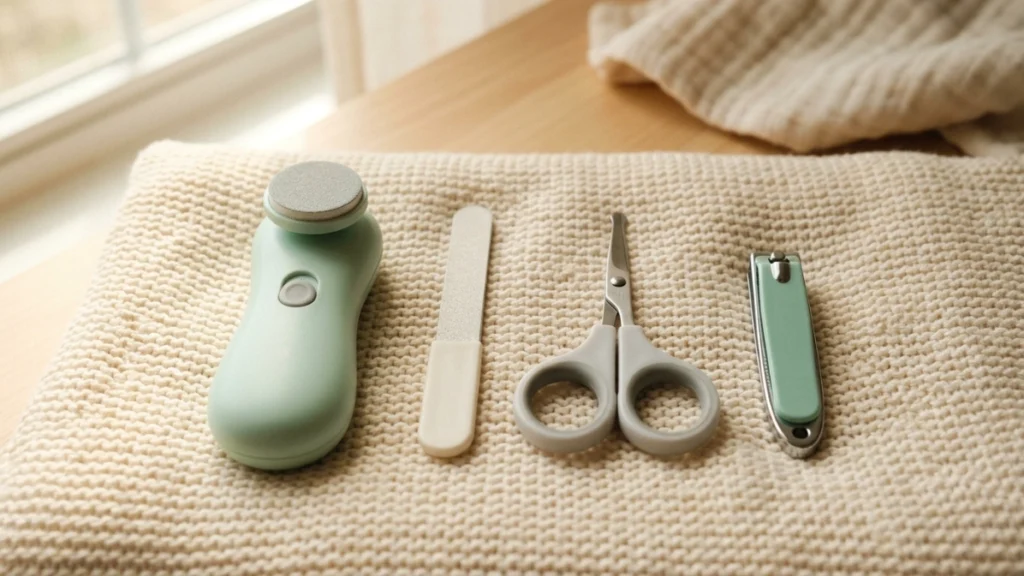
Electric Nail File vs Other Baby Nail Tools
| Nail Care Tool | Main Advantage | Main Limitation | Best For |
|---|---|---|---|
| Electric baby nail file | Removes nail gradually | Costs more and needs power | Parents nervous about cutting |
| Fine emery board | Simple and inexpensive | Can take longer | Newborn nails and minor rough edges |
| Baby nail clippers | Fast and precise | Can accidentally catch skin | Parents comfortable clipping |
| Round-tip baby scissors | Good visibility and control | Requires a steady hand | Thin nails with clear edges |
| Adult nail tools | Convenient if already owned | Often too large for tiny nails | Generally better avoided |
The American Academy of Dermatology’s baby nail-care advice recommends keeping baby’s nails smooth and using a nail file or emery board to create a rounded rather than jagged edge. Good lighting is also important while working on tiny nails.
Benefits of Using an Electric Nail File for a Baby
It Removes Nail Gradually
One reason parents like electric files is that they do not remove a large piece of nail at once.
A soft filing pad gradually wears down the edge.
That gives you time to stop before taking off too much.
There Is No Clipper Blade
Traditional clippers work well, but positioning the blade can make new parents nervous.
An electric file does not need to slide underneath the nail edge.
This may reduce one particular risk—accidentally catching fingertip skin with a clipper blade.
It does not make nail care completely risk-free.
It Can Smooth Sharp Corners
Sometimes a baby’s nail does not really need shortening. It simply has one sharp corner.
An electric file can make small adjustments without trimming the entire nail.
Some Parents Find It Easier to Control
A low-speed file allows you to work for a few seconds, stop, check the nail, and continue only if necessary.
That slow approach can be helpful when you are still learning how much nail to remove.
Limitations of Electric Baby Nail Files
Electric files are convenient, but they have disadvantages too.
They Can Still Irritate Skin
A rotating filing pad rubbing against the fingertip can cause irritation.
Do not assume a baby nail grinder cannot hurt skin just because it does not contain a blade.
Use very light pressure and keep the filing surface on the nail.
Babies Can Move Suddenly
Even a calm baby can pull away without warning.
A moving tool and a moving hand are not a good combination.
If your baby starts squirming, crying, or grabbing the device, stop.
Replacement Parts Add Cost
A basic emery board requires almost no setup.
An electric nail file may require:
- Batteries or charging
- Replacement filing pads
- Cleaning
- Storage of small accessories
If you only smooth a nail occasionally, the extra expense may provide little benefit.
Filing Can Take Longer
Clippers can shorten a long nail quickly.
A very gentle electric file removes smaller amounts.
That is useful for control, but it may take longer.
How to Use an Electric Nail File for Baby Nails Safely
Always follow the instructions supplied with your specific device. Designs, filing pads, and recommended age ranges can differ.
A simple routine is:
- Choose a calm time.
Try nail care while your baby is relaxed or sleeping. - Use good lighting.
Make sure you can clearly see the nail edge and fingertip. - Choose the gentlest suitable pad.
Use the filing surface recommended by the manufacturer for your baby’s age. - Start at the lowest speed.
More speed is not necessarily better. - Hold the finger securely but gently.
Support the fingertip so it does not move freely. - Touch only the nail edge.
Avoid filing the skin or cuticle. - Use very light pressure.
Let the file do the work. Do not push the spinning pad into the nail. - Work in short intervals.
File for a moment, stop, and inspect the nail. - Stop when the sharp edge is gone.
Baby nails do not need to be extremely short. - Clean the tool as directed.
Keep filing attachments clean and dry before storage.
Never continue filing while your baby is pulling their hand away.
Expert Tip: Stop filing as soon as the nail feels smooth. Trying to make every nail perfectly shaped can lead to unnecessary over-filing.
How Short Should Baby Nails Be?
You are not trying to create a salon-perfect manicure.
The goal is simply to remove sharp or broken edges that could scratch your baby’s skin.
Leave a small visible nail edge rather than grinding aggressively toward the fingertip.
If you cannot clearly tell where the nail separates from the skin, stop and look again in stronger light.
A little patience is safer than trying to finish every nail in one session.
Is a Manual Nail File Safer Than an Electric One?
Neither option is automatically safest in every situation.
A manual fine emery board has several advantages:
- No motor
- No batteries
- Very inexpensive
- Easy to control
- Removes small amounts of nail
For many newborns, it may be all you need.
An electric file can be easier when you want consistent, gentle filing or find manual filing frustrating.
Both tools can irritate skin if used too aggressively.
The best choice depends on your confidence and your baby’s movement.
What Should I Look for If I Buy an Electric Baby Nail File?
You do not need the most expensive model.
Focus on practical safety and usability.
Useful features include:
- Baby-specific filing pads
- A low-speed setting
- Easy-to-hold body
- Clearly marked pad types
- Simple cleaning instructions
- Secure battery compartment
- Easy-to-find replacement pads
- Built-in light if your room lighting is poor
Check the manufacturer’s age recommendations before using any attachment.
Also look at ongoing cost. A cheaper electric file may become less economical if replacement pads are expensive or difficult to find.
Quality and Durability
A useful baby nail file should operate smoothly without excessive vibration.
Attachments should fit securely rather than wobbling during use.
If a pad becomes damaged, loose, excessively worn, or dirty, replace it rather than continuing to use it.
Keep all detachable filing discs, batteries, caps, and other small pieces out of your baby’s reach, because small components can present a choking hazard.
What If I Accidentally Nick My Baby’s Finger?
Even careful parents sometimes catch the skin while trimming nails.
If there is a small superficial cut, stay calm and apply gentle pressure with clean gauze or a clean cloth until the bleeding stops.
The American Academy of Dermatology advises gently cleaning an injured nail area with soap and water and watching the injury as it heals. Its guidance for caring for an injured nail also explains basic wound care principles.
Contact your baby’s healthcare professional if bleeding does not stop, the injury looks deep, or you are concerned about the wound.
Do not try to solve a significant nail injury by filing it further.
Common Mistakes to Avoid
- Using an adult salon e-file. These tools can be much more powerful than baby-specific files.
- Using too much pressure. Gentle contact is enough.
- Filing skin along with the nail. Keep the pad on the nail edge.
- Trying to make nails extremely short. You only need to remove sharp edges.
- Continuing when the baby moves. Stop and try again later.
- Starting at high speed. Begin with the gentlest appropriate setting.
- Ignoring attachment instructions. Different pads may be intended for different ages.
- Using worn or damaged pads. Replace attachments when necessary.
- Sharing nail files between people. Keeping baby’s nail-care tools separate is more hygienic.
- Leaving small attachments within reach. Store the device and accessories safely after each use.
- Treating an abnormal nail as a grooming problem. Redness, swelling, drainage, or significant pain deserves medical attention.
When to See a Nail Technician or Dermatologist
For routine baby nail trimming, you normally do not need either a nail technician or dermatologist.
More importantly, a nail salon is not the right place to diagnose a baby’s nail problem.
Contact your pediatrician or another qualified healthcare professional if you notice:
- Increasing redness around a nail
- Swelling
- Pus or unusual drainage
- Persistent bleeding
- Significant tenderness
- A deep cut
- Skin that feels unusually warm around the nail
- A nail that appears badly damaged or detached
- Persistent changes in nail color or shape
- A nail problem that repeatedly returns
Your pediatrician can decide whether a dermatologist or another specialist is needed.
Do not put acrylic products, gel polish, nail glue, harsh removers, or other cosmetic nail treatments on an irritated or injured baby’s nail unless a qualified healthcare professional specifically advises it.
A Simple Decision Guide
If you are still wondering whether you need an electric file, this quick guide may help.
| Your Situation | Practical Choice |
|---|---|
| Newborn with very soft nails | Fine emery board may be enough |
| Parent is nervous about clippers | Baby electric nail file can be helpful |
| Baby has one small sharp corner | Manual or electric file |
| Nails are long and parent is confident | Baby clippers or safety scissors |
| Baby constantly moves during grooming | Wait until calm or asleep |
| Nail is red, swollen, painful, or draining | Contact a healthcare professional |
| You already use an emery board successfully | No strong reason to switch |
FAQs
Can I use an electric nail file on a newborn?
A baby-specific electric file may be suitable if its manufacturer says it is appropriate for newborns. Use the gentlest recommended pad, low speed, and very light pressure. A fine manual emery board is also a simple option for newborn nails.
Is an electric nail file safer than baby nail clippers?
It avoids the cutting blade used by clippers, which some parents find easier to manage. However, the rotating pad can still irritate skin. Neither tool is completely risk-free, so careful technique matters.
How often should I file my baby’s nails?
There is no fixed schedule that works for every baby. Check the nails regularly and smooth them when they become long, sharp, broken, or jagged.
Can I use my regular electric nail drill on my baby?
No. Professional or adult electric nail drills can be much more powerful than baby-specific nail files. Use a tool specifically designed for gentle infant nail care.
Should I file my baby’s nails while they are sleeping?
It can be easier because babies often move less while asleep. Both the American Academy of Pediatrics and NHS guidance note that trimming or filing while a baby is sleeping or relaxed can make the process easier.
Can an electric baby nail file cut the skin?
It does not cut like clippers, but a rotating filing surface can still rub or irritate delicate skin. Keep the filing pad on the nail and stop immediately if it touches the skin repeatedly.
What is the easiest baby nail tool for a first-time parent?
A fine emery board is one of the simplest options because it removes the nail gradually and requires no cutting blade. If manual filing feels too slow or awkward, a low-speed baby electric nail file can be a practical alternative.
Conclusion
So, do I need an electric nail file for baby nail care? For most parents, the answer is no. It is an optional convenience rather than an essential baby item.
A fine emery board, baby nail clippers, or rounded safety scissors can all work. An electric baby nail file may be worth considering if you are uncomfortable using clippers and prefer removing tiny amounts of nail at a time.
Whichever tool you choose, focus on good lighting, a calm baby, gentle pressure, and stopping as soon as sharp edges are smooth.
And remember that grooming tools are for healthy nails. If you see redness, swelling, drainage, persistent bleeding, or another unusual nail change, skip the DIY treatment and contact your baby’s healthcare professional.

