
Does Sally Beauty Have Nail Files? Types, Prices, Grits, and Buying Tips

If you need to smooth a broken nail, reshape your manicure, or pick up a file for acrylic or gel nails, Sally Beauty is one of the first beauty stores you might check.
So, does Sally Beauty have nail files? Yes. Sally Beauty currently carries a large selection of nail files, buffers, sanding tools, and related nail-care products online, with many products also eligible for in-store pickup depending on your location. Its nail file category includes basic emery-style boards, cushion files, different grit levels, buffer blocks, and even an electronic nail file.
The important part is choosing the right one. A file that works beautifully on thick acrylic nails may be much too rough for thin natural nails. Below, we’ll look at what Sally Beauty sells, common prices, grit numbers, safe filing techniques, hygiene, and when DIY filing is not the right choice.
Quick Answer
Yes, Sally Beauty has nail files. You can find basic nail files, cushion files, dual-grit files, emery-style boards, buffers, and some electric filing tools. Many inexpensive manual files cost only a few dollars, but availability varies by store. Choose your file based on your natural nails or nail enhancements and the grit you need.
What Types of Nail Files Does Sally Beauty Have?
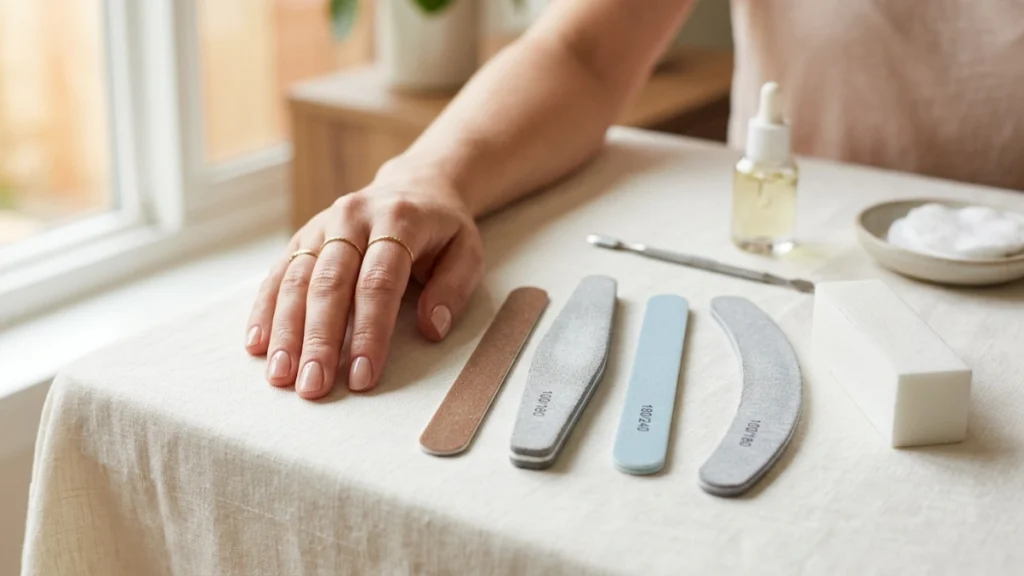
Sally Beauty has a dedicated nail files and buffers collection rather than offering only one or two basic emery boards.
At the time of this review, its online category showed dozens of nail files plus buffers and related nail-care tools. Products included Beauty Secrets cushion files, tapered files, banana-shaped files, Tropical Shine files, buffer blocks, and an electronic nail drill.
That gives you several choices depending on what you want to accomplish.
Standard Nail Files
Standard nail files are a simple choice for shortening and shaping the free edge of the nail.
Sally Beauty currently lists several traditional-style options, including straight, tapered, rectangular, and banana-shaped files. Some are inexpensive enough to keep one in your manicure kit, purse, or travel bag.
These are often practical for:
- Fixing a snagged nail
- Refining nail shape
- Shortening an edge slightly
- Smoothing rough corners
- Maintaining artificial nail shapes
The important consideration is grit. Two files that look almost identical can behave very differently if one is coarse and the other is fine.
Cushion Nail Files
Cushion files have a slightly padded or flexible center instead of feeling completely rigid.
Sally Beauty currently offers several cushion-style files, including medium/coarse and other grit choices from brands such as Beauty Secrets and Tropical Shine.
The cushioning can make a file feel more comfortable in your hand and may make it easier to follow the curve of a nail.
However, a cushion core does not automatically mean the abrasive surface is gentle. Always check the grit.
Dual-Grit Nail Files
A dual-grit file has two different abrasive surfaces.
This can be useful when you want one side for shaping and another for refining the finished edge.
For example, Sally Beauty currently lists 180/240-grit Tropical Shine files. The product description identifies them as tools for trimming, smoothing, and shaping fingernails.
Dual-grit designs are convenient because you do not have to keep switching tools during a basic manicure.
Nail Buffers
A buffer and a nail file are related, but they are not exactly the same tool.
A traditional nail file is primarily used around the edge to change the nail’s shape or length. Buffers are commonly used for gentler smoothing or finishing work.
Sally Beauty’s category currently includes several buffer blocks. One Sani-Block listing, for example, offers different versions ranging from 100/120 to 220/240 grit depending on the intended job.
Do not aggressively buff the surface of a natural nail. Removing too much of the nail plate can leave it thinner and more sensitive.
Electronic Nail Files
Sally Beauty also lists electronic filing equipment, including a wireless nail drill.
Electric files can remove product much faster than hand files, but speed is also their biggest drawback for beginners.
Too much pressure, the wrong bit, or staying in one place for too long can create heat and remove more material than you intended.
For ordinary natural-nail maintenance, a manual file is usually much easier for a beginner to control.
How Much Do Nail Files Cost at Sally Beauty?
One advantage of buying a basic nail file at Sally Beauty is that many manual options are inexpensive.
At the time checked, numerous manual files and buffer products were listed below $5. Examples included several Beauty Secrets files around $0.99 and Tropical Shine files around $1.49 to $2.99. The electronic nail drill was considerably more expensive. Prices can change, so check the current product page before purchasing.
Here is a simple comparison.
| Nail File Type | Typical Use | Current Sally Beauty Examples | What to Watch For |
|---|---|---|---|
| Basic nail file | Everyday shaping | Many low-cost options | Check grit before using |
| Cushion file | Shaping and refining | Multiple grit choices | Cushion does not mean fine grit |
| 180/240 file | Gentler shaping and smoothing | Tropical Shine options | Better suited to lighter filing |
| Buffer block | Surface finishing or smoothing | Several grit combinations | Avoid over-buffing natural nails |
| Electronic file | Faster enhancement shaping/removal | Wireless nail drill available | Easy to over-file without experience |
Current selection and prices can vary by location and over time.
What Nail File Grit Should You Choose?
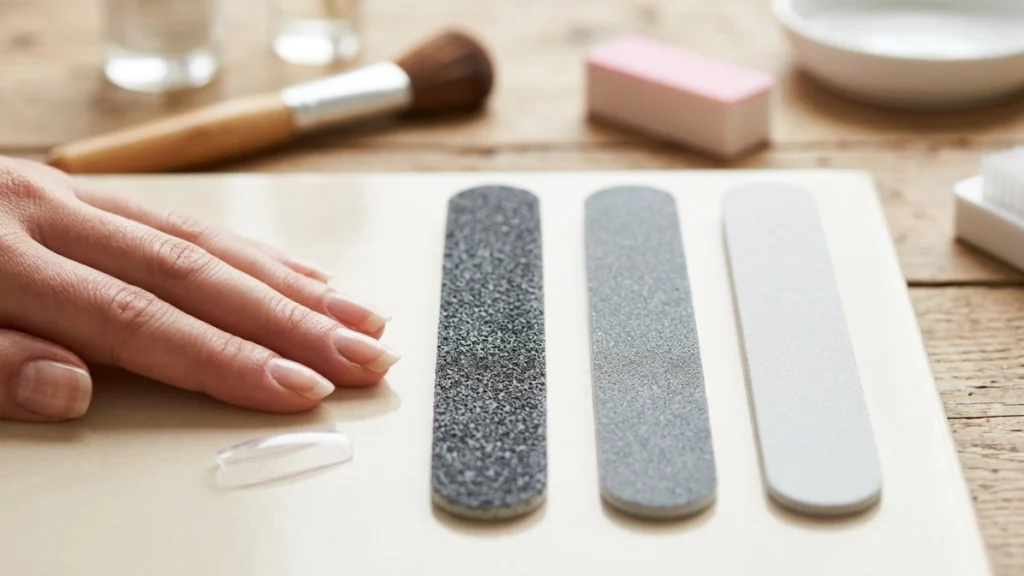
The grit number is one of the most important details printed on a nail file.
In simple terms, lower grit numbers are generally rougher, while higher numbers are finer. Sally Beauty’s Sani-Block listing demonstrates this clearly: it describes 100/120 as medium/coarse, 100/180 as medium/fine, and 220/240 as fine/super fine.
Around 100 Grit
A 100-grit file is relatively coarse.
You may see it used for artificial products where a substantial amount of material needs to be shaped. Sally Beauty sells several 100/180-grit files aimed at manicure or enhancement work.
For a thin natural nail, however, coarse filing can be too aggressive.
Around 180 Grit
A 180-grit surface gives you more control than a very coarse file and appears frequently in Sally Beauty’s current nail-file selection.
It can be useful for controlled shaping, depending on the nail’s thickness and whether you are working on natural or enhanced nails.
Use light pressure rather than trying to remove a lot of nail with each stroke.
Around 220 to 240 Grit
Finer grits are better suited to gentle finishing and smoothing.
Sally Beauty specifically describes the 220/240 version of its Sani-Block as suitable for finishing extensions or natural nails, while its Tropical Shine 180/240 file is marketed for shaping and smoothing.
If your natural nails are thin or prone to peeling, starting with a gentler file is usually the more cautious approach.
Expert Tip: If you are unsure between two grits, start with the finer option. You can always file a little longer, but you cannot put nail layers back after aggressive over-filing.
How to File Natural Nails Safely
Buying the right file is only half the job. Your technique matters too.
The American Academy of Dermatology recommends using a nail file or emery board to smooth rough edges and advises filing in the same direction rather than repeatedly sawing back and forth. Dermatologists warn that back-and-forth filing can weaken nails.
For a simple at-home manicure:
- Start with clean nails. Remove anything that makes it difficult to see the natural edge.
- Choose a reasonably fine file. Avoid grabbing the roughest file simply because it works faster.
- Hold the file comfortably. Do not squeeze it tightly.
- Use light strokes. Let the abrasive surface do the work.
- Shape gradually. Check both hands often so the lengths remain balanced.
- Smooth rough corners carefully. Do not file deeply into the sides of the nail.
- Stop when the edge feels smooth. More filing is not automatically better.
- Moisturize afterward. Nail and surrounding skin can become dry during grooming.
The AAD also recommends keeping grooming tools clean and notes that healthy nail-care practices can help reduce problems associated with dirt and bacteria. You can review its full dermatologist guidance on trimming and filing nails for additional safety advice.
Natural Nails vs. Acrylic, Gel, and Other Enhancements
Do not assume one file works equally well for every manicure.
Natural Nails
Natural nails need more conservative filing because you are working directly on your own nail plate.
Avoid unnecessary coarse filing, especially if your nails are already:
- Peeling
- Thin
- Flexible
- Tender
- Cracking easily
The goal should usually be to refine the free edge without aggressively removing healthy nail material.
Acrylic and Other Artificial Nails
Artificial enhancements can require heavier shaping, which is why you commonly see 100/180-grit files in professional nail sections.
That does not mean you should continue filing once you reach your natural nail.
The American Academy of Dermatology notes that preparing artificial nails can involve roughening the natural nail surface and that this process can thin and weaken natural nails. Its guidance for reducing artificial-nail damage also warns that repeated filing associated with artificial nail maintenance can contribute to damage.
If you are removing or reshaping thick enhancements and cannot tell where the product ends and your natural nail begins, professional help may be safer.
How to Choose the Best Sally Beauty Nail File
You do not necessarily need the most expensive file.
Instead, ask five practical questions.
1. What Are You Filing?
This is the most important question.
Natural nail? Choose gentler control.
Thick acrylic? You may need a stronger or coarser file for the artificial material.
Surface buffing? Look for a buffer designed specifically for that job.
2. What Grit Is Printed on It?
Do not judge by color alone.
A cute patterned file can still have a specific professional grit. Sally Beauty’s decorative Tropical Shine Pineapple file, for example, is clearly labeled 180/240.
3. Do You Want Disposable or Reusable?
Disposable-style files are inexpensive and convenient.
A reusable or washable tool may last longer, but it needs appropriate cleaning and storage.
Sally Beauty’s category lets shoppers filter for characteristics including washable and reusable products.
4. Are Your Nails Sensitive?
If filing makes your nail feel hot, sore, or tender, stop.
Do not continue just to achieve the perfect shape.
Thin or damaged nails may need minimal filing until the affected area grows out.
5. How Much Do You Want to Spend?
For an occasional broken edge, a simple inexpensive manual file may be enough.
If you maintain enhancements frequently, you may value a more durable professional-style file.
An electric tool is a much larger purchase and introduces a learning curve, so it is not automatically a better value for a beginner.
Nail File Hygiene: Can You Keep Reusing the Same File?
For personal use, whether you can safely reuse a file depends partly on its material and whether it can actually be cleaned.
Some Sally Beauty products are specifically marketed as washable, sanitizable, or reusable. The Sani-Block, for example, is described as sanitizable and reusable, while the manufacturer also provides separate guidance for professional single-use situations.
For home use:
- Keep your file dry between manicures.
- Do not share personal nail files casually.
- Replace disposable files when the surface becomes worn, dirty, damaged, or difficult to clean.
- Follow manufacturer cleaning directions for washable files.
- Store reusable tools somewhere clean and dry.
If a file has been used on a visibly infected or suspicious nail, continuing to use it on healthy nails is not a smart DIY shortcut.
Common Mistakes to Avoid
Even a cheap nail file can work well when used correctly. Most problems come from using too much force or the wrong tool.
Avoid these common mistakes:
- Using very coarse grit on thin natural nails. Faster removal is not worth unnecessary damage.
- Sawing aggressively back and forth. The AAD recommends filing in one direction to reduce weakening.
- Filing until the nail feels hot or painful. Discomfort is a reason to stop.
- Over-buffing the top of the nail. This can unnecessarily thin the nail plate.
- Using an electric drill without understanding speed and pressure. Manual filing is easier to control for beginners.
- Sharing dirty files. Nail tools should be kept clean.
- Trying to file away discoloration or a suspected infection. A cosmetic tool cannot diagnose or treat a medical nail problem.
- Continuing to file damaged artificial nails into the natural nail. Stop when you are unsure where the enhancement ends.
When to See a Nail Technician or Dermatologist
A nail technician can help when your main problem is cosmetic or involves an enhancement that is difficult to shape or remove safely.
Consider professional nail help if:
- Thick acrylic or gel product is difficult to remove
- You repeatedly over-file your nails at home
- An enhancement is lifting or cracking
- You cannot identify the correct grit or technique
- Filing causes discomfort
A dermatologist is the better choice when the problem appears to involve the nail itself rather than the manicure.
The American Academy of Dermatology recommends seeking evaluation when you notice significant changes in nail color, texture, or shape because some changes can be associated with infection or other health conditions.
Get medical advice if you have persistent:
- Pain
- Redness
- Swelling
- Drainage
- Nail separation
- Unexplained discoloration
- Thickening or crumbling
- Changes that continue getting worse
Do not try to file away a painful or infected-looking area. Filing may hide the appearance temporarily without addressing the cause.
FAQs
Does Sally Beauty sell regular nail files?
Yes. Sally Beauty currently sells numerous standard manual nail files in its nail files and buffers department, including rectangular, tapered, banana-shaped, cushion, and dual-grit styles.
Does Sally Beauty sell 100/180 nail files?
Yes. Current listings include several 100/180-grit options from brands such as Beauty Secrets and ASP.
Does Sally Beauty sell fine nail files for natural nails?
Yes. Its current selection includes finer options such as 180/240 files and 220/240 buffer products. Always check the product label and use gentle pressure on natural nails.
Does Sally Beauty sell nail buffers?
Yes. Sally Beauty currently has a separate selection of buffer blocks and multi-surface buffers within its nail-files-and-buffers category.
Are Sally Beauty nail files expensive?
Many manual options are inexpensive. At the time checked, several basic files were around $0.99 to a few dollars, although professional or electronic tools can cost substantially more. Prices and promotions can change.
Can I use a 100-grit Sally Beauty file on natural nails?
A 100-grit surface is relatively coarse and is usually better suited to heavier shaping jobs or artificial product than gentle natural-nail maintenance. Sally Beauty itself categorizes 100/120 as medium/coarse and 220/240 as fine/super fine on one of its buffer products.
Can I buy Sally Beauty nail files in stores?
Many Sally Beauty file listings offer an in-store pickup option, but availability depends on the store you select. Check your local store inventory before making a special trip.
Conclusion
So, does Sally Beauty have nail files? Yes, and the selection is much broader than a single basic emery board.
You can currently find inexpensive everyday files, cushion files, 100/180 and 180/240 grit combinations, fine buffers, decorative files, and electronic filing equipment.
For most people doing basic natural-nail care at home, the smartest choice is a controllable, reasonably fine manual file rather than the roughest tool available. Check the grit, use light pressure, keep your tools clean, and stop if you notice pain or significant nail damage.
If you’re shopping at Sally Beauty, choose your nail file based on your nail type and the job you actually need it to do—not simply by price or appearance.

