
Can Cats Play With Nail Files? What Nail Lovers Should Know

If your cat has ever swatted a nail file off your vanity or tried to chew an emery board while you were doing your nails, you are definitely not alone. Cats are naturally curious about small objects that move, scrape, slide, and make interesting sounds.
But can cats play with nail files safely?
In general, no. A nail file is designed for grooming human nails, not for feline play. Emery boards can fray, foam files can be chewed apart, glass files can chip or break, and small pieces may end up in your cat’s mouth.
That does not mean you need to panic if your cat briefly paws at an intact file. The bigger concern is repeated chewing, biting, breaking, or swallowing pieces.
Here is what nail lovers with curious cats should know about nail file materials, possible risks, hygiene, warning signs, and safer ways to redirect playful behavior.
Quick Answer
Can cats play with nail files? It is better not to let them. Nail files are grooming tools rather than pet toys, and chewing may loosen cardboard, abrasive coating, foam, or other pieces that can irritate the mouth or be swallowed. Store your files away and redirect your cat to a cat-safe toy.
Why Do Cats Want to Play With Nail Files?
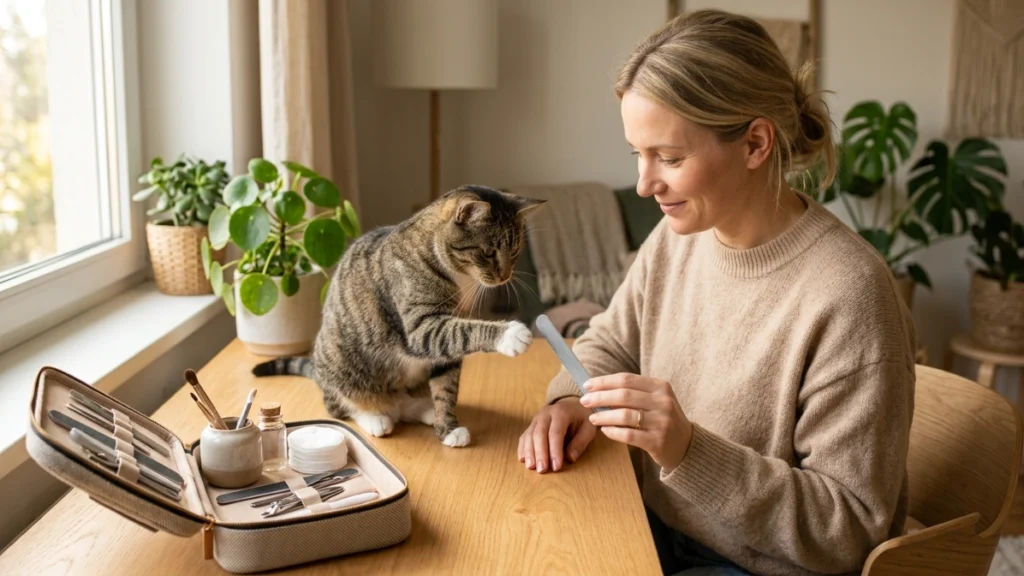
To you, an emery board is simply something that smooths a chipped nail. To your cat, it may behave like an interesting piece of prey.
A file can:
- Slide quickly across a table.
- Make a scratching sound.
- Move when your cat bats it.
- Fit easily between paws.
- Carry your scent after you use it.
- Have a rough texture that feels interesting to bite.
Kittens may be especially interested because they investigate objects with their paws and mouths.
Veterinary guidance supports giving cats toys that encourage natural behaviors such as chasing and capturing while avoiding objects that can be swallowed. VCA’s kitten toy safety guidance also recommends supervising play so kittens do not ingest inappropriate objects.
So your cat’s interest is normal.
The nail file simply is not the best object for satisfying that curiosity.
Are Nail Files Safe Toys for Cats?
No nail file should be treated as a regular cat toy.
The biggest problem is not necessarily that touching a nail file is poisonous. Instead, the risks depend on what the file is made from, whether your cat chews it, and whether pieces break off.
A cat batting an intact emery board once is very different from a cat sitting under the bed chewing it into pieces.
Possible Problems Include
Swallowing pieces
Cats may accidentally swallow bits of cardboard, foam, coating, plastic, or another material while chewing.
VCA explains that foreign objects can sometimes become lodged in a cat’s digestive tract, potentially creating an intestinal obstruction. Signs can include vomiting, reduced appetite, abdominal discomfort, lethargy, and changes in bowel movements.
Mouth irritation
The rough surface intended to grind human nails may scrape sensitive tissue inside a cat’s mouth if the animal repeatedly bites or licks it.
Sharp or broken edges
A damaged file can develop rough corners or fragments.
Glass files deserve particular caution because a cracked or broken file can create sharp pieces.
Choking
A small piece that breaks free may become a choking hazard.
Exposure to nail residue
A used file can hold nail dust and traces of products from your manicure routine.
For all these reasons, the safest habit is to treat nail files like other beauty tools: use them for your nails and store them when you finish.
Nail File Types and Their Risks Around Cats
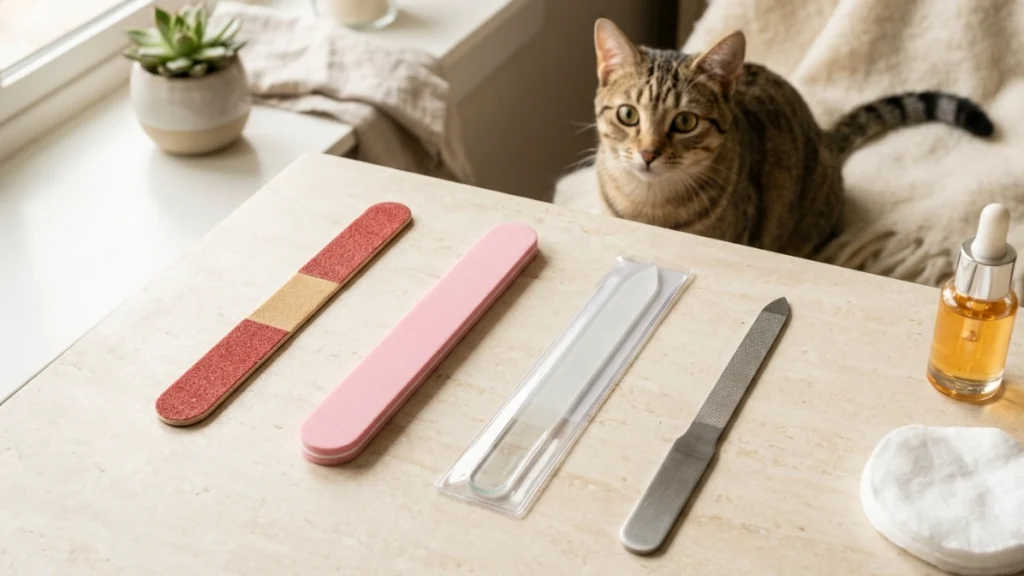
Not every nail file is constructed the same way.
Here is a practical comparison.
| Nail file type | What happens if a cat plays with it? | Main concern | Best practice |
|---|---|---|---|
| Emery board | May bend, fray, or shred when bitten | Swallowed cardboard or abrasive pieces | Store away after use |
| Foam/cushioned file | Easy for some cats to bite into | Foam or coating can break off | Do not leave unattended |
| Glass/crystal file | Hard and usually difficult to chew | Breakage, chips, sharp fragments | Keep in its protective case |
| Metal file | Durable but rigid | Mouth or tooth injury from aggressive biting | Store in a closed grooming kit |
| Disposable file | Often lightweight and easy to bat around | Fraying and ingestion | Dispose of damaged files promptly |
| Electric nail file attachments | Small removable components | Swallowing, chewing, mechanical hazard | Keep unplugged and securely stored |
Emery Boards
Emery boards are probably the most tempting type for cats because they are light and easy to knock around.
They are also relatively easy to damage.
Once your cat starts chewing the edge, layers may separate or fray. At that point, take the file away rather than letting the cat continue.
If you use disposable files frequently, NailPrime’s guide to disposable nail files explains how these tools are generally made for nail shaping and hygienic replacement—not use as durable play objects.
Glass Nail Files
A quality glass nail file can be durable during normal manicure use, but it remains a breakable grooming tool.
Never deliberately give a glass file to a cat.
If one falls onto tile and develops a crack or chip, replace it. Do not continue using it on your nails or leave it where a pet can reach it.
Metal Nail Files
Metal files may look less chewable, but they are still inappropriate toys.
A cat biting aggressively on a hard metal object could hurt its mouth or potentially damage a tooth.
Foam Files and Buffers
Soft-looking does not automatically mean pet-safe.
A foam buffer may be particularly appealing to a cat that likes chewing spongy materials. Once torn, however, small foam pieces can separate from the tool.
What Should You Do If Your Cat Grabs a Nail File?
If your cat simply steals an intact nail file and starts batting it around, you usually do not need to turn the situation into a crisis.
Instead:
- Calmly take the file away. Avoid turning the nail file into an exciting tug-of-war prize.
- Check the file for damage. Look for missing corners, bite marks, separated layers, cracks, or pieces of coating.
- Look around the floor. Pick up any loose fragments.
- Offer a proper cat toy. A ball, kicker toy, sturdy mouse toy, or another toy designed for feline play is a better choice.
- Store your manicure tools. Put files back in a drawer, case, cosmetic bag, or closed organizer.
If the file is completely intact and your cat did nothing more than paw at it briefly, careful observation is generally reasonable.
The situation changes if something appears to be missing.
What If Your Cat Chewed or Swallowed Part of a Nail File?
First, inspect whatever remains of the file.
Do not automatically assume your cat swallowed something just because you see bite marks. However, a visibly missing piece deserves more attention.
Watch for signs such as:
- Vomiting.
- Repeated gagging or retching.
- Drooling.
- Trouble swallowing.
- Refusing food.
- Reduced appetite.
- Unusual tiredness.
- Abdominal discomfort.
- Straining to pass stool.
- Major changes in behavior.
Foreign-body obstruction can be serious. VCA notes that swallowed non-food objects do not always pass normally and recommends contacting a veterinarian when foreign-object ingestion is suspected.
If you know or strongly suspect that your cat swallowed a sizeable, sharp, rigid, or broken fragment, contact your veterinarian rather than waiting for symptoms to become severe.
Do Not Try to Make Your Cat Vomit
Trying home remedies to force vomiting can make some situations worse.
VCA’s emergency guidance for cats specifically advises against inducing vomiting when a cat has ingested a foreign object.
Your veterinarian can decide whether observation, imaging, or treatment is appropriate based on what was swallowed and how your cat is behaving.
Is the Abrasive Material on a Nail File Toxic to Cats?
There is no single answer for every nail file because files can contain different materials.
An emery-style file may contain:
- Cardboard or wood-based material.
- Adhesive.
- Abrasive particles.
- Foam.
- Plastic.
- Printed ink or coloring.
- Various surface coatings.
The more predictable concern with an ordinary nail file is usually physical damage or ingestion of non-food material, rather than assuming every abrasive coating is poisonous.
However, you should not guess about an unknown coating if your cat has consumed a noticeable amount.
Keep the packaging if available. A veterinarian may want the product name, materials, or manufacturer information.
Used Nail Files Add a Hygiene Issue
There is another reason not to share your manicure tools with a playful pet: hygiene.
Nail files can collect:
- Nail dust.
- Skin debris.
- Oils.
- Polish residue.
- Gel or enhancement dust.
- Dirt from your hands.
Meanwhile, a file that has been inside your cat’s mouth can collect saliva and microorganisms.
That makes the file a poor candidate for going straight back into your manicure routine.
For inexpensive emery boards and disposable files, throwing away a file that your cat heavily chewed or mouthed is usually the simplest solution.
With a reusable file, follow the manufacturer’s cleaning instructions if the material can safely be cleaned.
Do not use a damaged file simply because it has been washed.
A cracked glass file, peeling abrasive surface, warped board, or rough metal edge should be replaced.
Better Toys for a Cat Who Loves Nail Files
If your cat repeatedly goes after files, the goal is not just to say “no.”
Give the cat something that provides a similar type of stimulation.
Good options may include:
- Sturdy cat balls.
- Kicker toys.
- Cat-safe stuffed mice.
- Crinkle toys.
- Puzzle feeders.
- Interactive chase toys.
- Scratching pads and posts.
- Wand toys used under supervision.
VCA recommends toys that support natural hunting, chasing, and capturing behavior.
Be careful with string-style toys as well. They may look like an obvious alternative, but veterinary guidance warns that cats can swallow string and similar materials.
The ASPCA’s advice for keeping cats away from household hazards notes that string can enter the digestive system and potentially require emergency veterinary treatment.
So even toys designed for interactive play should be used according to their safety instructions.
Expert Tip: Keep a small cat toy near the place where you normally do your nails. If your cat comes over to investigate your file, immediately redirect the cat to the toy instead of allowing the nail file to become part of the game.
How to Cat-Proof Your Nail Care Station
A few simple habits can prevent most problems.
Keep Files in a Closed Container
A nail organizer, drawer, zippered manicure bag, or hard case makes it much harder for your cat to steal a file.
This is especially helpful with glass files.
Clean Up Nail Clippings
Nail clippings can be interesting to curious pets too.
Throw them away when you finish rather than leaving them on a table or floor.
Put Small Nail Tools Away
The same basic rule applies to:
- Nail tips.
- Small drill bits.
- Cuticle tools.
- Cotton pieces.
- Foil wraps.
- Orangewood sticks.
- Nail-art decorations.
- Product caps.
A manicure area can contain many objects that are far more interesting to your cat than they appear to you.
Do Not Make Stealing a Game
If you chase your cat dramatically every time she grabs an emery board, the attention itself may make the behavior more rewarding.
Calm removal and redirection are usually more practical.
DIY Safety vs. Professional Help
Most nail-file incidents are prevention problems rather than emergencies. What matters is recognizing when the situation has moved beyond simple home observation.
| Situation | Reasonable next step |
|---|---|
| Cat briefly bats an intact file | Remove it and provide a safe toy |
| Cat mouths file but nothing is damaged | Remove, inspect, and monitor |
| File is shredded and pieces are missing | Contact your veterinarian for advice |
| Glass file breaks | Secure all fragments and keep cat away |
| Cat vomits or stops eating after suspected ingestion | Seek veterinary guidance promptly |
| Cat repeatedly eats non-food objects | Discuss the behavior with a veterinarian |
Repeatedly eating inappropriate objects can sometimes be associated with pica, a pattern involving ingestion of non-food items. VCA notes that pica can have behavioral or medical causes and may result in gastrointestinal obstruction.
Common Mistakes to Avoid
- Leaving emery boards on the floor. Their light shape makes them easy for cats to steal.
- Assuming a soft foam file is harmless. Soft material can still be bitten into pieces and swallowed.
- Letting your cat repeatedly chew the file because it looks cute. Repetition increases the chance of material breaking loose.
- Giving a cracked glass file back to your cat. Broken glass is not a toy.
- Continuing to use a heavily chewed file on your nails. Replace contaminated or structurally damaged tools.
- Ignoring missing pieces. If part of the file cannot be accounted for, consider possible ingestion.
- Trying to induce vomiting at home. Ask a veterinarian what to do after suspected foreign-body ingestion.
- Replacing the file with loose string or yarn. These can create their own serious ingestion hazards.
When to See a Nail Technician or Dermatologist
For a cat swallowing or chewing a nail file, a veterinarian—not a nail technician or dermatologist—is the appropriate professional.
A nail technician may be helpful if you are unsure whether a damaged manicure tool should be replaced or how to keep reusable nail tools hygienic.
A dermatologist may be appropriate for your own skin or nail problem if a contaminated tool causes a persistent cut, swelling, unusual nail changes, or another concern that needs medical evaluation.
For your cat, contact a veterinarian if you suspect ingestion or notice vomiting, loss of appetite, pain, lethargy, difficulty swallowing, or other concerning changes.
FAQs
Can cats play with emery boards?
It is better not to use emery boards as cat toys. Cats can chew through their layered material, creating small fragments that may be swallowed. Put the board away and offer a toy specifically designed for cats.
What happens if my cat licks a nail file?
A brief lick of an intact, ordinary file is unlikely to be the same concern as chewing and swallowing pieces. Remove the file and inspect it. If your cat consumed material or develops symptoms, contact your veterinarian.
What should I do if my cat ate part of an emery board?
Check how much appears to be missing and contact your veterinarian for guidance, especially if a significant piece may have been swallowed. Watch for vomiting, appetite loss, lethargy, abdominal discomfort, or difficulty passing stool.
Can a nail file hurt a cat’s mouth?
Potentially. Nail files have abrasive surfaces designed to remove human nail material. Aggressive chewing may irritate a cat’s mouth, while hard or broken files could cause more serious injury.
Are glass nail files safe around cats?
They are safe manicure tools when used and stored correctly, but they should not be cat toys. A glass file can crack, chip, or break if dropped, creating sharp fragments.
Why does my cat keep stealing my nail file?
The file moves easily, makes interesting sounds, carries your scent, and can be grabbed with the paws. Those qualities can trigger a cat’s natural curiosity and play behavior.
Can I wash a nail file after my cat puts it in her mouth?
That depends on the file material and the manufacturer’s cleaning instructions. Reusable glass or metal tools may be washable, while porous disposable boards are harder to clean thoroughly. If the file is damaged or heavily chewed, replacing it is the safer choice.
Conclusion
So, can cats play with nail files? The safest answer is no.
An occasional paw swipe at an intact file usually is not a reason to panic, but nail files were never designed to withstand feline biting and chewing. Emery boards can fray, foam can tear, glass can break, and pieces of any damaged file may become a swallowing hazard.
Keep your manicure tools in a closed organizer, inspect files that your cat gets hold of, and replace anything damaged or contaminated.
Most importantly, redirect that playful energy toward sturdy toys designed for cats.
And if any part of the nail file appears to have been swallowed—or your cat develops vomiting, appetite loss, pain, unusual tiredness, or other concerning symptoms—contact your veterinarian for individualized advice.

