
Why Do Cats Hate Nail Files? Simple Reasons Explained

You pull out a nail file to fix a rough edge, and your cat suddenly backs away, stares at it, flicks her ears, or leaves the room. Some cats may even swat at the file or act upset the moment they hear that scratchy filing sound.
So, why do cats hate nail files? In many cases, the nail file itself is not the real problem. Your cat may dislike its rough sound, unusual texture, smell, movement, or the experience she associates with it.
It is also worth knowing that not every cat hates nail files. Some cats ignore them, while others seem curious about emery boards. Each cat has different sensory preferences and past experiences.
Below, I’ll explain the most likely reasons for your cat’s reaction, the signs that mean she is truly uncomfortable, and how to keep both your cat and your manicure tools safe.
Quick Answer
Why do cats hate nail files? Many cats dislike nail files because the scraping sound, rough texture, unfamiliar smell, or sudden movement can feel strange or threatening. A cat may also connect the file with unwanted paw handling. Not every cat reacts this way, so watch your cat’s body language instead of assuming she is afraid.
Why Do Cats Hate Nail Files?
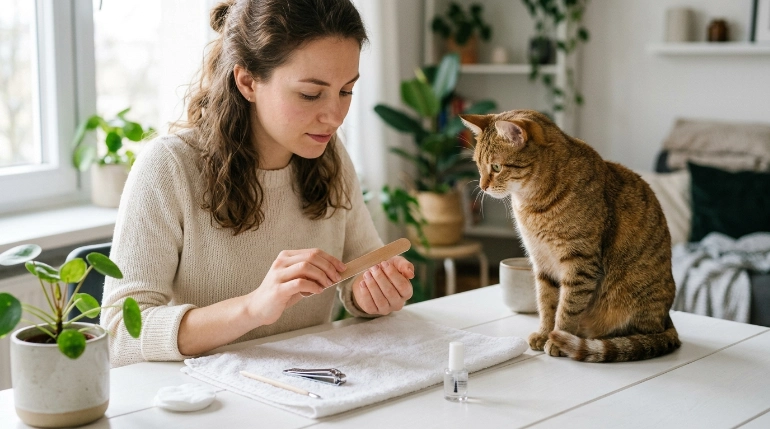
There is no single proven reason that explains why every cat reacts badly to a nail file.
Cats are highly aware of changes in their surroundings. Unfamiliar sounds, smells, objects, and handling can contribute to fear or stress in some cats, according to guidance from the Feline Veterinary Medical Association on creating a comfortable environment for cats.
A nail file combines several unusual sensations at once.
It can:
- Make a repetitive scraping sound
- Move quickly near the cat
- Have a gritty surface
- Carry hand cream, polish remover, nail dust, or other scents
- Be associated with touching paws
- Look like a small object being waved toward the cat
One cat may dislike the sound while another reacts mainly because she does not want her paws touched.
1. The Scraping Sound May Bother Your Cat
A manual nail file creates a dry, scratchy noise each time it moves across the nail.
You may barely notice that sound. Your cat may react differently.
Veterinary behavior guidance recognizes that unfamiliar or unpleasant sounds can contribute to fear and anxiety in cats. Cats may respond by moving away, hiding, flattening their ears, becoming restless, or trying to escape.
Watch what happens before assuming the file itself is the problem.
Try filing your nails while your cat is several feet away. If her ears rotate back or she immediately leaves once the scraping begins, the sound could be the trigger.
Do not repeatedly make the sound just to test her reaction. If your cat looks uncomfortable, stop.
2. The Rough Texture Can Feel Strange
Nail files and emery boards have an abrasive surface designed to remove tiny amounts of keratin from human nails.
To your fingers, that texture feels slightly gritty.
To a curious cat touching it with her nose, whiskers, mouth, or paw, it may feel unusual.
Some cats investigate unfamiliar textures. Others avoid them. Cats also have individual preferences when it comes to scratching surfaces and materials. Cornell’s information on normal feline scratching behavior notes that cats can prefer different scratching orientations and substrates.
That helps explain why one cat might avoid a gritty emery board while another tries to rub, scratch, or chew it.
3. Your Cat May Dislike the Smell
Your nail file may smell like almost nothing to you.
But it can pick up odors from:
- Hand lotion
- Nail polish
- Gel products
- Cuticle oil
- Acetone
- Cleaning products
- Nail dust
- Your hands
Unfamiliar or offensive smells can contribute to distress in cats, according to feline-friendly environmental recommendations.
This is especially important if the nail file has been sitting beside polish remover or other manicure chemicals.
Keep nail products closed and stored where your cat cannot lick, chew, spill, or walk through them.
4. Fast Movement Can Look Threatening
Think about how you normally use a nail file.
Your hand moves backward and forward quickly. If your cat is sitting close by, that small object may suddenly move toward her face or body.
A startled cat does not know that you are simply smoothing a broken nail.
Unexpected movements and sounds can trigger defensive responses, especially when a cat feels she cannot easily move away. Veterinary behavior guidance recommends allowing cats a sense of control and responding appropriately to signs of fear or anxiety.
Give your cat space instead of holding the file near her to see what she does.
5. She May Associate It With Paw Handling
Sometimes the problem is not the sound or texture.
It is the paws.
Cats vary widely in how comfortable they are with people touching their feet. Grooming and nail trimming can trigger defensive behavior in some cats, and warning signs may include dilated pupils, tail lashing, and ears moving backward.
If someone previously tried to file, trim, or hold your cat’s claws while she struggled, she may remember the experience.
Then simply seeing a grooming tool may predict something unpleasant.
A cat can also form associations between a frightening experience and something that happened around the same time.
That is one reason forcing a frightened cat through grooming can make future sessions harder.
6. Your Cat May Simply Be Startled by Something New
Cats notice small environmental changes.
A new glass file shining in the light, a colorful emery board moving across your lap, or an electric nail tool producing noise and vibration may be enough to make a cautious cat investigate from a distance.
That does not necessarily mean your cat has a serious fear.
If she looks once, walks away, and quickly returns to normal activities, she may simply be choosing not to interact with an unfamiliar object.
7. Some Cats Do Not Hate Nail Files at All
This is an important distinction.
Searching for why do cats hate nail files can make it sound as though nail-file hatred is a normal behavior shared by all cats. It isn’t.
Some cats may:
- Ignore nail files
- Sniff them
- Rub their face against them
- Paw at them
- Try to bite them
- Become interested in the gritty texture
- Leave as soon as filing starts
Individual responses matter more than the object itself.
If your cat voluntarily investigates a nail file, that does not mean it should become a toy. Small or damaged files can be chewed, and used manicure tools may contain nail debris or cosmetic residue.
Signs Your Cat Truly Dislikes the Nail File

A cat quietly walking away is different from a cat showing significant fear.
Pay attention to the whole body.
| What You Notice | What It May Suggest | What to Do |
|---|---|---|
| Turns head away | Mild avoidance | Give her space |
| Walks out of the room | Does not want interaction | Let her leave |
| Ears flatten or rotate back | Growing discomfort | Stop using it nearby |
| Tail lashes quickly | Irritation or arousal | Increase distance |
| Body crouches low | Fear or uncertainty | Remove the trigger |
| Hissing or growling | Strong warning | Do not approach |
| Swatting or biting | Defensive response | Stop and give her space |
| Hiding for a long time | More significant stress | Discuss repeated reactions with a vet |
Cornell notes that backward ears, dilated pupils, and tail lashing can appear before handling-related aggression. Respecting those early signals may help prevent escalation.
Never punish your cat for hissing, running away, or swatting at a nail file.
Punishment can increase fear rather than teaching the cat that the object is safe. Cornell specifically advises against punishment-based approaches for unwanted feline behavior because they may create fear and contribute to aggression.
Can I Use a Human Nail File on My Cat?
In most everyday situations, there is no reason to use your regular human nail file as your cat’s primary claw-care tool.
Cats naturally scratch surfaces, and regular claw trimming may also be appropriate. Cornell recommends careful trimming that avoids the quick—the sensitive area containing nerves and blood vessels.
A proper scratching surface gives your cat somewhere appropriate to perform normal scratching behavior.
If her claws need trimming, cat-appropriate clippers and correct technique give you better control than randomly sanding the claw with a human emery board.
If you are unsure how to trim them, ask your veterinarian to demonstrate the process.
Cornell’s guidance on choosing and caring for a cat specifically recommends asking a veterinarian for a lesson if you need help learning to clip your cat’s nails.
What About an Electric Nail File?
Be even more cautious with an electric nail grinder or similar manicure device.
It adds noise and vibration to an experience your cat may already find unfamiliar.
Do not place a running electric nail tool against your cat’s claws simply because it works well for your manicure.
A veterinarian or qualified grooming professional can help you choose an appropriate claw-care method for your individual cat.
Should You Let Your Cat Chew a Nail File?
No. I would not treat a nail file as a cat toy.
A used file can contain nail dust and residue from beauty products. A worn cardboard emery board can also fray or break apart when chewed.
Glass or metal files create different concerns because they are hard objects that were never designed for chewing.
Instead, remove the file and redirect your cat toward something intended for feline play.
This is especially important around a home manicure station. Keep files, clippers, acetone, polish, gel products, adhesives, and other beauty supplies out of your cat’s reach when you are finished.
How to File Your Nails Without Stressing Your Cat
You do not have to stop doing your nails because your cat dislikes the sound.
A few simple changes can make the routine easier.
Step 1: Create Some Distance
Do your manicure somewhere your cat can leave freely.
Avoid filing while she is trapped on your lap, inside a carrier, or between you and a wall.
Giving her a choice is important.
Step 2: Do Not Wave the File Toward Her
A curious cat may approach while you are doing your nails.
Keep the tool near your own hands instead of putting it in front of her face.
If she backs away, allow her to go.
Step 3: Keep Manicure Products Contained
Close bottles after use.
Clean nail dust from the area, and put disposable or damaged emery boards in the trash where your cat cannot pull them out.
Step 4: Reward Calm Behavior
If your cat notices the sound but remains relaxed at a comfortable distance, you can pair that calm moment with something she likes, such as a treat.
Positive reinforcement is widely recommended in feline training. The Feline Veterinary Medical Association notes that rewarding calm behavior can help teach desirable responses.
Do not lure your cat closer than she wants to come.
Step 5: Stop if Fear Appears
If the ears flatten, the body crouches, the tail lashes, or your cat tries to escape, stop.
Repeatedly exposing a frightened cat at an intensity that causes distress is not the goal.
Desensitization should begin at an intensity low enough that the animal remains comfortable, rather than forcing exposure through fear.
Expert Tip: If your cat dislikes your nail file, make distance—not restraint—your first solution. Let her choose how close she wants to be while you do your manicure.
Nail File Reaction vs. Normal Curiosity
Sometimes owners interpret curiosity as dislike.
A cat leaning forward, sniffing, or gently pawing at an object is not showing the same response as a cat crouching, hissing, or fleeing.
Look at what happens immediately afterward.
A relaxed cat will generally remain loose and able to disengage normally.
A frightened or defensive cat may become tense, move away rapidly, hide, hiss, growl, or swat.
Do not deliberately provoke a response to find out which one it is. Observe natural behavior and respect the first signs that your cat wants distance.
Hygiene Matters for You, Too
Your manicure tools should stay personal.
A nail file collects nail material as you use it. If your cat has licked, chewed, or walked on a reusable tool, clean it according to its manufacturer’s care instructions or replace it when appropriate.
Disposable cardboard files are inexpensive, so replacing a dirty or damaged one is usually simpler than trying to save it.
Do not use a visibly contaminated tool on irritated, cracked, bleeding, or injured skin around your nails.
If a cat scratches or bites you and breaks the skin, wash the area promptly and seek medical advice when appropriate, particularly if you develop increasing redness, warmth, swelling, pain, drainage, or other signs of infection.
DIY vs. Professional Help
Most nail-file reactions do not require professional treatment.
The right choice depends on whose nails—and whose health—you are concerned about.
| Situation | DIY Is Usually Reasonable | Professional Help Makes More Sense |
|---|---|---|
| Cat walks away from filing sound | Yes | Usually not needed |
| Cat briefly startles | Give more distance | If reactions become severe |
| Cat becomes aggressive during paw handling | Avoid forcing it | Veterinarian or qualified cat groomer |
| Cat claw looks split, swollen, or infected | No | Veterinarian |
| Your human nail is simply rough | Yes | Nail technician if desired |
| Skin around your nail is swollen or infected | Avoid cosmetic treatment | Medical professional/dermatologist |
| Cat bite or scratch becomes inflamed | No | Medical professional |
The most important rule is simple: do not turn a minor grooming problem into an injury by forcing either cat or human nail care.
Common Mistakes to Avoid
A few innocent mistakes can make a cat’s reaction worse.
- Holding the nail file directly in her face. Let her choose whether to investigate.
- Continuing after she hisses or growls. Those are warnings, not bad behavior.
- Restraining her so she “gets used to it.” Forced exposure can increase distress.
- Using your human emery board as a cat grooming tool without guidance.
- Letting your cat chew used nail files. Manicure tools are not cat toys.
- Leaving nail products accessible. Put files and cosmetic products away after use.
- Punishing fear. Yelling or startling an already worried cat may strengthen negative associations.
- Ignoring sudden behavior changes. A cat who suddenly resists paw handling may be uncomfortable or painful.
When to See a Nail Technician or Dermatologist
A nail technician or dermatologist is for your nails and skin—not your cat’s claws.
See a nail technician when you have a normal cosmetic nail issue that is safely within a nail professional’s scope, such as shaping healthy nails or improving your manicure routine.
If the skin around your nail is painful, badly swollen, draining, repeatedly bleeding, or appears infected, skip the cosmetic service and seek appropriate medical care. A dermatologist or other healthcare professional can evaluate medical nail and skin problems.
For your cat, contact a veterinarian instead.
When to Call Your Veterinarian
Talk with your vet if your cat:
- Suddenly refuses to let anyone touch a paw
- Limps or avoids placing weight on a foot
- Has a torn or bleeding claw
- Has swelling around a toe
- Constantly licks or bites one paw
- Shows severe fear or aggression during routine handling
- Develops a major behavior change without an obvious reason
Pain can contribute to behavior changes, so sudden sensitivity should not automatically be labeled stubbornness or dislike. Feline well-being guidance also emphasizes minimizing pain, fear, and distress during handling.
FAQs
Why does my cat run away when I file my nails?
Your cat may dislike the scraping noise, rapid movement, smell, or simply the unfamiliar activity. Give her enough room to leave and avoid following her with the file.
Are cats scared of the sound of nail files?
Some may be. Cats can react to unfamiliar or unpleasant sounds, but individual sensitivity varies. If your cat becomes tense whenever filing begins, use the file farther away from her.
Why does my cat attack my nail file?
She could be frightened, irritated, playful, or interested in the moving object. Look at her full body language. Hissing, flattened ears, crouching, and forceful swatting suggest discomfort rather than play.
Why does my cat like nail files instead of hating them?
Cats have different preferences. A cat may investigate the gritty texture, smell, or moving file because it is novel. Curiosity does not make a nail file a safe chew toy, so put it away after use.
Can I file my cat’s nails with an emery board?
A human emery board should not automatically replace proper feline claw care. If your cat’s claws need attention, ask your veterinarian about suitable clippers and safe technique.
Is an electric nail file safe around cats?
Keep a running electric file away from a cat who is frightened by its sound or vibration. Do not use a human electric manicure tool on your cat’s claws without appropriate professional guidance.
Should I make my cat stay near the nail file so she gets used to it?
No. Do not restrain a frightened cat beside the trigger. Controlled desensitization starts with a low-intensity exposure that does not produce fear and progresses gradually.
Conclusion
So, why do cats hate nail files? Usually, there is not one mysterious ingredient in the file that every cat hates.
The scraping sound, gritty texture, scent, fast movement, paw handling, or a previous unpleasant experience may all contribute. And some cats do not dislike nail files at all.
Your cat’s body language gives you the best clue.
If she walks away, let her. If she shows stronger fear, increase the distance and stop pushing the interaction. Keep used manicure tools and beauty products safely stored rather than letting her chew or play with them.
And if sudden paw sensitivity, limping, swelling, bleeding, or severe behavioral changes appear, talk with your veterinarian instead of trying to solve the problem with a nail tool at home.
Enjoy your manicure, respect your cat’s boundaries, and keep your nail station safe for both of you.

