
Why Do Cats Like Nail Files? Reasons and Safety Tips

If your cat runs over the second you pull out an emery board, you are not imagining the interest. Some cats sniff nail files, rub against them, paw at them, lick them, or even try to chew them.
So, why do cats like nail files?
There is no strong evidence that cats have a special attraction to nail files as a category. Their interest is more likely linked to the file’s rough texture, interesting smell, small movements, scratching sound, and the simple fact that it is a new object in your hands.
Most of the time, a curious sniff or paw is harmless. Chewing and swallowing pieces of a nail file is different. That can create safety problems for your cat and hygiene problems for your manicure tools.
Here is what may be attracting your cat, when the behavior becomes a concern, and what I recommend doing with a nail file after your cat has licked or chewed it.
Quick Answer
Cats may like nail files because of their rough texture, unusual scent, scratching sound, movement, and novelty. A cat may treat one like a small toy or interesting object. However, cats should not be allowed to chew or swallow nail-file material, and a file covered in cat saliva should not go straight back into your manicure kit.
Why Do Cats Like Nail Files in the First Place?
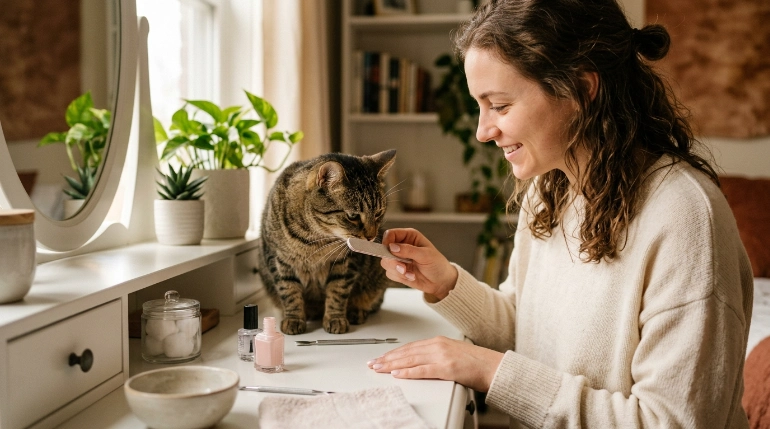
A nail file combines several things that can make it interesting to a curious cat.
It has texture. It makes noise. You move it repeatedly in your hand. A used file may also carry the scent of your hands, nail products, skin oils, and tiny amounts of nail debris.
That combination can turn an ordinary beauty tool into something your cat suddenly wants to investigate.
1. The Rough Texture May Feel Interesting
A standard emery board has a gritty surface designed to remove tiny amounts of nail material.
To your fingers, it simply feels rough. To a curious cat using its nose, paws, and mouth to investigate its environment, that texture can be unusual enough to deserve attention.
This does not mean the texture is good for a cat’s teeth or gums.
If your cat repeatedly bites the abrasive side, take the file away rather than treating it like a chew toy.
2. Your Nail File Smells Like You
A nail file that you have already used is not completely scent-free.
Your hands naturally leave oils and scent on objects you touch. A used file can also collect tiny particles from the edge of your nails.
Cats have a strong interest in scent, so your cat may simply be investigating something that smells familiar.
This may also help explain why a cat ignores a brand-new file but becomes interested after watching you use one.
3. Filing Creates Movement and Sound
Think about what happens when you shape your nails.
Your hand moves quickly back and forth. The file makes a light scratching noise. The tip of the file may move in short, unpredictable directions.
To a playful cat, that activity can resemble something worth chasing or grabbing.
The attraction may therefore be less about the nail file itself and more about what the object does while you are using it.
4. Cats Are Naturally Curious About Objects You Handle
A manicure demands attention. You may sit still and focus on a small tool for several minutes.
That alone can make your cat curious.
Some cats seem especially interested in whatever their person is currently touching. Put the same file down on a shelf and it may suddenly become much less exciting.
That is why I would not automatically assume licking or pawing at a nail file indicates a nutritional problem or unusual behavior.
5. Some Cats Simply Like Chewing Non-Food Objects
Occasional investigation is one thing. Persistent chewing is another.
Veterinary guidance describes pica as repeated ingestion of non-food objects. Cats with pica may chew or eat materials such as fabric, plastic, paper, string, or other inappropriate objects. Pica can also lead to dental damage or gastrointestinal obstruction if material is swallowed. VCA Animal Hospitals’ guide to pica in cats explains these risks in more detail.
If your cat tries to eat not only nail files but also plastic, fabric, paper, string, or other household objects, I would treat that as a separate behavior worth discussing with a veterinarian.
Is It Safe for Cats to Lick Nail Files?
A quick lick is unlikely to mean your cat has discovered some secret ingredient it loves. Still, I would not intentionally let a cat lick manicure tools.
The concern is not only the abrasive surface.
A used file can contain nail dust, skin oils, residue from polish or other products, and microorganisms from your hands. Once your cat licks it, saliva is added to the mix.
That makes the tool less hygienic for your next manicure.
My simple rule is this: manicure tools stay with the manicure kit, and pet toys stay with the cat.
Is It Safe for Cats to Chew Nail Files?
I would stop the behavior.
Veterinary guidance warns that cats can chew or swallow many inappropriate household objects, potentially leading to dental injuries or intestinal obstruction.
The exact risk depends on the file.
| Nail File Type | Main Concern Around Cats | What I Would Do |
|---|---|---|
| Cardboard/emery board | Pieces may tear off if chewed | Keep out of reach |
| Foam file or buffer | Soft material may be bitten apart | Store in a closed drawer |
| Glass/crystal file | Can break if dropped or bitten | Never use as a cat toy |
| Metal file | Hard surface may injure teeth or gums | Keep away from chewing |
| Disposable mini file | Small size can make it easier to carry away | Store securely after use |
The biggest mistake is assuming that because an emery board looks harmless, it is safe for a pet to chew.
It was designed to file keratin at the edge of your nails—not to withstand an animal biting and swallowing pieces of it.
What If My Cat Only Rubs Against the Nail File?
Rubbing is usually much less concerning than chewing.
Your cat may sniff the file, rub its cheek against your hand, paw at it, and walk away.
In that situation, you normally do not need to panic. Simply put the file away when you are finished.
I would still inspect it before using it again. If it has obvious saliva, fur, bite marks, damaged edges, or pieces missing, replacing it is the simplest choice.
Disposable emery boards are inexpensive enough that trying to rescue a badly chewed one rarely makes sense.
Why Hygiene Matters for Your Nails
Your cat’s safety is only half of the issue.
Your nails and the skin surrounding them can develop small cuts, hangnails, or irritated areas. Keeping manicure tools clean is especially important when those tools touch damaged skin.
The American Academy of Dermatology recommends keeping nails clean and dry and using appropriate nail-care practices to help reduce problems. Its healthy nail tips also recommend keeping rough edges smooth with an emery board.
If your cat has been licking or chewing your file, I would not immediately use that same surface around a torn cuticle or irritated nail fold.
Do not share manicure tools with pets and then continue using them as though nothing happened.
Should You Clean or Replace a Nail File After a Cat Licks It?
It depends on the material.
Disposable Emery Boards
I would replace them.
Cardboard-based emery boards are cheap, porous, and difficult to clean thoroughly without damaging them.
Once one is heavily licked, chewed, bent, or contaminated, throwing it away is usually the most practical decision.
A multipack of basic files often costs only a few dollars, so there is little benefit in keeping a questionable one.
Glass or Crystal Files
These are different.
Quality glass files usually cost more than disposable boards and have a solid, nonporous surface.
Follow the manufacturer’s cleaning instructions. If the file is chipped or cracked, stop using it.
A damaged glass file should not be kept around a cat either.
Metal Nail Files
Metal files can often be cleaned more easily than cardboard ones, but you should still follow the tool manufacturer’s care instructions.
Inspect the file closely after your cat gets hold of it.
If anything looks bent, damaged, rusty, or difficult to clean, replacing it is safer than continuing to use a questionable manicure tool.
Foam Buffers
These can be tricky.
The soft layers can hold moisture and become damaged by teeth. Once a cat has chewed deeply into a buffer, I usually consider it disposable.
How to Stop Your Cat From Playing With Your Nail Files
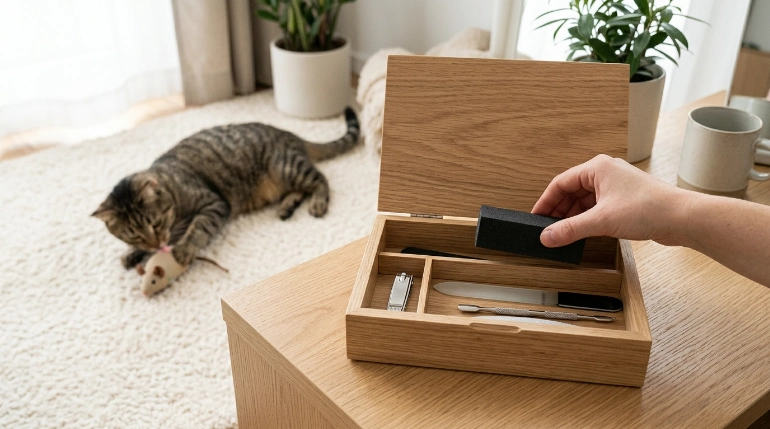
You do not need to punish your cat.
In fact, punishment may increase anxiety in cats with inappropriate chewing behavior. Veterinary guidance instead recommends preventing access to problem objects and redirecting cats toward appropriate enrichment.
Try this simple routine:
- Put nail files away immediately after use.
A closed drawer, manicure case, or lidded organizer works better than leaving them on a vanity. - Do not wiggle the file at your cat.
Turning it into a toy teaches your cat that grabbing the file is part of playtime. - Redirect the cat to a real toy.
If your cat wants to chase something, switch to a suitable interactive cat toy. - Check the floor after your manicure.
Do not leave broken file pieces, nail clippings, cotton, thread, or other small items behind. - Pay attention to repeated chewing.
One curious investigation is different from constantly seeking out non-food objects.
Veterinary information on feline chewing also warns that objects such as string, thread, plastic, pins, and similar household materials can create serious problems when swallowed.
Expert Tip
Expert Tip: Keep a small lidded manicure box beside the place where you normally do your nails. Put files, clippers, buffers, and other small tools back inside as soon as you finish using them. It protects your tools from pets and makes your nail routine more hygienic.
What If Your Cat Bites or Scratches You During a Manicure?
A playful swipe at a moving nail file can turn into a scratch quickly.
Do not ignore broken skin just because the scratch looks small.
The CDC notes that cats can transmit certain infections through scratches, bites, and contact between cat saliva and open wounds. Its information on cat scratch disease explains that infected cats can spread Bartonella henselae through scratches and potentially through bites or licking open wounds.
Clean a fresh scratch or bite promptly.
If the area becomes increasingly red, painful, warm, swollen, or otherwise concerning, contact a healthcare professional.
And if you already have broken skin around a cuticle, I would keep your cat away from your hands until you finish your manicure and wash up.
Could Nail Products Be Part of the Risk?
Yes, depending on what is on the file or your hands.
A plain, unused nail file is different from one that has been sitting beside polish, remover, gel products, acrylic materials, adhesives, or other manicure chemicals.
Do not intentionally let your cat lick cosmetic residues.
Also remember that filing artificial nails can create dust and residue. The American Academy of Dermatology notes that some artificial-nail procedures can thin the natural nail and that chemicals used in artificial nail products may irritate surrounding skin.
The simplest habit is to do your manicure in a clean area and keep curious pets away from the workstation until you have finished cleaning it.
Does the Type of Nail File Matter for Your Own Nails?
Yes.
The safest file for you is not necessarily the most interesting-looking file or the hardest grit you can find.
For natural nails, you generally want enough abrasiveness to shape the free edge without aggressively scraping away healthy nail.
The American Academy of Dermatology advises smoothing uneven or rough nail edges with a nail file or emery board and filing in one direction rather than repeatedly sawing back and forth. Their nail-trimming guidance explains the technique.
If your natural nails are already thin, peeling, sore, or damaged, aggressive filing can make your routine worse.
That is another reason a chewed or damaged file belongs in the trash rather than back in your manicure kit.
DIY Nail Care vs. Professional Help
For simple shaping, basic DIY care is usually convenient.
But there are times when filing more is not the answer.
| Situation | DIY Nail File? | Better Choice |
|---|---|---|
| Minor rough nail edge | Usually reasonable | File gently |
| Slight uneven shape | Usually reasonable | Shape gradually |
| File contaminated by pet saliva | Replace or clean as appropriate | Use a clean tool |
| Deep split into living nail | Avoid aggressive filing | Nail professional or clinician |
| Pain, swelling, or pus | No | Healthcare professional |
| Nail lifting or major color change | Do not simply file it away | Dermatologist |
| Artificial nail damage | Depends on severity | Experienced nail technician |
| Cat repeatedly eating non-food objects | Nail care is not the issue | Veterinarian |
A salon professional can help with cosmetic shaping and product removal.
A dermatologist is the better choice when the problem involves possible disease, infection, significant pain, or changes in the nail itself.
When to See a Nail Technician or Dermatologist
A cat touching your nail file does not automatically mean you need professional nail care.
The condition of your nails matters more.
Consider seeing an experienced nail technician if you need help with safe product removal, shaping artificial nails, or correcting a manicure problem without over-filing your natural nail.
See a dermatologist or another appropriate healthcare professional when you have warning signs such as:
- Increasing redness or swelling around a nail
- Pus or drainage
- Significant pain
- A nail separating from the nail bed
- Persistent nail discoloration
- A deep split or injury
- Ongoing changes you cannot explain
- Signs of infection after a cat scratch or bite
Dermatologists specialize in conditions affecting the skin, hair, and nails, so a nail problem that appears medical rather than cosmetic belongs with a medical professional.
When to Call a Veterinarian
Your cat’s behavior deserves professional attention if it moves beyond simple curiosity.
Contact your veterinarian if your cat repeatedly consumes non-food objects or develops vomiting, reduced appetite, abdominal discomfort, weakness, or other unusual symptoms after chewing or swallowing something.
Pica can lead to gastrointestinal obstruction, and sharp or indigestible objects can cause serious complications.
If you believe a substantial piece of a nail file has been swallowed, do not assume it will safely pass.
Common Mistakes to Avoid
If your cat loves hanging around during manicure time, a few simple mistakes can create unnecessary problems.
- Using a nail file as a cat toy. It may encourage biting and chewing.
- Leaving disposable files on the floor. Small or damaged pieces may become accessible.
- Reusing a badly chewed emery board. A fresh one is usually the better option.
- Putting a saliva-covered file near broken skin. Keep manicure tools clean.
- Ignoring missing pieces. If part of a file has disappeared, consider whether your cat may have swallowed it.
- Punishing persistent chewing. Prevent access and redirect the behavior instead.
- Assuming every chewing habit is harmless curiosity. Repeated ingestion of non-food material warrants veterinary attention.
- Filing an injured or infected-looking nail harder. Filing cannot treat an infection or underlying nail disorder.
FAQs
Why does my cat lick my nail file?
Your cat may be investigating its texture, scent, nail residue, or simply an object you have been holding. There is no strong evidence that nail files contain something cats universally crave.
Why does my cat chew on emery boards?
The rough texture and small size may make an emery board interesting to chew or play with. However, repeated chewing of non-food objects can also occur with pica or other behavioral or medical issues.
Can I let my cat play with a nail file?
I would not. Nail files are manicure tools, not cat toys. Cardboard and foam files can break apart, while hard glass or metal files may create other injury risks.
Should I throw away a nail file after my cat licks it?
For a cheap disposable emery board, replacement is the easiest hygienic choice. For reusable glass or metal tools, follow the manufacturer’s cleaning instructions and inspect the tool carefully before using it again.
Can cat saliva on a nail file cause an infection?
Cat saliva can contain microorganisms, and the CDC advises avoiding contact between cat saliva and open wounds. If you have broken skin around your nails, use a clean manicure tool rather than one your cat has licked.
What should I do if my cat swallowed part of a nail file?
Contact a veterinarian for advice, especially if a piece is definitely missing or your cat shows vomiting, poor appetite, pain, lethargy, or other unusual symptoms. Swallowed non-food material can cause gastrointestinal obstruction or injury.
Why does my cat come over every time I file my nails?
The movement, scratching sound, your attention, and the unfamiliar object may all be interesting. Your cat may simply be investigating your activity rather than having a specific attraction to nail files.
Conclusion
So, why do cats like nail files? In most cases, the best explanation is simple curiosity. Nail files combine an unusual rough texture, familiar human scent, movement, and scratching sounds that can attract an interested cat.
A quick sniff or paw is usually very different from repeatedly chewing or swallowing the file.
Keep your manicure tools stored away, replace contaminated disposable files, and redirect your cat toward appropriate toys instead of encouraging play with beauty tools.
For your own nails, stick with clean and undamaged tools. If you notice pain, swelling, infection, or unusual nail changes, get professional advice rather than trying to file the problem away.
And if your cat is regularly eating nail files or other non-food objects, make that a veterinary question—not just a quirky manicure habit.

