
You sit down to fix a chipped nail, and suddenly your cat appears. She sniffs the emery board, rubs her face near it, paws at it, or tries to bite the edge.
It can make you wonder, why do cats like nail files so much?
There is no single proven reason that makes every cat obsessed with nail files. In most cases, the attraction is probably a mix of curiosity, texture, scent, movement, and the fact that you are paying attention to the object.
The important part is knowing when harmless curiosity turns into unsafe chewing. A nail file may look simple, but it is still a human grooming tool—not a cat toy.
This guide explains why your cat may be interested in your nail file, which file materials deserve extra caution, how to stop the habit without creating more excitement, and when chewing may point to a larger health or behavior concern.
Quick Answer
Why do cats like nail files so much? Nail files can attract cats because they have an unusual rough texture, carry smells from your hands and manicure products, move easily when batted, and make scratching sounds. Curiosity is usually harmless, but cats should not chew or swallow nail files because broken pieces can cause injury.
Why Do Cats Like Nail Files So Much?
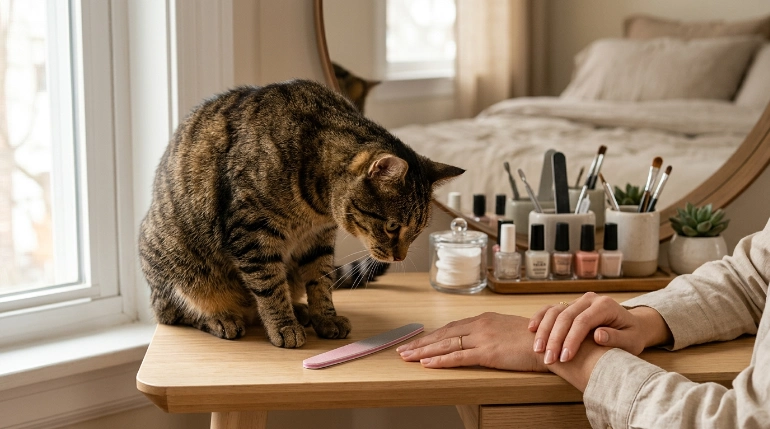
A cat cannot tell that the little rectangle in your manicure kit is supposed to smooth human nails.
To her, it is simply a strange object with an interesting feel, smell, sound, and shape.
Veterinary guidance notes that cats naturally investigate new sights, smells, and tastes. That curiosity can sometimes lead them to mouth or swallow objects that are not food. VCA Animal Hospitals’ guide to foreign-body ingestion in cats explains why this kind of investigation deserves attention when swallowing becomes possible.
Here are the most likely reasons a nail file gets your cat’s attention.
1. The Rough Texture Feels Unusual
One of the most obvious differences between a nail file and most household objects is its surface.
An emery board is rough. A glass file has a textured filing surface. Foam buffers may feel soft in one area and abrasive in another.
Your cat may simply find that sensation interesting against her teeth, lips, tongue, or paws.
That does not mean the texture is good for her mouth.
Repeated biting or licking can expose sensitive tissues to an abrasive surface. Nail files are intentionally designed to remove small amounts of hard nail material, so they should not be treated like chew toys.
2. Your Nail File Smells Like You
A nail file you have already used is different from a brand-new file.
It has been handled by your fingers and may carry traces of natural skin oils, nail dust, hand lotion, cuticle products, polish, gel, or other products from your manicure routine.
Cats rely heavily on smell when investigating their environment. A personal item that carries your scent may therefore get more attention than an unused object lying nearby.
This does not prove your cat loves the taste of nail dust or needs something contained in the file.
In fact, there is no strong veterinary evidence showing that cats specifically seek nail files because of a nutritional ingredient or nail residue. Treat unusual interest as curiosity first rather than assuming your cat is craving something.
3. Nail Files Move Like Small Toys
Think about what happens while you are filing your nails.
The file moves quickly back and forth. It may slide across a table. It can fall onto the floor with a light sound. A disposable emery board is also small enough for a cat to bat with one paw.
Those movements can make the file much more exciting.
Your cat may not care about the manicure tool itself. She may care about the moving object.
Cats benefit from opportunities to chase and capture appropriate toys, so redirecting that interest toward a proper wand toy, small cat toy, or another supervised play activity makes more sense than letting the manicure tool become part of playtime.
4. The Scratching Sound May Get Her Attention
Filing creates a distinctive scraping sound.
Some cats ignore it. Others immediately look toward it.
Once your cat investigates and discovers that the object also moves, smells like you, and can be knocked off the table, the whole experience may become more interesting.
Watch what happens next time you file your nails.
If your cat only approaches after she hears the filing sound or sees your hand moving, the attraction may be more about the activity than the actual nail file.
5. You May Be Accidentally Making It More Exciting
Cats are very good at learning which actions get a reaction.
Imagine your cat grabs an emery board.
You quickly reach for it.
She runs away with it.
You follow her.
Now the nail file has accidentally turned into a game.
The same thing can happen if you wave it around, repeatedly grab it from her paws, or give her lots of attention every time she approaches your manicure kit.
A calmer response usually works better.
Take the file away without turning the moment into a chase, then redirect your cat toward something she is allowed to play with.
6. Your Cat May Simply Like Investigating New Objects
Sometimes the explanation is not complicated.
The file is new.
It is small.
It smells different.
It appears when you sit down and focus on your nails.
Cats often investigate unfamiliar household objects. A brief sniff, paw tap, or lick does not automatically indicate a behavior problem.
Repeatedly eating pieces is different.
That is the point where you should pay closer attention.
7. Persistent Eating Could Be Related to Pica
If your cat does more than investigate the file and repeatedly tries to eat it, the situation changes.
Persistent ingestion of non-food material is called pica.
According to VCA Animal Hospitals’ information on pica in cats, cats with pica may persistently consume things such as plastic, paper, fabric, string, or thread. Possible causes can include behavioral concerns as well as underlying medical problems.
One chewed emery board does not automatically mean your cat has pica.
However, mention the behavior to your veterinarian if your cat regularly tries to eat:
- Nail files
- Cardboard
- Plastic
- Fabric
- String
- Paper
- Foam
- Rubber
- Other household objects
This is especially important if the behavior is new, frequent, or getting worse.
Is It Safe to Let a Cat Lick or Chew a Nail File?
No nail file should be used as a cat chew toy.
A cat briefly sniffing or touching an intact file is very different from biting pieces from it.
The risks depend on the file material and what happens during chewing.
| Nail File Type | Why a Cat May Like It | Main Risk | Best Practice |
|---|---|---|---|
| Emery board | Light, rough, easy to bat | Fraying and swallowed pieces | Store after every use |
| Foam buffer | Soft and easy to bite | Foam or coating may tear off | Keep out of reach |
| Glass/crystal file | Interesting hard texture | Chipping or breakage | Keep in its case |
| Metal file | Firm and sometimes shiny | Mouth, tooth, or facial injury | Store in a closed kit |
| Electric file bits | Small and unusual shape | Small parts may be swallowed | Secure the device and bits |
An inexpensive emery board may seem less worrying than a glass or metal file, but cheap does not mean pet-safe.
If a cat tears it apart, pieces of the backing or abrasive surface may be swallowed. NailPrime’s existing guidance likewise recommends against allowing cats to chew nail files because of mouth irritation and foreign-object risks.
Why Swallowing a Nail File Is More Serious Than Licking One
A quick lick of a clean, intact file does not automatically mean your cat is in danger.
Swallowing part of one deserves much more attention.
Foreign objects can occasionally pass through an animal’s digestive system, but others may become lodged.
The MSD Veterinary Manual’s overview of gastrointestinal obstruction lists warning signs such as vomiting, loss of appetite, diarrhea, lethargy, and abdominal discomfort. A known foreign-object ingestion is an important part of veterinary diagnosis.
Watch especially for:
- Repeated vomiting
- Gagging or repeated swallowing
- Excessive drooling
- Refusing food
- Unusual tiredness
- Abdominal discomfort
- Trouble passing stool
- Hiding more than normal
- Pawing at the mouth
- Mouth bleeding
Do not wait for every symptom to appear if you actually saw your cat swallow a sharp or substantial piece.
Call your veterinarian.
What to Do If Your Cat Chews a Nail File
If you catch your cat chewing your manicure tool, avoid panicking.
Work through the situation in order.
1. Take the File Away
Remove the nail file and any broken pieces you can see.
Do not turn the situation into a tug-of-war.
2. Check the File
Look carefully at the entire tool.
Ask:
- Is a corner missing?
- Has the board been shredded?
- Did layers separate?
- Is a glass file chipped?
- Is a metal tip damaged?
- Did your cat swallow anything?
Take a photo if the file is damaged.
That can be useful if you need to describe the object to your veterinarian.
3. Think About What Was on the File
A clean nail file and one covered in manicure residue are not exactly the same situation.
Consider whether it had contact with:
- Nail polish
- Gel products
- Acrylic residue
- Nail glue
- Acetone
- Polish remover
- Primer
- Cuticle oil
- Cleaning products
Chemical exposure may change what your veterinarian recommends.
4. Watch Your Cat
If you are confident nothing was swallowed and your cat appears completely normal, continued observation may be reasonable.
If material is missing, however, contact your veterinarian for individualized advice.
5. Do Not Try to Make Your Cat Vomit
Do not give hydrogen peroxide or experiment with oils, salt, milk, or other home methods.
The ASPCA’s guidance on inducing vomiting specifically states that there is no safe at-home method for making a cat vomit and advises contacting a veterinarian or poison-control professional when ingestion is concerning.
How to Stop Your Cat From Stealing Nail Files
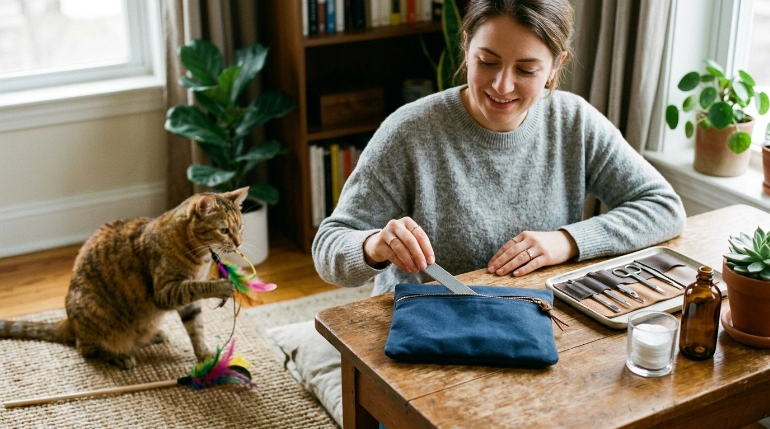
Prevention is easier than repeatedly taking the same file away.
Store Your Manicure Tools Immediately
Do not leave emery boards on a coffee table, bed, bathroom counter, or vanity after you finish.
Use:
- A closed drawer
- A manicure case
- A zippered pouch
- A cabinet
- A lidded organizer
Glass and metal tools deserve especially careful storage.
Give Your Cat Something Better to Chase
If movement attracts your cat, redirect that urge.
Try a pet-safe toy that allows chasing, batting, or pouncing.
The goal is not to punish curiosity.
It is to give that curiosity a safer target.
Avoid Using the File as a Teaser Toy
It may be tempting to slide an emery board across the floor because your cat loves chasing it.
Skip that game.
Allowing play sometimes while taking the file away at other times makes the boundary harder to understand.
Replace Damaged Files
Throw away disposable files that are heavily chewed, frayed, or separating.
Stop using chipped glass files or badly damaged metal tools on yourself as well.
Keep Manicure Chemicals Separate
Your polish, remover, glue, gel products, and other manicure supplies should also remain securely stored.
A curious cat that discovers the nail file may start investigating the rest of your kit.
Hygiene Matters for You Too
Once your cat has had a nail file in her mouth, think about your own nail-care hygiene.
Cats can carry germs even when they look healthy, and the CDC’s healthy-pet guidance recommends regular handwashing after handling and caring for cats.
For your manicure routine:
- Replace a disposable file after significant chewing.
- Clean reusable tools according to manufacturer instructions.
- Do not use a visibly contaminated tool around broken cuticles.
- Avoid sharing personal nail files.
- Wash your hands before nail care if you have just handled your cat.
You do not need to become afraid of your manicure kit.
Basic hygiene and sensible storage are enough for most homes.
Expert Tip
Expert Tip: Keep one closed manicure pouch beside the place where you normally do your nails. Put every file, buffer, clipper, and small attachment back inside as soon as you finish using it. Removing access is usually easier and safer than repeatedly trying to train a curious cat to ignore an interesting object.
Common Mistakes to Avoid
A cat’s interest in your nail file can look funny, but a few common reactions make the situation riskier.
- Letting the cat chew because the file is cheap. Price has nothing to do with whether swallowed pieces are safe.
- Using the nail file as a toy. This teaches your cat that the manicure tool is something worth chasing.
- Assuming cardboard will always pass safely. Even soft-looking material can become a foreign object when swallowed.
- Ignoring missing pieces. If part of a file disappears, determine whether your cat could have eaten it.
- Forcing your cat’s mouth open. A frightened cat can injure you or herself.
- Using a chewed file on damaged cuticles. Replace or properly clean contaminated tools.
- Trying home vomiting remedies. Cats should not be made to vomit at home without professional veterinary direction.
- Assuming repeated non-food eating is just a quirky personality trait. Persistent ingestion deserves discussion with a veterinarian because pica can have behavioral or medical causes.
When to See a Nail Technician or Dermatologist
For a cat that chewed or swallowed a nail file, a nail technician or dermatologist is not the right professional. Contact a veterinarian.
A nail technician may help you understand whether a damaged reusable manicure tool should be replaced and how a particular professional nail tool is normally cleaned.
If your own nail, cuticle, or surrounding skin becomes painful, swollen, red, draining, or otherwise appears infected after using a contaminated grooming tool, stop using it. A dermatologist or another qualified medical professional can evaluate human nail and skin problems.
For your cat, veterinary help is more appropriate when:
- Part of a file is missing
- Glass, metal, or another sharp piece may have been swallowed
- Your cat vomits
- Your cat stops eating
- Drooling or gagging develops
- The mouth is bleeding
- Your cat seems painful or unusually tired
- Non-food chewing happens repeatedly
A veterinarian can also help determine whether frequent chewing is simple behavior, pica, or a sign that further evaluation is needed.
FAQs
Why does my cat lick my nail file?
Your cat may be investigating its smell, texture, or residue from your hands. A quick lick does not necessarily mean something is wrong, but do not encourage repeated licking or chewing.
Why does my cat bite emery boards?
Emery boards are light, rough, easy to hold between the paws, and easy to move. Those features can make them interesting. Biting becomes unsafe when the board begins to break apart.
Does my cat like the smell of my nails on the file?
Possibly. A used file carries scents from your hands, nails, skin oils, and any products you have used. However, there is no good evidence that cats specifically need or crave human nail residue.
Can cats eat nail files?
No. Nail files are non-food objects. Pieces of cardboard, foam, glass, metal, or other materials may cause mouth injuries or digestive problems if swallowed.
Is an emery board safer than a glass nail file?
An emery board is less likely to create sharp glass fragments, but it is still not safe for chewing. Cats can shred and swallow its layers. Glass files deserve extra caution because damaged glass may chip or break.
Does chewing nail files mean my cat has pica?
Not necessarily. One episode may simply come from curiosity or play. If your cat repeatedly tries to ingest nail files and other non-food materials, however, discuss pica with your veterinarian.
What should I do if my cat swallowed part of a nail file?
Remove the remaining file, identify what material is missing, and contact your veterinarian. Seek prompt help for suspected sharp-object ingestion or signs such as vomiting, appetite loss, abdominal pain, drooling, or lethargy.
Conclusion
So, why do cats like nail files so much?
For most cats, the answer is probably simple. Nail files combine several things cats naturally find interesting: unusual texture, scent, scratching sounds, movement, and attention from their favorite human.
That interest does not make nail files safe toys.
A quick sniff is very different from repeated chewing. Store your files after use, redirect playful behavior toward proper cat toys, and inspect any file your cat manages to bite.
If part of the file has been swallowed—or your cat regularly eats other non-food objects—the smartest next step is to contact your veterinarian.
You can enjoy your manicure routine and your curious cat at the same time. A closed manicure kit and a safer toy nearby may be all it takes.
