
Why Do Cats Like the Smell of Nail Files?

You pull out a nail file, start shaping your nails, and suddenly your cat appears. She sniffs the file, rubs her face on it, licks it, or even tries to steal it.
So, why do cats like the smell of nail files?
There is no single proven reason. A used nail file can carry your natural scent, tiny bits of nail dust, skin oils, and traces of products from your hands. At the same time, its rough texture, movement, and scratching sound may make it interesting to a curious cat.
Most casual sniffing is not a reason to panic. Chewing or swallowing pieces of a nail file is different, though, and should be discouraged.
Quick Answer
Cats may like the smell of nail files because used files carry human scent, nail dust, skin oils, and other interesting odors. The rough texture and movement can also attract them. Occasional sniffing is usually harmless, but licking, chewing, or swallowing pieces of a nail file should be stopped for safety.
Why Do Cats Like the Smell of Nail Files?
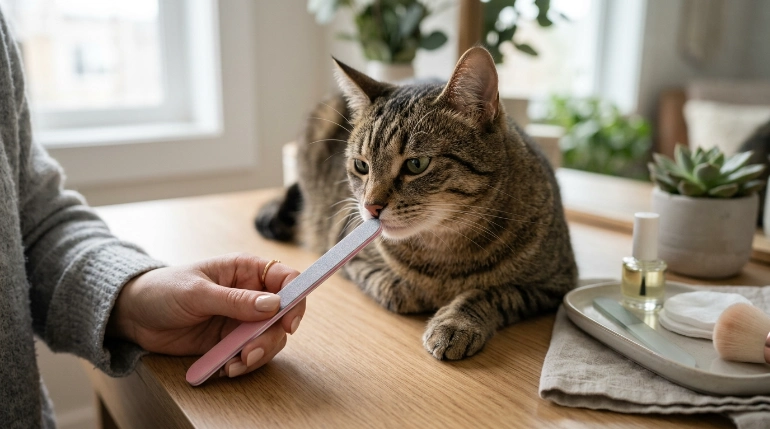
The important thing to understand is that your cat may not be reacting to one specific “nail file smell.”
A used nail file is a small collection of smells and textures.
After you handle and use it, the surface may contain:
- Your natural skin oils
- Your personal scent
- Tiny pieces of nail dust
- Hand lotion residue
- Nail polish or manicure product residue
- Dust and debris from storage
Cats investigate much of their environment through scent. Your nail file may simply smell far more interesting to your cat than it does to you.
There is also an important distinction between smelling the nail file and being attracted to what you are doing with it. A moving emery board can look like a small toy, while the scraping sound and rough surface provide extra sensory stimulation.
That means your cat’s reaction probably involves a combination of smell, touch, curiosity, and play rather than one mysterious ingredient.
1. Your Nail File Smells Like You
One of the simplest explanations is also one of the most convincing: you handle the file with your hands.
Your fingers leave oils and scent compounds on objects you touch. A nail file that you use regularly may therefore carry a familiar smell.
Cats also use scent to communicate.
According to VCA Hospitals’ explanation of feline facial rubbing, cats have scent glands around areas such as their cheeks, mouth, chin, and ears. Rubbing their faces against objects can deposit pheromones and mark familiar parts of their environment.
So if your cat sniffs your nail file and then rubs her cheek against it, she may be doing more than enjoying its smell.
She may be investigating your scent and then adding hers.
Watch What Your Cat Actually Does
Her behavior can give you clues.
If she:
- Sniffs it closely: scent curiosity is likely involved.
- Rubs her cheeks on it: scent marking may be involved.
- Licks the used surface: nail dust or residue may interest her.
- Bites and carries it: texture or play may be more important.
- Pounces while you file: movement and sound may be triggering play behavior.
This is why two cats can react very differently to exactly the same nail file.
2. Used Nail Files Collect Nail Dust
A fresh nail file and a used nail file do not smell or feel exactly the same.
Every time you file a fingernail, a tiny amount of material is removed from the nail plate. Human nail plates are primarily made of keratin, according to the NCBI overview of nail structure.
Those fine particles can remain trapped in the textured surface of an emery board.
You may barely notice them.
Your cat may notice that the file has changed.
This is also why some owners report that their cats show more interest in used files than clean ones. That observation does not prove that keratin itself is irresistible to cats, but it does make nail dust one reasonable part of the explanation.
Do not deliberately give a used nail file to your cat to test this theory. Sniffing is one thing. Chewing and swallowing abrasive material is another.
3. The Rough Texture May Be as Important as the Smell
Sometimes we assume a cat likes the smell of an object when texture is doing much of the work.
Think about an ordinary emery board.
It is:
- Rough
- Lightweight
- Easy to bat
- Easy to grab
- Small enough to carry
- Slightly flexible
- Covered in an unusual gritty surface
That is a lot of sensory information packed into one little object.
A curious cat may rub her cheek against the gritty surface or test it with her teeth.
Cats naturally interact with textured surfaces through scratching, rubbing, pawing, and biting. A nail file can accidentally become another interesting object to investigate.
This also explains why a cat may continue playing with a new file that has very little nail dust on it.
4. The Sound and Movement Can Trigger Curiosity
Notice when your cat comes running.
If she ignores a nail file sitting on your dresser but becomes fascinated as soon as you start using it, smell probably isn’t the whole explanation.
Filing creates repetitive movement.
Your hand moves back and forth. The narrow file changes direction quickly. It makes a scraping sound.
To a playful cat, that can look like something worth catching.
Your cat may initially approach because of the movement or sound. Once she reaches the file, she begins sniffing it. From your point of view, it can look as though the smell attracted her from the beginning.
This distinction matters because it helps you redirect the behavior.
A cat that wants to play may be perfectly happy chasing a wand toy instead.
5. Your Cat May Be Scent-Marking the File
Some cats do not lick or chew nail files at all.
Instead, they sniff the file and rub the sides of their face against it.
That behavior fits normal feline scent marking.
Cats leave scent on familiar people and objects by rubbing against them.
If your nail file smells strongly of you, it may be particularly interesting.
Think of it as a scent exchange:
Your scent is already on the file → your cat investigates it → your cat rubs against it → the object now carries feline scent signals too.
In this situation, the nail file itself may not be particularly special.
Your cat could display similar behavior with your phone, makeup brush, glasses, shoes, or other objects that you handle frequently.
6. What About the “Fish Glue” Nail File Theory?
One explanation repeated online is that cats love emery boards because they contain fish-based glue.
I would be careful with that claim.
Nail file construction varies by manufacturer and product. Unless the manufacturer identifies the adhesive used, there is no good reason to assume that a particular modern nail file contains fish-derived glue.
More importantly, there is no strong evidence showing that fish glue is the main reason cats become interested in nail files.
The simpler explanations fit the behavior without requiring that assumption:
- Human scent
- Nail dust
- Rough texture
- Movement
- Sound
- Normal curiosity
- Scent marking
So I would not buy a certain type of nail file—or let a cat chew one—because of the fish-glue theory.
7. Does Liking Nail Files Mean My Cat Has a Mineral Deficiency?
Not automatically.
This is another claim that deserves some caution.
If your cat merely sniffs a nail file, rubs against it, or tries to play with it, that behavior alone does not prove a nutritional deficiency.
Repeatedly eating non-food objects is more important.
Veterinarians call persistent ingestion of non-food material pica. VCA’s guide to pica in cats explains that pica can have behavioral or medical causes, including anxiety, compulsive behavior, gastrointestinal problems, anemia, and nutritional problems.
The difference is important:
Sniffing isn’t the same as eating.
A cat who occasionally investigates your manicure supplies is very different from a cat who repeatedly searches for and consumes cardboard, plastic, fabric, file material, or other non-food objects.
Are Nail Files Safe for Cats?
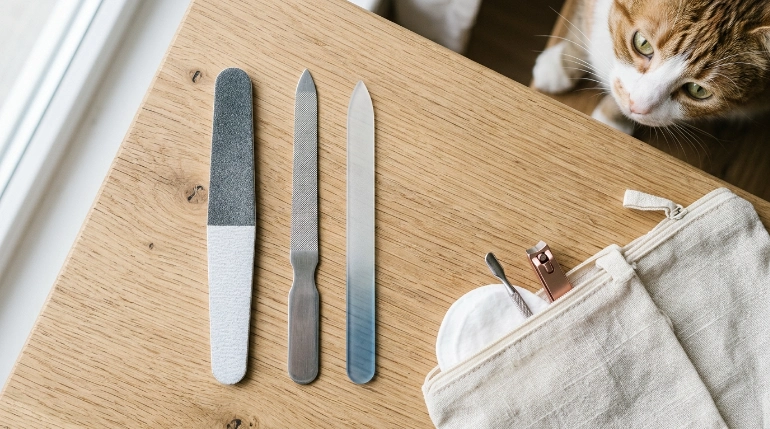
I would treat nail files as human grooming tools, not cat toys.
The level of risk depends partly on the type of file and what your cat does with it.
| Nail File Type | Why a Cat May Notice It | Main Concern | Hygiene | Relative Cost |
|---|---|---|---|---|
| Emery board | Rough, light, holds nail dust | Can be shredded or swallowed | Porous; replace if heavily licked | Low |
| Glass file | Smooth but textured surface | Can break if dropped or bitten | Usually easier to clean | Medium |
| Metal file | Texture and human scent | Hard or sharp edges may injure mouth | Reusable and washable | Medium |
| Electric nail file | Sound, movement, dust | Moving bit, cord, heat, loose accessories | Requires careful cleaning | Higher |
The safest approach is simple: let your cat observe from a reasonable distance, but do not encourage chewing or licking.
Used Files Need Extra Care
A used manicure file may contain more than nail dust.
Depending on your routine, it might also pick up residue from:
- Nail polish
- Gel products
- Acrylic or dip products
- Hand cream
- Cuticle oil
- Cleaning products
- Polish remover
That is another reason not to treat a used nail file as a chew toy.
If your cat mouths a disposable emery board, I would replace it rather than return it to your manicure kit.
What Should I Do If My Cat Keeps Stealing My Nail File?
You don’t need an elaborate training system.
Try these steps.
1. Put Nail Files Away After Use
Keep them in a drawer, closed manicure case, or container your cat cannot open.
This is especially important for metal files, glass files, electric-file bits, and small manicure accessories.
2. Don’t Turn Stealing Into a Game
If every stolen nail file causes you to chase your cat around the house, your cat may learn that taking it starts a very entertaining game.
Trade the file calmly for a safe toy or treat instead.
3. Offer a Better Texture
Provide scratching surfaces and cat-safe toys that satisfy the urge to paw, scratch, rub, and bite.
Cats that have suitable opportunities for scratching, climbing, chewing, play, and exploration may be easier to redirect away from household objects.
4. Keep the Manicure Area Clean
Wipe away nail dust after filing.
Don’t leave used emery boards, nail clippings, cotton pads, polish-remover materials, or small manicure pieces where a curious cat can reach them.
5. Watch for Actual Ingestion
Sniffing and rubbing are usually much less concerning than tearing off and swallowing pieces.
If your cat begins consuming the file, the situation has moved beyond harmless curiosity.
Expert Tip: Keep one closed container beside your manicure area for used files, clippings, cotton pads, and small tools. Putting everything away immediately is easier than trying to retrieve a tempting object from a playful cat later.
What If My Cat Ate Part of a Nail File?
First, remove the remaining file so your cat cannot eat more.
Then look at what is missing.
A tiny scrape from the surface is different from a noticeable chunk of emery board, broken glass, metal, or another hard object.
Foreign objects can sometimes become trapped in the digestive tract. The Merck Veterinary Manual’s overview of gastrointestinal obstruction notes that foreign-body obstruction can cause signs such as vomiting, reduced appetite, diarrhea, lethargy, and abdominal discomfort.
Contact your veterinarian promptly if you know or strongly suspect your cat swallowed a substantial piece, a sharp piece, or part of a glass or metal file.
Do not try to make your cat vomit unless a veterinarian specifically tells you to do so.
When to Call a Veterinarian
An occasional sniff of your nail file does not usually require a veterinary appointment.
I would become more concerned if your cat:
- Regularly eats non-food objects
- Tears apart and swallows emery boards
- Suddenly develops a strong urge to chew unusual objects
- Vomits after swallowing something
- Stops eating
- Seems unusually tired
- Drools excessively
- Has difficulty swallowing
- Appears to have mouth pain
- Develops abdominal discomfort
- Has noticeable changes in weight or appetite
Persistent non-food eating deserves more attention because pica can have several possible medical and behavioral causes.
A veterinarian can determine whether your cat simply has an unusual habit or whether further evaluation is needed.
When to See a Nail Technician or Dermatologist
Your cat’s interest in a nail file normally doesn’t mean your nails have a medical problem.
However, your own nail health still matters.
A professional nail technician may help if you are unsure which file grit or filing technique is appropriate for a manicure. Aggressive filing can thin or roughen the nail plate.
A dermatologist is the better choice if you have:
- Persistent pain around a nail
- Swelling or redness
- Discharge or possible infection
- Significant nail separation
- Unexplained discoloration
- Repeated splitting or crumbling
- Ongoing skin irritation around the nails
A salon can improve appearance and technique, but it cannot diagnose a medical nail condition.
Common Mistakes to Avoid
A cat obsessed with your manicure routine can be funny, but a few common mistakes create unnecessary risk.
- Letting the cat chew the file because it looks harmless. Emery boards can break apart.
- Assuming nail-file obsession proves a mineral deficiency. Sniffing and playing alone are not enough to make that conclusion.
- Believing every nail file contains fish glue. Materials vary, and this explanation is not well established.
- Chasing your cat every time she steals one. That can accidentally turn theft into a rewarding game.
- Leaving manicure products beside the file. Polish, remover, glue, tips, bits, and other small accessories create additional hazards.
- Reusing a disposable file after your cat has chewed it. Replace it for better hygiene.
- Ignoring repeated swallowing of non-food objects. Persistent ingestion deserves veterinary attention.
- Allowing a cat near an operating electric file. Movement, cords, rotating bits, and nail dust make this a poor place for feline curiosity.
FAQs
Why does my cat lick my nail file?
Your cat may be investigating your scent, nail dust, skin oils, or the unusual rough texture. Occasional licking does not reveal one specific cause, but it is better to prevent it because nail files are not designed to be chewed or eaten.
Why does my cat rub her face on nail files?
Face rubbing can be normal feline scent-marking behavior. Cats have scent glands around the face and use rubbing to leave chemical signals on familiar objects.
Are cats attracted to the keratin in human nails?
Human nails contain large amounts of keratin, but there is not good evidence proving that keratin itself is what attracts cats to used nail files. Your scent, nail dust, texture, sound, and movement are all plausible contributors.
Is it safe for my cat to chew an emery board?
I would not encourage it. The board can fray or break apart, and your cat may swallow pieces. Keep emery boards stored away once your manicure is finished.
Does my cat need vitamins if she likes nail files?
Not necessarily. Simply sniffing or playing with a nail file does not prove a vitamin or mineral deficiency. Persistent eating of non-food objects is more concerning and should be discussed with a veterinarian.
Why does my cat only like used nail files?
A used file carries additional material that a new one does not, including your scent, skin oils, and nail dust. That may make it more interesting. It is still difficult to identify exactly which scent your individual cat prefers.
Should I throw away a nail file after my cat licks it?
For a porous disposable emery board, replacing it is the simplest hygienic choice. Reusable glass or metal files may be cleaned according to their manufacturer’s care instructions, but they should still be stored away from your cat.
Conclusion
So, why do cats like the smell of nail files? There probably isn’t one universal answer.
A used nail file carries your scent and nail dust, while its gritty texture, movement, and sound can make it unusually interesting. Some cats may also rub against the file as part of normal scent-marking behavior.
The key is to separate harmless curiosity from risky behavior.
A quick sniff or cheek rub is usually very different from repeatedly chewing and swallowing pieces. Keep nail files and other manicure tools stored away when you’re finished, and talk to your veterinarian if your cat regularly eats non-food objects.
You can enjoy your manicure routine—and your cat’s strange curiosity—without turning a nail file into a feline toy.

