
How Long Do Sapphire Nail Files Last? Lifespan & Care Guide

If you have switched from disposable emery boards to a sapphire nail file, you may wonder whether you will ever need to replace it. Sapphire files look simple, but their metal base and abrasive coating make them much more durable than many traditional nail files.
So, how long do sapphire nail files last? A good-quality sapphire nail file can often stay useful for several years with normal personal use. There is no fixed expiration date, though. How long yours lasts depends on the quality of the coating, how often you file your nails, how much pressure you use, and how well you clean and store the tool.
The important thing is not just age. You should watch how the filing surface feels and performs.
Below, I will explain what affects sapphire nail file lifespan, how to recognize a worn-out file, how to clean it, and when replacing it is the smarter choice.
Quick Answer
How long do sapphire nail files last? A quality sapphire nail file can usually last for several years with normal at-home use. Unlike disposable emery boards, it does not need frequent replacement. Replace it when the abrasive surface becomes smooth, patchy, damaged, rusty, or noticeably less effective at shaping your nails.
What Is a Sapphire Nail File?
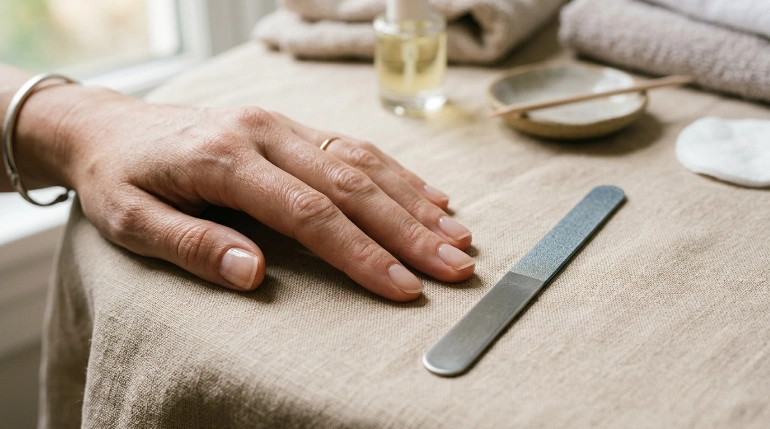
A sapphire nail file is usually a thin metal file covered with tiny abrasive particles often described as a sapphire coating.
Many models have two filing surfaces.
The coarser side removes length and shapes the nail. The finer side smooths rough edges after shaping.
For example, ZWILLING’s sapphire nail file uses a sapphire-coated file blade with coarse and fine filing surfaces. The manufacturer also describes the stainless-steel design as suitable for hygienic nail care.
This construction is one reason sapphire files can outlast ordinary cardboard-style emery boards.
However, there is an important distinction.
The sapphire abrasive is a coating.
That means the metal file itself may remain perfectly usable while the abrasive coating slowly wears down. A sapphire file therefore should not automatically be considered a lifetime nail tool.
How Long Does a Sapphire Nail File Last in Real Life?
There is no universal replacement schedule such as six months, one year, or five years.
Manufacturers generally describe quality sapphire files as durable or long-lasting rather than promising a specific number of years. ZWILLING, for example, describes its sapphire files as durable and designed for long-term functionality.
For normal personal nail care, it is reasonable to expect a good sapphire file to remain useful for several years when it is:
- Used only on fingernails and toenails
- Cleaned properly
- Dried after cleaning
- Stored somewhere dry
- Used with light pressure
- Protected from bending and physical damage
A file used for occasional natural-nail maintenance may last much longer than one used several times a week on thick toenails or artificial enhancements.
Instead of putting a replacement date on your calendar, check the filing surface regularly.
Think About Performance, Not Just Age
An old sapphire file that still shapes smoothly and has an even abrasive surface may be perfectly usable.
A newer file with damaged or missing abrasive areas may need replacement much sooner.
This makes sapphire files different from many disposable nail tools.
Condition matters more than the number of months you have owned the file.
What Makes a Sapphire Nail File Wear Out Faster?
Several everyday habits can shorten its useful life.
1. Frequent Filing
Someone who files her nails once every week will naturally put more wear on the abrasive coating than someone who reaches for the file once or twice a month.
This does not mean regular filing is bad.
It simply means usage affects lifespan.
If you regularly maintain long nails, thick toenails, or nail enhancements, inspect the filing surface more often.
2. Filing Thick or Hard Nails
Hard, thick nails require more work from the file.
You may also apply more pressure without realizing it.
A sapphire file used mainly for gentle natural-nail touch-ups will usually experience less wear than one repeatedly used to shorten thick toenails.
3. Pressing Too Hard
You should not need to grind aggressively against the nail.
Heavy pressure creates unnecessary friction and can also make filing uncomfortable.
Instead, use controlled strokes and let the abrasive surface do the work.
The American Academy of Dermatology’s nail-trimming guidance recommends using a nail file or emery board to gently round fingernail corners after trimming.
4. Using the File for the Wrong Jobs
A sapphire nail file is designed for nails.
Avoid using it to scrape glue, remove stubborn gel product, clean household objects, or file other hard materials.
Those jobs can clog or damage the abrasive coating.
They may also bend the thin metal body.
5. Poor Cleaning
Nail dust can collect between abrasive particles.
When that happens, a perfectly good file may temporarily feel less effective.
That does not necessarily mean the abrasive has worn away.
It may simply need cleaning.
6. Leaving It Wet
Some quality files use corrosion-resistant stainless steel, but keeping any metal nail tool wet for long periods is still poor care.
After washing your file, dry it well before putting it away.
7. Storing It Loose
A sapphire file tossed into a drawer or makeup bag can rub against clippers, tweezers, bottles, and other tools.
It may eventually get scratched or bent.
A sleeve or protective case is a much better storage option.
How to Tell When a Sapphire Nail File Needs Replacing
You do not need to throw away a sapphire file simply because it is old.
Look for these signs instead.
| What You Notice | What It May Mean | What to Do |
|---|---|---|
| Filing takes much longer | Abrasive coating may be worn | Clean it first, then test again |
| Surface feels unusually smooth | Grit may be disappearing | Consider replacement |
| Shiny or bald patches appear | Coating has worn unevenly | Replace if filing becomes inconsistent |
| File catches unpredictably | Surface may be damaged | Stop using it |
| Metal body is bent | Control may be reduced | Replace it |
| Rust or corrosion appears | Tool has deteriorated | Replace it |
| Nail edges feel rough after filing | File may no longer finish evenly | Try the fine side; replace if needed |
| Surface cannot be cleaned properly | Debris may be trapped | Replace for easier hygiene |
The Simplest Test
Run the file gently over the edge of one healthy nail.
Do not press hard.
A good sapphire file should still feel abrasive and remove a small amount of nail predictably.
If you need repeated hard strokes to see any result, clean the file.
Test it again once it is dry.
If performance is still poor, the coating is probably worn enough to justify replacement.
Can a Sapphire Nail File Last Forever?
Probably not.
This is where sapphire files are sometimes confused with certain glass or crystal files.
A traditional sapphire file generally has a durable metal base with abrasive material incorporated into or applied to the filing surface. Even though that construction can last a long time, the working abrasive surface can gradually wear.
ZWILLING describes its sapphire files as metal tools with coarse and fine abrasive surfaces and provides cleaning guidance for maintaining them.
So while a quality sapphire file may give you years of use, do not assume it will remain equally abrasive forever.
How it feels on your nails is the better indicator.
Sapphire Nail File vs. Emery Board vs. Glass File
If durability is your main reason for buying a sapphire file, it helps to understand how the common materials differ.
| File Type | Typical Durability | Main Benefit | Main Limitation |
|---|---|---|---|
| Sapphire file | Long-lasting; often years with good care | Strong, reusable, precise | Coating eventually wears |
| Glass/crystal file | Long-lasting if undamaged | Very smooth filing | Can chip or break if dropped |
| Emery board | Relatively short-lived | Cheap and convenient | Abrasive wears quickly |
| Metal file | Long-lasting | Strong and easy to carry | May feel aggressive on thin nails |
| Foam/buffer file | Limited | Good for smoothing and buffing | Surface gradually loses effectiveness |
There is no single perfect file for every person.
If your nails are very thin, peeling, or fragile, a gentler fine-grit file may feel more comfortable.
If your nails are strong or thick, a sapphire file can give you faster shaping and good control.
How to Make a Sapphire Nail File Last Longer
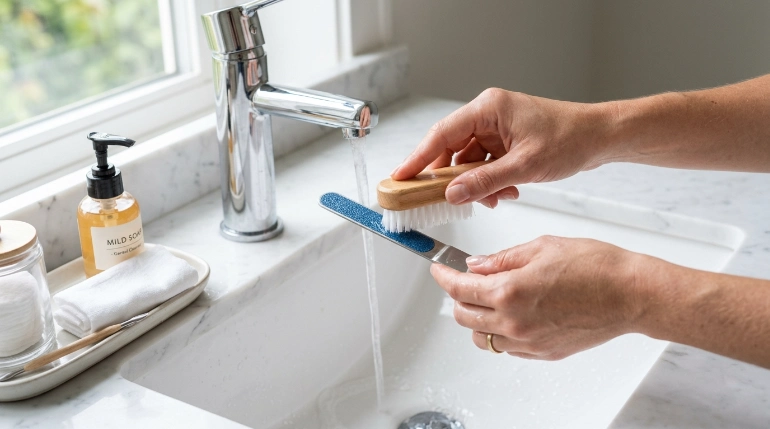
A little maintenance can make a noticeable difference.
1. File Clean, Dry Nails
Natural nails can become softer after long exposure to water.
For routine shaping, wait until your nails are dry.
You will usually have better control and can see exactly how much nail you are removing.
2. Use Light Pressure
You do not need to force the file against your nail.
Start gently.
If your file has coarse and fine surfaces, use the coarse side only when you need to remove more length. Finish with the fine side to smooth the edge.
3. Clean Away Nail Dust
After filing, check the abrasive surface.
A soft brush can remove loose nail dust.
For compatible sapphire files, cleaning may also involve running water and mild detergent. ZWILLING specifically advises cleaning its sapphire files with a soft hand brush, running water, and mild detergent when necessary, followed by careful drying with a lint-free cloth.
Always follow the care instructions supplied with your own file because materials and finishes can vary between brands.
4. Dry It Completely
Do not put a damp file straight into a closed manicure kit.
Dry the surface and handle.
Then allow any remaining moisture to disappear before storage.
5. Store It in a Case
A protective sleeve prevents the abrasive surface from constantly rubbing against other manicure tools.
It also keeps the pointed end from catching on items in your bag.
6. Keep Personal Tools Personal
For home use, the easiest hygiene habit is to keep your nail file for yourself.
If another person has a possible nail infection, do not casually share nail tools.
Expert Tip: Before replacing a sapphire file that suddenly feels dull, clean and dry it first. Packed nail dust can make an abrasive surface feel worn even when plenty of usable grit remains.
Does Cleaning a Sapphire Nail File Wear It Out?
Normal cleaning should not quickly ruin a well-made sapphire file when you follow the manufacturer’s directions.
Aggressive cleaning is different.
Avoid scraping the filing surface with another metal object. Do not attack stubborn debris with sharp tools.
You could disturb the abrasive surface instead of cleaning it.
A soft brush is safer.
Also be cautious with strong disinfectants unless your file’s manufacturer specifically says the material is compatible with them.
For your personal at-home nail kit, routine cleaning plus good storage is usually simpler than repeatedly exposing the tool to harsh chemicals.
Is a Sapphire Nail File Safe for Natural Nails?
It can be, but technique matters.
A durable tool is not automatically a gentle tool.
If the coarse surface feels aggressive on your natural nails, switch to the fine side and use very light pressure.
Stop filing if you notice:
- Pain
- Heat or burning
- New peeling
- Splitting
- Very thin edges
- Skin irritation
- Bleeding around the nail
You should be shaping the free edge of the nail, not grinding surrounding skin or thinning the top of the natural nail plate.
The American Academy of Dermatology recommends keeping nails shaped and free of snags as part of healthy nail care and also advises keeping nails clean and dry.
What If My Nails Are Already Damaged?
A nail file can smooth an ordinary snag.
It cannot diagnose or treat an underlying nail condition.
If your nail is separating from the nail bed, changing color, becoming unusually thick, developing a dark streak, bleeding, or changing shape without an obvious reason, repeatedly filing it may hide the problem rather than solve it.
The American Academy of Dermatology’s guide to nail changes explains that changes in nail color, texture, or shape sometimes deserve examination by a dermatologist.
Similarly, filing alone does not cure a fungal nail infection because the fungus can exist within and beneath the nail.
Do not use aggressive filing as a substitute for treatment.
When to See a Nail Technician or Dermatologist
For ordinary shaping, minor snags, and basic maintenance, a sapphire file is easy to use at home.
Professional help makes more sense in some situations.
Consider a Nail Technician When:
- You are unsure how much length to remove.
- You regularly damage your nail shape while filing.
- You have thick acrylic, gel, or other enhancements.
- You need product removal rather than simple edge shaping.
- You want help choosing an appropriate file or grit.
A trained nail technician can help with cosmetic nail care, but she should not be expected to diagnose a medical condition.
Consider a Dermatologist When:
- A nail becomes painful or swollen.
- You see pus or signs of infection.
- The nail repeatedly separates from the nail bed.
- A nail changes color unexpectedly.
- A dark streak appears or changes.
- The nail becomes unusually thick or distorted.
- The skin around the nail stays red or irritated.
- You suspect nail fungus.
- A damaged nail is not improving.
When health is involved, changing files is not necessarily enough.
Cost: Is a Sapphire Nail File Worth It?
Sapphire files normally cost more upfront than a basic disposable emery board.
The value comes from reuse.
Instead of replacing an inexpensive board again and again, you may be able to keep one quality sapphire file in your manicure kit for years.
That does not automatically make the most expensive file the best choice.
Look at:
- Construction quality
- Coarse and fine surfaces
- Comfortable grip
- Ease of cleaning
- Rust-resistant materials
- Protective storage case
- Manufacturer care instructions
If you only file your nails occasionally, even a simple file may meet your needs.
If you maintain your nails frequently and dislike disposable tools, paying more for a durable reusable file can make practical sense.
Common Mistakes to Avoid
A sapphire nail file is easy to use, but a few habits can reduce its lifespan or make filing harder on your nails.
- Pressing too hard. More pressure does not always mean faster or better shaping.
- Using the coarse side for everything. Switch to the finer surface when smoothing natural nail edges.
- Ignoring buildup. A dirty file can feel dull before it is truly worn out.
- Putting it away wet. Dry metal tools thoroughly before storage.
- Using it as a scraper. Reserve your nail file for nails.
- Continuing to use a bent file. A damaged file is harder to control.
- Filing irritated skin. Nail files belong on the nail edge, not sore skin.
- Sharing personal nail tools casually. Keeping individual tools separate is a simple hygiene precaution.
- Trying to file away an infection. Filing cannot replace appropriate medical treatment.
- Replacing the file simply because it is old. Check its actual condition first.
FAQs
How often should I replace a sapphire nail file?
There is no fixed replacement schedule. Replace it when the abrasive surface becomes noticeably smooth, uneven, damaged, rusty, or ineffective even after cleaning.
Do sapphire nail files get dull?
Yes. The abrasive filing surface can gradually wear down. Nail dust can also clog the texture and make the file temporarily feel dull, so clean it before assuming it needs replacement.
Can a sapphire nail file last for years?
Yes. A quality sapphire nail file can remain useful for several years when used for personal nail care, cleaned correctly, dried well, and protected during storage. Exact lifespan varies by construction and frequency of use.
Can I wash a sapphire nail file?
Many quality sapphire files can be washed, but check the manufacturer’s instructions first. Some manufacturers recommend a soft brush, running water, mild detergent, and thorough drying.
Is a sapphire nail file better than an emery board?
It depends on your priorities. Sapphire files are durable and reusable, while emery boards are inexpensive and convenient. A sapphire file may offer better long-term value if you file your nails regularly.
Are sapphire nail files good for weak nails?
They can be used carefully, but a coarse sapphire surface may feel too aggressive on very thin or peeling nails. Use the finer surface with light pressure, or consider a gentler fine-grit glass file.
How do I know if my sapphire file is worn out or just dirty?
Clean the file and allow it to dry completely. Then test it gently on one nail edge. If it still feels smooth, has visible bare patches, or requires excessive pressure to work, the abrasive surface is probably worn.
Conclusion
So, how long do sapphire nail files last? For most people using a quality file at home, the answer is potentially several years rather than a few weeks or months.
But there is no universal expiration date.
The smartest way to judge your file is by its condition. Keep using it while the abrasive surface remains even, clean, secure, and effective. Clean away nail dust, dry the file thoroughly, avoid excessive pressure, and store it safely.
If it becomes smooth, patchy, rusty, bent, or difficult to control, replace it.
Most importantly, remember that a nail file is a grooming tool, not a treatment for painful, infected, or unusually changing nails. Use your sapphire file gently for routine shaping, and get professional help when the problem goes beyond normal nail care.

