
Can You Use Human Nail Files on Dogs? A Safe Guide

If your dog’s nails feel sharp and you already have an emery board sitting in your manicure kit, you may wonder: can you use human nail files on dogs?
In many cases, yes. A clean manual human nail file can help smooth a dog’s nail tips, especially on puppies and small dogs with thinner nails. However, human files are not always strong or efficient enough for thick adult dog claws.
The type of file, your dog’s nail thickness, hygiene, and how calmly your dog handles paw care all matter. This guide explains which human nail files are reasonable to use, which ones to avoid, how to file safely, and when a dog-specific grinder or professional nail trim makes more sense.
Quick Answer
Yes, you can use human nail files on dogs for light smoothing and small amounts of nail removal. A clean medium- or fine-grit manual file works best. However, thick or overgrown dog nails usually need dog-specific clippers or a grinder. Never aggressively file, force a frightened dog, or continue if a nail becomes painful or bleeds.
Are Human Nail Files Safe for Dogs?

A manual nail file can be a reasonable grooming tool for some dogs. In fact, veterinary guidance recognizes handheld files as one method of gradually wearing down a dog’s nails. VCA Animal Hospitals’ dog nail-trimming guide notes that some owners use a handheld file or grinder instead of clipping, and that gradual filing can leave a smoother nail edge.
The important distinction is that possible does not always mean ideal.
Human nail files are designed for relatively thin human fingernails. Dog claws can be much thicker, harder, and more curved. An ordinary emery board may therefore work beautifully for rounding one sharp edge but take far too long to shorten a large dog’s overgrown nails.
A human file is most useful for:
- Smoothing freshly clipped nail edges
- Removing tiny amounts of length
- Maintaining small dogs’ nails between trims
- Filing soft puppy nails
- Dogs that dislike the snapping sensation of clippers
- Owners who want more control than clipping provides
It is less practical for very thick, long, cracked, or badly overgrown claws.
Human Nail File vs. Dog Nail File or Grinder
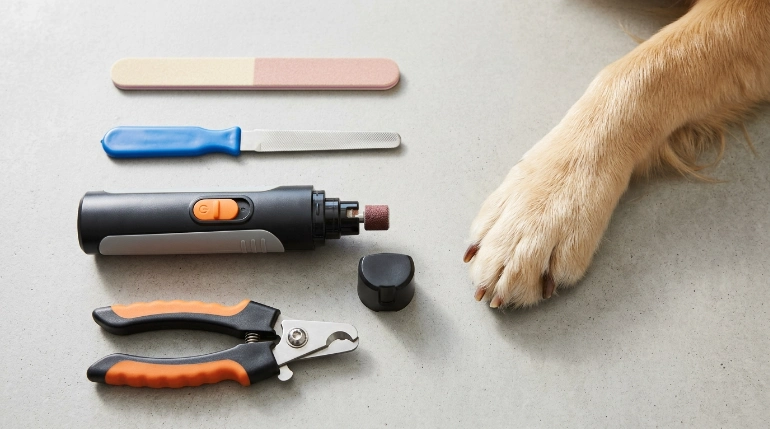
The best tool depends on what you are trying to accomplish.
| Tool | Best For | Speed | Control | Main Limitation |
|---|---|---|---|---|
| Human emery board | Light smoothing | Slow | High | Wears out quickly on thick claws |
| Human glass file | Gentle finishing | Slow | High | Can break and may be awkward around an active dog |
| Metal human file | Occasional smoothing | Medium | Moderate | Can feel harsh and may have sharp edges |
| Dog manual nail file | Routine filing | Medium | High | Still slow on very thick nails |
| Dog nail grinder | Shortening and shaping | Fast | High when used correctly | Noise, vibration, and heat |
| Dog nail clippers | Removing significant length | Fast | Moderate | Easier to accidentally cut the quick |
Dog-specific tools tend to make more sense when nail maintenance is going to become a regular part of your routine. The American Kennel Club’s dog nail-trimming guidance recommends appropriate clippers or grinders and emphasizes taking off only small amounts at a time.
From a cost perspective, a basic human emery board is the cheapest option if you already own one. A reusable dog file costs a little more, while an electric grinder is the larger upfront purchase. However, a grinder may save considerable time if you have a medium or large dog with hard nails.
Which Human Nail Files Work Best on Dogs?
Not every file in your manicure drawer is equally suitable.
Emery Boards
A standard emery board is usually the simplest human nail file to try.
Choose a medium or relatively fine surface rather than an extremely coarse file. You want enough texture to remove keratin gradually without aggressively scraping the claw.
Emery boards are especially useful for puppies and small dogs.
Their biggest drawback is durability. A thick dog claw can quickly wear down a disposable file.
Glass Nail Files
Glass files produce a smooth finish on human nails and may also work for carefully smoothing a dog’s nail tips.
However, they are not my first choice around a dog that suddenly jerks its paw, tries to bite grooming tools, or cannot remain still. Glass is rigid and potentially breakable.
If you use one, keep the session calm and controlled and put the file away immediately afterward.
Metal Nail Files
A metal file can remove material faster than a soft emery board, but it can also be more aggressive.
Check the edges before bringing it near your dog’s paw. Avoid any file with sharp corners, rust, damaged surfaces, or rough projections that could scrape the surrounding skin.
Very Coarse Acrylic Nail Files
Coarse files designed for acrylic enhancements can be unnecessarily aggressive for casual dog nail maintenance.
More grit does not automatically mean a better result. You are trying to shorten the hard nail gradually, not create friction as quickly as possible.
For beginners, controlled filing is more important than aggressive filing.
Expert Tip: Keep one inexpensive nail file exclusively for your dog. Label it and store it with the dog’s grooming supplies so you never accidentally move bacteria, dirt, or debris between your manicure tools and your dog’s paws.
How to File Your Dog’s Nails With a Human Nail File
The safest approach is slow, short, and calm.
1. Choose a Clean File
Start with a new or thoroughly clean file.
Do not grab an old emery board covered in nail dust, gel residue, polish, cuticle oil, or other manicure products.
Ideally, your dog’s file should become a pet-only tool.
2. Check Each Paw First
Before filing, look at the nail and surrounding skin.
Stop and reconsider DIY grooming if you notice:
- Active bleeding
- A split extending toward the base
- Swelling around the toe
- An obviously loose nail
- Significant redness
- Discharge
- A nail growing into the paw pad
- Pain when the toe is touched
- Limping or persistent paw licking
Filing an already injured nail may make the problem worse.
3. Let Your Dog Inspect the File
Dogs often tolerate grooming better when new tools are introduced gradually.
Let your dog sniff the file. Touch it gently against the paw without filing, then reward calm behavior.
The same gradual conditioning approach is recommended for other nail tools. VCA’s guidance on reducing nail-trimming stress emphasizes working with the dog’s comfort level instead of forcing a stressful trim.
4. Hold One Toe Gently
Support the paw without squeezing tightly.
Keep fur away from the nail so you can clearly see what you are doing.
If your dog repeatedly pulls away, growls, pants heavily, hides, or becomes increasingly upset, end the session rather than wrestling with the paw.
5. File the Tip Gradually
Use short, controlled strokes on the hard tip of the nail.
You do not need to saw aggressively back and forth.
Remove a tiny amount, inspect the nail, and continue only if necessary.
6. Stay Away From the Quick
Inside each dog’s nail is living tissue commonly called the quick, which contains blood vessels and nerves. Cutting or grinding into it hurts and causes bleeding. The quick can be especially difficult to judge in dark-colored nails. Merck Veterinary Manual’s overview of dog nails explains the importance of avoiding this sensitive area during nail trimming.
A manual file gives you the advantage of removing nail material slowly, but that does not make it impossible to go too far.
If you are unsure, stop early.
7. Smooth the Edge
Once the nail is an appropriate length, use lighter strokes to round sharp corners.
The goal is a smooth edge that does not snag on blankets, clothing, or your skin.
8. Reward Your Dog
Finish with praise or a favorite treat.
You do not have to complete every paw in one sitting. For a nervous dog, filing two nails successfully today may be better than forcing all eighteen nails and making the next grooming session harder.
Why Filing Can Be Easier Than Clipping
One reason owners like nail files is control.
Clippers remove a noticeable piece of nail instantly. Filing removes much smaller amounts.
That gradual process can feel less intimidating when you are nervous about reaching the quick.
Some dogs also dislike the pressure or snapping sensation produced by clippers but tolerate filing or grinding better. VCA specifically notes that some dogs that resist clipping may be more accepting of a handheld file or grinder.
Filing also leaves the nail edge smooth.
That can be useful after clipping because freshly cut nails may have surprisingly sharp corners.
However, filing has one major disadvantage: it is slow.
Trying to remove substantial length from thick Labrador, German Shepherd, Rottweiler, or other large-dog claws with a manicure emery board can become frustrating for both you and your dog.
When a Human Nail File Is Not Enough
A file should not be treated as a solution for every nail problem.
Very Overgrown Nails
When nails have become dramatically overgrown, simply filing them down in one long session is not a good strategy.
The quick can extend farther into an overgrown nail, meaning substantial shortening may require a gradual maintenance plan.
A groomer or veterinarian can help you determine a safer approach.
Thick Adult Dog Nails
Large dogs frequently have nails that are simply too strong for a disposable human file to handle efficiently.
A dog-specific grinder may provide much better control and speed.
The American Kennel Club notes that grinders can smooth nails effectively, although grinders introduce their own concerns, including heat and the possibility of catching long fur.
Cracked or Broken Nails
Do not aggressively file a badly broken nail because you assume the loose section should come off.
Broken nails can be painful and may involve living tissue. The Merck Veterinary Manual’s guidance on broken pet nails advises veterinary help when a broken portion cannot be safely managed.
Dogs That Cannot Be Safely Restrained
If your dog panics, snaps, or tries to bite when you touch the paws, stop.
This is not a grooming task worth turning into a physical struggle.
A groomer experienced with nervous dogs or a veterinarian can help create a safer plan. In severe cases involving extremely long nails and intense fear, veterinary assistance may be needed.
Can Filing a Dog’s Nails Hurt Them?
Filing the hard outer portion of a healthy nail should not normally be painful.
Problems occur when you:
- File too far toward the quick
- Apply excessive pressure
- Scrape the surrounding skin
- Work on an already damaged nail
- Force the paw into an uncomfortable position
- Continue despite signs of pain
- Use an electric tool long enough to generate excess heat
Watch your dog’s body language.
Pulling one paw away once does not necessarily mean injury. But repeated yelping, sudden guarding of the paw, limping, bleeding, or intense licking deserves attention.
Pain is a reason to stop, not a reason to hold the paw more firmly.
Hygiene: Should You Share the Same Nail File With Your Dog?
It is better not to.
Even if a human nail file technically works on dog nails, give your dog a dedicated one.
Dog paws contact floors, soil, sidewalks, grass, saliva, and plenty of other everyday contaminants. Reusing the same porous emery board on your own fingernails is unnecessary.
Disposable files are inexpensive enough that sharing offers very little benefit.
For reusable files, clean them according to the manufacturer’s instructions and allow them to dry fully before storage.
Also avoid using a file on a visibly infected, bleeding, or damaged dog nail and then returning it to your normal manicure kit.
How Often Should You File Your Dog’s Nails?
There is no perfect schedule for every dog.
Nail wear depends on size, activity level, surface type, age, and how quickly the nails grow. Dogs that regularly walk on rough pavement may naturally wear their nails more than dogs spending most of their time on carpet or grass.
A useful practical clue is sound. The ASPCA’s dog grooming guidance notes that clicking or snagging nails can indicate that a trim is due.
Check your dog’s nails regularly rather than waiting for them to become dramatically long.
Frequent tiny maintenance sessions are usually easier than occasional major corrections.
Human Nail File vs. Professional Grooming
DIY filing makes sense when your dog is cooperative and the nails only need minor maintenance.
Choose professional help when:
- The nails are extremely long
- You cannot identify a safe stopping point
- Several nails are black and you are uncomfortable judging length
- The dog becomes highly anxious
- A claw is split or damaged
- The nail is curling toward the paw pad
- There is bleeding, swelling, or obvious pain
- Previous nail trims have resulted in biting or panic
A professional groomer can handle routine shortening. A veterinarian is the better choice when pain, injury, infection, or an abnormal nail is involved.
Professional trimming costs more than using a file already in your drawer, but paying for experienced handling can be worthwhile when DIY grooming is stressful or unsafe.
Common Mistakes to Avoid
Even a simple nail file can cause trouble if it is used carelessly.
- Using the same dirty file on yourself and your dog. Keep separate grooming tools.
- Trying to fix severely overgrown nails in one session. Nail shortening may need to happen gradually.
- Filing aggressively because progress seems slow. Switch to a more appropriate dog tool instead.
- Ignoring your dog’s stress signals. Fear tends to worsen when grooming becomes a wrestling match.
- Filing an injured or bleeding claw. Examine the nail first.
- Getting too close to the quick. Stop earlier if you cannot clearly judge the safe length.
- Using a fragile glass file around a dog that bites tools. Choose something safer and easier to control.
- Using an electric human manicure drill as though it were a dog grinder. Dog-specific grinders are designed around pet nail grooming and are the more sensible choice.
- Forgetting the dewclaws. These nails may receive less natural wear because they often do not contact the ground.
When to See a Nail Technician or Dermatologist
Because this article is about dog nails, a human nail technician or dermatologist is not the appropriate professional for your dog’s claw problem.
For routine dog nail care that feels beyond your comfort level, contact a professional groomer. For bleeding, swelling, broken nails, suspected infection, significant pain, or an abnormal-looking claw, contact your veterinarian.
A dermatologist becomes relevant to you if you develop persistent skin or nail irritation after handling contaminated grooming equipment. A nail technician can help with cosmetic human nail care, but neither should diagnose or treat your dog’s paws.
Keeping those roles separate helps you get the right type of help faster.
FAQs
Can I use a regular emery board on my dog’s nails?
Yes. A clean medium- or fine-grit emery board can work for smoothing sharp edges or removing small amounts of nail. It is most practical for puppies and small dogs because thick claws can wear out an emery board quickly.
Can I use a human nail file on a puppy?
Usually, yes. Puppy nails are often thinner than adult dog nails, making a manual file useful for gentle smoothing. Introduce the file slowly and use very light pressure.
Is filing dog nails safer than clipping?
Filing removes nail gradually, which can give beginners more control and may reduce the chance of suddenly removing too much. However, you can still reach the sensitive quick if you keep filing, so you must still stop at a safe length.
Can I use a glass nail file on my dog?
A sturdy glass file may work for light smoothing on a calm dog, but it is not ideal for dogs that jerk their paws or chew grooming tools. An emery board or dog-specific manual file is usually a simpler beginner option.
Can I file my dog’s nails instead of cutting them?
Yes, particularly when the nails are already close to an appropriate length. Handheld files and grinders can be used to wear away nail gradually. Thick or substantially overgrown nails may require a grinder, clippers, or professional help.
What happens if I file my dog’s nail too far?
You may reach the quick, which contains nerves and blood vessels. This can cause pain and bleeding. Stop immediately if bleeding occurs. Persistent bleeding, severe pain, or a badly damaged nail warrants veterinary advice.
Should I buy a dog nail grinder instead?
If you have a medium or large dog, thick claws, or regularly maintain your dog’s nails at home, a dog nail grinder can be more efficient than a human file. Introduce the sound and vibration gradually, and avoid keeping the grinder against one spot long enough for the nail to become hot.
Conclusion
So, can you use human nail files on dogs? Yes—but think of them as a light-maintenance tool, not a universal replacement for dog nail equipment.
A clean emery board can be excellent for smoothing sharp tips, maintaining puppy nails, or removing a tiny amount of length from a small dog’s claws. Keep the file exclusively for your dog, work slowly, reward calm behavior, and stay well away from the quick.
If the nails are thick, seriously overgrown, damaged, painful, or difficult to manage, switch to an appropriate dog-specific tool or get help from a groomer or veterinarian.
The best nail-care method is not the one that removes nail fastest. It is the one that keeps you in control, your dog comfortable, and every paw safe.

