
Can You Use Nail Files on Dogs? A Safe, Simple Guide

If you have a regular nail file sitting in your manicure kit, you may wonder whether it can pull double duty on your dog’s claws. After all, both human nails and dog nails contain keratin, and filing seems gentler than clipping.
So, can you use nail files on dogs? In some situations, yes. A clean manual nail file can help smooth a small rough or sharp edge on a dog’s nail. However, human nail files are not always efficient enough for shortening thick dog nails, and some file types are less suitable than others.
The safest choice depends on your dog’s nail thickness, temperament, coat length, and how much nail needs to be removed. This guide explains when a human nail file may work, when a dog-specific file or grinder is better, how to file safely, and when to leave the job to a groomer or veterinarian.
Quick Answer
Yes, you can use some manual nail files on dogs for light smoothing, especially on small or thin nails. However, a dog-specific file, clipper, or grinder is usually better for regular nail maintenance. Never file aggressively or into the quick, and stop if your dog shows pain, bleeding, or significant stress.
Is It Actually Safe to Use a Nail File on a Dog?
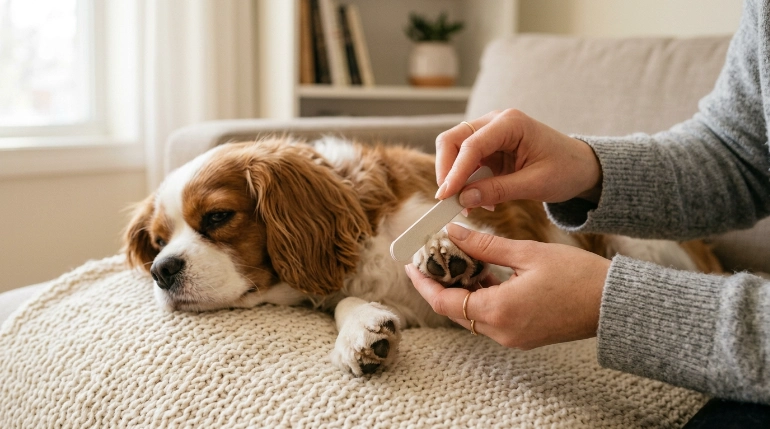
A manual nail file can be safe when you are working only on the hard outer tip of the nail and using gentle, controlled strokes.
A dog’s nail has a hard keratin shell surrounding sensitive living tissue called the quick. The quick contains nerves and blood vessels. Filing or clipping into it can hurt and cause bleeding. The AKC’s guide to safely trimming dog nails recommends removing only small amounts at a time and avoiding the quick.
That means the important question is not simply whether the file was marketed for humans or dogs. You should also consider its:
- Abrasiveness
- Shape and size
- Condition and cleanliness
- Ease of control
- Ability to remove material without excessive friction
A soft emery board may barely affect a large dog’s thick nails, while a very coarse metal file may be unnecessarily aggressive around a small dog’s toes.
The goal is controlled smoothing, not grinding the nail down as quickly as possible.
Human Nail Files vs. Dog Nail Files and Grinders
Human and canine nail tools may look similar, but they are designed around different nail sizes and grooming needs.
| Tool | Best Use | Control | Cost Level | Main Limitation |
|---|---|---|---|---|
| Human emery board | Smoothing tiny rough edges | High | $ | Slow on thick dog nails |
| Glass/crystal file | Light smoothing | High | $–$$ | Can be fragile and inefficient |
| Metal nail file | Occasional smoothing | Medium | $ | May feel harsh or awkward |
| Dog-specific manual file | Routine smoothing | High | $ | Still slower than clipping |
| Dog nail clipper | Removing noticeable length | Medium | $–$$ | Can hit the quick if misused |
| Dog nail grinder | Shortening and smoothing | High | $$ | Noise, heat, dust, and hair entanglement |
The ASPCA’s dog grooming guidance notes that dog-specific clippers are common for nail care and that an electric nail grinder can be an alternative for dogs that dislike clipping.
For occasional touch-ups, therefore, you may already have something usable at home. For ongoing maintenance, investing in a pet-specific tool generally makes the process easier.
Which Human Nail Files Can You Use on Dogs?
Not every manicure file is equally practical.
Emery Boards
A standard disposable emery board is one of the simplest options for smoothing a freshly clipped nail or taking off a tiny sharp point.
It gives you good control and does not create the mechanical risks associated with a powered grinder.
The downside is speed. Dog nails can be much thicker than human fingernails, so an ordinary emery board may wear down quickly.
It is most practical for:
- Puppies with small nails
- Small breeds
- Thin nail tips
- Smoothing after clipping
- Removing a tiny snag
For a large dog with long, thick nails, you could spend a long time filing without removing enough material.
Glass or Crystal Nail Files
A glass file can produce a smooth edge, but it is not necessarily the best dog grooming tool.
It may be useful for a small touch-up when the dog is relaxed. However, because glass files can break if dropped or knocked against a hard surface, use extra care around a dog that suddenly jerks its paw away.
If you decide to use one, keep it specifically for your dog rather than moving it back and forth between your manicure kit and pet grooming supplies.
Metal Nail Files
Metal files are reusable and can remove more material than a very fine emery board.
The drawback is that some are fairly aggressive. Their narrow edges may also make accidental contact with the skin around the toe uncomfortable.
Use gentle pressure and keep the abrasive surface centered on the hard nail rather than rubbing against the paw.
Human Electric Nail Drills
This is where the answer changes.
A powered manicure drill designed for artificial or human nails is not my first choice for a dog. Speed, heat buildup, rotating attachments, and loose fur make powered tools more complicated.
VCA notes that rotating nail grinders can catch long hair and that contact with the skin can cause injury.
If you want a powered option, a grinder specifically intended for pet nail care is generally the more sensible choice.
When a Regular Nail File Makes Sense
Using a human nail file on a dog is most reasonable when very little nail needs to come off.
Imagine that you clipped your dog’s nails yesterday and one nail now feels sharp when your dog puts a paw on your leg. A few gentle strokes with a clean emery board may be all you need.
A file may also be useful when:
- One nail has a slightly jagged edge
- Your dog dislikes the snapping sensation of clippers
- You want to smooth nails after trimming
- Your puppy has thin, needle-like tips
- Only minimal maintenance is needed between trims
Filing becomes much less practical when nails are significantly overgrown.
Long nails should not simply be filed aggressively in one session because the sensitive quick may extend farther toward the tip. VCA recommends shortening nails gradually in small amounts when the quick is difficult to see.
How to Use a Nail File on a Dog Safely
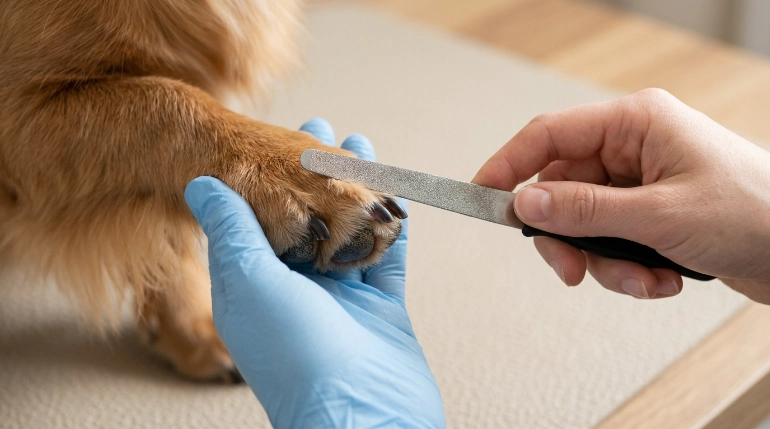
If your dog is calm and only needs minor smoothing, keep the process simple.
1. Choose a Clean, Easy-to-Control File
Use a manual file with enough texture to affect the nail without feeling extremely coarse.
Ideally, keep a separate file exclusively for your dog. This is an inexpensive way to keep your beauty tools and pet grooming tools separated.
2. Get Your Dog Comfortable Before Filing
Do not start by grabbing a paw and immediately filing.
Let your dog sniff the tool. Touch the paw briefly, reward calm behavior, and gradually work toward holding an individual toe.
The VCA guidance on reducing nail-trim stress recommends gradual handling and watching for body-language signals such as moving away, leaning away, tucked tails, trembling, growling, or snapping.
If your dog is struggling intensely, forcing the session can increase both stress and the chance of injury.
3. Hold One Toe Gently
Support the paw without squeezing it tightly.
Separate enough fur to clearly see the nail, especially on long-haired breeds. Good visibility makes it easier to keep the file away from skin.
4. File Only the Tip
Use short, gentle strokes on the hard tip.
You are trying to round off sharpness rather than reshape the entire nail in one sitting. Check your progress frequently.
Do not keep filing deeper simply because the nail still looks long.
5. Stop Before Reaching Sensitive Tissue
With pale nails, the pink quick may be visible through the nail. Dark nails are harder because you cannot easily see where the quick ends.
VCA recommends taking very small amounts from dark dog nails rather than making a large cut. The same conservative principle makes sense when filing.
6. Reward and Finish Early
You do not have to complete every nail in one session.
If your dog calmly lets you smooth two nails, that can be more productive than struggling through all four paws.
Give praise or an appropriate treat and finish on a calm note.
Expert Tip: Keep one inexpensive nail file labeled “dog only” for quick touch-ups after clipping. It is easier, cleaner, and less confusing than sharing the file from your manicure kit.
Can You File a Dog’s Nails Instead of Clipping Them?
Yes, filing or grinding can sometimes replace clipping, but the right choice depends on the dog.
VCA explains that filing or grinding can smooth the nail and may lower the chance of accidentally removing a large amount at once. Some dogs also tolerate grinding better than the pressure of a clipper.
However, manual filing is slow.
If your dog’s nails are noticeably overgrown, clipping or a pet nail grinder is likely to be more efficient. The Humane Society’s at-home dog grooming advice also recommends dog-specific clippers or a Dremel-style grinder depending on what the dog tolerates.
Think of a human nail file as a touch-up tool, not necessarily the main tool for every dog.
Why Nail Length Matters
Keeping dog nails at a comfortable length is more than a beauty issue.
If nails become long enough to contact the floor constantly, they can interfere with normal paw positioning and movement. Clicking against hard flooring is also a common practical sign that it may be time to check nail length. Both VCA and ASPCA advise monitoring how the nails contact the ground when deciding when maintenance is needed.
Dewclaws need attention too. Because they may not rub against pavement or other hard surfaces, they can continue growing without the natural wear that affects some of the other nails.
A quick visual paw check every week makes it easier to notice long, cracked, snagged, or unusually shaped nails before they become bigger problems.
What If Your Dog Has Black Nails?
Dark nails make DIY grooming harder because the quick is not easily visible from the outside.
Do not compensate by filing faster or applying more pressure.
Instead, take off very small amounts and inspect the nail after each short round. VCA recommends conservative trimming of dark nails for the same reason: gradually removing tiny amounts reduces the risk of reaching sensitive tissue unexpectedly.
If your dog’s dark nails are badly overgrown and you are unsure where it is safe to stop, a veterinarian or experienced groomer is a better choice.
What If the Nail Starts Bleeding?
Stop immediately.
Bleeding means sensitive living tissue may have been exposed. Apply gentle pressure and use a pet-appropriate styptic product if available.
According to VCA’s guidance on dog nail injuries, the quick contains nerves and blood vessels, and exposing it is painful and may cause bleeding. More serious nail injuries can also create an infection concern.
Contact your veterinarian if bleeding does not stop promptly, the nail is torn rather than simply nicked, your dog is in significant pain, or you notice swelling or other signs of a deeper injury.
Do not keep filing a bleeding nail.
Hygiene: Should You Share Your Own Nail File With Your Dog?
Technically, the physical file may work, but sharing the exact same file between yourself and your dog is unnecessary.
A basic emery board is inexpensive. Keeping separate manicure and pet grooming supplies makes cleaning easier and reduces cross-use of dusty or soiled tools.
After working on your dog’s nails:
- Dispose of single-use emery boards when heavily worn or dirty.
- Clean reusable tools according to their manufacturer instructions.
- Remove visible nail dust and debris.
- Store dog grooming tools separately from cosmetic manicure tools.
- Wash your hands after handling paws and grooming equipment.
This is especially sensible if your dog has cracked nails, irritated paw skin, or any suspected infection.
Manual File vs. Dog Nail Grinder
For beauty lovers who are already comfortable using nail tools, a dog nail grinder may look like an oversized manicure tool. The technique is still different.
A manual file offers maximum control and almost no noise, but it is slow. A pet grinder removes nail more efficiently but introduces vibration, noise, heat, dust, and moving parts.
AKC recommends using a grinder designed for dogs, removing only small amounts at a time, and keeping long fur away from the spinning mechanism.
If using a grinder, make brief contact rather than holding the rotating surface against one spot continuously.
For a nervous small dog that only needs smoothing, a manual file may be the simplest answer.
Signs You Should Stop DIY Nail Filing
A routine grooming session should not become a battle or a medical procedure.
Stop and get professional help if you notice:
- Active bleeding
- A split extending toward the base of the nail
- A nail hanging partially detached
- Redness or swelling around the toe
- Discharge, odor, or obvious inflammation
- Sudden limping
- Strong pain when the paw is touched
- A nail growing into the paw pad
- Extreme fear, growling, snapping, or panic
Broken nails can be very painful, and VCA advises veterinary care for significant nail injuries because the quick is living tissue connected closely with deeper structures of the toe.
Common Mistakes to Avoid
Even a simple manual file can cause problems when used incorrectly.
- Trying to shorten severely overgrown nails in one session. The quick may extend farther down a long nail.
- Filing too aggressively. More pressure does not automatically make grooming safer or better.
- Using a very coarse file near the skin. Abrasive material can scrape the surrounding toe.
- Using a powered human manicure drill without understanding the risks. Rotating tools create heat and can catch fur.
- Forcing a frightened dog to stay still. Anxiety increases movement and makes accidents more likely.
- Ignoring dewclaws. These may not naturally wear against the ground.
- Sharing dirty grooming tools. Keep your personal manicure tools separate whenever possible.
- Filing an injured or infected-looking nail. Pain, swelling, bleeding, or discharge deserves professional attention.
When to See a Nail Technician or Dermatologist
For your dog’s nail problem, a human nail technician or dermatologist is not the correct professional. Choose a veterinarian or qualified dog groomer instead.
A groomer can be appropriate for routine trimming when the nails are healthy but difficult for you to maintain. A veterinarian is the better choice when there is bleeding, significant pain, infection, a broken nail, an abnormal nail, or severe grooming anxiety.
For your own hands, a dermatologist may be appropriate if grooming your dog results in a skin wound that becomes red, swollen, painful, or infected. A nail technician can help with cosmetic damage to your own nails, but suspected infections or medical nail problems belong with a healthcare professional.
This distinction matters: cosmetic nail care and veterinary nail care require different expertise.
FAQs
Can you use nail files on dogs safely?
Yes. A clean manual nail file can be used gently on the hard tip of a healthy dog nail, particularly for smoothing rough edges. Avoid aggressive filing and never intentionally file into the quick.
Can I use a human emery board on my dog’s nails?
Yes, especially for small touch-ups. Emery boards work best on puppies, small dogs, or freshly clipped nails. Thick nails may require a dog-specific file, clipper, or grinder instead.
Can I use a glass nail file on my dog?
A glass file can smooth a dog nail, but use it cautiously because it may break if dropped or struck during sudden movement. A dedicated pet grooming file is usually more practical for frequent use.
Is filing a dog’s nails better than clipping?
Neither method is automatically better. Filing gives excellent control but takes longer. Clippers remove length quickly, while pet grinders sit somewhere between the two. Your dog’s nail thickness and tolerance should guide the choice.
How often should a dog’s nails be trimmed or filed?
There is no identical schedule for every dog. VCA says many dogs need trimming around monthly, while dogs that naturally wear their nails on hard surfaces may need less frequent maintenance. Check whether the nails are reaching the ground or clicking on hard floors.
What should I do if my dog hates having her paws touched?
Start with gentle paw handling without filing or clipping. Pair brief touches with praise or treats and progress gradually. If your dog shows extreme anxiety, growling, snapping, or panic, consult your veterinarian rather than forcing the session.
Can I file a broken dog nail?
Do not treat a significant broken or partially detached nail like a routine manicure. Broken nails can expose sensitive tissue and may require veterinary treatment. Seek veterinary help when there is substantial pain, bleeding, or a deeper tear.
Conclusion
So, can you use nail files on dogs? Yes—but think of a human nail file as a light-duty grooming tool rather than the perfect solution for every dog.
A clean emery board or similar manual file can work well for smoothing a sharp tip, touching up a freshly clipped nail, or maintaining thin nails on a calm small dog. For thick or overgrown nails, dog-specific clippers, a pet nail file, or a properly used pet grinder will usually be more practical.
Whatever tool you choose, work slowly, remove only small amounts, watch your dog’s body language, and respect the quick. Stop when you see pain, bleeding, significant damage, or fear.
Keep a dedicated dog nail tool in your grooming kit, check your dog’s paws regularly, and choose a veterinarian or experienced groomer whenever the job moves beyond a simple DIY touch-up.

