
Should Toenails Be Cut Straight Across? Safe Trimming Guide

If you have ever looked down after a pedicure and wondered whether your toenails should be square, rounded, or somewhere in between, you are not alone. The shape may seem like a beauty preference, but the way you trim your toenails can affect comfort, snagging, and your risk of developing a painful ingrown nail.
So, should toenails be cut straight across? For most people, yes. The safest everyday approach is to trim toenails straight across, avoid cutting them too short, and gently smooth any sharp or rough edges with a nail file.
That does not mean your toenails have to look perfectly boxy. The goal is to keep the corners visible rather than digging down into the sides of the nail. Below, we will cover the best trimming technique, which tools to use, what mistakes to avoid, and when a nail problem deserves professional attention.
Quick Answer
Yes, toenails should generally be cut straight across. Leave the nail long enough that the corners remain visible instead of rounding or cutting deeply into the sides. After clipping, gently smooth sharp edges with a nail file. This technique can reduce pressure on the surrounding skin and help lower the risk of ingrown toenails.
Why Should Toenails Be Cut Straight Across?
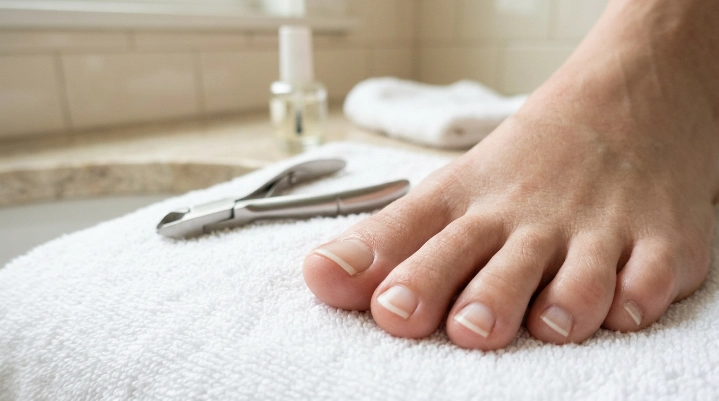
Toenails grow forward from the nail root and rest on the nail bed, which is the skin underneath the visible nail plate. When the corners of a toenail are repeatedly cut away, the surrounding skin can move into the space where the nail normally grows.
As the nail grows back, its edge may begin pressing or growing into that skin.
This is one reason dermatologists commonly recommend straight-across trimming for toenails. The American Academy of Dermatology advises cutting toenails straight across to help reduce the chance of an ingrown nail. American Academy of Dermatology nail-trimming guidance
Mayo Clinic also identifies cutting toenails too short or failing to cut straight across as common contributors to ingrown toenails. Mayo Clinic’s ingrown toenail guidance
The important distinction is this:
- Straight across: The corners remain present and grow naturally forward.
- Deeply rounded: The corners are cut down into the sides of the toe.
- Too short: The nail ends well behind the tip of the toe, allowing skin and shoe pressure to crowd the growing nail.
- Filed smooth: Sharp edges are gently softened without removing the supporting corners.
For most healthy toenails, straight across with light filing gives you the best combination of neat appearance and practical protection.
What Should a Properly Cut Toenail Look Like?
A correctly trimmed toenail does not need to form a perfectly rigid square.
Instead, imagine a mostly straight line following the front of the nail. Both corners should still be visible rather than disappearing deep into the side folds of the toe.
The free edge—the lighter portion extending beyond the attached nail bed—should not be completely removed.
MedlinePlus similarly recommends trimming straight across without tapering or rounding the corners and warns against trimming toenails too short. MedlinePlus guidance on ingrown toenails
Can You File the Corners a Little?
Yes. There is an important difference between smoothing a sharp corner and cutting the corner away.
If a newly trimmed nail has a tiny sharp point that catches your socks, use a fine nail file to soften that point gently. You do not need to turn the entire nail into a rounded shape.
Think smooth square, not semicircle.
A file is especially helpful if clipping leaves a jagged edge. Light filing gives you control without removing much nail length.
Straight vs. Rounded Toenails
| Nail Shape | What It Means | Ingrown Nail Consideration | Best Use |
|---|---|---|---|
| Straight across | Corners remain visible | Generally the preferred approach | Most healthy toenails |
| Soft square | Straight edge with lightly smoothed tips | Usually reasonable when corners are not removed | Neat cosmetic finish |
| Deeply rounded | Sides and corners are cut away | May encourage the nail edge to press into skin | Usually best avoided |
| Very short | Little or no free edge remains | Shoe pressure may increase irritation | Usually best avoided |
| Uneven/jagged | Rough clipping leaves sharp areas | May irritate neighboring skin | Smooth carefully with a file |
The NHS also recommends cutting straight across rather than cutting down the edges and advises against trimming toenails too short. NHS guidance for preventing ingrown toenails
How to Cut Toenails Straight Across
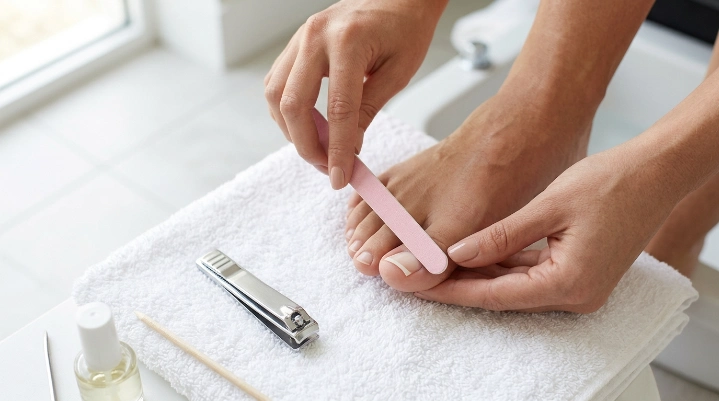
Good technique matters just as much as the shape.
1. Start With Clean Feet and Tools
Wash your feet and dry them thoroughly, especially between the toes.
Use clean nail clippers or nail nippers. Avoid borrowing someone else’s nail tools without appropriate cleaning because tools can collect nail debris and microorganisms.
If your clipper looks rusty, damaged, or no longer makes a clean cut, replace it.
2. Choose the Right Toenail Tool
Toenails are generally thicker than fingernails, so a toenail clipper or nail nipper may provide better control than a tiny fingernail clipper.
Common choices include:
- Toenail clipper: Easy and inexpensive for normal nails.
- Nail nipper: Gives more control when nails are thick or difficult to cut.
- Nail scissors: Suitable for people who already use them comfortably.
- Nail file: Useful for smoothing edges or gradually shortening nails.
Tool material matters less than condition and cleanliness. Stainless-steel clippers are popular because they are durable and easy to clean, but even a high-quality tool becomes unsafe if it is dull or dirty.
3. Make Several Small Cuts
Do not try to remove a thick toenail with one huge clip.
Start near one side and make several controlled cuts across the nail. Follow a mostly straight line rather than digging down toward either corner.
Mayo Clinic recommends small, straight cuts when trimming thickened toenails because they offer more control and can help reduce splintering. Mayo Clinic guide to trimming thickened toenails
4. Do Not Cut Too Short
Stop before removing every bit of white nail.
Your exact ideal length depends on your toe and nail shape, but you should not feel as though you are cutting into the nail bed or side grooves.
Pain is not part of normal nail trimming.
If trimming one corner hurts, do not keep cutting deeper in an attempt to “fix” it.
5. Smooth Rough Edges With a Nail File
After trimming, run your fingertip lightly along the nail edge.
If something feels sharp, use a fine-grit nail file or emery board. File gently rather than aggressively sawing away at the nail.
The American Academy of Dermatology recommends smoothing uneven edges with a nail file and filing in one direction rather than repeatedly sawing back and forth.
6. Clean and Dry Your Tools
Remove visible nail debris after use.
Follow the tool manufacturer’s cleaning or disinfection instructions, and store tools completely dry. Avoid keeping damp metal tools sealed in a humid bathroom container.
Expert Tip: If you are tempted to keep cutting because one corner looks slightly uneven, stop and use a nail file instead. Filing gives you much finer control and helps prevent accidentally removing the corner that protects against ingrowing.
Should You Soak Toenails Before Cutting Them?
You do not necessarily need to soak normal, easy-to-cut toenails.
However, thick or hard nails can become easier to manage after a shower or short warm-water soak.
Mayo Clinic recommends soaking thickened toenails in warm water for about 5 to 10 minutes before trimming, then drying the feet and nails.
Avoid leaving your feet soaking for a very long time merely to make the nails extremely soft. A heavily softened nail can be harder to judge accurately and may tear rather than cut cleanly.
If your toenails are consistently extremely thick, distorted, painful, or difficult to cut, professional assessment may be more useful than repeatedly soaking and forcing a clipper through them.
Can You Use a Nail File Instead of Clippers?
Yes, especially if your nails are not very long.
Filing can be a useful option when you want precise control or when taking off only a small amount of length.
A file can also be helpful if:
- Your clipper tends to leave jagged edges.
- You want to maintain rather than dramatically shorten the nail.
- Your nails split easily after clipping.
- You have a slightly sharp corner that catches socks.
- You are uncomfortable making a large cut.
However, filing a very thick toenail can take a long time. Aggressive filing can also thin or irritate the nail.
For thick nails, a suitable toenail clipper or nipper followed by gentle filing is often more practical.
What Type of Nail File Is Best for Toenails?
Toenails can usually tolerate a sturdier file than delicate natural fingernails, but you still do not need extreme abrasiveness.
Emery Boards
Emery boards are inexpensive and easy to control. They are useful for light smoothing but wear out over time and may not be ideal for sharing.
Glass Nail Files
Glass files offer a smooth filing surface and are washable. They work especially well for refining a normal nail edge, although thick toenails may take longer to shorten.
Metal Nail Files
Metal files are durable and useful for thicker nails when used gently. Because they can feel aggressive, avoid pressing hard or scraping the skin beside the nail.
Whatever you choose, stop if filing causes pain, heat, bleeding, or skin irritation.
Why Cutting Toenails Too Short Can Cause Problems
A very short pedicure may look neat initially, but cutting toenails extremely close to the skin can create unnecessary pressure.
Shoes naturally push against your toes while you walk. If the nail has been cut far back, the surrounding skin may be pushed toward the nail edge as it starts growing forward again.
Mayo Clinic specifically advises maintaining a moderate toenail length and notes that pressure from shoes can contribute to a nail growing into surrounding tissue when nails are cut too short.
Shorter is therefore not always cleaner or healthier.
Aim for tidy and comfortable, not the maximum amount of nail removal possible.
What If Your Toenails Are Naturally Curved?
Some people have nails that naturally curve more dramatically at the sides.
Do not automatically try to flatten that appearance by cutting deeper into the corners. Natural shape varies, and repeatedly digging out the sides can irritate the skin.
Instead:
- Keep the front edge mostly straight.
- Leave the corners visible.
- Smooth only truly sharp areas.
- Wear shoes with enough room for your toes.
- Watch for redness, tenderness, or swelling.
If the nail continually curves into the skin even when you trim it correctly, a podiatrist or dermatologist may be able to determine whether your nail shape needs professional care.
Toenail Trimming at Home vs. a Professional Pedicure
Both can be reasonable choices.
| Consideration | At Home | Salon/Professional |
|---|---|---|
| Cost | Lower after purchasing basic tools | Higher and varies by service/location |
| Convenience | Trim whenever needed | Requires an appointment or visit |
| Control | You decide exactly how much is removed | Communicate your preferred shape clearly |
| Hygiene | You control your own tools | Depends on salon sanitation practices |
| Thick/difficult nails | Can be challenging | Experienced professionals may have better tools |
| Pain or suspected infection | DIY treatment has important limits | A salon is not a substitute for medical care |
If you get pedicures, tell your nail technician that you prefer your toenails straight across and not excessively short.
A cosmetic service should never involve painful digging into the nail corners.
Hygiene and Sensitive Skin Considerations
Toenail care involves both the nail and the surrounding skin.
Do not cut living skin around the nail simply because it looks uneven. Cuts around the nail create an opening where germs may enter.
The American Academy of Dermatology advises leaving cuticles alone because they help protect the nail root from infection.
If you have sensitive skin:
- Avoid aggressive scraping around the nail folds.
- Do not keep filing once the surrounding skin becomes red.
- Stop immediately if a clipper causes bleeding.
- Keep tools clean and dry.
- Avoid sharing personal nail tools.
- Give irritated skin time to recover before applying strong cosmetic products.
Common Mistakes to Avoid
Several common pedicure habits can turn a simple trim into a sore toe.
- Rounding toenails deeply at the sides. This removes the corners and can encourage the growing edge to contact surrounding skin.
- Cutting the nail extremely short. Leave enough nail to protect the nail bed and surrounding skin.
- Digging out a painful corner yourself. If it already hurts, repeated cutting can worsen irritation.
- Making one huge cut through a thick nail. Small controlled cuts are easier to manage.
- Using dull clippers. Dull blades may crush, tear, or split the nail.
- Aggressively filing back and forth. Use controlled strokes and stop when the edge is smooth.
- Sharing dirty nail tools. Keep personal tools clean and properly stored.
- Ignoring tight shoes. Correct trimming alone may not solve repeated irritation if your footwear continually squeezes the toe.
- Covering a suspicious nail problem with polish. Persistent discoloration, swelling, drainage, or pain deserves attention rather than camouflage.
Signs You May Have an Ingrown Toenail
An ingrown toenail occurs when an edge or corner of the nail begins growing into or pressing painfully against the surrounding skin.
Early signs may include:
- Tenderness along one side of the nail
- Red or inflamed skin
- Swelling
- Pain when wearing shoes
- Sensitivity when the toe is touched
More concerning signs include drainage, pus, increasing warmth, worsening swelling, spreading redness, or severe pain.
Mayo Clinic notes that ingrown toenails can cause pain, inflammation, swelling, and sometimes infection.
Do not keep cutting deeper into an already painful nail corner.
When to See a Nail Technician or Dermatologist
A healthy nail that simply needs routine shortening can usually be managed at home or by a careful nail technician.
A professional nail technician may be useful if you:
- Have difficulty creating an even shape.
- Cannot comfortably reach your feet.
- Have thick but otherwise healthy-looking nails.
- Want help maintaining a neat straight-across shape.
However, a nail salon is not a substitute for medical evaluation.
See a dermatologist, podiatrist, or other appropriate healthcare professional if you notice:
- Significant or worsening pain
- Pus or drainage
- Spreading redness or swelling
- Bleeding that keeps recurring
- A nail that is becoming increasingly thick or distorted
- A persistent unexplained color change
- An ingrown nail that repeatedly returns
- Difficulty trimming the nail safely
People with diabetes, poor circulation, reduced sensation, or other conditions that make foot injuries more serious should be especially cautious with DIY nail trimming. Mayo Clinic advises people with diabetes, poor circulation, or reduced sensation to discuss safe toenail trimming with their healthcare team.
When you are unsure whether a toenail problem is cosmetic or medical, choosing professional medical advice is safer than repeatedly cutting, filing, or digging at the area yourself.
FAQs
Should toenails always be cut perfectly straight?
They should generally be trimmed straight across, but the edge does not have to look mathematically perfect. Small sharp tips can be gently smoothed with a file as long as you do not cut deeply into the corners.
Why shouldn’t you round toenail corners?
Deep rounding removes the corners that normally grow forward alongside the skin. As the nail regrows, its edge may press into or grow into the surrounding skin.
How short should you cut your toenails?
Avoid cutting them extremely close to the skin. Keep a moderate length so the corners remain visible and the nail is not buried behind the surrounding skin.
Should I cut a painful toenail corner out?
No. If a corner is already painful, swollen, or embedded in the skin, continuing to dig at it can cause additional injury. Seek professional advice if symptoms persist or worsen.
Is it better to clip or file toenails?
Both can work. Clippers are faster for removing length, while a nail file gives you more control when smoothing edges. Many people get the best result by clipping first and gently filing afterward.
Should I cut toenails before or after a shower?
Normal nails can be trimmed when clean and dry. Thick or very hard nails may be easier to trim after a short warm-water soak or shower because they become slightly softer.
How can I make straight-across toenails look attractive?
Use a fine file to smooth tiny rough points without removing the corners. Finish with moisturizer around the surrounding skin and your preferred polish if the nail and skin are healthy.
Conclusion
So, should toenails be cut straight across? For most people, yes. A straight-across trim that leaves the corners visible and avoids excessive shortening is the safest everyday approach.
Use clean, sharp tools, take several controlled cuts rather than one aggressive clip, and smooth rough edges gently with a nail file. Avoid digging into the sides simply to create a rounded cosmetic shape.
Most importantly, listen to your toe. Routine trimming should not cause significant pain, bleeding, swelling, or drainage. If something looks or feels wrong, stop the DIY grooming and get appropriate professional advice.
The next time you trim your toenails, aim for straight, comfortable, smooth, and not too short. Your pedicure can still look polished without sacrificing healthy nail-care habits.

