
How to Cut Toenails That Are Hard to Reach Safely

Cutting your toenails sounds simple until reaching your toes becomes the hardest part. Maybe bending forward feels awkward, your hips are tight, your stomach gets in the way, or you simply cannot see the nail clearly enough to place a clipper with confidence.
Learning how to cut toenails that are hard to reach is less about forcing yourself into an uncomfortable position and more about improving your setup. The right chair, better lighting, a long-handled or angled clipper, and a nail file can make a big difference.
Most importantly, toenail trimming should never require painful stretching or blind cutting. This guide explains safer positions, useful tools, a step-by-step trimming method, hygiene basics, common mistakes, and when DIY nail care is no longer the best choice.
Quick Answer
To cut toenails that are hard to reach, sit in a stable chair, raise one foot onto a low stool if comfortable, use bright lighting, and choose long-handled or angled toenail clippers. Trim softened nails in small cuts straight across, then gently file sharp edges. Never cut blindly or force an uncomfortable position.
Why Hard-to-Reach Toenails Need Extra Care
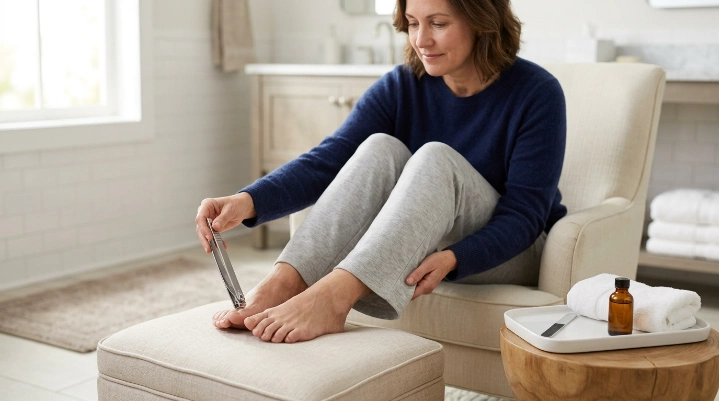
Poor reach changes more than comfort. It can also affect how clearly you see the nail and how steadily you control the clipper.
If you have to twist your torso, hold your breath, stretch your leg awkwardly, or clip from an angle you cannot see, you are more likely to:
- Cut the nail too short
- Clip into surrounding skin
- Leave sharp corners
- Split a thick nail
- Accidentally round the sides too deeply
- Lose your grip on a sharp tool
The goal is therefore not simply to reach the nail. You want a setup that allows you to see the cutting edge, stabilize your foot, and control every small cut.
The American Academy of Dermatology recommends using proper toenail clippers, softening nails before trimming when needed, cutting toenails straight across, and smoothing rough edges with a file. American Academy of Dermatology’s nail-trimming guide
Start With a Safer Position
Before buying a special tool, change the way you sit.
Use a Stable Chair
A firm chair with a supportive back is usually easier to work from than standing, balancing on one leg, or sitting on the edge of a bathtub.
Place your supplies within reach before you begin so you do not have to keep bending down.
Helpful supplies include:
- Toenail clippers
- Nail file or emery board
- Small towel
- Good light
- Low footstool, if comfortable
- Container or tissue for clippings
- Reading glasses, if you normally use them
Avoid trimming while balancing awkwardly on a bathroom floor or leaning over a slippery tub.
Bring the Foot Toward You
If your flexibility allows it comfortably, place your foot on a low stool or another stable surface.
You may also sit sideways in a chair and gently bring one leg closer rather than bending your entire upper body toward the floor.
Do not force your knee, hip, back, or ankle into a painful position just to reach a toenail.
If a position causes pain, numbness, cramping, dizziness, or significant strain, stop and choose another approach.
Improve Your View
Good visibility is surprisingly important.
Use bright overhead lighting or a movable lamp. If the nail is difficult to see, reposition your foot before placing the clipper.
A small mirror can help you inspect the underside or sides of a toe, but a mirror should not encourage you to make a cut that you cannot control directly.
If you genuinely cannot see where the blade meets your nail, professional trimming is safer than guessing.
Choose the Right Tool for Hard-to-Reach Toenails
A tiny standard clipper is not always the easiest option when reaching your toes is already difficult.
| Tool | Best For | Main Benefit | Limitation |
|---|---|---|---|
| Standard toenail clipper | Normal, easy-to-cut nails | Simple and inexpensive | Short handle may require more bending |
| Long-handled clipper | Limited reach | Brings your hand farther from the toe | Takes practice to position |
| Angled-head clipper | Poor viewing angle | Helps you see the blade more easily | Can feel unfamiliar at first |
| Nail nipper | Thick, tough nails | Strong leverage and wide opening | Very sharp and requires control |
| Nail file | Rough or sharp edges | Smooths without removing large pieces | Too slow for shortening long nails |
Long-Handled Toenail Clippers
Longer handles can reduce how far your hand must travel toward your toes. They may also provide more leverage, which is helpful when nails are firm.
Look for:
- A textured or nonslip grip
- A handle large enough to hold securely
- Sharp, well-aligned blades
- An angled head if visibility is difficult
- A jaw opening appropriate for your nail thickness
The important feature is control, not simply the longest handle available.
Nail Nippers for Thick Toenails
Nippers have plier-style handles and strong cutting jaws. They can work well on nails too thick for a basic clipper.
Mayo Clinic notes that nail nippers may be useful for thickened toenails and recommends making small, straight cuts rather than attempting to remove the nail in one large cut. Mayo Clinic’s guide to trimming thickened toenails
Because nippers are extremely sharp, they are not necessarily safer just because they are stronger. If you cannot see the blades clearly or keep your hand steady, do not use them.
A Nail File Is More Important Than It Looks
A nail file lets you smooth a corner without taking another deep bite with the clipper.
After trimming, use a fine or medium file to remove only sharp or rough areas. Gentle filing can also prevent freshly cut edges from catching on socks.
Avoid aggressive back-and-forth sawing. The American Academy of Dermatology recommends filing in the same direction because repeated sawing can weaken the nail.
How to Cut Toenails That Are Hard to Reach Step by Step
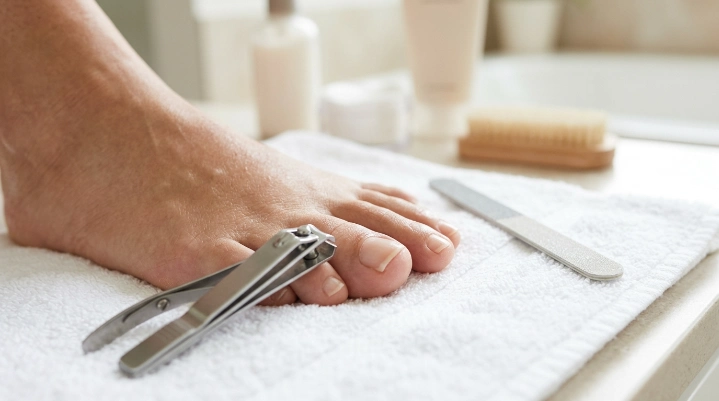
Once you have a comfortable setup, take your time.
1. Wash Your Feet and Inspect the Nails
Clean feet make it easier to see the nail and surrounding skin.
Before clipping, check for:
- Redness
- Swelling
- Bleeding
- Drainage
- Open cuts
- Significant discoloration
- Nail separation
- Severe thickening
- Painful ingrown edges
If something looks infected or unusually painful, trimming it aggressively is not the solution.
2. Soften Hard Toenails
If your nails are firm or difficult to cut, trimming after a bath or shower can make the job easier.
Alternatively, Mayo Clinic suggests soaking thickened toenails in warm water for approximately 5–10 minutes before drying them and trimming.
The nail should be softer, but your hands, feet, and tools should not be slippery.
Dry everything thoroughly before picking up the clipper.
3. Position One Foot Securely
Work on one foot at a time.
Place it somewhere stable where you can see the nails without excessive bending. Check that your chair and foot support cannot slide.
Never hold your foot in the air while struggling to clip at the same time.
4. Start With Small Cuts
Place the clipper where you can clearly see both the blade and nail.
Instead of trying to cut the entire nail in one squeeze, make several controlled cuts.
For a large toenail, you can work gradually from one side toward the other while maintaining a generally straight line.
Do not rip or tear away a partially cut piece of nail. Reposition your tool and complete the cut cleanly.
5. Cut Straight Across
Toenails should generally be trimmed straight across rather than deeply rounded at the corners.
Mayo Clinic identifies cutting toenails too short or not straight across as factors that can contribute to ingrown toenails. Mayo Clinic’s ingrown toenail guidance
Leave enough nail that you are not cutting into the attached pink portion or digging beneath the corners.
Your freshly trimmed nail does not need to look perfectly curved like a manicure.
6. File Sharp Edges
After clipping, gently feel the free edge of the nail.
If a corner feels sharp, smooth it with a nail file instead of cutting deeply down the side.
Use light strokes and stop when the edge no longer catches.
7. Check the Surrounding Skin
Once you finish, look for:
- Tiny cuts
- Bleeding
- Tenderness
- Pinched skin
- Newly exposed sore areas
If you accidentally nick the skin, stop trimming that area and keep it clean.
8. Clean and Dry Your Tools
Do not put a clipper away while it is wet or covered with nail debris.
The American Academy of Dermatology recommends routinely disinfecting nail-trimming tools.
Personal tools also should not be casually shared between people.
Expert Tip
Expert Tip: If you keep leaning closer and closer because you cannot see the blade, stop repositioning your body and reposition your foot and light instead. Better visibility usually gives you more control than extra bending.
What If You Still Cannot Reach Your Toenails?
There is a point where buying another gadget stops being the best answer.
If you cannot comfortably see and reach your feet, having someone qualified trim them can be safer.
The National Institute of Diabetes and Digestive and Kidney Diseases specifically advises people with diabetes to have a foot doctor trim their nails if they cannot see, feel, or reach their feet. NIDDK guidance on diabetes and foot care
Even without diabetes, professional help may make sense if mobility limitations make safe clipping unrealistic.
DIY vs. Professional Toenail Care
DIY care is convenient and inexpensive when your nails are healthy and you can control the tool.
A salon pedicure can be useful for routine cosmetic maintenance, but a nail technician is not a substitute for medical care.
A podiatrist or other healthcare professional is more appropriate when the problem involves pain, infection, severe thickening, circulation problems, loss of sensation, or recurrent ingrown nails.
Hygiene Matters More Than a Perfect Pedicure
A neat-looking toenail is not worth damaging the skin around it.
Keep trimming tools clean and dry, and avoid sharing them whenever possible. Fungi and bacteria can spread through contaminated nail-care items, and small breaks in skin create opportunities for infection.
The CDC advises keeping feet clean, checking regularly for changes, and maintaining good foot hygiene.
After trimming, dry your feet well, especially between the toes.
Moisturizer can be useful for dry skin around your feet, but avoid leaving the spaces between your toes damp.
Common Mistakes to Avoid
- Cutting while you cannot see the blade. A long handle does not make blind trimming safe.
- Bending until it hurts. Change your setup instead of forcing your back or hips.
- Cutting toenails extremely short. This can leave the surrounding skin more vulnerable and may contribute to ingrown nails.
- Rounding deeply into the corners. Aim for a straighter free edge.
- Removing the whole nail edge in one large cut. Small cuts are easier to control.
- Using dull clippers. Dull jaws can crush, bend, or tear nails instead of cutting cleanly.
- Using oversized nippers without practice. More cutting power also means a bigger mistake if the tool slips.
- Picking at nail corners. Use a file for minor roughness rather than tearing the nail.
- Sharing unclean nail tools. Personal grooming tools should be cleaned appropriately.
- Ignoring pain or infection. A painful nail problem should not automatically be treated as a DIY pedicure issue.
Special Caution for Diabetes, Poor Circulation, or Reduced Sensation
Home toenail trimming deserves extra caution if you have diabetes, poor circulation, neuropathy, or reduced feeling in your feet.
A small accidental cut may be harder to notice and potentially more complicated than it would be for someone with normal sensation and circulation.
The CDC advises people with diabetes to trim toenails straight across and have a podiatrist handle trimming when they cannot see or reach their feet.
If this applies to you, personalized advice from your healthcare team should take priority over general beauty-care instructions.
When to See a Nail Technician or Dermatologist
A nail technician may be appropriate when your nails are healthy and you simply want routine trimming or cosmetic care.
However, see a dermatologist, podiatrist, or other appropriate medical professional when you notice:
- Increasing pain around a nail
- Redness or swelling
- Pus or drainage
- Bleeding without an obvious minor cause
- A nail becoming markedly yellow, brown, black, or distorted
- Severe thickening
- Nail separation
- A recurrent ingrown toenail
- An injury that has significantly damaged the nail
- Persistent changes in nail shape or texture
The American Academy of Dermatology recommends medical evaluation when nail color, texture, or shape changes unexpectedly because some changes can reflect infection or other health conditions.
Do not ask a nail technician to diagnose or treat a suspected infection. Salon professionals can provide cosmetic nail services, while medical nail and foot problems belong with healthcare professionals.
FAQs
What is the easiest way to cut toenails when you cannot bend over?
Sit in a stable chair and bring one foot closer using a low, secure footrest if your mobility allows it. Long-handled or angled toenail clippers can reduce how far you need to reach.
Are long-handled toenail clippers safe?
They can be helpful when they improve reach and control, but they still have sharp blades. Use them only when you can clearly see the nail and control the cutting edge.
Should I cut hard toenails before or after a shower?
After a shower or bath is often easier because the nail has softened. Dry your feet and hands before clipping so the tool does not slip.
How short should toenails be?
Avoid cutting them extremely short. Leave a small free edge and trim generally straight across rather than digging into the corners.
Can I file toenails instead of cutting them?
A file can shorten nails gradually, especially if only a little length needs removing. However, filing very long or thick toenails may take considerable time. Filing is especially useful for smoothing sharp edges after clipping.
What should I do if my toenails are extremely thick?
Soften them first and consider an appropriate nail nipper if you can use one safely. If the nail is painful, severely thickened, yellow, distorted, or difficult to trim without risking injury, seek professional medical foot or nail care.
Who can cut my toenails if I cannot reach them myself?
A nail technician can help with healthy nails during routine pedicure care. If you have diabetes, poor circulation, reduced sensation, severe nail thickening, infection, pain, or ingrown nails, a podiatrist or other healthcare professional is the safer choice.
Conclusion
Learning how to cut toenails that are hard to reach starts with changing your setup rather than forcing your body into an uncomfortable position.
Sit securely, bring your foot closer, improve the lighting, and choose a tool that gives you better reach and control. Soften hard nails when necessary, make small cuts straight across, and use a nail file to smooth rough edges instead of digging into the corners.
Most importantly, know when DIY trimming has reached its limit. If you cannot clearly see or safely control the tool—or the nail is painful, infected, severely thickened, or otherwise abnormal—professional care is the smarter next step.
Take your time, protect the surrounding skin, and make safe, comfortable trimming the priority over achieving a perfectly shaped pedicure.

