
How to Trim Long Toenails Properly: Safe Step-by-Step Guide

Long toenails can become uncomfortable surprisingly fast. They may press against shoes, snag on socks, collect debris underneath, or become harder to trim cleanly once they grow past the end of the toe.
Learning how to trim long toenails properly is less about cutting off as much length as possible and more about staying in control. The safest approach is to use clean, sharp toenail clippers, remove excess length gradually, keep the final edge mostly straight across, and smooth rough spots gently with a nail file.
This guide walks you through the tools, technique, hygiene steps, common mistakes, and warning signs that mean a DIY pedicure should stop.
Quick Answer
To trim long toenails properly, clean and dry your feet, use sharp toenail clippers, and shorten the nail gradually with several small cuts. Keep the final edge straight across rather than digging into the corners. Leave a little visible nail instead of cutting extremely short, then gently file any sharp or rough edges.
Why Proper Toenail Trimming Matters
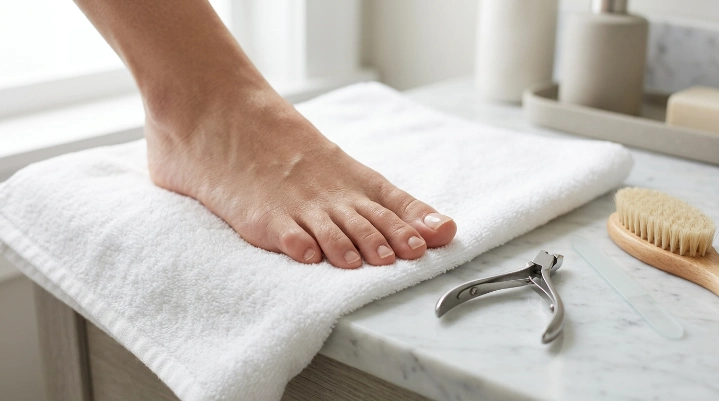
Toenails grow more slowly than fingernails, so it is easy to forget about them until they feel noticeably long. But cutting them aggressively once they become overgrown can create splitting, tenderness, or sharp corners.
One of the biggest concerns is an ingrown toenail. This happens when the edge of the nail presses or grows into the surrounding skin.
The American Academy of Dermatology’s guide to trimming nails recommends cutting toenails straight across to help reduce the chance of an ingrown nail. It also recommends smoothing rough edges with a nail file rather than aggressively cutting into the corners.
Proper trimming can also help:
- Reduce pressure inside closed-toe shoes
- Prevent snagging and accidental tearing
- Keep the free edge easier to clean
- Make regular pedicures easier to maintain
- Reduce the temptation to pick or rip broken edges
- Help you notice unusual nail changes sooner
A neat-looking toenail should never come at the cost of pain, bleeding, or damaged skin.
What You Need Before You Start
You do not need a full salon kit to trim long toenails safely. A few appropriate tools are usually enough.
| Tool | Best Use | What to Look For |
|---|---|---|
| Toenail clippers | Routine shortening | Sharp, aligned blades and a comfortable grip |
| Nail nippers | Very thick or hard nails | Strong jaws and handles you can control |
| Fine or medium-fine nail file | Smoothing rough edges | Gentle grit suitable for natural nails |
| Clean towel | Drying feet and tools | Fresh and completely dry |
| Small cleaning brush | Removing debris from tools | Easy to wash and dry |
| Moisturizer | Skin care after trimming | Comfortable formula that does not irritate your skin |
A standard fingernail clipper may feel too small for a large or thick big toenail. Using a tool that is too weak can make you squeeze harder, which reduces control.
If you need nail nippers because your nails are unusually thick, remember that their blades can be extremely sharp.
Choosing a Nail File for Toenails
A nail file is useful for finishing the trim, not for aggressively thinning an unhealthy-looking nail.
For ordinary natural toenails, choose a reasonably fine file that lets you smooth small snags without removing large amounts of nail quickly. Avoid attacking a natural nail with an extremely coarse file.
Glass or crystal files can be comfortable for gentle finishing, while a fresh emery board is an inexpensive option. Whatever you choose, the surface should be clean and in good condition.
Do not share personal nail files or clippers with other people.
The AAD also advises against sharing nail-grooming tools because organisms responsible for nail and skin infections can spread through contaminated personal items.
How to Trim Long Toenails Properly Step by Step
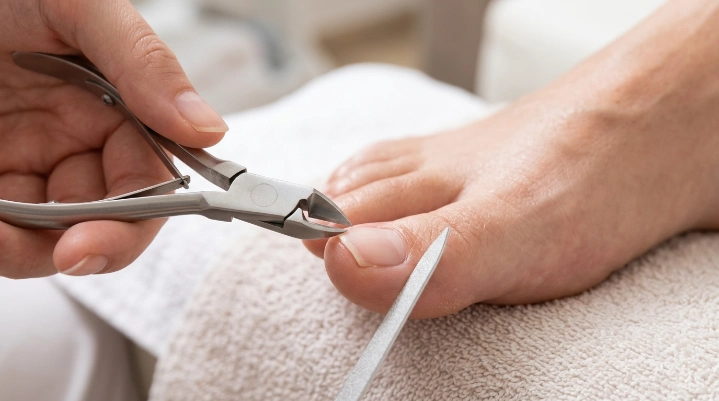
1. Look at the Nail Before Cutting
Take a moment to examine each toe.
Routine DIY trimming is most appropriate when the nail looks generally healthy and the surrounding skin is intact.
Stop before trimming if you see:
- Pus or drainage
- Significant redness or swelling
- Bleeding
- An open sore
- Severe pain
- A nail that is lifting significantly
- Dark discoloration without an obvious explanation
- A dramatically thickened, crumbling nail
- A nail deeply embedded in the side of the toe
These problems may require more than cosmetic nail care.
2. Clean Your Feet and Tools
Wash your feet and remove visible dirt around the nails. Dry the toes carefully, including the spaces between them.
Your clippers or nippers should also be clean and completely dry.
The American Academy of Dermatology recommends periodically disinfecting nail-trimming tools and drying them thoroughly before storage.
If a disposable emery board has become dirty, torn, damp, or difficult to clean, replace it rather than keeping it indefinitely.
3. Soften Very Hard or Thick Toenails if Necessary
Healthy toenails do not have to be soaked for a long time before every trim. However, a short warm-water soak can make especially hard or thickened nails easier to cut.
The Mayo Clinic’s guidance for trimming thickened toenails suggests soaking the feet in warm water for about 5–10 minutes before trimming thick nails, followed by thorough drying.
Do not keep your toes waterlogged. You want the nail manageable, not extremely soft and slippery.
4. Position Yourself So You Can See Clearly
Good control matters more than speed.
Sit somewhere stable with bright lighting. Bring the foot toward you rather than twisting your body into an uncomfortable position.
If you cannot clearly see or safely reach your toenails, do not trim by feel.
Poor visibility is an easy way to cut the skin accidentally.
5. Reduce Long Nails Gradually
When a toenail extends well past the toe, resist the urge to remove all the length with one giant clip.
Instead:
- Start at one side of the free edge.
- Take a small, controlled cut.
- Move gradually across the nail.
- Continue with several small cuts until the excess length is removed.
- Stop before the nail becomes extremely short.
Small cuts give you more control and can reduce the chance of cracking or splintering, particularly with firm toenails.
Mayo Clinic similarly recommends using small, straight cuts across thickened toenails rather than trying to round the sides with nippers.
6. Keep the Final Shape Straight Across
This is one of the most important steps.
Your toenail does not need to look perfectly square, but do not carve deeply down the sides to create a rounded shape.
The final free edge should stay mostly straight across.
According to the Mayo Clinic’s ingrown toenail prevention advice, trimming too short or failing to cut straight across can increase the risk of an ingrown toenail.
A good practical target is to keep the nail around the level of the tip of the toe rather than cutting far below it.
7. Leave the Corners Alone
It can be tempting to remove a corner that looks sharp or seems slightly longer.
Do not dig your clipper underneath the side of the nail.
Deep corner cutting can leave a spike of nail behind or encourage the remaining edge to press into the surrounding skin.
If the corner simply feels slightly rough, use your file instead.
8. File Rough Edges Gently
Once the length looks right, run a clean finger lightly across the free edge.
If anything feels sharp, jagged, or likely to catch on a sock, smooth it with your nail file.
Use light pressure. You are refining the edge, not reshaping the entire nail.
Filing in one direction is a gentle option for natural nails and can help avoid unnecessary back-and-forth abrasion.
Do not file deeply down the sidewalls in an attempt to prevent an ingrown nail.
That can create the opposite problem.
Expert Tip: After trimming, put on a clean sock and gently move your toes around inside it. If the nail catches on the fabric, take the sock off and smooth only that rough spot with a fine nail file rather than cutting the nail shorter.
9. Clean Up and Moisturize
Brush away nail dust and clippings.
If the skin around your toes feels dry, apply a small amount of moisturizer to the tops and sides of your feet. Avoid leaving heavy moisture trapped between the toes.
Wash and dry reusable tools before putting them away.
Store your kit somewhere dry rather than leaving metal clippers or files in a damp bathroom area.
How Short Should Long Toenails Be?
Shorter is not automatically healthier.
A toenail trimmed extremely close to the skin may become tender, especially when pressure from shoes pushes against the tip of the toe.
The goal is a comfortable, moderate length with no long overhang and no exposed, freshly cut nail bed.
Mayo Clinic recommends keeping toenails approximately even with the tips of the toes to help reduce ingrown-nail risk.
If a nail has become extremely long, curved, or distorted, you may not be able to restore a normal-looking shape in one DIY session safely.
Do not force it.
What If Your Long Toenails Are Very Thick?
Thick toenails need extra caution.
Thickness can happen for several reasons, including repeated trauma, aging, pressure from footwear, or a fungal nail infection. Trying to grind an unexplained thick nail aggressively until it looks thin is not a treatment for the underlying cause.
For manageable thick nails:
- Consider a short warm-water soak first.
- Use sturdy, sharp toenail nippers if ordinary clippers cannot handle the nail.
- Make several small cuts.
- Keep the shape straight across.
- Stop if cutting requires excessive force.
- Do not pull off partially cut sections.
If the nail is so thick that you cannot cut it safely, professional foot care is the better choice.
The NHS guidance on nail problems specifically recommends seeking professional foot care when nails are too tough to cut or cannot be reached safely.
How Often Should You Trim Toenails?
There is no perfect schedule for everyone because toenail growth varies.
Instead of trimming according to a strict calendar, check your nails regularly and trim when the free edge begins growing noticeably beyond the toe or becomes uncomfortable in shoes.
A simple maintenance routine is:
- Inspect your toenails every week or two.
- Trim only when enough length has grown.
- Smooth snags before they turn into tears.
- Keep tools clean and dry.
- Check shoes for pressure on the nail tips.
Regular light maintenance is usually easier than waiting until the nails become very long.
Tool, Cost, and Safety Considerations
A basic at-home trimming kit does not need to be expensive. A good toenail clipper and a gentle file may be all you need for routine maintenance.
Spend more attention on sharpness, control, cleanability, and comfort than on fancy accessories.
Professional-style nippers may cost more than basic clippers, but they can make sense for naturally firm nails when you have good hand control.
However, buying a stronger tool does not make every toenail safe to trim yourself.
If you have poor circulation, decreased feeling in your feet, diabetes, or another condition that makes foot injuries harder to detect or heal, talk with your healthcare team about the safest way to manage your toenails. Mayo Clinic specifically advises extra caution with sharp nail nippers in these situations.
Common Mistakes to Avoid
Even a simple home pedicure can go wrong when you focus too much on getting a perfectly polished shape.
Avoid these common mistakes:
- Cutting too short. Leave enough nail to protect the toe comfortably.
- Rounding the corners deeply. Keep the final shape mostly straight.
- Making one huge cut. Small cuts give you better control.
- Using dull clippers. They may crush or tear instead of cutting cleanly.
- Digging underneath the nail. Sharp tools can injure the nail bed or surrounding skin.
- Sharing clippers or files. Personal grooming tools can carry microorganisms.
- Filing aggressively. Stop if the nail feels tender, hot, thin, or painful.
- Pulling at a cracked nail. Trim only what you can cut cleanly.
- Ignoring redness or pus. Those are not ordinary cosmetic concerns.
- Trying to thin a suspicious nail until it looks normal. Filing cannot diagnose or cure a nail disorder.
- Forcing thick nails through small clippers. Switch tools or seek professional help.
- Trimming when you cannot see or reach the toe properly. Lack of control increases injury risk.
DIY Trimming vs. Professional Foot or Nail Care
| Situation | DIY Trimming | Professional Help |
|---|---|---|
| Healthy but slightly long nails | Usually reasonable | Optional |
| Minor rough edge | File gently at home | Usually unnecessary |
| Very thick but manageable nail | Possible with caution | Helpful if difficult |
| Nail difficult to reach | Not ideal | Recommended |
| Cosmetic pedicure and shaping | Reasonable | Nail technician can help |
| Painful ingrown edge | Avoid digging at it | Podiatrist/medical care may be needed |
| Pus, spreading redness, or swelling | Not appropriate | Medical evaluation |
| Unexplained nail discoloration or distortion | Do not treat by filing | Dermatologist or other clinician |
| Diabetes, poor circulation, or reduced sensation | Extra risk | Ask healthcare team |
When to See a Nail Technician or Dermatologist
A licensed nail technician can help with cosmetic maintenance when the toenail and surrounding skin appear healthy. For example, you may simply want help shaping long nails because flexibility or hand strength makes home trimming awkward.
A dermatologist is more appropriate when a nail has unexplained changes in color, texture, thickness, attachment, or surrounding skin.
For problems involving difficult toenail trimming, painful ingrown nails, or other foot-specific issues, a podiatrist may be the most appropriate professional.
Seek medical advice rather than attempting a DIY fix if you notice:
- Significant or worsening pain
- Pus or drainage
- Spreading redness
- Warm, swollen skin
- Bleeding that does not stop
- An open wound
- A toenail that repeatedly grows into the skin
- Significant nail lifting
- Thick, crumbly or distorted nails
- New unexplained dark pigmentation
- Symptoms that continue despite basic care
The NHS ingrown toenail guidance advises medical evaluation when an ingrown toe becomes painful and swollen with pus, and it highlights the need for particular caution when diabetes is present.
DIY nail care has limits. Do not cut into painful skin, perform your own nail surgery, or repeatedly dig beneath an ingrown edge.
FAQs
Should I soak long toenails before cutting them?
You do not necessarily need to soak healthy toenails. If they are unusually hard or thick, soaking your feet in warm water for about 5–10 minutes may make trimming easier. Dry the feet carefully before using sharp tools.
Should toenails be cut straight or curved?
Toenails should generally be trimmed straight across rather than deeply rounded at the corners. This helps reduce the chance of the nail edge growing into the surrounding skin.
Can I use a nail file instead of toenail clippers?
A nail file works well for smoothing and minor shortening, but filing a very long toenail down completely can be slow and may encourage over-filing. Clippers are usually more practical for removing significant length, followed by a file for finishing.
What nail-file grit should I use on natural toenails?
Choose a relatively gentle fine or medium-fine grit designed for natural nails. Avoid extremely coarse files for ordinary natural toenail edges. Use light pressure and stop as soon as the rough spot feels smooth.
Why do my toenails hurt after I cut them?
They may have been cut too short, a sharp corner may be pressing into the skin, or the toe may already be irritated. If pain is significant, worsening, accompanied by swelling, redness, or drainage, seek professional advice.
Can I cut an ingrown toenail myself?
Do not dig deeply into an ingrown corner or try to perform a miniature nail-removal procedure at home. If the area is painful, swollen, infected-looking, or repeatedly ingrown, a healthcare professional or podiatrist should assess it.
What should I do if my toenail is too thick to cut?
Do not force a small clipper through it. A short warm soak and properly controlled nail nippers may help with manageable thickness. If the nail remains extremely hard, distorted, painful, or difficult to reach, professional foot care is safer.
Conclusion
Knowing how to trim long toenails properly comes down to control rather than cutting aggressively.
Use clean, sharp tools, shorten long nails gradually, keep the final edge mostly straight across, avoid digging into the corners, and finish rough areas gently with a suitable nail file. Regular maintenance can make each trim faster and easier.
Most importantly, pay attention to what your toes are telling you. Pain, pus, swelling, unexplained discoloration, extreme thickness, or an ingrown nail are reasons to stop treating the problem like a routine pedicure.
Keep your trimming kit clean, check your toenails regularly, and choose professional help whenever a nail problem moves beyond simple grooming.

