
How to Prevent Toenails From Becoming Sharp After Cutting

Freshly trimmed toenails should feel smooth and comfortable—not sharp enough to catch on socks, scratch nearby toes, or dig into the skin. Yet it is surprisingly common to finish a pedicure and notice one corner feels pointed or the cut edge feels rough.
Learning how to prevent toenails from becoming sharp after cutting mostly comes down to three things: using the right tool, cutting in the right shape, and gently filing the freshly cut edge afterward.
The goal is not to make your toenails perfectly rounded. In fact, rounding the corners too aggressively can create another problem: ingrown toenails. Below, you’ll learn a simple trimming-and-filing routine that keeps toenails smoother while protecting the surrounding skin.
Quick Answer
To prevent toenails from becoming sharp after cutting, trim them straight across using small, controlled cuts, leave a little length, and gently smooth rough edges with a clean nail file. Do not deeply round or cut down the corners. Filing only enough to remove sharp points gives you a smoother finish without increasing ingrown-nail risk.
Why Do Toenails Feel Sharp After You Cut Them?
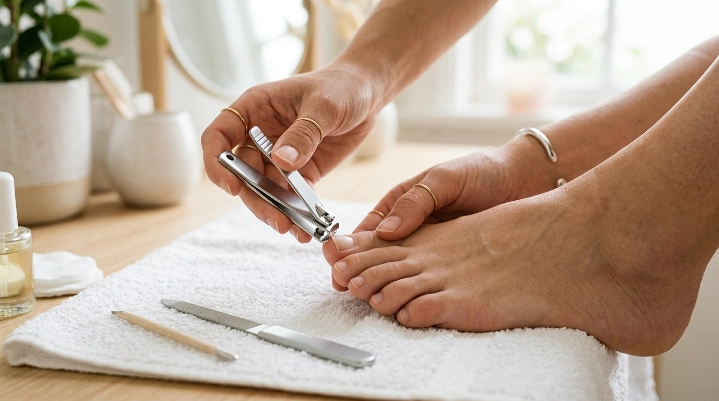
Toenails are made of compact layers of keratin. When a clipper cuts through those layers, it does not always leave a perfectly smooth edge.
A toenail may feel sharp afterward because:
- The clipper left a tiny jagged edge.
- You cut across the entire nail in one large clip.
- One corner was cut at a steeper angle than the other.
- The nail was very dry or brittle.
- Your clipper was dull.
- The nail is unusually thick.
- You cut the nail too short.
- You rounded the sides too aggressively.
Sometimes the nail looks smooth but still feels sharp against your fingertip. That is why checking the edge after trimming is an important final step.
The American Academy of Dermatology’s nail-trimming guidance recommends cutting toenails straight across and smoothing uneven or rough edges with a nail file or emery board.
The Best Way to Cut Toenails Without Leaving Sharp Edges
A good pedicure does not require complicated tools. Technique matters more.
1. Start With Clean Toenails and Tools
Wash your feet first and remove obvious dirt from around the nails.
Toenails are often easier to trim after a bath or shower because they are slightly softer. If your nails are particularly thick, Mayo Clinic recommends softening them in warm water for about 5–10 minutes before trimming, then drying the feet and nails.
Your tools should also be clean.
At minimum, have:
- A quality toenail clipper or nail nipper
- A nail file
- A clean towel
- Rubbing alcohol or another appropriate tool-cleaning method
Avoid sharing personal nail tools whenever possible.
2. Use a Toenail Clipper That Fits the Nail
Small fingernail clippers can work on thin toenails, but they often require extra pressure on thicker nails.
A wider toenail clipper usually gives you better control.
For particularly thick nails, a nail nipper may be easier to use because its blades can handle more nail thickness. However, nippers are extremely sharp, so they require careful handling.
Never force a dull clipper through a thick toenail. Crushing or twisting the nail can leave splintered, rough edges.
3. Cut Straight Across
This is the most important part.
Start at one side and make several small cuts across the nail instead of trying to remove the entire free edge with one dramatic clip.
Aim for a mostly straight line.
According to Mayo Clinic’s guidance on preventing ingrown toenails, toenails should be trimmed straight across rather than curved to match the shape of the toe. Cutting them too short or rounding their corners can encourage the nail to grow into surrounding tissue.
You do not need a ruler-straight edge. The point is to avoid digging deeply into the sides.
4. Leave a Little Length
One common beauty mistake is trying to make toenails look extra clean by trimming them extremely short.
Shorter is not always better.
Ideally, the nail should still provide some protection for the end of your toe. Mayo Clinic recommends keeping toenails at a moderate length, roughly even with the tips of the toes.
Cutting too short can also make the corners feel surprisingly sharp because there is less nail available to file safely.
5. Check the Edge With Your Fingertip
Once you finish clipping, gently run your fingertip across the free edge.
You are looking for:
- Tiny points
- Jagged sections
- Splintered layers
- Corners that catch
- Uneven clipping marks
Do not keep clipping every small imperfection. This is where your nail file should take over.
How to File Toenails After Cutting
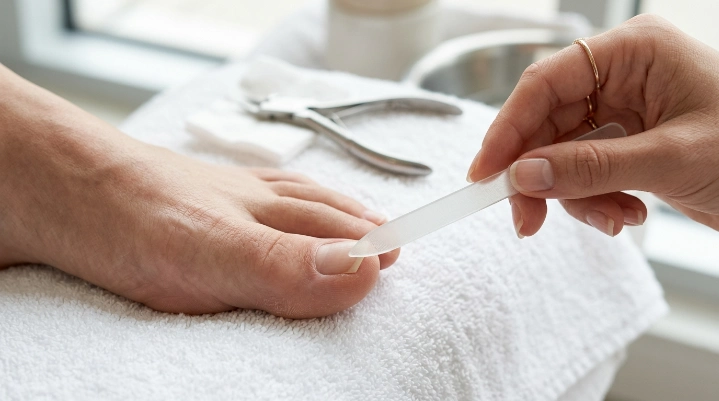
Filing is the easiest way to prevent a freshly trimmed toenail from feeling sharp.
The trick is to smooth the edge without changing the overall straight shape you just created.
Step 1: Choose the Right File
You have several options.
| Nail File Type | Best For | Main Benefit | Typical Cost |
|---|---|---|---|
| Emery board | Normal, thinner toenails | Affordable and beginner-friendly | $1–$5 |
| Glass file | Thin to normal nails | Smooth, precise finish | $5–$15 |
| Metal file | Firmer toenails | Durable and washable | $3–$10 |
| Coarser foot/nail file | Thick toenails | Removes roughness faster | $5–$20 |
Prices vary by brand and quality, but you do not need an expensive professional tool for basic maintenance.
For delicate, peeling, or naturally thin nails, start with a finer file rather than a very rough surface.
Step 2: File Gently Across the Free Edge
Hold the file against the freshly cut edge and use light pressure.
You only need to remove the roughness created by clipping.
The American Academy of Dermatology advises filing nails in the same direction rather than aggressively sawing backward and forward, because repeated back-and-forth filing can weaken the nail.
A few controlled strokes are usually enough.
Step 3: Soften Only the Sharpest Corner
If a corner feels needle-like, give that tip one or two light strokes.
Do not reshape the entire toenail into an oval.
Think “remove the point” rather than “round the corner.”
This small distinction helps create a comfortable edge while preserving a safer toenail shape.
Step 4: Stop When the Edge Feels Smooth
More filing is not automatically better.
Stop when:
- The nail no longer catches your fingertip.
- There are no obvious splinters.
- The corners are comfortable.
- The nail remains mostly straight across.
Over-filing can thin the nail edge and make it more likely to peel or split.
Expert Tip: After filing, lightly run a piece of soft cotton or tissue across the nail edge. If fibers catch on one spot, that area probably needs one or two more gentle file strokes.
Straight Toenails vs. Rounded Toenails
A rounded shape may look attractive, especially if you prefer oval fingernails. Toenails are different.
The NHS guidance on ingrown toenails advises against cutting toenails too short and recommends cutting straight across rather than cutting into the edges.
This does not mean you must live with painfully sharp corners.
You can lightly file an obvious rough point while leaving the structural corner of the nail intact.
A helpful rule is:
Clip straight. File smooth. Do not carve out the sides.
What If Your Toenails Are Thick or Very Hard?
Thick toenails can be harder to cut cleanly, which makes rough or sharp edges more likely.
Try trimming them after a shower or after briefly soaking your feet in warm water. Dry them before handling the tools so your fingers do not slip.
Then:
- Use a proper toenail clipper or nail nipper.
- Take multiple small cuts.
- Never twist the clipper through the nail.
- Leave the corners visible.
- Finish with a suitable nail file.
If you repeatedly have extremely thick, yellow, crumbly, distorted, or difficult-to-cut nails, the problem may be more than simple dryness. Nail fungus and other nail conditions can change the nail’s texture and thickness.
In that situation, cosmetic filing alone may improve the edge but will not treat the underlying cause.
Dry, Brittle Toenails Need a Gentler Approach
Dry nails often produce rougher edges because tiny layers may separate during clipping.
If your toenails split easily:
- Avoid ripping loose pieces.
- Use smaller clipper cuts.
- Choose a finer nail file.
- Avoid excessive buffing.
- Moisturize the skin and nail area regularly.
- Wear shoes that do not repeatedly press against the nail.
You can apply a simple moisturizer around the nail and surrounding skin after your pedicure.
However, do not heavily pack greasy products underneath the nail or between the toes where excess moisture may linger.
Keep Nail Tools Clean
Your clipper and file come into direct contact with nails and surrounding skin. If a sharp tool accidentally nicks the skin, poor hygiene becomes more important.
The American Academy of Dermatology recommends regularly disinfecting nail clippers and nail scissors and keeping them clean and dry.
For home care:
- Remove visible nail debris after each use.
- Clean reusable tools according to their material and manufacturer instructions.
- Let tools dry completely before storage.
- Replace disposable emery boards when worn or dirty.
- Avoid sharing nail files or clippers.
- Never use a rusty or damaged clipper.
If you visit a salon, it is reasonable to choose one that follows proper cleaning and disinfection practices.
Common Mistakes to Avoid
Even careful nail lovers can accidentally create sharp or uncomfortable edges.
Avoid these common mistakes:
- Cutting toenails extremely short. This gives you less room to safely smooth the edge and can contribute to ingrown nails.
- Digging into the corners. Removing the sides may temporarily eliminate a sharp spot but can encourage the nail to grow into the skin.
- Trying to make toenails perfectly oval. A mostly straight shape is generally safer.
- Using dull clippers. Dull blades can crush or tear instead of making a clean cut.
- Taking one giant clip. Small cuts give you more control.
- Aggressively sawing with a file. Gentle filing is enough for most freshly clipped edges.
- Filing the skin instead of the nail. Stop if the file begins rubbing the surrounding toe.
- Pulling off a sharp nail fragment. Clip or file loose nail carefully instead of tearing it.
- Ignoring pain, redness, or swelling. A painful corner may already be irritating or entering the skin.
- Sharing pedicure tools. Personal tools are easier to keep hygienic.
What If a Sharp Toenail Keeps Catching on Socks?
First, inspect the nail under good lighting.
A tiny rough section is usually easy to correct with a fine nail file. File only the area that catches, then check again with your fingertip.
If the nail is already very short, do not keep cutting it shorter just to remove the sharp feeling. Filing is generally the more controlled option.
Also look at your socks and shoes.
A toe repeatedly pressed against tight footwear can feel irritated even when the actual nail edge is only slightly rough. Tight shoes are also recognized as a risk factor for ingrown toenails.
DIY Pedicure or Professional Pedicure?
For healthy, easy-to-cut toenails, routine trimming and filing are usually manageable at home.
A salon visit can be helpful when you want:
- More precise cosmetic shaping
- Polish application
- General pedicure maintenance
- Help reaching your toenails comfortably
However, a nail technician is not a substitute for a medical professional.
If the toe is painful, infected, bleeding, badly ingrown, or showing an unexplained nail change, skip the cosmetic pedicure and get appropriate medical advice.
People with diabetes, reduced circulation, reduced feeling in the feet, or other conditions that make foot injuries riskier should be particularly cautious about cutting their own toenails. Mayo Clinic specifically recommends speaking with a healthcare professional when medical conditions make toenail trimming less safe.
When to See a Nail Technician or Dermatologist
A nail technician may be appropriate when the nail is healthy but you simply need help achieving a smoother, neater pedicure.
Consider a dermatologist, podiatrist, or other qualified healthcare professional if you notice:
- Increasing pain around the nail
- Redness or swelling
- Warm skin around the toe
- Pus or drainage
- Bleeding
- A nail corner visibly growing into the skin
- Persistent thickening or crumbling
- Yellow, green, brown, or black discoloration without a clear cosmetic cause
- A nail changing shape for no obvious reason
- Repeated ingrown toenails
Do not try to dig underneath a painful nail corner with scissors, clippers, tweezers, or another sharp object.
The NHS notes that soreness, redness, swelling, and warmth around a nail can be signs of infection or an ingrown toenail and may require professional evaluation.
A Simple Maintenance Routine for Smooth Toenails
You do not have to wait until a toenail becomes sharp enough to scratch before fixing it.
Try this routine:
- Check your toenails every week or two.
- Trim only when enough free edge has grown.
- Cut mostly straight across.
- Take several small cuts.
- Leave the nail at a moderate length.
- Feel along the edge for rough areas.
- File roughness gently in one direction.
- Clean and dry your tools.
- Watch the surrounding skin for irritation.
Toenails grow slowly, so most people do not need to clip them nearly as often as fingernails.
If one tiny section becomes rough between trims, simply filing that spot may be enough.
FAQs
Should I file my toenails after every time I cut them?
You do not have to file every toenail after every trim, but it is helpful when the cut edge feels rough or sharp. A few gentle strokes can remove tiny jagged areas left by the clipper.
Should toenails be square or rounded?
Toenails are generally safest when trimmed mostly straight across. You can lightly smooth a sharp point with a file, but avoid deeply rounding or cutting down the corners.
Why are the corners of my toenails so sharp?
Corners can become sharp when the clipping angle leaves a small point behind. They may also feel sharper if the nail is dry, thick, brittle, or cut too short. Light filing usually helps when the nail and surrounding skin are otherwise healthy.
Can I use a glass nail file on my toenails?
Yes. Glass files can work well on normal or relatively thin toenails and can provide a smooth finish. Very thick toenails may require a more durable or slightly coarser file.
Is it better to cut toenails wet or dry?
Slightly softened toenails can be easier to cut, especially if they are thick. Trimming after a bath or a short warm-water soak can help. Dry your feet and hands before using sharp tools so you have a secure grip.
What should I do if a sharp toenail has already cut the skin?
Stop trimming or filing that area. Wash the skin gently and keep it clean. Watch for increasing redness, swelling, warmth, drainage, or pain. Seek medical advice if the injury looks infected or does not improve.
Can I cut off the sharp corner of an ingrown toenail?
Avoid digging into or cutting deeply down the side of a suspected ingrown toenail. Removing the corner may make the problem worse as the nail grows back. Persistent pain, redness, swelling, or drainage is a reason to see a healthcare professional.
Conclusion
The easiest way to learn how to prevent toenails from becoming sharp after cutting is to stop relying on the clipper alone.
Use a good toenail clipper, make small cuts straight across, avoid trimming too short, and finish by gently filing any rough or pointed spots. Smooth the edge without carving away the corners.
For healthy toenails, this simple routine can make at-home pedicures much more comfortable. If you notice pain, swelling, infection, unusual discoloration, or a nail growing into the skin, put the DIY tools down and get professional advice instead.
Your next pedicure goal is simple: clip straight, check the edge, file gently, and protect the corners.

