
How Long Does It Take for a Toenail to Grow Back?

Losing a toenail can be surprisingly stressful. Whether it came off after stubbing your toe, wearing tight shoes, dealing with an ingrown nail, or having part of the nail removed, you probably want to know when your toe will look normal again.
So, how long does it take for a toenail to grow back? In most cases, a completely lost toenail needs about 12 to 18 months to fully replace itself. You may notice new nail growth much sooner, but toenails grow slowly, so patience is a big part of the process.
Below, we’ll explain what normal regrowth looks like, what can slow it down, how to protect the new nail, and when a slow-growing or unusual-looking toenail needs professional attention.
Quick Answer
A toenail usually takes about 12 to 18 months to grow back completely after it is lost because toenails grow slowly—roughly around 1 mm per month. You may see new growth much sooner, but the final result depends on whether the nail matrix was damaged, your health, and the reason the nail came off.
How Fast Does a Toenail Grow Back?
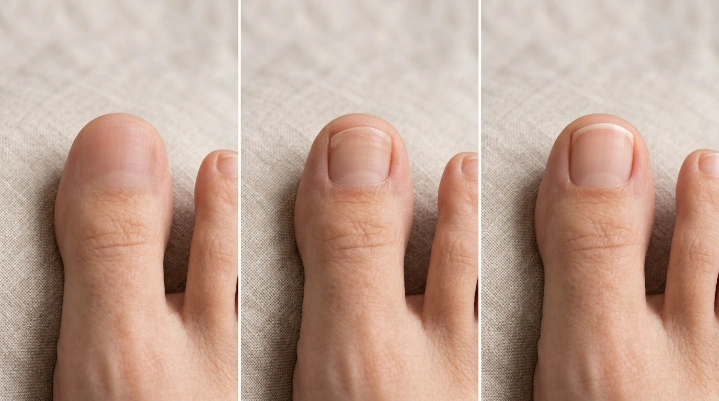
Toenails grow much more slowly than fingernails. According to an overview of toenail anatomy and growth from the NCBI, toenails grow at about 1 mm per month and generally need around 12 to 18 months for complete replacement.
That does not mean your toe will look completely bare for a year.
If the nail-producing area is healthy, you may gradually notice a thin new nail appearing near the base of your toe. That new growth slowly moves toward the tip until the old damaged section has been completely replaced.
A rough timeline may look like this:
| Stage | What You May Notice |
|---|---|
| First few weeks | Tenderness and damaged skin begin healing |
| 1–3 months | Early new nail growth may become noticeable |
| 3–6 months | A larger portion of new nail becomes visible |
| 6–12 months | Nail continues moving toward the tip |
| 12–18 months | Complete replacement may occur |
These are only estimates. Your toenail may grow somewhat faster or slower.
The big toenail also has much more nail plate to replace than a smaller toenail, so waiting for a big toenail to look completely normal can feel especially slow.
Why Toenails Take So Long to Grow Back
The visible toenail is made mainly of keratin, a tough protein. New nail is produced from an area underneath the skin at the base of the nail called the nail matrix.
Think of the matrix as the nail’s growth center.
As the matrix produces new nail cells, older cells are pushed forward. Because this process happens gradually, replacing an entire toenail takes months rather than weeks.
The NHS guidance on common nail problems also notes that toenails lost after an injury may take up to 18 months to grow back.
The Nail Bed and Nail Matrix Are Different
These terms are easy to confuse.
The nail bed is the skin directly underneath the visible nail plate. The nail matrix sits closer to the base of the nail and produces much of the nail plate itself.
A damaged nail bed may be sore while it heals, but damage to the nail matrix can have a bigger effect on future nail growth.
If the matrix is significantly injured or scarred, the new toenail may:
- Develop ridges
- Grow thicker or thinner
- Split repeatedly
- Grow unevenly
- Look permanently different
- In severe cases, fail to regrow normally
That is one reason a serious crush injury deserves more attention than a simple cosmetic break.
What Affects How Long a Toenail Takes to Grow Back?
The 12-to-18-month range is useful, but every toenail does not grow at exactly the same speed.
How Much Nail Was Lost
A small chipped section can simply grow forward and be trimmed away.
If the entire toenail has detached, the body has to produce a complete new nail from the base to the tip. Naturally, that takes considerably longer.
The Type of Injury
Repeated shoe pressure is different from dropping something heavy on the toe.
A mild injury may affect only the nail plate. A severe crush or cut can injure the nail bed or matrix underneath it, making regrowth less predictable.
Nail Fungus
A fungal infection can cause toenails to become yellow, thick, crumbly, distorted, or partially separated from the nail bed.
Even after the underlying problem is treated, the damaged-looking nail does not instantly become clear. A healthier-looking nail must grow from the base and slowly replace the affected section.
If you’re unsure whether a nail is simply damaged or infected, avoid covering the problem indefinitely with polish or enhancements.
Age and Circulation
Nail growth can become slower with age. Conditions that reduce healthy circulation to the feet may also affect healing and nail growth.
If you have diabetes, poor circulation, reduced sensation in your feet, or a weakened immune system, it is safer to get individualized medical advice instead of aggressively trimming or treating an injured toenail yourself.
Repeated Pressure From Shoes
A new toenail needs room.
Shoes that repeatedly press against the toe can irritate the area, cause new trauma, and potentially encourage the nail to lift or grow uncomfortably.
Choose shoes with enough room around the toes while the nail is recovering.
What Happens After a Toenail Falls Off?
The appearance can be alarming, but an uncomplicated nail injury often improves gradually.
The skin underneath may initially appear pink, red, sensitive, or slightly moist. It can feel uncomfortable when exposed to socks, bedding, or shoes.
The American Academy of Dermatology’s advice for an injured nail recommends gently cleaning the area, trimming only nail that is no longer attached, and protecting the injury while it heals.
Do not pull off a section that is still firmly attached. You could tear healthy tissue underneath it.
If the area is actively bleeding, severely painful, deeply cut, or badly crushed, treat it as an injury rather than a beauty-care problem.
How to Care for a Toenail While It Grows Back
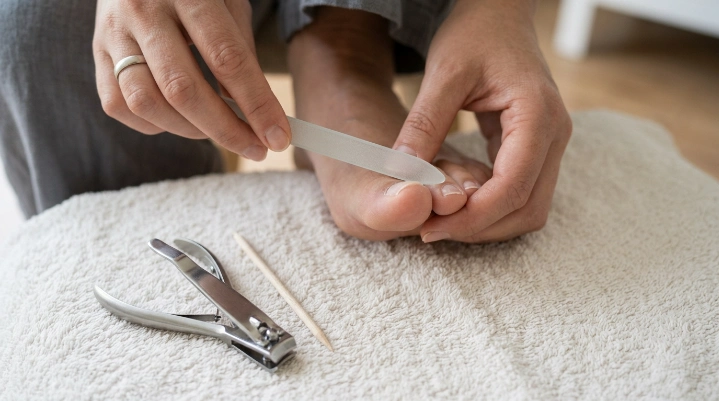
You cannot force a toenail to replace itself overnight, but you can create a cleaner, safer environment for normal growth.
1. Keep the Area Clean
Wash an uncomplicated healing area gently with soap and water.
Pat it dry rather than aggressively rubbing it.
If you were given wound-care instructions after a medical nail removal, follow those instructions instead of replacing them with a DIY routine.
2. Protect Tender Skin
A light protective dressing can reduce friction when the nail bed is still sensitive.
Avoid attaching strong adhesive directly to damaged nail tissue whenever possible.
Once the area is fully closed and no longer tender, you may not need to keep it covered continuously.
3. Wear Roomy Shoes
Choose shoes with a comfortable toe box.
Your toes should not repeatedly hit the front of the shoe when walking. This is particularly important for runners, hikers, dancers, and anyone whose toenails experience frequent pressure.
4. Do Not File Exposed Skin
A nail file is useful for smoothing actual nail growth, not for filing a healing nail bed.
Wait until you have enough firm nail plate to shape safely.
When the new edge becomes long enough, use a clean, fine nail file with light pressure rather than trying to dramatically reshape it.
5. Trim New Growth Carefully
The AAD’s guidance on properly trimming nails recommends cutting toenails straight across and smoothing rough edges with a nail file. It also advises filing in one direction rather than aggressively sawing back and forth.
This becomes especially useful once your new toenail is long enough to catch on socks.
6. Keep Your Tools Clean
Do not share toenail clippers, files, or other foot-care tools with another person.
Wash reusable tools according to their care instructions, dry them thoroughly, and replace disposable files when they become worn or contaminated.
If you visit a salon, choose one that follows proper tool cleaning and disinfection practices.
What Nail File Should You Use on a Growing Toenail?
A newly regrown toenail may initially feel thin or uneven, so aggressive filing is unnecessary.
For light smoothing, consider:
- A fine-grit emery board
- A smooth glass nail file
- A clean file designed for natural nails
Avoid digging underneath the nail or aggressively filing the sides.
If the nail is very thick, unusually curved, painful, or difficult to cut, stronger tools are not automatically the answer. Those changes can sometimes signal a nail condition that deserves professional assessment.
Never use a nail file to remove infected-looking tissue or file deeply into painful skin.
Can You Use Nail Polish While a Toenail Grows Back?
Once the nail and surrounding skin are fully healed, ordinary polish may be reasonable for many people.
But polish should not be used to hide an active problem.
Wait if the toe is:
- Bleeding
- Raw or open
- Swollen
- Draining fluid
- Painful
- Red and increasingly irritated
- Showing possible infection
Gel, dip, acrylic, glue-on enhancements, or aggressive removal can add extra stress to an already fragile nail.
If the new nail looks abnormal, it is often better to leave it visible until you understand why.
DIY Care vs. Salon or Medical Care
The smartest option depends on what is actually happening to your toe.
| Option | Best For | Cost Consideration | Main Limitation |
|---|---|---|---|
| DIY care | Mild injury that is healing normally | Usually low; basic dressing and grooming supplies | Cannot diagnose infection or matrix damage |
| Nail salon | Cosmetic shaping after the nail and skin have healed | Moderate; varies by salon and location | Nail technicians do not replace medical diagnosis |
| Dermatologist or podiatrist | Pain, infection, abnormal growth, repeated nail loss, severe ingrown nails | Higher and varies by insurance/location | Requires a medical appointment |
A salon professional can help with neat shaping and cosmetic maintenance once the toe is healthy.
A nail technician should not be expected to diagnose a fungal infection, treat an open wound, or determine whether a damaged nail matrix needs medical care.
Expert Tip: Take one clear photo of the toenail every four weeks in similar lighting. Monthly photos make slow growth easier to notice and can help you see whether healthy nail is steadily moving forward.
What If the Toenail Was Removed for an Ingrown Nail?
The answer depends on exactly what was done.
Sometimes only part of an ingrown toenail is removed. In other cases, a healthcare professional may treat part of the nail’s growth center specifically to prevent that problematic section from returning.
That means not every medically removed toenail is expected to completely regrow.
After an ingrown toenail procedure, follow your clinician’s instructions and ask whether the removed section is supposed to return. Mayo Clinic’s ingrown toenail treatment guidance also emphasizes watching the toe’s healing after nail-removal procedures and contacting a healthcare professional if it is not healing properly.
Common Mistakes to Avoid
Toenail regrowth requires patience. Trying to speed things up can sometimes create a new problem.
Avoid these common mistakes:
- Pulling off a partially attached nail. Let firmly attached nail remain unless a healthcare professional tells you otherwise.
- Cutting the nail extremely short. Repeated deep trimming can irritate the surrounding skin.
- Digging into nail corners. This may increase irritation and ingrown-nail problems.
- Filing exposed nail-bed skin. A nail file belongs on nail plate, not healing tissue.
- Using dirty clippers or files. Keep personal tools clean and avoid sharing them.
- Covering suspicious discoloration with polish for months. Persistent yellowing, thickening, lifting, or crumbling deserves attention.
- Wearing tight shoes during recovery. Constant pressure can repeatedly traumatize the toe.
- Assuming supplements will dramatically speed regrowth. Toenails naturally grow slowly, and no beauty product can replace a healthy nail matrix overnight.
- Going straight back to gel, dip, or enhancements after an injury. Give irritated tissue time to fully recover first.
When to See a Nail Technician or Dermatologist
A nail technician is a good choice when the toe is healthy and your main goal is cosmetic grooming.
For example, a licensed nail technician may help you gently shape an uneven but healthy new nail once there is enough nail plate to work with.
Choose a dermatologist, podiatrist, or other healthcare professional instead if you notice:
- Increasing redness or swelling
- Pus, drainage, or an unpleasant smell
- Significant warmth around the toe
- Severe or worsening pain
- Persistent bleeding
- A black or purple nail after a significant injury
- A nail that keeps lifting
- Thick, crumbly, or strongly discolored growth
- An ingrown edge causing persistent pain
- No visible progress in nail growth for a prolonged period
- A new nail that repeatedly splits or grows severely distorted
Also seek professional guidance sooner if you have diabetes, poor circulation, reduced foot sensation, or another condition that makes foot injuries harder to heal safely.
Do not ask a salon to work over an open wound or suspected infection. Medical problems should be addressed before cosmetic treatment.
FAQs
Can a toenail grow back after completely falling off?
Yes. If the nail matrix remains healthy, a completely lost toenail can usually grow back. Complete replacement commonly requires around 12 to 18 months.
How soon will I see a new toenail after losing one?
Some people begin noticing early growth within several weeks or a few months. Because toenails grow slowly, the change may be subtle at first.
Will my toenail look the same when it grows back?
Often it will, especially after a mild injury. However, damage to the nail matrix can cause ridges, splitting, thickness changes, or an irregular shape.
Can I make my toenail grow back faster?
There is no reliable at-home trick that makes a toenail replace itself quickly. Protecting the toe from repeated injury, eating a balanced diet, managing underlying health conditions, and treating infections appropriately support normal growth.
Should I file a toenail while it is growing back?
You can gently smooth a firm new nail edge once enough nail has grown. Do not file exposed skin, a tender nail bed, or an open injury.
Can I get a pedicure while my toenail is growing back?
Wait until the nail area is fully closed, comfortable, and free from signs of infection. Tell the nail technician about the previous injury and request gentle treatment. If the area is painful, swollen, draining, or suspicious, see a healthcare professional instead.
Why is my new toenail growing back thick?
Temporary unevenness can occur after trauma, but persistent thickening can also be associated with repeated injury or nail conditions such as fungal infection. A dermatologist or podiatrist can help identify the cause if the change continues.
Conclusion
So, how long does it take for a toenail to grow back? For a completely lost toenail, a realistic expectation is roughly 12 to 18 months.
The most important thing is not trying to rush the process. Keep the toe clean, protect it from friction, wear roomy shoes, use clean nail-care tools, and gently trim or file only healthy new nail.
If the nail is steadily growing and the toe feels comfortable, patience may be all you need. But increasing pain, swelling, drainage, severe discoloration, repeated lifting, or abnormal regrowth is a reason to stop DIY care and get professional advice.
Give your toenail the time and protection it needs, and make healthy regrowth the priority before polish or perfect-looking pedicures.

