
Why Do Toenails Grow Slowly? Causes, Normal Growth, and When to Worry

If you keep checking your pedicure and wondering why your toenails seem to stay the same length for weeks, you are not imagining it. Toenails naturally grow much more slowly than fingernails, so even healthy growth can be difficult to notice from day to day.
So, why do toenails grow slowly? In most cases, slow growth is completely normal. Age, previous toe injuries, nail thickness, circulation, health conditions, infections, and certain medications can also affect the speed.
Understanding what is normal can help you avoid over-filing, over-trimming, or trying questionable “nail growth” treatments. It also makes it easier to recognize when a slow-growing toenail deserves professional attention.
Quick Answer
Toenails grow slowly because their natural growth cycle is much slower than that of fingernails. Healthy toenails typically grow around 1.5 millimeters per month, although growth varies from person to person. Age, injuries, circulation problems, infections, illnesses, and damage to the nail-producing area can make toenails grow even more slowly.
How Fast Do Toenails Normally Grow?

Toenail growth is surprisingly slow.
A study indexed by PubMed on fingernail and toenail growth rates measured average toenail growth at about 1.62 millimeters per month, compared with about 3.47 millimeters per month for fingernails. Cleveland Clinic similarly notes that toenails typically grow about 1.5 millimeters per month.
That means you may see only a tiny amount of new nail at the base after several weeks.
If an entire toenail has to grow back, the process can take approximately 12 to 18 months. The big toenail may take especially long simply because there is much more nail plate to replace.
So if your toenails seem slow but are otherwise smooth, comfortable, attached, and a normal color for you, their growth rate may be perfectly healthy.
Why Do Toenails Grow More Slowly Than Fingernails?
Your visible toenail is called the nail plate. It is made mainly from keratin, the same type of protein found in hair.
New nail cells are produced underneath the skin in an area called the nail matrix. You can think of the matrix as the nail’s growth center or factory. As new cells form, older cells are pushed forward and become the hard nail plate you see.
Cleveland Clinic’s guide to nail anatomy and growth explains that toenails naturally grow at about half the speed of fingernails. This difference is part of normal nail physiology rather than automatically being a sign that something is wrong.
The important question is usually not, “Are my toenails growing fast?” but rather, “Has their growth suddenly changed?”
A consistently slow-growing toenail can be normal. A nail that suddenly stops growing or changes dramatically deserves more attention.
Common Reasons Toenail Growth Can Become Slower
Several everyday and medical factors can affect the nail matrix or the condition of the nail.
| Possible factor | What you may notice | Best next step |
|---|---|---|
| Normal growth pattern | Healthy-looking nail that simply grows slowly | Continue routine nail care |
| Aging | Slower, thicker or more brittle nails | Gentle trimming and filing |
| Repeated shoe pressure | Thickening, tenderness or ridges | Improve shoe fit and reduce pressure |
| Previous injury | Ridge, discoloration or uneven growth | Protect the toe while it grows out |
| Fungal infection | Yellowing, thickening, crumbling or lifting | Seek professional diagnosis |
| Reduced circulation | Slow growth plus other foot symptoms | Discuss with a healthcare professional |
| Illness or medication | Multiple nails develop changes | Ask your medical provider |
| Nail-matrix damage | Growth becomes irregular or stops | Dermatologist evaluation |
1. Aging
Toenails often grow more slowly as we get older.
They may also become thicker and more difficult to trim. Mayo Clinic notes that thickened toenails commonly occur with aging as the nail plate’s growth rate slows.
For beauty routines, this means an older or naturally thick toenail may need less frequent clipping but more careful maintenance with the right file.
2. Pressure From Tight Shoes
Toenails spend hours inside shoes, where repeated pressure can irritate the nail and surrounding tissue.
Shoes that are too short or narrow may repeatedly press against the big toenail, especially during walking, running, or workouts. Over time, this can contribute to nail trauma, thickening, discoloration, or irregular growth.
Your shoes should give your toes enough space to lie comfortably without constantly hitting the front.
3. Previous Toe Injuries
Dropped something on your toe? Stubbed it badly? Wore heels that repeatedly pushed your toes forward?
An injury can affect the nail matrix even after the pain disappears.
According to Cleveland Clinic’s nail matrix health guide, matrix injuries can temporarily cause ridges, dents, bruising, discoloration, or changes in nail growth. Severe injuries may even cause a toenail to fall off.
Because toenails grow so slowly, evidence of an old injury can remain visible for many months.
4. Fungal Nail Infection
A fungal infection can make a toenail thick, yellowish, cloudy, crumbly, or partially separated from the nail bed.
People sometimes mistake this appearance for a nail that simply “isn’t growing.”
The American Academy of Dermatology explains that toenail fungus may cause thickening and other changes and that diagnosis can require examination or testing because other nail conditions can look similar.
Do not aggressively file away a suspicious thick or discolored nail in an attempt to make it grow faster. Filing can make the nail thinner, but it does not treat the underlying infection.
5. Reduced Blood Flow
Healthy tissue depends on adequate circulation, including the nail matrix.
Certain circulation problems affecting the legs and feet can interfere with nail growth. Cleveland Clinic notes that peripheral artery disease can reduce blood flow to the feet and may slow growth from the nail matrix.
Slow nail growth alone does not prove you have a circulation problem. However, slow growth combined with persistent coldness, unusual color changes, sores that heal poorly, or other foot symptoms should be discussed with a healthcare professional.
6. Illnesses and Certain Medications
A significant illness can temporarily interrupt nail production.
When nail growth slows or stops for a period, horizontal grooves called Beau’s lines can eventually appear. The American Academy of Dermatology notes that fever, major illness, injury, chemotherapy, and substantial physical stress can temporarily slow or stop nail growth.
Some medications can affect the nail matrix as well.
If several nails suddenly develop similar changes, mention them to your healthcare provider rather than trying to treat each nail cosmetically.
7. Nutritional Problems
Healthy nails require normal nutrition, but that does not mean everyone with slow toenails needs supplements.
True deficiencies can affect nail quality and growth. However, taking biotin, zinc, collagen, or other supplements without knowing whether you actually need them is not a reliable shortcut to faster toenails.
If you also have unexplained fatigue, hair changes, skin changes, appetite problems, or other symptoms, your healthcare provider can determine whether testing makes sense.
Can You Make Toenails Grow Faster?
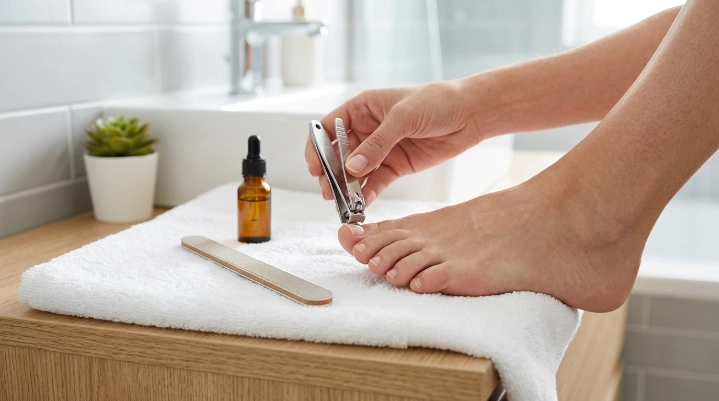
There is no safe beauty trick that will suddenly turn a naturally slow-growing toenail into a fast-growing one.
What you can do is protect the environment in which healthy nail growth occurs.
Keep Your Toenail Routine Simple
- Keep your feet clean and dry. Excess moisture can encourage fungal growth.
- Wear properly fitting shoes. Give your toes enough room.
- Trim toenails straight across. Avoid digging deeply into the corners.
- Smooth sharp edges gently. Use a clean nail file rather than repeatedly clipping tiny corners.
- Protect injured toenails. Avoid picking, peeling, or aggressively thinning them.
- Moisturize dry skin around the nails. Apply moisturizer to the surrounding skin without leaving your feet constantly damp.
- Give growth time. Toenail changes are measured in months, not days.
The American Academy of Dermatology’s nail-trimming guidance recommends trimming toenails straight across, smoothing rough edges with a file, keeping tools clean, and avoiding damage to the cuticle.
Expert Tip: Take a clear photo of the toenail once every four weeks under similar lighting. Comparing monthly photos is much more useful than checking it every day and can help you see whether the nail is actually moving forward.
Does Filing Your Toenails Help Them Grow?
Filing does not make new nail cells form faster.
A nail file is useful because it can smooth rough edges, control excess length, and make thick nails easier to manage. But nail growth starts in the matrix underneath the skin, not at the free edge you file.
For healthy toenails, an emery board, glass file, or other clean nail file can work well. You generally do not need an expensive professional tool for routine maintenance.
Basic nail files often cost only a few dollars, while higher-quality glass or reusable files may cost more but can last longer when properly cleaned.
When filing:
- Use light pressure.
- Concentrate on rough or sharp edges.
- Avoid grinding deeply into the sides of the nail.
- Stop if the nail or surrounding skin becomes sore.
- Do not share personal nail files.
- Clean reusable tools according to their care instructions.
If a nail is extremely thick, painful, infected-looking, or difficult to reach safely, professional care is a better choice than aggressive DIY filing.
Nail Polish, Gel, and Pedicures: Do They Slow Growth?
Regular nail polish sitting on top of a healthy nail does not physically block new nail production at the matrix.
However, the way a pedicure is performed can affect nail health.
Repeated aggressive filing, drilling, scraping underneath the nail, cutting the cuticle, or peeling off gel can damage the nail plate or surrounding protective tissue. A painful manicure or pedicure is not something you should simply accept as normal.
If your toenails or skin are sensitive:
- Avoid aggressive e-file use.
- Don’t let a technician deeply cut the corners.
- Avoid cutting healthy cuticles.
- Stop using products that cause burning, itching, redness, or swelling.
- Never cover an obviously infected or injured nail simply to hide it.
A beautiful pedicure should not require damaging the structures responsible for healthy nail growth.
Common Mistakes to Avoid
When toenails seem slow, it is easy to become impatient. Avoid these common mistakes:
- Cutting them extremely short. Shorter nails do not grow faster.
- Digging into the corners. This can irritate skin and increase ingrown-toenail problems.
- Filing aggressively every few days. You may remove new length faster than you can see it grow.
- Picking at a damaged nail. This can cause additional trauma.
- Cutting or digging at the cuticle. The cuticle helps protect the nail-growth area from germs.
- Sharing clippers or files. Nail tools can carry microorganisms.
- Ignoring yellow, thick, painful nails. These may need medical evaluation.
- Buying supplements immediately. Slow toenail growth by itself does not prove a vitamin deficiency.
- Expecting overnight improvement. Even after the original problem is corrected, damaged nail must slowly grow forward.
When to See a Nail Technician or Dermatologist
A nail technician can be helpful when your toenails are otherwise healthy and you simply need cosmetic shaping, gentle filing, polish removal, or routine pedicure maintenance.
However, nail technicians are not medical providers and should not be expected to diagnose infections, circulation problems, or nail disease.
See a dermatologist, podiatrist, or other appropriate healthcare professional if you notice:
- A toenail that appears to have stopped growing.
- Persistent pain, redness, warmth, or swelling.
- Pus or drainage around the nail.
- Significant thickening or crumbling.
- A nail lifting away from the skin.
- A new or changing dark streak.
- Unexplained changes in several nails.
- A nail that repeatedly grows abnormally after an injury.
- A suspicious color or texture change that doesn’t grow out.
- Difficulty safely cutting very thick toenails.
The AAD’s guide to nail changes that should be examined by a dermatologist specifically advises professional evaluation for changes such as nail lifting, swelling, significant discoloration, deep grooves, and concerning dark streaks.
Do not try to file, scrape, polish over, or self-diagnose a nail that looks infected or significantly abnormal. Cosmetic improvement and medical treatment are not the same thing.
FAQs
Is it normal for toenails to grow very slowly?
Yes. Toenails naturally grow much slower than fingernails. Around 1.5 millimeters of growth per month is typical, although individual growth rates vary.
Why does my big toenail look like it isn’t growing?
It may be growing so gradually that the change is hard to notice. Previous injury, thickening, fungus, repeated shoe pressure, or matrix damage can also make growth less obvious. Take monthly photos to track it.
How long does it take for a toenail to completely grow back?
A full toenail commonly takes around 12 to 18 months to regrow. Growth after a severe injury or infection may be irregular while the nail matrix recovers.
Does cutting toenails make them grow faster?
No. Cutting changes the length of the visible nail plate but does not speed cell production in the nail matrix.
Does filing toenails make them grow faster?
No. Filing is useful for smoothing and shaping the nail, but it does not stimulate faster growth. Excessive filing can actually thin or damage the nail.
Can toenail fungus stop nail growth?
A fungal infection can cause thickening, crumbling, discoloration, lifting, and abnormal-looking growth. Because several nail conditions can resemble fungus, professional diagnosis is preferable to guessing from appearance alone.
Should I take biotin for slow-growing toenails?
Not automatically. Slow toenail growth is usually normal and does not by itself prove a nutritional deficiency. Ask a healthcare professional before using supplements specifically to treat unexplained nail changes.
Conclusion
So, why do toenails grow slowly? Most of the time, it is simply how toenails are designed to grow. Healthy toenails usually advance only around 1.5 millimeters per month, which means noticeable changes require patience.
Support healthy growth with properly fitting shoes, clean tools, straight-across trimming, gentle filing, good foot hygiene, and protection from repeated trauma.
More importantly, pay attention to changes from your normal. A toenail that suddenly stops growing, becomes painful, thick, swollen, discolored, detached, or unusually shaped deserves more than a cosmetic fix.
Keep your routine gentle, track changes over time, and choose professional care whenever a nail problem looks like more than ordinary grooming.

