
Do Toenails Grow Faster Than Fingernails? What Nail Growth Speed Really Looks Like

If you have ever compared a fresh manicure with a pedicure a few weeks later, you may have noticed something strange: your fingernails already need reshaping while your toenails barely seem longer.
So, do toenails grow faster than fingernails? No. In most people, fingernails grow significantly faster than toenails. Fingernails typically grow about 3 millimeters per month, while toenails grow around 1.5 millimeters per month.
That difference affects everything from how often you need to trim your nails to how long you may wait for a damaged nail to completely grow out.
Below, we will explain normal fingernail and toenail growth rates, why your hands usually win the growth race, what can affect nail growth, and when unusually slow or abnormal growth deserves professional attention.
Quick Answer
No, toenails do not usually grow faster than fingernails. Fingernails generally grow about 3 millimeters per month, while toenails grow around 1.5 millimeters per month. That means fingernails can grow approximately twice as fast. Individual growth rates still vary depending on age, health, injury, circulation, and other factors.
How Fast Do Fingernails and Toenails Grow?
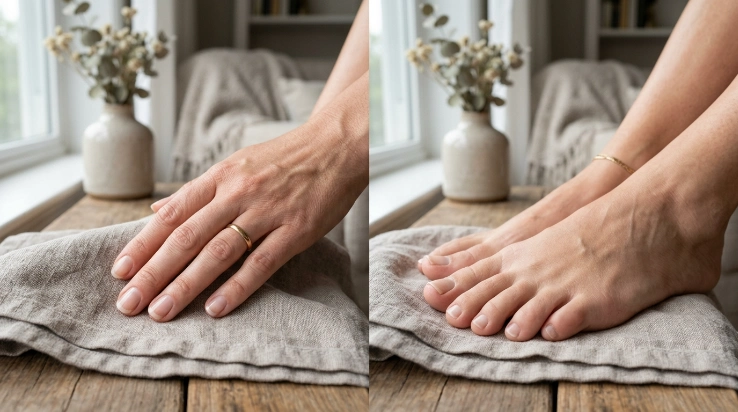
Your nails grow from living tissue hidden beneath the skin at the base of each nail. This area is called the nail matrix.
The matrix continually produces new nail cells. As these cells become packed with keratin, they harden and push the older nail plate forward toward the tip of your finger or toe.
According to Cleveland Clinic’s guide to fingernail and toenail anatomy, fingernails typically grow around 3 millimeters per month, while toenails grow around 1.5 millimeters per month.
Here is the difference at a glance:
| Nail Type | Typical Monthly Growth | Approximate Full Regrowth |
|---|---|---|
| Fingernails | About 3 mm per month | At least 6 months |
| Toenails | About 1.5 mm per month | About 12–18 months |
| Growth difference | Fingernails grow roughly twice as fast | Toenails require much more patience |
These numbers are averages rather than strict deadlines. One person’s nails may naturally grow somewhat faster or slower.
Why Do Fingernails Grow Faster Than Toenails?
Researchers and medical professionals recognize that nail growth is affected by several biological and environmental factors. There is not one simple reason your fingernails grow faster.
Instead, several differences between your hands and feet probably contribute.
Your Fingers Get More Daily Activity
Think about how frequently you use your hands.
You type, cook, clean, text, open containers, wash your hands, apply beauty products, and handle objects throughout the day.
Your toes generally experience less fine movement and direct activity.
Greater activity and blood flow in the fingers may help explain some of the difference in growth rate, although nail growth is influenced by many factors rather than movement alone.
Fingernails Have a Naturally Faster Growth Cycle
Even healthy toenails are simply programmed to grow more slowly.
That is why you may need to file or trim your fingernails every week or two while your toenails can stay at a comfortable length considerably longer.
Slow toenail growth by itself is not usually a sign that something is wrong.
Toenails Deal With Different Physical Stress
Toenails spend much of the day inside socks and shoes.
They can experience:
- Pressure from footwear
- Repeated rubbing
- Running or exercise-related trauma
- Accidental toe impacts
- Moisture from sweating
- Compression from tight shoes
These stresses can affect the nail plate and surrounding tissue.
A badly injured toenail may look abnormal for many months simply because the damaged portion has to slowly grow forward before it can be trimmed away.
How Long Does It Take a Nail to Completely Grow Back?
The difference becomes especially noticeable if you lose an entire nail.
A fingernail can generally replace itself in around six months or somewhat longer. A toenail commonly requires 12 to 18 months for complete replacement.
The NHS guidance on common nail problems similarly notes that a fingernail lost after an injury should grow back within about six months, while a toenail can take up to 18 months.
That long timeline matters when you are dealing with:
- A bruised toenail
- A nail lost after trauma
- Damage from tight shoes
- Nail separation
- A previous infection
- Over-filing
- An aggressive pedicure
You might see healthy new growth developing near the base while the damaged portion remains visible farther up the nail.
Do not assume a nail treatment has failed simply because the damaged section is still visible after a few weeks. Toenails especially require patience.
What Can Affect How Fast Your Nails Grow?
Normal nail growth varies from one person to another.
Several factors can influence what you notice.
Age
Nail growth and nail texture can change as you get older.
Toenails may become thicker with age, and their growth can slow. Mayo Clinic notes that aging is a common reason toenails become thicker because nail-plate growth slows over time.
Nail Injury
A hard impact, repeated shoe pressure, aggressive filing, or another injury can temporarily affect the way a nail grows.
If the nail matrix itself is significantly injured, growth may become uneven or distorted.
Overall Health
Certain illnesses, skin conditions, infections, medications, or circulation problems can affect the appearance or growth of nails.
That does not mean every slow-growing nail indicates a medical problem. Naturally slow toenail growth is common.
The more important warning sign is a significant or unexplained change from your normal pattern.
Nail Biting and Picking
Frequently biting, picking, tearing, or manipulating your nails can damage the surrounding skin and nail structure.
It also makes it difficult to judge normal growth because the free edge is repeatedly being removed.
Repeated Nail Product Damage
Gel, acrylic, dip powder, press-ons, and polish do not automatically stop nail growth.
Problems usually come from aggressive preparation or removal.
Excessive filing, scraping, peeling enhancements off, or repeatedly thinning the natural nail plate can leave your nails weak even while normal growth continues underneath.
Pregnancy and Hormonal Changes
Some people notice changes in nail strength, texture, or growth during pregnancy.
These changes can vary widely. Nail appearance usually cannot tell you exactly what is happening hormonally, so avoid using nail growth alone as a health indicator.
Does Faster Nail Growth Mean Healthier Nails?
Not necessarily.
Fast growth and strong nails are two different things.
A fingernail can grow quickly while still being:
- Thin
- Brittle
- Peeling
- Dry
- Damaged from manicures
- Frequently broken
Meanwhile, a slowly growing toenail may be completely healthy.
Instead of obsessing over speed, look at the overall condition of your nails.
Healthy nails are generally attached securely, comfortable, and free from persistent unexplained changes.
Mayo Clinic’s healthy fingernail care recommendations advise paying attention to significant changes in nail color, shape, thickness, attachment, and growth rather than judging health by appearance alone.
How to Support Healthy Nail Growth
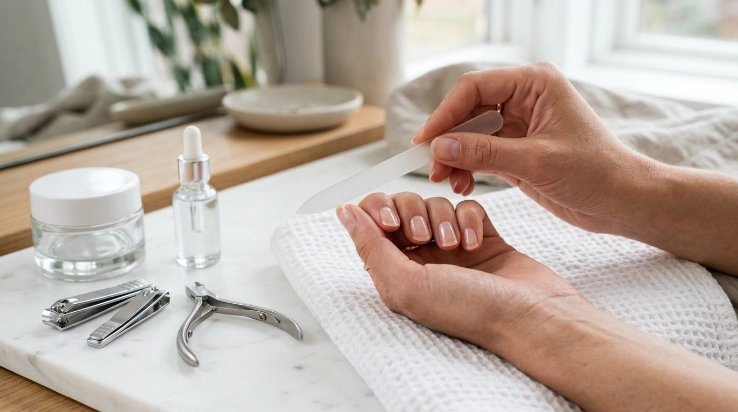
You cannot realistically force toenails to start growing at fingernail speed.
What you can do is protect the new nail as it grows.
1. Keep Nails Clean and Dry
Regular hygiene helps reduce the buildup of germs around and beneath the nails.
Dry your feet carefully after bathing, especially around the toes.
2. Trim Fingernails Carefully
Use clean, sharp manicure scissors or clippers.
Fingernails can be trimmed mostly straight across and then gently shaped at the corners.
3. Cut Toenails Mostly Straight Across
Toenails require slightly different shaping.
The American Academy of Dermatology’s nail-trimming guidance recommends cutting toenails straight across to reduce the risk of ingrown nails.
Avoid digging deep into the corners just to create a perfectly rounded shape.
4. Smooth Rough Edges With a Nail File
A nail file is useful for removing tiny snags after trimming.
For natural nails, choose a relatively gentle file and use light pressure.
The AAD recommends filing in the same direction rather than aggressively sawing backward and forward because repeated back-and-forth filing can weaken nails.
5. Moisturize Dry Nails and Surrounding Skin
Apply hand cream or moisturizer to your fingers, nails, and surrounding skin.
Dry nails can become more likely to split, making it seem as though they are not growing because the ends keep breaking.
6. Wear Shoes With Enough Toe Space
Shoes that squeeze the toes can repeatedly traumatize toenails.
Make sure your toes have enough room, particularly if you run, walk long distances, or spend many hours standing.
7. Stop Picking at the Cuticle
The cuticle helps protect the area where your new nail develops.
Aggressive cutting or picking can damage the surrounding skin and create an opportunity for infection.
Expert Tip: If you are tracking nail growth after damage, take a clear photo once every four weeks instead of checking every day. Toenails grow so slowly that comparing monthly photos makes progress much easier to see.
Fingernail vs. Toenail Care: Tools, Cost, and Hygiene
You do not need expensive equipment to maintain healthy natural nails.
| Tool | Best Use | Typical Cost | Hygiene Consideration |
|---|---|---|---|
| Fingernail clipper | Routine fingernail trimming | $3–$15 | Clean and dry after use |
| Toenail clipper | Thicker toenails | $5–$20 | Avoid sharing |
| Emery board | Gentle edge smoothing | $1–$5 | Replace when dirty or worn |
| Glass nail file | Precise reusable filing | $5–$20 | Washable; store carefully |
| Nail nipper | Very thick nails | $10–$30+ | Very sharp; requires control |
| Buffer | Light surface smoothing | $2–$10 | Overuse can thin nails |
Prices vary widely depending on material, brand, and quality.
For ordinary healthy nails, a clean clipper and gentle file are usually enough. Buying a powerful electric file or professional nipper does not automatically improve your results.
If your nails are thin, peeling, sensitive, or sore, use gentler tools and less pressure.
Nail File Safety Matters
Because this topic relates closely to nail files, it is worth emphasizing one common mistake: filing more does not make a nail healthier.
The visible nail plate is made of layers of keratin.
Aggressive filing can remove too much material and make the nail thinner.
For everyday natural-nail shaping:
- Start with a clean file.
- Use a fine or moderately fine abrasive.
- Concentrate on the free edge.
- Use light, controlled strokes.
- Stop once the snag or uneven edge is smooth.
Do not aggressively grind the surface of a healthy natural nail simply because you want it to grow faster.
Filing cannot speed up growth from the nail matrix.
DIY Nail Care vs. Salon Care
Most routine nail growth and maintenance questions can be handled at home.
DIY care is usually reasonable when:
- Your nails are comfortable.
- The surrounding skin is healthy.
- You only need routine trimming or filing.
- There is no unexplained discoloration.
- There is no bleeding, swelling, or drainage.
A salon visit can be helpful when you want professional shaping, polish, nail art, or routine cosmetic care.
Choose a salon where tools and work areas appear properly cleaned and technicians follow appropriate hygiene practices.
A salon service should never require you to tolerate sharp pain, bleeding, burning, or aggressive filing.
And remember: a nail technician handles cosmetic nail care, not medical diagnosis or treatment.
When to See a Nail Technician or Dermatologist
Slow toenail growth by itself is usually normal.
However, contact a dermatologist or another appropriate healthcare professional if your nail develops an unexplained or persistent change.
Mayo Clinic recommends professional evaluation for signs such as changes in nail color or shape, thinning or thickening, separation from the surrounding tissue, bleeding, swelling, pain, or failure to grow.
Pay particular attention to:
- Increasing redness
- Swelling or warmth
- Pus or drainage
- Significant pain
- Nail separation
- Major thickening
- Crumbling
- Persistent yellow, brown, green, or dark discoloration
- Bleeding
- A nail that suddenly stops growing
- A new dark streak
- Repeated ingrown toenails
A licensed nail technician may help with ordinary grooming after the nail and surrounding skin are healthy.
Pain, infection, significant injury, or unexplained nail changes should be evaluated medically rather than covered with polish or filed away.
People with diabetes, reduced circulation, reduced sensation in the feet, or wound-healing problems should be particularly cautious with aggressive DIY toenail trimming.
Common Mistakes to Avoid
Nail growth is naturally slow, especially on your feet. Trying to hurry the process can sometimes create more damage.
Avoid these common mistakes:
- Expecting toenails to grow as quickly as fingernails.
- Cutting toenails extremely short because they seem slow-growing.
- Digging deeply into toenail corners.
- Aggressively buffing the nail surface.
- Using a very coarse file on thin natural nails.
- Peeling off gel, acrylic, dip, or press-on products.
- Filing repeatedly because you think it stimulates growth.
- Sharing nail files, clippers, or other personal grooming tools.
- Ignoring pain, redness, swelling, or drainage.
- Assuming every slow-growing toenail needs a supplement.
- Continuing a salon service when the nail or surrounding skin hurts.
The goal is not maximum growth speed. The goal is healthy nail growth with as little unnecessary damage as possible.
FAQs
Do toenails grow faster than fingernails?
No. Fingernails usually grow faster. Fingernails average around 3 millimeters per month, compared with approximately 1.5 millimeters per month for toenails.
Why do my fingernails grow so much faster than my toenails?
The difference is normal. Fingernails naturally have a faster growth cycle, and differences in circulation, activity, location, and physical stress may contribute to the speed difference.
How long does it take a toenail to grow back completely?
A completely lost toenail generally takes around 12 to 18 months to grow back. Fingernails commonly replace themselves much faster.
Does cutting your nails make them grow faster?
No. Trimming removes the dead free edge of the nail. Growth begins in the nail matrix underneath the skin, so cutting the tip does not directly make the matrix produce nail faster.
Can filing nails make them grow faster?
No. Filing changes the shape or smoothness of the visible nail but does not speed growth from the matrix. Excessive filing can actually thin or weaken the nail plate.
Why does one nail grow faster than another?
Small differences can be normal. Previous injuries, repeated pressure, nail health, and differences between individual fingers or toes may affect what you notice. A sudden major change in one nail deserves closer attention.
Should I worry if my toenails barely seem to grow?
Not necessarily. Toenails naturally grow very slowly, so changes may be hard to notice from week to week. However, if a nail suddenly stops growing or develops pain, swelling, discoloration, significant thickening, separation, or another unexplained change, contact a healthcare professional.
Conclusion
So, do toenails grow faster than fingernails? No. Fingernails normally win by a considerable margin.
Fingernails grow roughly 3 millimeters per month, while toenails average around 1.5 millimeters per month. That slower growth is also why a completely lost toenail may take 12 to 18 months to replace itself.
Instead of trying to force faster growth, focus on protecting the nail you are producing. Use clean tools, trim carefully, file gently, moisturize dry nails, wear comfortable shoes, and avoid repeatedly damaging the nail plate.
Most importantly, pay attention to changes rather than speed alone.
Give healthy nails time to grow—and if you notice unexplained pain, swelling, discoloration, separation, or a nail that stops growing normally, choose professional advice over another DIY treatment.

