
How Can You Protect a Toenail While It Grows Back?

Losing part or all of a toenail can be uncomfortable, inconvenient, and a little alarming—especially when you realize a new toenail does not appear overnight. Whether your nail came off after stubbing your toe, wearing tight shoes, repeated pressure, or another minor injury, protecting the sensitive area underneath becomes your main priority.
So, how can you protect a toenail while it grows back? In most mild cases, the goal is to keep the area clean, lightly covered when necessary, protected from friction, and free from additional trauma while the new nail slowly grows forward.
You also need to know when normal healing turns into something that deserves professional attention. This guide explains practical protection methods, footwear choices, safe filing, hygiene, common mistakes, warning signs, and when to stop DIY care.
Quick Answer
To protect a toenail while it grows back, gently clean the area, keep loose nail edges trimmed or filed smooth, use a light non-stick dressing when friction is likely, and wear roomy shoes. Avoid picking, aggressive filing, artificial nails, and pressure on the toe. Watch for worsening pain, swelling, redness, warmth, or drainage.
Why a Growing Toenail Needs Extra Protection
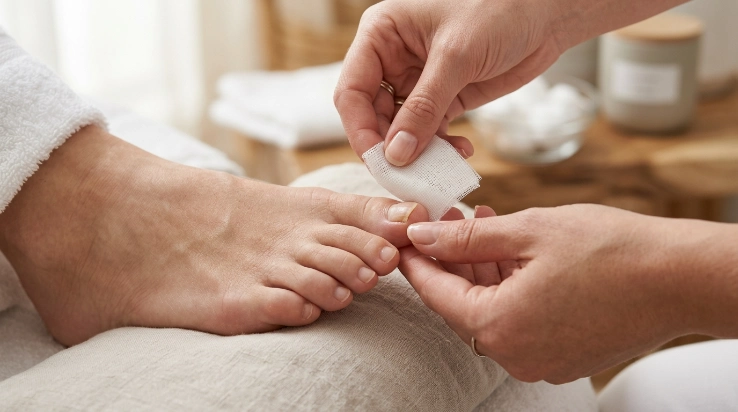
The hard toenail normally acts like a small protective shield over the sensitive nail bed underneath it.
When a nail becomes partially detached or falls off, that protection is reduced. Shoes, socks, bedding, and even a small bump can suddenly feel much more noticeable.
The nail also grows slowly.
According to the NHS guidance on common nail problems, a toenail that falls off after an injury can take up to 18 months to fully grow back. Your individual timeline may be shorter or longer depending on which toe is involved, the extent of the injury, your health, and whether the nail-growing area was damaged.
That makes protection a long-term habit rather than something you do for only a day or two.
How to Protect a Toenail While It Grows Back: Step by Step
If the injury is minor and you do not have signs of a serious wound or infection, simple home care may be enough.
1. Gently Clean the Area
Wash your hands before touching the injured toe.
Then gently clean the toe with mild soap and water. You do not need aggressive scrubbing, a stiff nail brush, or harsh disinfectants for routine care.
Pat the toe dry rather than rubbing it.
Keeping the area clean matters, but over-cleaning can irritate already sensitive skin.
If the nail bed is still an open or actively bleeding wound, follow any instructions you received from a healthcare professional rather than treating it like a normal cosmetic nail-care problem.
2. Deal With Loose Nail Carefully
A partially detached toenail can catch on socks, blankets, or shoes.
Do not pull the attached portion off simply because part of the nail feels loose.
The American Academy of Dermatology’s injured nail guidance recommends gently trimming away only the part of an injured nail that is no longer connected to the skin.
If you cannot clearly tell what is attached, leave it alone and ask a dermatologist, podiatrist, or other qualified healthcare professional.
3. Smooth Sharp Edges With a Nail File
A rough or jagged nail edge can snag repeatedly.
This is where a nail file may be more useful than additional clipping.
Use a clean, fine-grit file and apply very light pressure. File only the hard nail edge that is clearly intact.
A glass file or fine emery board can work well because you can smooth a small rough spot gradually instead of removing a large amount of nail at once.
Never file exposed skin or a tender nail bed.
If filing hurts, stop.
4. Use a Light Protective Dressing When Needed
You do not necessarily have to keep a healing toenail wrapped every minute of the day.
However, light protection can be helpful when the toe will rub against socks or shoes.
The AAD recommends using a light dressing, such as gauze or a bandage, to provide padding and protection to an injured nail while it heals. It also advises keeping adhesive material on the surrounding skin rather than sticking it directly onto the injured nail.
A bulky dressing is not automatically better.
The covering should protect the toe without squeezing it.
Change a dirty or wet dressing promptly. Constant moisture trapped against the skin may create its own problems.
5. Choose Shoes With Plenty of Toe Room
Your footwear can make a huge difference.
A shoe that presses on the recovering nail can repeatedly irritate the same area every time you walk.
Look for:
- A roomy toe box
- Enough length so the toe does not hit the front
- Soft material around the toe area
- Secure heel fit so your foot does not slide forward
- Comfortable socks without thick seams pressing against the injury
The AAD’s healthy nail care recommendations specifically encourage properly fitting footwear and keeping toenails appropriately trimmed to reduce trauma.
If one pair of shoes makes the toe hurt, rub, or throb, switch to something roomier.
6. Reduce Repeated Pressure
Think beyond shoes.
Running, hiking, dancing, soccer, long walks, or other activities can repeatedly push your toes into the front of your footwear.
You may need to temporarily reduce an activity if it repeatedly irritates the recovering nail.
This does not mean everyone with a damaged toenail needs complete rest. It means paying attention to how the toe responds.
Increasing pain after an activity is a signal to reassess the pressure you are putting on it.
What Should You Put Over a Toenail That Is Growing Back?
What you need depends on whether the skin is still healing.
For a minor injured nail, a simple protective routine may involve:
- Mild soap and water for cleaning
- Petroleum jelly when appropriate for a healing superficial wound
- Non-stick gauze or a light bandage
- Medical tape applied to surrounding healthy skin
- Clean socks
- Roomy footwear
AAD guidance recommends petroleum jelly and a dressing for some minor nail injuries after bleeding has stopped, rather than putting dry gauze directly against a wound where it can stick.
Do not automatically apply antibiotic creams, antifungal medications, nail glue, acrylic, gel, or other treatments to an injured nail unless there is a specific reason and the product is appropriate for your situation.
A product that is useful for one nail problem may be completely wrong for another.
Nail File Types: Which Is Safest Around a Recovering Toenail?
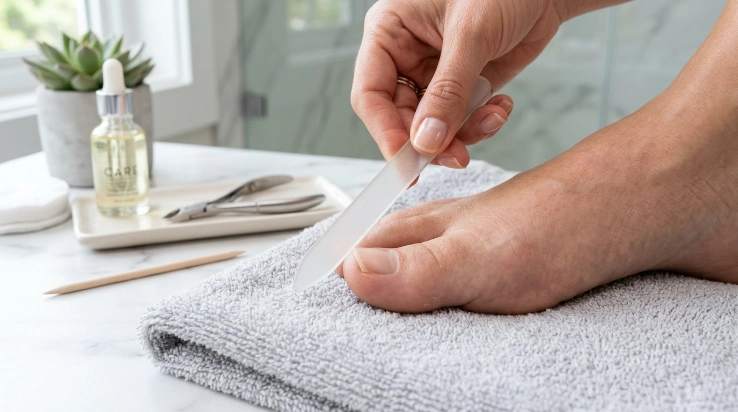
A file can help prevent snagging, but this is a situation where gentler is better.
| Tool | Best Use | Main Limitation |
|---|---|---|
| Fine emery board | Light smoothing of a rough nail edge | Disposable and can wear out quickly |
| Glass nail file | Gentle shaping and smoothing | Can break if dropped |
| Metal nail file | Durable general filing | May feel too aggressive around a sensitive injured nail |
| Coarse foot file | Thick skin or callus care | Not appropriate for an exposed nail bed |
| Nail buffer | Cosmetic surface smoothing | Unnecessary on a newly growing or damaged toenail |
For a recovering nail, choose the least aggressive tool that gets the job done.
Clean reusable tools after use and allow them to dry completely. Do not casually share nail files, clippers, or other pedicure tools.
Expert Tip
Expert Tip: If a recovering toenail keeps catching on socks, smooth only the sharp free edge instead of filing the entire nail surface. Removing extra nail does not make the new nail grow faster and may leave the area more vulnerable.
Should You Cover the Toenail All the Time?
Usually, protection should match the situation.
A light dressing can be useful while the area is tender, when there is a healing superficial wound, or whenever shoes and socks are likely to create friction.
Once the skin has closed and the toe is comfortable, constantly covering it may not always be necessary.
Ask yourself:
- Is the toe still tender?
- Is there an open area?
- Will my shoe rub against it?
- Is the nail edge catching on fabric?
- Is the dressing staying clean and dry?
If protection prevents friction, use it.
If a dressing becomes sweaty, wet, tight, or irritating, change it rather than leaving it in place indefinitely.
Can You Use a Silicone Toe Cap?
A soft toe cap or protective sleeve may provide temporary cushioning against shoe pressure once the injured area is suitable for it.
However, it should not:
- Compress the toe
- Trap excessive moisture
- Rub against an open wound
- Make pain worse
- Hide an infection that needs medical care
Remove it regularly to check the skin.
A protective accessory should make the toe more comfortable, not create another source of irritation.
Keep the New Toenail Short—but Do Not Cut Too Deep
Once enough new nail has grown to require trimming, keep it neat so it is less likely to catch.
For toenails, a generally safer approach is to trim mostly straight across rather than carving deeply into the corners.
Cutting too short can leave tender skin exposed and may increase the chance of irritation around the nail edge.
Use clean, sharp clippers and take small cuts.
If the nail is thick, distorted, painful, or difficult to reach safely, a podiatrist may be a better option than forcing a DIY trim.
What Should You Avoid While a Toenail Grows Back?
The new nail needs time more than it needs complicated beauty treatments.
Try to avoid:
- Picking at loose nail
- Pulling off an attached section
- Digging underneath the nail
- Filing exposed skin
- Cutting deeply into nail corners
- Tight shoes
- Repeated toe impact
- Dirty or shared pedicure tools
- Gluing a false nail over an injury
- Acrylic or gel application over a damaged nail
- Aggressive buffing
It may be tempting to hide an unattractive recovering nail under a cosmetic enhancement.
That can backfire.
The AAD notes that artificial-nail preparation and removal can weaken natural nails, and chemicals used in these services can irritate surrounding skin. A damaged or actively healing toenail is generally not the time to prioritize cosmetic coverage.
Hygiene Matters More Than a Perfect-Looking Pedicure
A recovering toenail does not need to look perfect.
It needs to stay protected.
Wash reusable clippers and files appropriately after use and let them dry. Do not use the same potentially contaminated tool on an injured nail and then on your other nails without cleaning it.
At a salon, pay attention to sanitation.
A reputable nail technician should use properly cleaned or disinfected reusable tools and should not pressure you into a cosmetic service over an obviously injured or suspicious nail.
If the toe appears infected, a nail technician should not be expected to diagnose or medically treat it.
What Does Normal Toenail Regrowth Look Like?
New growth begins near the base of the nail, under the skin at the cuticle area, and gradually moves toward the tip.
Early regrowth may not look perfectly smooth.
Depending on the original injury, you may temporarily notice:
- An uneven surface
- A ridge
- Different thickness
- Slight changes in shape
- A rough-looking edge
The final appearance depends partly on whether the nail matrix—the area responsible for producing nail—was injured.
More severe damage can sometimes affect the way the new nail grows.
Do not repeatedly buff or file the new nail in an attempt to force it to look smooth.
Warning Signs You Should Not Ignore
Some discomfort after a nail injury may be expected, but worsening symptoms deserve attention.
Watch for:
- Increasing redness
- Spreading redness
- Swelling
- Warm or hot skin
- Increasing pain
- Pus or unusual drainage
- Foul smell
- Fever
- Persistent bleeding
- Significant dark discoloration after trauma
- Difficulty walking
- A nail that continues lifting
- Symptoms that get worse instead of better
Cleveland Clinic notes that an injured toenail can develop an infection, with symptoms such as redness, pain, inflammation, and potentially fever.
Do not cover these symptoms with polish or an artificial nail and assume the problem will disappear.
When to See a Nail Technician or Dermatologist
Knowing which professional to see can save you from unnecessary treatments.
A Nail Technician May Help When:
The injury has healed, there is no active pain or infection, and you simply need cosmetic maintenance such as gentle shaping of a healthy nail edge.
Tell the technician that the nail recently experienced trauma so they can work cautiously.
A Podiatrist May Help When:
You have a difficult-to-trim toenail, recurring pressure problems, foot mechanics contributing to repeated nail trauma, or a nail issue that needs professional foot care.
A Dermatologist or Healthcare Professional Is More Appropriate When:
You have:
- Significant pain
- Spreading redness
- Pus or drainage
- Persistent swelling
- An open wound that is not healing
- Major discoloration after injury
- Repeated nail detachment
- Unexplained nail changes
- Suspected infection
The AAD recommends medical evaluation for particularly painful nail injuries, extensive dark discoloration, difficulty bending the affected digit, or injuries that do not improve appropriately.
People with diabetes, circulation problems, immune-system conditions, or other health issues affecting wound healing should be particularly cautious about treating foot injuries without professional guidance.
DIY Protection vs. Professional Care
| Situation | DIY Care May Be Reasonable | Professional Care Is Smarter |
|---|---|---|
| Small rough nail edge | Yes, gentle filing | If filing causes pain |
| Mild friction from shoes | Roomier shoes and light padding | If pain persists |
| Small uncomplicated injury improving daily | Basic cleaning and protection | If improvement stops |
| Nail partially detached | Protect attached portion | If separation is extensive or painful |
| Redness and swelling | Not ideal for cosmetic DIY care | Medical assessment may be needed |
| Pus or foul drainage | No | Seek healthcare advice |
| Nail grows back unusually | Monitor mild temporary changes | Dermatologist/podiatrist if persistent |
DIY protection is generally inexpensive. Basic dressings, petroleum jelly, and a fine nail file are low-cost items compared with professional care.
However, saving money should not be the deciding factor if infection or significant injury is possible.
Medical and podiatry costs vary widely based on where you live, your insurance coverage, testing, and treatment required.
What About Sensitive Skin?
If the skin around your toenail is easily irritated, keep your routine simple.
Fragranced creams, strong antiseptics, adhesives, and cosmetic nail products can all be irritating for some people.
If bandage adhesive causes itching or redness, consider asking a pharmacist or healthcare professional about a gentler dressing option.
Stop using any product that produces burning, significant itching, blistering, or worsening redness.
Remember that an allergic or irritant reaction can sometimes resemble other nail problems, so persistent symptoms should be assessed rather than repeatedly covered with new products.
Common Mistakes to Avoid
Protecting a growing toenail is mostly about avoiding additional damage.
Common mistakes include:
- Pulling off a loose nail. An attached portion may still protect sensitive tissue.
- Cutting too much at once. Only remove an edge you can safely identify as loose.
- Using a coarse file. Aggressive filing can irritate a thin or damaged nail.
- Keeping a wet dressing on. Replace damp or dirty coverings.
- Wearing tight shoes for appearance. Repeated pressure can prolong discomfort.
- Trying to hide the nail with acrylic or press-ons. Cosmetic coverage can make monitoring the area harder.
- Sharing nail tools. Personal tools are easier to keep hygienic.
- Ignoring increasing pain or redness. A worsening problem needs attention.
- Expecting fast regrowth. Toenails grow slowly, so patience matters.
- Treating every nail change as fungus. Trauma, infection, pressure, and other conditions can create similar-looking changes.
FAQs
How long does it take for a toenail to grow back completely?
A toenail may take many months to fully replace itself. NHS guidance says toenails that fall off after injury can take up to about 18 months to regrow completely. The exact timeline varies by person and injury.
Should I keep a missing toenail covered?
Covering can help when the area is tender, healing, or exposed to friction. Use a light, clean dressing rather than tightly wrapping the toe. Once the area has healed, constant coverage may not always be necessary.
Can I put a fake toenail over a toenail that is growing back?
It is better to avoid artificial nails over an actively damaged or healing nail. Glue, filing, removal, and trapped moisture may irritate the area and make it harder to monitor changes.
Can I file a toenail while it grows back?
Yes, if you are filing only a hard, intact, rough nail edge and it does not hurt. Use a fine file with gentle pressure. Never file exposed skin or a sensitive nail bed.
What happens if my new toenail grows back uneven?
Some temporary ridging or unevenness can happen after trauma. If the nail continues growing abnormally, becomes painful, repeatedly lifts, or changes significantly in color or thickness, ask a dermatologist or podiatrist to examine it.
How do I protect a growing toenail inside shoes?
Choose shoes with a wide, roomy toe box and avoid pairs that push the toe forward. A clean dressing or appropriate protective toe sleeve may provide extra cushioning if it does not compress or irritate the area.
How do I know if my toenail is infected?
Increasing redness, warmth, swelling, pain, pus, unusual drainage, or a foul smell can be warning signs. Seek healthcare advice if these symptoms appear or worsen rather than trying to cover them cosmetically.
Conclusion
So, how can you protect a toenail while it grows back? Keep your routine simple: clean the area gently, protect it from rubbing, smooth only safe rough edges, wear roomy shoes, keep your nail tools hygienic, and resist the urge to pick, over-file, or hide the injury under artificial nails.
Toenail regrowth takes patience. Your goal is not to make the nail look perfect every week—it is to give the new nail the best chance to grow without repeated trauma.
Pay attention to how the toe feels as well as how it looks. If pain, redness, swelling, drainage, or other concerning changes develop, stop DIY cosmetic care and get professional advice.
Protect the toe now, and let healthy-looking regrowth happen at its own pace.

