
What Is the Best Way to File Thick Toenails?

Thick toenails can make a simple pedicure feel like hard work. A regular nail file may seem to do almost nothing. If you press harder, though, you can make the nail sore or damage the skin around it.
So, what is the best way to file thick toenails? The safest approach is to soften the nail first, use a sturdy manual nail file, work slowly with controlled strokes, and stop before the nail becomes tender or overly thin.
It is also important to know why the toenail is thick. Age, repeated shoe pressure, old injuries, psoriasis, and fungal infections can all change the thickness of a toenail. Mayo Clinic lists each of these among the possible causes of thickened nails.
This guide explains how to choose a file, prepare your toenails, file them safely, keep your tools clean, and recognize when DIY care is no longer the smartest choice.
Quick Answer
The best way to file thick toenails is to soften them first, dry them well, and use a sturdy nail file with gentle, controlled strokes. Smooth rough edges first and reduce extra thickness only gradually. Stop if you feel heat, pain, tenderness, or sensitivity, and do not aggressively grind a thick nail down.
Why Do Toenails Become Thick?
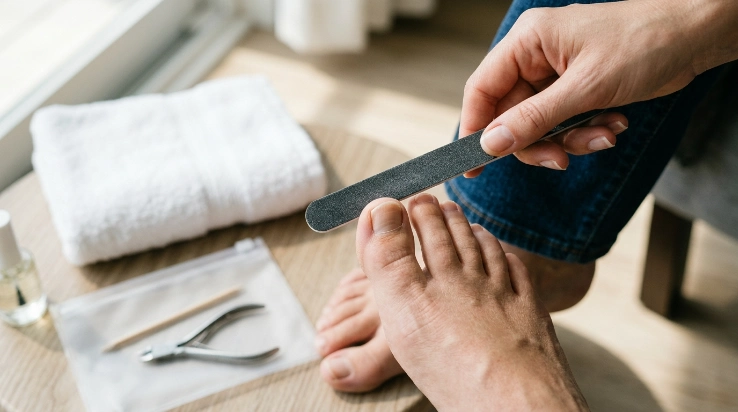
Before reaching for a nail file, look at the nail itself.
A thick toenail is not always just a cosmetic problem. Sometimes it is simply a change that comes with age. In other cases, it may be related to repeated pressure, injury, a skin condition, or infection.
Common reasons include:
- Aging
- Tight or poorly fitting shoes
- Repeated pressure from walking or sports
- An old toe injury
- Psoriasis
- Fungal nail infection
- Long-term changes in the nail’s shape
According to Mayo Clinic’s guide to thickened toenails, aging is a common cause, while trauma, tight shoes, psoriasis, and fungal infections can also contribute.
That matters because filing can improve the shape and comfort of a thick nail, but it does not treat every underlying cause.
If fungus is causing the thickness, for example, filing alone will not cure the infection.
What Type of Nail File Is Best for Thick Toenails?
The best file depends on how thick and hard the nail is.
A very soft manicure file can wear out before it makes much progress. At the other extreme, an aggressive metal file or electric drill can remove nail material faster than a beginner expects.
For most at-home care, a firm manual nail file or sturdy emery board gives you the most control.
Nail File Comparison for Thick Toenails
| Tool | Best For | Cost Level | Main Benefit | Main Limitation |
|---|---|---|---|---|
| Sturdy emery board | Mild to moderate thickness | Low | Cheap and easy to control | Wears out quickly |
| Washable nail file | Regular maintenance | Low to moderate | Reusable and firm | Needs proper cleaning |
| Glass or crystal file | Final smoothing | Moderate | Smooth finish | Can be slow on very thick nails |
| Metal nail file | Hard free edges | Low to moderate | Strong and durable | Easy to use too aggressively |
| Electric nail file | Significant thickness | Moderate to high | Removes material quickly | Higher risk of heat and over-filing |
| Professional care | Severe or difficult nails | Higher | Better visibility and control | Requires an appointment |
What About Nail File Grit?
“Grit” tells you how rough the file surface is.
A coarser surface removes nail material faster. A finer surface works more slowly and is usually better for finishing rough edges.
With a thick natural toenail, you need enough texture to make progress without trying to grind through the nail aggressively.
If you are a beginner, control matters more than speed.
A file that takes a little longer is often easier to use safely than a very aggressive file.
What Is the Best Way to File Thick Toenails Step by Step?
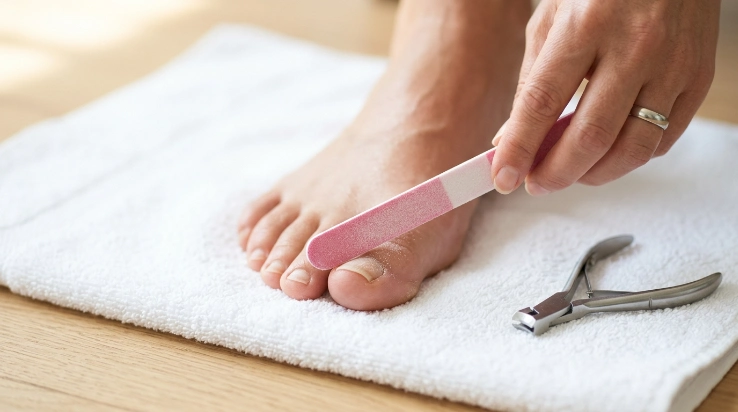
Good preparation can make thick toenails much easier to manage.
Mayo Clinic recommends softening thickened toenails by soaking the feet in warm water for 5–10 minutes before trimming. The American Academy of Dermatology also recommends softening nails before nail grooming.
Here is a simple routine.
1. Check the Nail Before You Start
Look closely at the toenail.
Do not treat every thick nail like an ordinary pedicure issue.
Pay attention to:
- Significant yellow, brown, white, or unusual discoloration
- Crumbling
- Nail separation
- Swelling
- Redness
- Drainage
- Bleeding
- Bad odor
- Pain around or under the nail
A fungal nail infection can cause toenails to become thick, discolored, brittle, ragged, or misshapen.
If the nail looks infected or is painful, professional advice may be more appropriate than heavy DIY filing.
2. Soften the Toenail
Soak your feet in comfortably warm water for about 5–10 minutes.
You can also plan your nail care for just after a bath or shower.
The goal is not to leave your feet wet for a long time. You simply want to make a very hard nail easier to work with.
3. Dry Your Feet and Toenails
Dry your toes thoroughly.
Pay attention to the spaces between them as well.
A damp nail may seem softer, but keeping feet continually moist is not helpful if you are concerned about fungal problems.
You also want your file and hands to have a secure grip.
4. Trim Excess Length First If Needed
If a thick nail is very long, filing the whole length away can take a long time.
If you can trim it safely, shorten it first with suitable toenail clippers or nail nippers.
For thick toenails, Mayo Clinic recommends small, straight cuts rather than forcing the tool through a large section at once. Toenails should generally be cut straight across to help reduce the risk of an ingrown nail.
Never force a clipper that cannot comfortably fit around the nail.
If the tool keeps slipping, the nail is extremely hard, or you cannot see what you are cutting, stop.
5. Smooth the Free Edge First
Start with the part of the toenail that extends beyond the toe.
Use light, controlled strokes.
Your first goal is to remove:
- Sharp corners
- Snags
- Rough spots
- Small uneven areas
The American Academy of Dermatology’s nail-trimming guidance recommends using a nail file or emery board to smooth rough edges and filing in the same direction rather than aggressively sawing back and forth.
6. Reduce Surface Thickness Only If Necessary
This is where people often become too aggressive.
If the nail is thick enough to cause pressure inside a shoe, gentle surface filing may make it more manageable.
Hold the file securely and work across the thick area with light pressure.
Remove a small amount at a time.
Pause often and feel the nail.
You are trying to make it smoother and more comfortable—not turn a naturally thick nail into a thin manicure-style nail.
7. Stop Before the Nail Feels Sensitive
This is one of the most important rules.
Stop filing if you notice:
- Heat
- Burning
- Tenderness
- Throbbing
- Increased sensitivity
- Pain
- Bleeding
- Skin irritation
If your filing creates heat, you are probably using too much speed, pressure, or friction.
Do not keep filing just because the nail still looks thick.
A thick nail may need gradual maintenance over several sessions.
8. Finish With a Finer File
Once the major roughness has been reduced, use a smoother file if available.
This helps refine sharp areas that could catch on socks or rub neighboring toes.
Mayo Clinic specifically recommends gently filing thick toenails after trimming to remove sharp edges that could cut the skin or catch on socks.
Expert Tip
Expert Tip: Do not measure success by how thin you can make the toenail in one session. A safer goal is a nail that feels smoother, has no sharp edges, and causes less pressure in your shoes.
Should You Use an Electric Nail File on Thick Toenails?
Electric nail files are tempting because they work quickly.
That speed is also their biggest drawback.
An electric file can create friction and heat before a beginner realizes how much nail has been removed. It can also slip onto the surrounding skin.
For minor or moderate thickness, a manual file generally gives you more time to notice what is happening.
An electric nail file may be better left to someone with proper experience, especially when the nail is severely thick, distorted, painful, or difficult to reach.
Faster is not automatically safer.
How Much of a Thick Toenail Should You File Off?
There is no safe universal thickness you should try to reach.
Toenails naturally vary.
The goal is usually to:
- Smooth the edge
- Reduce obvious roughness
- Keep the nail from catching on socks
- Reduce mild pressure from excess thickness
- Make routine trimming easier
Do not keep grinding until the nail matches a normal-looking toenail beside it.
If the thickening comes from an old injury or another condition, the nail may remain thicker even with good grooming.
Nail File Hygiene Matters
A nail file touches nail debris and sometimes skin.
Keeping your tools clean is especially important when you are dealing with a nail that may have an infection.
The AAD advises regular disinfection of nail grooming tools.
For reusable tools:
- Clean away visible debris after use.
- Follow the manufacturer’s cleaning instructions.
- Let reusable tools dry completely before storage.
- Do not share personal nail tools.
- Replace worn, cracked, or damaged files.
Disposable emery boards are difficult to clean thoroughly. If you have a toenail that may be infected, using a dedicated disposable file and throwing it away after appropriate use may be a practical option.
Do not use the same dirty file on an affected toenail and then immediately use it on healthy nails.
Can Filing Help a Fungal Toenail?
Filing may make a fungal toenail smoother or easier to manage, but it should not be confused with treating the infection.
Fungal nails can become thick, discolored, crumbly, ragged, or misshapen. The nail may also begin separating from the nail bed.
Mayo Clinic notes that trimming and thinning a fungal nail can reduce pressure and may help some topical medication reach deeper areas of the nail.
For more information on the symptoms, see Mayo Clinic’s nail fungus guidance. The NHS fungal nail infection guide also notes that fungal nails may become thicker, brittle, or discolored.
If you think the nail is fungal, getting the cause confirmed can be more useful than repeatedly filing it down.
DIY Filing vs. Professional Nail Care
DIY care works best when the nail is manageable, painless, and easy for you to reach.
Professional help makes more sense when you cannot safely see or control what you are doing.
| Situation | DIY Filing May Be Reasonable | Professional Care Is Better |
|---|---|---|
| Mild thickening | Yes | Optional |
| Rough free edge | Yes | Usually unnecessary |
| Nail catches on socks | Often | If severe |
| Very hard or distorted nail | Limited | Often |
| Nail is painful | No | Yes |
| Bleeding or swelling | No | Yes |
| Suspected infection | Only gentle maintenance | Medical assessment may be needed |
| Difficulty reaching feet | Riskier | Usually safer |
| Reduced sensation or poor circulation | Avoid risky DIY care | Healthcare guidance recommended |
Professional nail care costs more than a basic home file, but the extra cost may be worthwhile when safe access and control are difficult.
When to See a Nail Technician or Dermatologist
A nail technician can help with cosmetic grooming when the nail and surrounding skin appear healthy.
However, a nail technician is not a substitute for medical diagnosis.
See a dermatologist, podiatrist, or other appropriate healthcare professional when you notice:
- Increasing pain
- Redness or swelling
- Bleeding
- Drainage or pus
- Nail separation
- Major discoloration
- Rapid change in nail shape
- Severe thickening
- Difficulty walking
- Possible fungal infection that is not improving
- A nail you cannot safely trim or file yourself
Mayo Clinic advises seeking medical care when thick toenails continue getting thicker, become painful, or cannot be safely managed at home.
People with diabetes, poor circulation, or reduced sensation in the feet need extra caution with sharp nail tools. Mayo Clinic specifically advises discussing thick-toenail care with a healthcare professional when these issues are present.
Common Mistakes to Avoid
Even a basic nail file can cause problems when it is used too aggressively.
Avoid these common mistakes:
- Filing as hard as possible. More pressure creates more friction and less control.
- Trying to make the nail thin in one sitting. Gradual maintenance is safer.
- Ignoring pain. Filing should not hurt.
- Using an electric drill without experience. It can remove material very quickly.
- Filing surrounding skin. Stay on the nail.
- Sharing nail files. Nail debris and microorganisms can transfer between people.
- Using dirty reusable tools. Clean and dry them properly.
- Assuming every yellow thick nail is fungus. Several conditions can cause similar changes.
- Treating filing as a cure. Filing changes thickness and shape; it does not necessarily fix the cause.
- Continuing when the nail becomes hot. Heat is a warning that friction is becoming excessive.
FAQs
Can you file down very thick toenails?
You can gently reduce some thickness, but you should not aggressively grind the nail until it becomes thin. File a little at a time and stop if you feel pain, heat, or sensitivity.
Is it better to file thick toenails wet or dry?
Softening thick nails with a brief warm-water soak can make grooming easier. Dry your feet and nails thoroughly before working so you can hold your tools securely and see what you are doing.
What kind of nail file works fastest on thick toenails?
Coarser, sturdy files remove material faster than very fine files. However, faster removal also increases the chance of over-filing. Beginners should choose a file they can control comfortably.
Can I use a metal nail file on thick toenails?
Yes, but use light pressure. Metal files can feel aggressive on natural nails, so stop as soon as the edge is smooth or the thickness has been reduced enough for comfort.
Can filing get rid of toenail fungus?
No. Filing can reduce thickness and roughness, but it does not reliably eliminate the infection itself. If you suspect fungus, consider medical or pharmacy advice about appropriate treatment.
Why does my toenail hurt after filing?
Pain can happen if you removed too much nail, created excess friction, irritated nearby skin, or were filing a nail that was already inflamed. Stop filing and allow the area to settle. Persistent or worsening pain deserves professional evaluation.
How often should I file thick toenails?
There is no fixed schedule for everyone. File only when the nail needs smoothing or controlled maintenance. It is usually better to remove small amounts periodically than to perform one aggressive filing session.
Conclusion
So, what is the best way to file thick toenails? Start gently. Soften the nail, dry it well, use a sturdy manual file, smooth rough edges first, and reduce thickness only a little at a time.
Your goal is comfort and safe maintenance—not creating a perfectly thin toenail.
Keep your tools clean, do not share them, and stop immediately if filing causes heat, tenderness, pain, or bleeding. If the toenail is severely thick, discolored, crumbly, painful, swollen, or difficult to manage safely, let a nail or healthcare professional assess it before doing more DIY filing.
A careful five-minute grooming session is far better than damaging a nail because you tried to fix years of thickness in one afternoon.

