
Why Do Toenails Become Thick After Injury?

You injured your toe months ago, the pain went away, and now the toenail looks completely different. It may be thicker, harder to cut, ridged, uneven, or slightly discolored.
So, why do toenails become thick after injury?
An injury can affect the part of your toe that produces the nail. As the damaged area heals, the new nail may grow differently from the old one. Sometimes the change is temporary. Other times, a significant injury can leave a toenail thicker or more distorted for a long time.
The tricky part is that an injured toenail can look similar to a fungal nail infection. That is why it helps to understand what happened beneath the nail before you start cutting, filing, or treating it.
Below, we will look at why injury causes thick nails, how long the change may last, how to file and trim the nail safely, and when a dermatologist should take a closer look.
Quick Answer
Toenails can become thick after an injury because trauma may damage or disturb the nail matrix, which is the area that produces new nail cells. The new nail can then grow thicker, ridged, uneven, or misshapen. Mild changes may grow out, while more serious matrix damage can cause longer-lasting changes.
Why Can a Toenail Become Thick After an Injury?
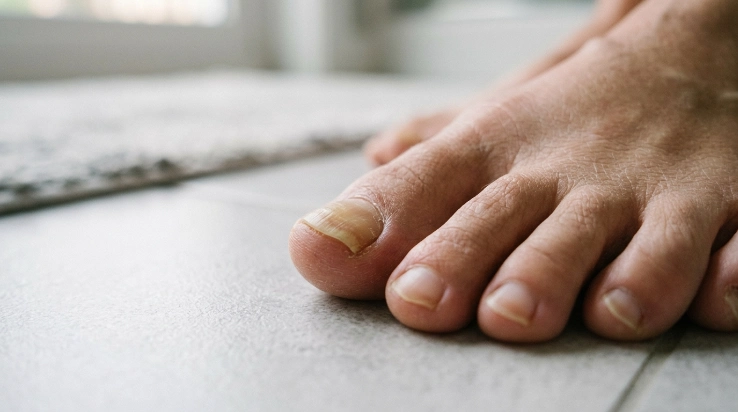
Your toenail is not simply a hard piece of material sitting on top of your toe.
The visible part is called the nail plate. Under and behind it are tissues responsible for supporting and growing the nail.
One of the most important is the nail matrix.
The nail matrix sits mainly beneath the base of the nail and produces the cells that eventually form your toenail. Cleveland Clinic explains that injuries to the nail matrix can interfere with normal nail growth. Cleveland Clinic’s guide to the nail matrix
If that area gets crushed, pinched, or repeatedly irritated, the nail that grows afterward may not look exactly like the nail you had before.
The Nail Matrix May Have Been Injured
Think of the nail matrix as the nail’s growth center.
If you drop something heavy on your toe, stub it badly, jam it inside a shoe, or experience another strong impact, the matrix may temporarily stop producing a smooth nail.
As growth resumes, you might notice:
- A thicker section
- Horizontal ridges
- An uneven surface
- A slightly curved nail
- Changes in color
- A nail that grows more slowly
- A nail that feels harder than before
A minor injury may only affect one section of the nail.
A deeper injury can potentially affect how the nail grows for much longer.
The Nail May Grow Unevenly
After trauma, different parts of the nail may not grow at exactly the same rate.
That can make the nail plate look stacked, ridged, or unusually dense.
You may notice that one side looks normal while the other side seems thicker.
This is especially common with the big toenail because it takes a lot of pressure from shoes, walking, exercise, and accidental bumps.
Blood or Damage Under the Nail Can Change Its Shape
A hard impact can also cause bleeding underneath the nail.
This is sometimes called a subungual hematoma, which simply means trapped blood beneath the nail plate.
A badly bruised nail may temporarily separate from the nail bed. As the damaged nail grows forward and a new nail forms underneath, the nail can look unusually thick or layered.
The American Academy of Dermatology recommends medical evaluation for more serious nail injuries, especially when much of the nail becomes black or purple, pain is severe, or the toe cannot move normally. American Academy of Dermatology’s injured nail guidance
Repeated Small Injuries Can Matter Too
You do not always need one dramatic accident.
Repeated pressure can also affect the nail.
Examples include:
- Running in shoes that are too short
- Wearing tight pointed-toe shoes
- Hiking downhill for long periods
- Playing sports that push the toes against the shoe
- Repeatedly bumping the same toenail
- Wearing footwear with very little toe room
Mayo Clinic lists both toe trauma and tight-fitting shoes among the possible causes of thickened toenails. Mayo Clinic’s guide to thickened toenails
If the nail keeps getting injured while it is trying to recover, normal-looking growth may take even longer.
Injury vs. Toenail Fungus: How Can You Tell?
This is one of the most important questions.
A thick toenail after an obvious injury may be related to trauma, but thickness alone does not prove the cause.
Toenail fungus can also make nails thicker.
The NHS notes that fungal nail infections may cause toenails to become thick, brittle, crumbly, or discolored. NHS guidance on fungal nail infections
Here is a simple comparison:
| Nail Change | More Consistent With Injury | Could Suggest Fungus |
|---|---|---|
| One nail changed after a known accident | Often | Possible |
| Ridge or dent matching the timing of an injury | Often | Less typical |
| Nail became thick after repeated shoe pressure | Possible | Possible |
| Yellow or brown discoloration | Possible | Common |
| Crumbly edges | Less typical | Common |
| Debris building up under nail | Possible | Common |
| Several toenails becoming affected | Less typical | More suspicious |
| Nail lifting | Possible | Possible |
| Red, swollen skin around nail | Needs attention | Needs attention |
You cannot reliably diagnose fungus just by looking at the nail.
If you are unsure, a dermatologist or podiatrist can examine it and may test nail material before recommending treatment.
Do not automatically start antifungal treatment simply because an injured toenail became thick.
Will a Thick Toenail Return to Normal?
Sometimes.
The outcome depends heavily on how badly the nail-producing tissue was injured.
Mild Injuries May Grow Out
If the matrix was only temporarily disturbed, you may eventually see healthy-looking nail growing from the base.
As that new nail moves forward, the damaged portion can gradually be trimmed away.
Toenails grow slowly, though.
That means visible improvement can take many months.
Major Matrix Damage Can Cause Lasting Changes
A deeper crush injury can potentially damage the nail matrix more permanently.
The nail may continue growing but remain:
- Thicker
- Ridged
- Split
- Curved
- Misshapen
- Uneven
If the nail repeatedly grows abnormally after the original injury has fully healed, a dermatologist or podiatrist can help determine whether permanent matrix damage may be involved.
Can You File Down a Thick Toenail After Injury?
You can sometimes gently file a fully healed, painless thick toenail, but filing should be treated as grooming rather than treatment.
A file cannot repair the nail matrix.
It also cannot fix fungus or another underlying nail condition.
Your goal is simply to make rough or thick areas easier to manage.
Wait Until the Initial Injury Has Healed
Do not start aggressively filing a recently injured nail.
Avoid filing if you still have:
- Bleeding
- An open wound
- Significant bruising
- Strong tenderness
- Drainage
- Swelling
- Loose or partially detached nail tissue
Fresh injuries need protection, not cosmetic thinning.
Choose a Nail File You Can Control
For most people doing basic home care, manual files provide more control than electric drills.
| Nail File Type | Best Use | Cost Level | Main Consideration |
|---|---|---|---|
| Emery board | Light edge smoothing | Low | Difficult to disinfect thoroughly |
| Glass/crystal file | Smoothing rough edges | Medium | May be slow on very thick nails |
| Metal file | Hard, thick edges | Low to medium | Can remove nail quickly |
| Coarse manual file | Very thick free edges | Low to medium | Requires light pressure |
| Electric nail file | Fast reduction | Medium to high | Easy to over-file or create heat |
For a beginner, a controlled manual file is usually the more forgiving option.
Electric nail drills can remove material surprisingly fast. They may also generate heat or accidentally touch the surrounding skin.
How to Care for an Injury-Thickened Toenail Safely
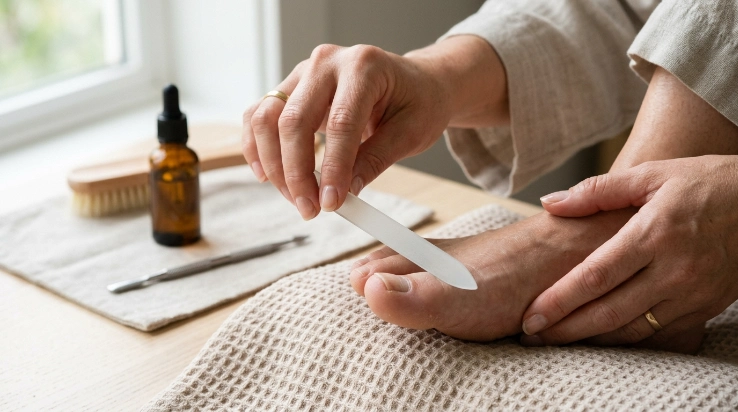
If the injury has completely healed and the nail is painless, basic maintenance may make it more comfortable.
1. Check the Nail First
Before reaching for your clippers, look closely.
Stop DIY care if you see obvious swelling, drainage, worsening pain, significant lifting, or rapidly changing discoloration.
2. Soften a Very Hard Nail
Thick nails are easier to trim when slightly softened.
Mayo Clinic recommends soaking thickened toenails in warm water for about 5 to 10 minutes before trimming.
Dry the foot thoroughly afterward.
Do not leave your toes damp inside socks or shoes.
3. Clean Your Tools
Use clean toenail clippers, nippers, and files.
Do not casually share nail tools with another person.
Reusable metal or glass tools are generally easier to clean than porous disposable files.
4. Trim in Small Sections
Do not try to force a clipper through the entire thick nail at once.
Take small, controlled cuts.
Toenails should generally be trimmed fairly straight across rather than deeply rounded into the corners.
5. Smooth the Edge With a File
Once the nail is trimmed, use a file to remove rough or sharp points.
The AAD recommends filing uneven nail edges in the same direction rather than repeatedly sawing back and forth. AAD nail trimming recommendations
Use light pressure.
Stop if you feel heat, pain, burning, or sensitivity.
6. Reduce Future Pressure
Your nail will have a harder time recovering if it keeps hitting the front of your shoe.
Look for footwear with enough room for your toes to move naturally.
This is especially important during running, hiking, or sports.
Expert Tip: If you can see healthier-looking nail growing from the base, focus on protecting that new growth instead of trying to aggressively grind the older damaged nail thinner.
How Much Should You File Off?
Less than you may think.
A thick nail can be frustrating, so it is tempting to keep filing until it looks thin again.
That is not the safest goal.
The deeper layers of the nail sit close to sensitive tissue underneath. Filing too far can leave the area sore and vulnerable.
A safer approach is to:
- Smooth sharp edges.
- Remove obvious snags.
- Reduce only a small amount of excess thickness.
- Stop before the nail becomes tender.
- Repeat gentle maintenance later rather than doing everything at once.
If substantial thinning is required, professional care is safer.
Common Mistakes to Avoid
A few simple mistakes can turn manageable nail thickness into a painful problem.
Avoid:
- Assuming every thick nail is fungus. Injury, shoe pressure, psoriasis, and other conditions can look similar.
- Filing a freshly injured nail. Wait for wounds and significant tenderness to heal.
- Grinding the nail until it feels thin. Cosmetic appearance should never come before comfort and safety.
- Using excessive pressure with a metal file. Hard files remove nail faster than you may realize.
- Using an electric drill without experience. Heat and over-filing can develop quickly.
- Digging underneath the nail. Sharp tools can injure the nail bed.
- Cutting deeply into the corners. This can increase irritation and ingrown toenail risk.
- Sharing nail tools. Shared grooming tools can spread microorganisms.
- Ignoring new pain or drainage. Those are not simply cosmetic problems.
- Continuing to wear shoes that hit the same toe. Repeated trauma can keep the cycle going.
Hygiene and Sensitive Skin Considerations
Keeping the nail area clean matters, but aggressive cleaning is unnecessary.
Wash your feet normally and dry carefully between the toes.
Avoid pushing sharp objects beneath the nail to remove debris.
If you have sensitive skin, stop using any nail-care product that causes:
- Burning
- Redness
- Itching
- Rash
- Peeling
- Swelling
You should also be especially cautious about DIY toenail trimming if you have reduced feeling in your feet, circulation problems, or diabetes. Mayo Clinic specifically advises caution when using sharp nail nippers in people with diabetes, poor circulation, or reduced foot sensation.
DIY Care vs. Professional Care
Not every thick toenail needs professional treatment.
But not every thick toenail belongs in a home pedicure either.
Home Care May Be Reasonable When:
- The original injury has healed
- The nail is firmly attached
- There is no drainage
- The surrounding skin looks healthy
- The nail is not significantly painful
- You only need light trimming or smoothing
Professional Care Is Smarter When:
- The nail is extremely thick
- Regular clippers cannot safely handle it
- The nail repeatedly cracks or splits
- Walking or shoes cause pain
- You suspect fungus
- The nail is lifting
- The skin is red or swollen
- The cause of the change is unclear
A nail technician may help with routine cosmetic grooming of an otherwise healthy nail.
However, a nail technician should not be expected to diagnose a medical nail condition.
When to See a Nail Technician or Dermatologist
For a healed, stable toenail that simply needs cosmetic shaping, an experienced nail technician may be able to perform gentle trimming and filing.
Tell the technician about the previous injury before the service begins.
However, choose a dermatologist or podiatrist rather than a salon when the nail appears medically abnormal.
Get professional medical advice if you notice:
- Increasing pain
- Redness or warmth
- Swelling
- Pus or drainage
- A bad odor with other changes
- Significant nail lifting
- Rapidly worsening thickness
- Several nails becoming affected
- Severe discoloration
- A new or changing dark streak
- Repeated bleeding
- Difficulty walking because of the nail
The AAD specifically recommends dermatologic evaluation for concerning changes in nail color, shape, texture, lifting, or surrounding inflammation.
A dermatologist can also help determine whether the change is related to old trauma, fungus, psoriasis, or another nail disorder.
FAQs
Can hitting your toe permanently thicken the toenail?
It can. A mild injury may only cause temporary abnormal growth, but a serious injury involving the nail matrix can sometimes produce long-lasting changes in nail thickness, shape, or texture.
How long does an injured toenail take to look normal again?
Toenails grow slowly, so improvement can take many months. You may gradually see healthier nail growing from the base while the damaged portion moves toward the tip.
Why did my toenail become thick months after the injury?
The nail you see today was produced gradually. Damage to the nail matrix may not become obvious until abnormal nail growth moves far enough forward to be visible.
Does a thick toenail after injury mean I have fungus?
No. Injury itself can cause toenail thickening. However, fungus can produce similar changes, including thickening, discoloration, crumbling, and nail lifting. A dermatologist or podiatrist can help distinguish between them.
Can I use a nail file on an injured thick toenail?
Yes, but only after the acute injury has healed and the nail is stable and painless. Use gentle pressure and stop immediately if filing creates heat, pain, or tenderness.
Should I use an electric nail file on a thick toenail?
Most beginners do not need one. Electric files work quickly and can cause heat, excessive thinning, or skin injury. A manual file provides more control for basic at-home maintenance.
Can a nail salon fix a thick toenail caused by injury?
A salon may be able to improve the cosmetic appearance of a healthy, healed nail through careful trimming and filing. It cannot repair damage to the nail matrix or diagnose fungus, infection, or another medical condition.
Final Thoughts
So, why do toenails become thick after injury?
In many cases, the original trauma disturbed the nail matrix or changed the way the new nail formed. The result may be a thicker, harder, ridged, or uneven toenail that becomes visible weeks or months after the accident.
Mild changes may slowly grow out. More significant nail-matrix damage can cause longer-lasting changes.
For a fully healed, painless nail, gentle trimming and filing may make the thickness easier to manage. Keep your tools clean, use light pressure, protect the toe from repeated shoe trauma, and resist the urge to grind the nail dramatically thinner.
Most importantly, do not treat every thick toenail as a cosmetic problem. Pain, swelling, drainage, nail lifting, significant discoloration, or unexplained changes deserve professional attention.
Protect the healthy new growth, give the nail time, and ask a dermatologist or podiatrist for help when you are unsure.

