
Thick Toenails vs Normal Toenails: What Is the Difference?

You may notice one day that your big toenail looks thicker, harder, or more yellow than the others. Maybe your usual clippers suddenly struggle to cut it. Or perhaps you are wondering whether your toenails have always been this thick and you simply never paid attention before.
Understanding thick toenails vs normal toenails matters because thickness is not always just a cosmetic issue. Toenails can change because of age, shoe pressure, repeated injury, fungal infection, or certain skin conditions.
The good news is that mild thickness can often be managed with careful grooming. The important part is knowing what looks normal, when a nail file can help, and when it is safer to stop DIY care and get professional advice.
Quick Answer
Thick toenails vs normal toenails differ mainly in texture, appearance, flexibility, and ease of trimming. Normal toenails are firm but relatively smooth and easy to cut. Thick toenails may feel dense, hard, raised, discolored, curved, or difficult to trim. Persistent or worsening thickness may need professional evaluation.
What Does a Normal Toenail Look and Feel Like?
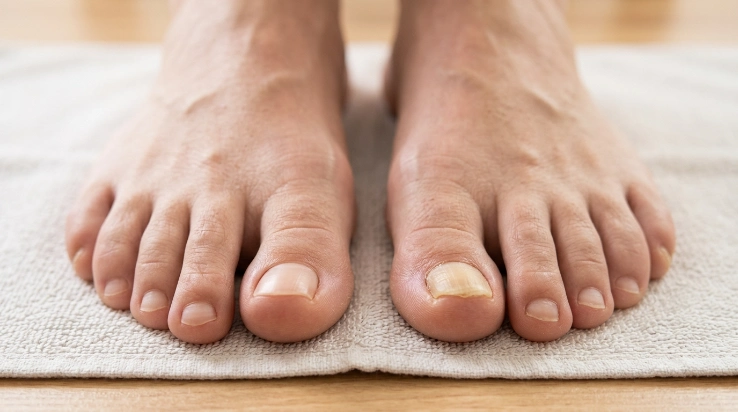
There is no single perfect toenail shape or thickness.
Toenails naturally vary from person to person. Your big toenail is also usually stronger and more substantial than your smaller toenails.
A normal toenail is generally:
- Firm but still manageable with toenail clippers
- Attached securely to the nail bed
- Relatively smooth
- Free of major crumbling
- Not painful
- Not unusually raised
- Not surrounded by swollen or irritated skin
- Fairly consistent in appearance over time
Small ridges, minor color differences, and slightly uneven edges can happen without indicating a serious problem.
What matters most is change.
If one toenail suddenly becomes much thicker, darker, more brittle, or harder to cut than it used to be, pay attention.
What Is Considered a Thick Toenail?
A thick toenail has more nail material than expected and may feel unusually dense or hard.
You may first notice the difference while trimming your nails. Your regular clipper might struggle to fit around the nail or require much more pressure.
A thick toenail may also:
- Look raised compared with neighboring nails
- Feel extremely hard
- Develop a rough surface
- Become yellow, white, brown, or dull
- Curve more than usual
- Crumble around the edge
- Collect debris underneath
- Press against your shoes
- Become difficult to trim neatly
- Feel uncomfortable when walking
According to Mayo Clinic, aging is a common reason toenails become thicker, but psoriasis, toe injuries, tight-fitting shoes, and fungal infections can also contribute. Mayo Clinic’s guide to thickened toenails
Thick Toenails vs Normal Toenails: Key Differences
Here is a simple comparison.
| Feature | Normal Toenails | Thick Toenails |
|---|---|---|
| Texture | Firm and relatively smooth | Dense, hard, rough, or uneven |
| Trimming | Usually easy with standard toenail clippers | May require stronger or wider tools |
| Filing | Light filing usually works | May require a sturdier file |
| Color | Usually consistent | May become yellow, white, brown, or dull |
| Shape | Generally follows the toe | May become raised, curved, or distorted |
| Edge | Usually cuts cleanly | May split or crumble |
| Comfort | Usually painless | May press against shoes or become painful |
| Main concern | Routine grooming | Cause of thickening may need attention |
Thickness alone cannot tell you why the nail changed.
A thick nail may simply reflect age or repeated pressure. It can also be associated with fungal infection or another nail condition.
Why Do Toenails Become Thicker?
Several different things can change toenail thickness.
Normal Aging
Toenails often become harder and thicker as people get older.
Nail growth can slow over time. Because the nail grows differently, it may gradually become denser and harder to cut.
If the change is slow, painless, and affects several nails similarly, aging may be one possible explanation.
That does not mean every thick nail should automatically be blamed on age.
Look at the whole nail.
New discoloration, crumbling, lifting, pain, or swelling deserves more attention.
Repeated Pressure From Shoes
Shoes that repeatedly press against the toenails can cause ongoing trauma.
This is especially common around the big toe.
You may experience more pressure if:
- Your shoes are too short
- The toe box is narrow
- Your toes hit the front of your shoes
- You walk or run long distances
- Your work involves being on your feet all day
Repeated minor trauma can gradually change how a toenail grows.
Choosing shoes with enough room around the toes may help reduce continued pressure.
Previous Toe Injury
Have you ever dropped something on your toe?
Stubbed it badly?
Lost a toenail after running or hiking?
Even after the injury heals, the new toenail may not grow exactly like the old one. It may become thicker, ridged, curved, or slightly misshapen.
Toenails grow slowly, so changes can remain noticeable for months.
Fungal Nail Infection
Fungal infection is one of the most important causes to recognize because simply filing the nail thinner will not remove the infection.
The American Academy of Dermatology notes that nail fungus can cause thickness, discoloration, brittleness, crumbling, buildup beneath the nail, lifting, and changes in nail shape. American Academy of Dermatology nail fungus symptoms guide
Possible warning signs include:
- Yellow, brown, or white discoloration
- Crumbling edges
- Nail lifting
- Debris beneath the nail
- Increasing thickness
- Several affected nails
- An unusual odor
- Nail distortion
Do not assume every yellow or thick toenail is fungal, however.
Different nail problems can look similar.
The AAD explains that dermatologists sometimes examine nail material because nail fungus can resemble conditions such as nail psoriasis or previous nail injury.
Psoriasis and Other Nail Conditions
Psoriasis can affect the nails as well as the skin.
Changes can include thickening, surface irregularity, discoloration, or separation from the nail bed.
This is another reason aggressive DIY filing is not a good way to diagnose or treat an unexplained thick toenail.
If you cannot tell why your nail has changed, professional evaluation is more useful than repeatedly grinding away the surface.
Can You Tell the Difference Just by Looking?
Sometimes you can clearly see that one nail is thicker than another.
But appearance alone usually cannot tell you the cause.
For example, both repeated injury and fungal infection can produce a thick, discolored toenail.
Instead of focusing on thickness alone, ask:
- Did the change happen gradually or suddenly?
- Is one nail affected or several?
- Is the nail painful?
- Is it crumbling?
- Has the color changed?
- Is the nail lifting?
- Is the skin around it red or swollen?
- Have you injured that toe before?
- Do your shoes repeatedly press against it?
These clues can help you decide whether normal grooming is reasonable or professional care makes more sense.
How Nail Files Behave Differently on Thick vs Normal Toenails
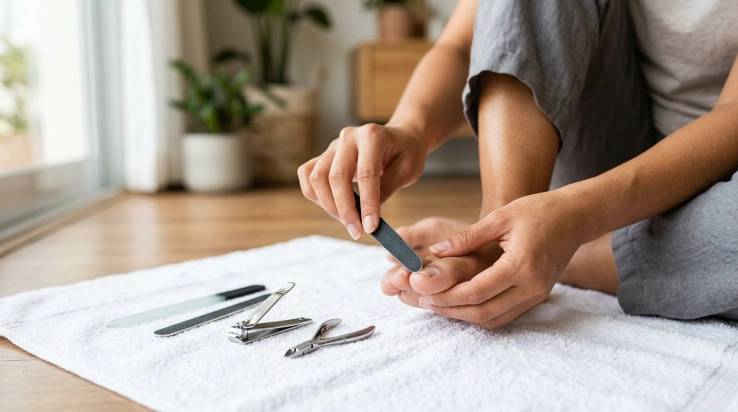
A normal toenail usually needs very little filing.
After trimming, a fine or medium-fine file can smooth any sharp edges.
A thick toenail may take noticeably more work.
That does not mean you should immediately reach for the roughest file available.
Emery Boards
Emery boards are inexpensive and easy to find.
They work well for:
- Small rough edges
- Light finishing
- Normal toenails
- Mild thickness
The downside is that they wear out quickly and can be difficult to clean thoroughly.
Glass or Crystal Files
Glass files offer a smoother filing surface and are often comfortable for routine finishing.
They are useful for:
- Normal natural nails
- Smoothing trimmed toenails
- Minor roughness
- People who prefer a washable file
They may feel slow on a very thick, hard toenail.
Metal Nail Files
Metal files are durable and reusable.
They can handle tougher edges, but they may feel more aggressive than glass files or fine emery boards.
Use light pressure.
Do not scrape the surrounding skin.
Coarse Nail Files
A coarse file removes nail material quickly.
That can sound convenient when you have a thick toenail, but faster removal also makes over-filing easier.
Do not grind continuously until the toenail looks thin or “normal.”
A thickened toenail may have an underlying cause that filing cannot fix.
Expert Tip: If filing creates heat, burning, tenderness, or sensitivity, stop. Your goal is to smooth and manage the nail—not force it to match the appearance of a thinner toenail.
How to Care for a Manageable Thick Toenail at Home
If the nail is mildly thick, painless, stable, and free from obvious signs of infection or injury, gentle maintenance may be reasonable.
1. Look at the Nail Before You Start
Check for:
- Swelling
- Redness
- Bleeding
- Drainage
- Severe discoloration
- Significant lifting
- Open skin
- Strong pain
If any of these are present, do not treat the nail like a routine pedicure.
2. Soften the Toenail
Thick toenails are often easier to cut after bathing or soaking briefly in lukewarm water.
Mayo Clinic recommends soaking thickened toenails before trimming if needed, then making small cuts.
Dry your feet well afterward, especially between the toes.
3. Choose an Appropriate Clipper
A regular fingernail clipper may not open wide enough for a dense big toenail.
Depending on thickness, you might use:
- Standard toenail clippers
- Wide-jaw toenail clippers
- Nail nippers
Stainless steel is common because it is durable and relatively easy to clean.
Sharp, well-aligned blades are more important than simply buying the biggest tool.
A basic toenail clipper may cost only a few dollars, while larger wide-jaw clippers, nail nippers, glass files, and professional-style tools can cost more.
Choose control over power.
A very sharp nipper is not safer if you cannot comfortably see or control where its blades are going.
4. Make Small Cuts
Do not try to force a thick toenail through one huge clip.
Work gradually across the nail.
Small cuts give you more control and reduce the chance of cracking the nail or slipping into the skin.
Toenails should generally be trimmed straight across rather than deeply rounding the corners.
5. Smooth the Edge
Use a clean nail file to smooth rough or sharp areas.
Light pressure is enough.
You do not need to remove every ridge or make the surface perfectly flat.
Nail File and Clipper Hygiene Matters
Reusable nail tools need basic hygiene whether your nails are normal or thick.
The AAD recommends keeping nails short and avoiding shared grooming tools because organisms responsible for fungal infections can spread through contaminated personal items. AAD guidance for preventing nail fungus
Good habits include:
- Do not share nail clippers or files.
- Clean reusable tools after use.
- Let washable tools dry completely.
- Replace worn disposable emery boards.
- Do not use a dirty file on broken skin.
- Keep your feet clean and dry.
- Store tools somewhere dry rather than in a damp shower area.
If you suspect fungal infection, be especially careful about sharing tools.
Normal Thickness Does Not Always Mean a Healthy Nail
It is easy to assume a thin or normal-looking nail must be healthy.
That is not always true.
A nail problem can begin before major thickening appears.
Watch for:
- New dark streaks or unexplained pigmentation
- Pain
- Persistent redness
- Swelling
- Nail separation
- Bleeding
- Changes that continue getting worse
Likewise, a mildly thick toenail is not automatically unhealthy.
The pattern and symptoms matter more than thickness alone.
DIY Care vs Professional Care
| Situation | DIY Grooming May Be Reasonable | Professional Care Is Safer |
|---|---|---|
| Mild stable thickness | Yes | Usually optional |
| Rough free edge | Yes | Usually optional |
| Nail difficult to cut | Possibly, with suitable tools | Yes if control is poor |
| Significant pain | No | Yes |
| Redness or swelling | No | Yes |
| Bleeding or drainage | No | Yes |
| Major nail lifting | No | Yes |
| Suspected fungal infection | Grooming only will not solve the cause | Medical evaluation may be needed |
| Severe distortion | Avoid aggressive DIY filing | Yes |
| Difficulty seeing or reaching your toes | Risk of accidental cuts increases | Professional trimming may be safer |
A licensed nail technician can help with routine cosmetic grooming, shaping, and safe tool use.
A nail technician cannot diagnose medical nail disease.
When infection, persistent pain, unusual discoloration, or another health issue is suspected, a dermatologist, podiatrist, or other healthcare professional is the better choice.
Common Mistakes to Avoid
Thick toenails often tempt people to become too aggressive.
Avoid these common mistakes:
- Forcing a small clipper through a nail that does not fit
- Trying to remove the entire edge in one cut
- Filing until the nail becomes hot
- Grinding deeply into the nail surface
- Cutting into painful or swollen tissue
- Digging down the sides of the toenail
- Using household scissors, knives, or blades
- Sharing files or clippers with another person
- Assuming every thick yellow nail is definitely fungus
- Assuming fungal nail changes can be completely filed away
- Ignoring worsening pain or discoloration
The NHS notes that fungal nail infections may make nails thicker than usual, brittle, discolored, or crumbly and can take a long time to treat. NHS fungal nail infection guidance
When to See a Nail Technician or Dermatologist
A nail technician may be helpful when your concern is mainly cosmetic and the nail appears otherwise healthy.
For example, you might want help with:
- Shaping difficult toenails
- Smoothing rough edges
- Routine pedicure maintenance
- Choosing an appropriate nail file
- Managing nails that are difficult to reach
Choose a salon that uses clean tools and follows good sanitation practices.
A dermatologist or other healthcare professional is more appropriate if you notice:
- Increasing thickness without an obvious reason
- Significant yellow, brown, white, green, or dark discoloration
- Crumbling
- Nail separation
- Bleeding
- Swelling
- Drainage
- Increasing pain
- Difficulty walking
- Several nails becoming abnormal
- Changes that do not improve
Mayo Clinic specifically recommends seeking medical advice when a nail keeps becoming more discolored, thickened, or misshapen, and also highlights symptoms such as bleeding, swelling, pain, or difficulty walking.
If you have diabetes or another condition that makes foot injuries more concerning, avoid aggressive self-treatment and ask your healthcare provider how your toenails should be managed.
FAQs
Are thick toenails normal?
They can be. Toenails may gradually thicken with age, repeated pressure, or previous injury. However, fungal infection, psoriasis, and other problems can also cause thickening. New or worsening changes deserve attention.
How thick should a normal toenail be?
There is natural variation, so appearance and change over time are more useful than trying to measure your nail at home. A normal toenail should generally remain manageable, comfortable, securely attached, and reasonably easy to trim.
Does a thick toenail always mean fungus?
No. Fungal infection is one possible cause, but aging, pressure from shoes, previous injury, and psoriasis can also produce thick toenails.
Can I file a thick toenail thinner?
You can gently smooth a thick toenail or reduce minor roughness, but avoid aggressive grinding. Filing cannot correct every underlying cause, and the AAD notes that filing cannot remove all fungal infection because fungus can live within and beneath the nail.
What nail file is best for thick toenails?
A sturdy medium or moderately coarse file can help with tough free edges, while a finer or glass file works well for finishing. Start gently rather than using the most aggressive file available.
Should I use an electric nail file on a thick toenail?
Electric files remove material quickly, which also makes it easier to remove too much or create uncomfortable heat. Beginners usually have more control with a manual file. Severely thick or abnormal nails are better assessed professionally.
Why is only my big toenail thick?
A single thick big toenail may result from repeated shoe pressure, an old injury, or another nail condition. Fungal infection can also begin in one nail. If the nail keeps changing, becomes painful, discolored, crumbly, or lifts, consider professional evaluation.
Conclusion
The main difference between thick toenails vs normal toenails is more than appearance. A normal toenail is usually firm, comfortable, securely attached, and manageable with basic grooming tools. A thick toenail may become harder, rougher, more curved, discolored, or difficult to trim.
Mild, stable thickness can often be managed with proper clippers, gentle filing, clean tools, and good footwear.
But do not make aggressive filing your first response to every thick nail.
Look for changes in color, shape, comfort, and attachment. Stop DIY care if the nail hurts, bleeds, swells, crumbles badly, lifts, or keeps getting worse.
The smartest next step is simple: groom healthy-looking nails gently, keep your tools clean, and get unusual nail changes checked rather than trying to file them away.

