Why Are My Toenails Peeling? Causes, Warning Signs, and Safe Care

If you look down during a pedicure and notice thin layers of your toenail flaking, splitting, or peeling away, it is easy to wonder whether you simply need a better nail file—or whether something is wrong underneath.
So, why are my toenails peeling? Common reasons include repeated pressure from shoes, minor injuries, dryness, aggressive filing or pedicures, and fungal nail infections. Sometimes what looks like “peeling” is actually the nail lifting away from the nail bed, which deserves closer attention.
The good news is that minor surface peeling can often be managed with gentler nail care. The important part is knowing when to stop treating the problem as cosmetic.
This guide explains the most common causes, what your toenails may be telling you, how to file peeling nails safely, and when a nail technician or dermatologist is the smarter next step.
Quick Answer
Toenails can peel because of dryness, repeated shoe pressure, injury, aggressive filing, frequent pedicures, or a fungal infection. Mild peeling may improve as healthy nail grows out, but thickening, discoloration, crumbling, pain, swelling, or nail lifting should be checked rather than repeatedly filed or covered with polish.
What Does a Peeling Toenail Actually Look Like?
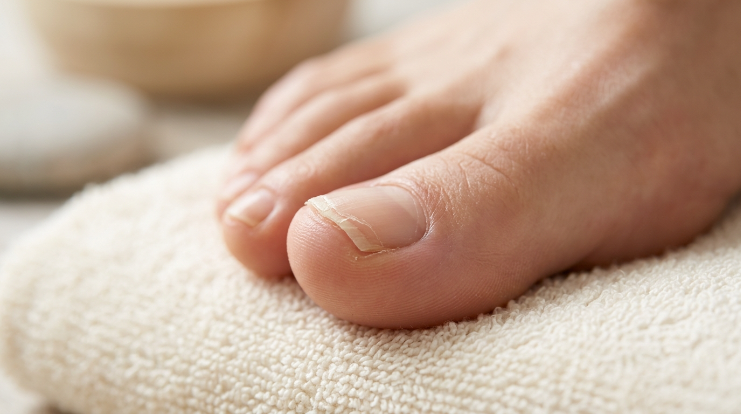
“Peeling” can describe several different nail changes.
Your nail plate is the hard part of the nail you see. If the very top layers begin splitting or flaking at the edge, the problem may be mostly surface damage.
Other people use “peeling” to describe a nail that is separating from the skin underneath it.
That distinction matters.
Surface Peeling or Splitting
You may notice:
- Thin layers flaking from the free edge
- A rough or uneven nail tip
- Small pieces catching on socks
- Splitting without significant pain
- A dry, brittle appearance
Surface peeling can occur after repeated physical stress or overly aggressive grooming.
Nail Lifting From the Nail Bed
If part of the nail becomes white or opaque because it is no longer attached to the skin underneath, this may be onycholysis, the medical term for nail separation.
The American Academy of Dermatology’s guidance on nail changes notes that nail lifting can be associated with fungal infection, psoriasis, or injury, including aggressive manicures and trauma from cleaning beneath the nail.
Do not try to file away or glue down a nail that is clearly lifting.
Why Are My Toenails Peeling? The Most Common Causes
Several everyday situations can make toenails look flaky, brittle, or separated.
1. Repeated Pressure From Shoes
Toenails take more physical abuse than most people realize.
Shoes that are too short or tight can repeatedly press the nail against the toe. Walking, running, dancing, hiking, or spending long hours on your feet can make that pressure worse.
You may not remember one specific injury because the damage happens gradually.
Watch for:
- Peeling concentrated near the tip
- Tenderness after wearing certain shoes
- Nail changes on the longest toes
- Repeated cracking in the same area
- Darkening after an obvious impact
If a certain pair of shoes repeatedly presses your nails, changing the footwear may be more useful than changing your nail products.
2. Aggressive Filing or Buffing
A nail file is useful for smoothing rough edges, but it can also remove more nail material than intended.
Problems are more likely when you:
- Use a very coarse file on a natural toenail
- Press hard because the nail seems thick
- File repeatedly in the same spot
- Buff the nail surface until it feels thin
- Use an electric nail drill without enough experience
- Keep filing because you want the nail to look perfectly smooth
Filing will not repair a damaged nail. It only removes material.
Once too much nail plate has been removed, you have to wait for healthier nail to grow forward.
3. Minor Nail Trauma
Dropping something on your toe is an obvious injury, but minor trauma can be surprisingly subtle.
A toenail can be stressed by:
- Stubbing your toe
- Running downhill
- Repetitive sports
- Tight socks
- A poorly fitting shoe
- Cutting the nail extremely short
- Digging into the nail corners
- Rough pedicure techniques
According to Cleveland Clinic’s information about nail separation, trauma and pressure from shoes are among the potential causes of onycholysis.
If trauma is responsible, the damaged area usually has to grow out rather than being instantly “fixed.”
4. Fungal Nail Infection
A fungal infection is one of the more important causes to rule out when a toenail is peeling, crumbling, or changing color.
Fungus does not always start with a dramatic yellow nail.
Early or developing symptoms may include:
- White, yellow, or brown discoloration
- Brittle or crumbly edges
- Thickening
- Debris underneath the nail
- A misshapen nail
- Nail lifting
- Several nails gradually becoming affected
Mayo Clinic’s nail fungus symptom guide describes thickening, discoloration, brittleness, crumbling, misshaping, and separation from the nail bed as possible symptoms.
Do not assume every peeling toenail is fungus. Injury, psoriasis, and other nail conditions can look similar.
Repeatedly filing a suspicious nail thinner may improve its appearance temporarily without treating the cause.
5. Dry, Brittle Nail Plates
Nails can become dry and fragile just like skin.
Frequent polish removal, repeated pedicures, harsh products, and environmental dryness can contribute to brittleness.
The American Academy of Dermatology recommends moisturizing nails after trimming and notes that dry nails split more easily.
A simple fragrance-free moisturizer or small amount of petroleum jelly around the nail and cuticle may be enough for routine dryness.
However, moisture balance matters with feet.
You want the nail and surrounding skin comfortably moisturized—not constantly damp inside sweaty socks or shoes.
6. Nail Products and Pedicure Damage
Gel polish, traditional polish, removers, adhesives, enhancements, and repeated buffing can all place stress on nails when used aggressively.
Your toenails may need a break if they become:
- Rough after product removal
- Thin after buffing
- Sensitive during filing
- Flaky after repeated polish changes
- Irritated around the nail folds
If peeling started immediately after a pedicure, product removal, or heavy buffing session, give the nail time to recover before repeating the service.
7. Psoriasis or Other Nail Conditions
Not all abnormal toenails are caused by fungus.
Psoriasis and other dermatologic conditions can change nail thickness, texture, color, and attachment.
If several nails are changing or you also have persistent skin symptoms, it is worth discussing the pattern with a dermatologist.
The goal is to identify the cause rather than trying increasingly aggressive cosmetic treatments.
How to Tell Whether Peeling Needs More Attention
Use the following guide as a starting point—not a diagnosis.
| What You Notice | Possible Explanation | Best Next Step |
|---|---|---|
| Mild flaking at the edge | Dryness or minor mechanical damage | Gentle filing and basic nail care |
| Peeling after aggressive buffing | Surface damage | Stop buffing and let nail grow |
| Peeling after tight shoes or running | Repeated trauma | Improve footwear and monitor |
| Yellow, thick, crumbly nail | Possible fungal infection | Consider professional evaluation |
| White area spreading from nail edge | Possible nail lifting | Avoid digging underneath; get checked if persistent |
| Redness, warmth or swelling | Possible irritation or infection | Seek medical advice |
| Significant pain or drainage | Infection or injury may be present | Stop DIY care and contact a healthcare professional |
| Dark streak or unexplained pigment change | Needs assessment | See a dermatologist |
Can You File a Peeling Toenail?
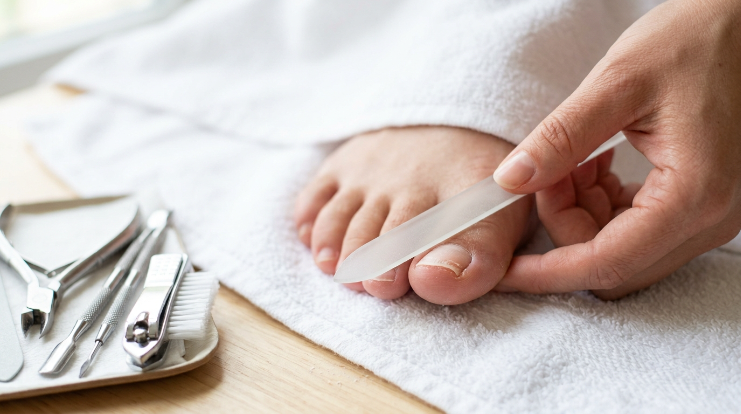
Yes—but only if you are smoothing a loose, rough edge on an otherwise manageable nail.
A file should not be used to remove an unexplained abnormality.
The AAD recommends smoothing rough nail edges with a nail file or emery board and filing in the same direction rather than sawing aggressively back and forth.
Nail File Options for Peeling Toenails
| File Type | Typical Cost | Best Use | Main Caution |
|---|---|---|---|
| Fine emery board | Low | Light edge smoothing | Wears out quickly and is difficult to thoroughly clean |
| Glass/crystal file | Moderate | Gentle finishing on natural nails | Can break if dropped |
| Fine-grit washable file | Low to moderate | Regular controlled shaping | Must be cleaned properly |
| Metal file | Low to moderate | Harder nail edges | Can feel aggressive on thin, damaged nails |
| Electric nail file | Moderate to high | Specialized material removal | Easy to over-file or create heat |
For a peeling natural toenail, control matters more than speed.
A fine manual file is usually a more forgiving choice than a powerful electric tool.
Expert Tip: If you keep needing to file the same peeling, discolored, or thickened area, stop treating it as a shaping problem. A nail file can smooth damage, but it cannot diagnose or cure whatever is causing the damage.
How to Care for a Peeling Toenail at Home
For mild peeling without pain, swelling, or suspected infection, keep the routine simple.
1. Examine the Nail Before Doing Anything
Remove polish if necessary so you can clearly see the nail.
Look for:
- Discoloration
- Thickening
- Lifting
- Bleeding
- Crumbling
- Red or swollen skin
- Drainage
- Tenderness
If anything looks suspicious, avoid aggressive cosmetic work.
2. Trim Conservatively
Toenails should generally be trimmed straight across.
Do not dig deeply into the corners trying to create a rounded shape.
Leave enough nail that you are not cutting into sensitive skin.
3. Smooth Only the Rough Edge
Use a clean, fine file.
File gently until the snag is no longer catching.
You do not need to make every layer look perfectly flat.
Stop if you notice:
- Heat
- Tenderness
- Increasing sensitivity
- Thinning
- Pain
4. Moisturize Dry Nails
If the nail and surrounding skin feel dry, apply a small amount of moisturizer around the nail.
Avoid packing oily products underneath a nail that has lifted.
A separated area can trap moisture and debris.
5. Reduce Repeated Shoe Pressure
Make sure your toes are not hitting the front or top of your shoes.
Your footwear should give your toenails enough space during walking.
This is especially important for runners and people who spend hours standing.
6. Keep Your Feet Clean and Dry
Change damp socks and allow shoes to dry between wears.
Warm, moist environments favor fungal growth, and the AAD advises keeping nails clean and dry as part of healthy nail care.
7. Give the Nail Time
Toenails grow slowly.
If the problem was caused by trauma, over-filing, or another temporary source of damage, the affected nail has to move forward as new nail grows from the base.
Cleveland Clinic notes that a toenail can take roughly 12 to 18 months to grow out completely.
That means improvement usually requires patience.
Nail File Hygiene Matters
A reusable nail tool should be treated like a personal-care tool, not a communal household item.
Good habits include:
- Do not share nail files or clippers.
- Remove nail debris after use.
- Wash reusable tools when their material allows it.
- Follow the manufacturer’s cleaning instructions.
- Allow washable tools to dry completely before storage.
- Replace worn or damaged emery boards.
- Keep tools used on a suspicious nail separate from your regular manicure tools.
If you suspect fungus, be especially cautious about cross-contamination.
Common Mistakes to Avoid
Avoid these common reactions when you notice a peeling toenail:
- Filing until every peeling layer disappears. You may make the nail thinner and more sensitive.
- Pulling loose layers off. The peel can travel farther into healthy nail.
- Digging underneath a lifted nail. This may injure the nail bed and introduce bacteria.
- Covering unexplained discoloration immediately with polish. Look at the nail first.
- Assuming yellow or peeling nails automatically mean fungus. Several conditions can look similar.
- Sharing nail files. Personal grooming tools can transfer organisms between people.
- Using an electric drill aggressively at home. Heat and excessive thinning can occur quickly.
- Ignoring shoe fit. Repeated pressure can keep damaging the nail even if your nail-care routine is perfect.
- Trying to treat pain, swelling, or infection with cosmetic products alone.
DIY Care vs. Salon Care
A nail technician can be helpful when the problem is primarily cosmetic.
For example, a professional may help you:
- Shape uneven nails
- Choose appropriate filing tools
- Perform a gentle pedicure
- Maintain healthy-looking nails
- Avoid unnecessary over-filing
But a nail technician is not a substitute for a medical professional when the nail appears infected or diseased.
Avoid requesting polish, acrylic, gel, or aggressive cosmetic correction simply to hide an unexplained nail change.
When to See a Nail Technician or Dermatologist
Consider a licensed nail technician when your toenail is healthy but difficult to shape or maintain cosmetically.
A dermatologist, podiatrist, or other healthcare professional is more appropriate if you notice:
- Persistent or worsening pain
- Redness or swelling
- Pus, drainage, or an unpleasant smell
- Significant nail lifting
- Thickening with discoloration
- Crumbling or distortion
- Several nails becoming abnormal
- Bleeding around the nail
- A dark streak or unusual pigment change
- A problem that continues despite gentle care
- Possible fungal infection
Medical evaluation is especially important if you have diabetes, poor circulation, a weakened immune system, or another condition that makes foot problems more complicated.
DIY nail care has limits. When the question changes from “How do I smooth this?” to “Why is my nail doing this?” professional evaluation may save you months of ineffective treatments.
FAQs
Why are the top layers of my toenails peeling?
Surface layers may peel because of repeated friction, dryness, minor trauma, aggressive buffing, or filing. If the nail is also thick, discolored, crumbling, painful, or lifting, another condition such as a fungal infection may be involved.
Can toenail fungus cause peeling?
Yes. Fungal nail infections can make toenails brittle, crumbly, thickened, discolored, or separated from the nail bed. However, appearance alone cannot always confirm fungus because injuries and skin conditions may look similar.
Should I file off a peeling toenail?
You can gently smooth a loose rough edge, but do not aggressively file away the nail surface. If peeling keeps returning, focus on finding the cause rather than removing more nail material.
Should I pull off the peeling part?
No. Pulling or tearing a loose layer can extend the split into healthy nail. Trim or lightly file only the clearly loose free edge.
Can nail polish make toenails peel?
Repeated polish removal, buffing, dehydration, and harsh manicure techniques may contribute to brittle or damaged nails. If peeling starts after repeated pedicures, consider taking a break and using gentler nail care.
How long does a damaged toenail take to grow out?
Toenails grow slowly, and complete replacement can take roughly 12 to 18 months. Small damaged areas may visibly improve sooner as they move toward the free edge.
Can a nail technician fix peeling toenails?
A nail technician can help with gentle cosmetic maintenance of otherwise healthy nails. Persistent discoloration, significant lifting, pain, swelling, drainage, or suspected infection should be evaluated medically rather than covered or aggressively filed.
Conclusion
If you have been wondering, “Why are my toenails peeling?”, start by looking at the whole nail rather than only the flaky edge.
Minor dryness, shoe pressure, an old injury, or aggressive filing may be responsible, and these problems often improve with gentler care and time. Keep your toenails trimmed appropriately, smooth only rough edges, use clean tools, reduce repeated pressure, and give damaged nail time to grow forward.
At the same time, do not ignore thickening, crumbling, discoloration, significant lifting, swelling, or pain. Those changes may need more than a home pedicure.
Your safest next step is simple: protect the nail first, file less rather than more, and get unexplained changes checked instead of trying to hide them.