Why Is My Toenail Loose? Common Causes and What to Do

Noticing that one of your toenails feels loose can be unsettling. Maybe the edge moves when you touch it, part of the nail looks white where it used to be pink, or the nail seems to be separating from the skin underneath.
So, why is my toenail loose? Common causes include an old injury, repeated pressure from tight shoes, a fungal nail infection, an aggressive pedicure, or another nail or skin condition.
Sometimes a loose toenail simply needs time and protection while healthy nail grows out. Other times, especially when there is pain, swelling, drainage, unusual discoloration, or no obvious reason for the change, it deserves professional attention.
Here is how to tell what may be happening, what you can safely do at home, and when to leave the nail alone and see a professional.
Quick Answer
A toenail can become loose after an injury, repeated shoe pressure, fungal infection, or another nail condition. Protect the nail, keep it clean and dry, and avoid pulling or aggressively filing it. If the nail is painful, swollen, discolored, draining, or becoming loose without an obvious cause, have it medically evaluated.
What Does a Loose Toenail Actually Mean?
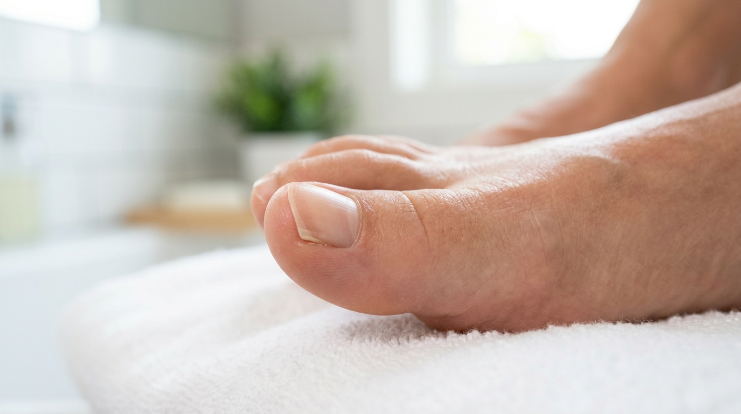
Your hard toenail sits on top of the nail bed, which is the skin underneath the nail plate.
When part of the nail separates from the nail bed, the separated section may appear:
- White or pale
- Yellowish
- Raised
- Hollow underneath
- Easier to move
- More likely to catch on socks
A small amount of separation near the end after an injury may eventually grow out.
However, a nail that is separating farther back toward the cuticle deserves more attention.
The American Academy of Dermatology recommends having a lifting nail evaluated because causes can include fungal infection, psoriasis, and nail injury. Its guide to nail changes a dermatologist should examine explains why unexplained nail lifting should not automatically be treated as a cosmetic issue.
Why Is My Toenail Loose? Common Causes
Several problems can make a toenail loosen. The appearance of the nail and what happened before you noticed the change can provide useful clues.
1. You Injured Your Toe
Trauma is one of the most straightforward explanations.
You may remember:
- Stubbing your toe
- Dropping something on your foot
- Kicking a hard object
- Having your toe stepped on
- Injuring it while exercising
But the injury is not always dramatic.
Repeated minor trauma can loosen a nail too.
For example, a runner whose toenail repeatedly hits the front of a shoe may eventually notice separation even without one obvious accident.
The American Academy of Dermatology’s injured nail care recommendations note that sports, unsuitable footwear, and everyday accidents can all injure nails.
2. Your Shoes Are Putting Too Much Pressure on the Nail
Shoes that are too short, narrow, or tight around the toes can repeatedly push against a toenail.
Over time, that pressure may cause:
- Tenderness
- Nail thickening
- Bruising
- Dark discoloration
- Lifting
- Nail loss
This is especially common if you walk, run, hike, or exercise regularly.
Check where your toes sit inside your shoes. They should not constantly hit the front of the shoe or feel compressed from the sides.
Changing footwear can help prevent additional damage, but it cannot immediately reattach a nail that has already separated.
3. You May Have a Fungal Nail Infection
Fungal nail infections frequently affect toenails.
A loose toenail becomes more suspicious for fungus when it is also:
- Yellow, white, or brown
- Thick
- Brittle
- Crumbly
- Distorted
- Surrounded by flaky skin
- Becoming progressively more separated
According to the NHS guide to fungal nail infections, fungal infections can cause a toenail to become thick, discolored, brittle, and eventually lift away.
Do not assume every yellow or loose nail is fungal, though. Injuries and other nail conditions can produce similar changes.
A nail file cannot diagnose or cure a fungal infection.
Trying to aggressively grind away a suspicious nail may irritate the tissue underneath and make it harder to tell what is happening.
4. An Aggressive Pedicure Damaged the Nail
Sometimes the problem starts during nail care.
Possible triggers include:
- Filing too deeply underneath the nail
- Aggressively scraping beneath the toenail
- Cutting the nail extremely short
- Using an electric file too aggressively
- Picking or prying at an attached nail
- Trying to remove material from under the nail with a sharp tool
A professional-looking pedicure should never require damaging the connection between your nail and nail bed.
If your toenail became loose soon after a salon visit or DIY pedicure, mechanical trauma may be involved.
5. Repeated Nail Polish or Enhancement Removal May Contribute to Damage
Regular polish itself does not normally make an otherwise healthy toenail suddenly fall off.
The bigger concern is how products are removed.
Scraping, peeling, prying, or aggressive filing can remove layers of natural nail and cause trauma.
If the nail already feels loose, avoid:
- Peeling polish from it
- Scraping underneath it
- Buffing aggressively
- Forcing off adhered product
- Covering a suspicious nail simply to hide it
A cosmetic cover-up can also make it harder for you to monitor changes in color, swelling, or separation.
6. An Ingrown Toenail or Surrounding Inflammation May Be Involved
An ingrown toenail happens when the side or corner of the nail grows into the surrounding skin.
Typical signs include:
- Pain along one nail edge
- Tenderness
- Swelling
- Inflamed skin
- Occasionally infection
Mayo Clinic notes that tight footwear, cutting toenails too short, nail injuries, infections, and strongly curved nails can contribute to ingrown toenails.
Do not use a nail file to dig underneath a painful nail corner.
That can injure the skin further.
7. Another Nail or Skin Condition Could Be Responsible
Not every loose nail has a simple DIY explanation.
Psoriasis and certain other medical conditions can affect how the nail grows and attaches.
That is one reason unexplained nail changes should not automatically be treated as fungus.
The NHS overview of common nail problems advises getting medical advice when a nail changes color or shape, falls off, or changes without an obvious explanation.
What Your Loose Toenail Looks Like Can Give You Clues
| What You Notice | Possible Explanation | Best Next Step |
|---|---|---|
| Loose after obvious impact | Nail trauma | Protect and monitor |
| Dark or purple after injury | Bleeding beneath nail may be present | Seek care if severe or very painful |
| Yellow, thick, crumbly and lifting | Possible fungal infection | Consider medical evaluation |
| Loose after aggressive filing | Mechanical nail damage | Stop filing and protect nail |
| Red, swollen skin around nail | Irritation or infection | Get professional advice |
| Pain along one nail corner | Possible ingrown toenail | Avoid digging or cutting deeply |
| Nail loosens without known cause | Several conditions are possible | Dermatologist or other qualified clinician |
A visual clue can help you decide what to do next, but appearance alone cannot reliably diagnose the cause.
What Should I Do With a Loose Toenail?
If the nail is only mildly damaged and there are no warning signs, gentle protection is usually smarter than trying to “fix” the nail cosmetically.
1. Do Not Pull the Toenail Off
A partially attached nail may be annoying, especially when it catches on socks.
Resist the temptation to pull.
You could tear nail that is still attached to living tissue, causing:
- Bleeding
- Pain
- Additional nail-bed injury
- A larger open wound
- Increased infection risk
Let the remaining attached section stay in place unless a healthcare professional advises otherwise.
2. Keep the Area Clean
Wash the toe gently with soap and water when appropriate.
Pat it dry rather than rubbing aggressively.
Keeping your feet dry is especially important if fungal infection is a possibility.
3. Protect the Nail From Snagging
A loose edge can catch on:
- Socks
- Blankets
- Carpet
- Shoes
- Clothing
If part of the nail is exposed or tender, light protection can reduce accidental pulling.
For an injured nail, the American Academy of Dermatology recommends protecting the area while it heals and advises applying adhesive materials to surrounding skin rather than directly onto the damaged nail.
4. Wear Roomy Shoes
Give the toe space.
Choose footwear that does not push against the injured nail or squeeze your toes together.
If every step causes the nail to hit the shoe, the repeated trauma may slow recovery.
Can You File a Loose Toenail?
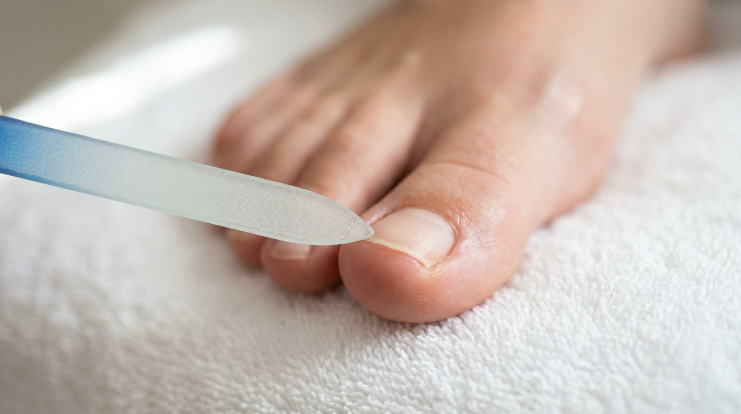
Sometimes—but very carefully.
A nail file can be useful if a fully detached free edge is rough or catching, but it should not be used to grind down the attached portion or explore underneath the loose nail.
Safer Nail File Options
| File Type | Best Use | Loose Toenail Consideration |
|---|---|---|
| Fine emery board | Smoothing a small rough edge | Easy to discard after use |
| Glass nail file | Gentle finishing on healthy attached edge | Clean after use |
| Metal nail file | Firmer nails | May feel too aggressive when nail is damaged |
| Coarse file | Thick artificial material or specific filing jobs | Usually too aggressive for a tender loose nail |
| Electric nail file | Fast material removal | Avoid DIY use on an injured or unexplained loose nail |
For most beginners, a fine manual file gives you more control.
How to File a Sharp Edge Safely
If there is no bleeding, severe pain, or obvious infection:
- Wash your hands.
- Make sure the nail and tool are clean.
- Identify only the rough free edge.
- Support the toe so the loose nail is not moving excessively.
- Use very light, controlled strokes.
- Stop as soon as the snag feels smooth.
- Do not push the file beneath the nail.
- Stop immediately if you feel pain, heat, pulling, or tenderness.
The goal is simply to stop a rough edge from catching.
Do not try to file the loose nail until it looks thin, flat, or normal again.
Expert Tip: If moving the file also moves the attached part of your toenail, stop filing. Protect the nail instead. Removing a tiny snag is useful; repeatedly flexing an already loose nail can cause more trauma.
Nail File Hygiene Matters More When a Nail Is Loose
Damaged nails deserve especially clean tools.
Do not share your toenail:
- Clippers
- Files
- Nippers
- Cuticle tools
A disposable emery board can be a practical option if fungal infection is suspected because you can throw it away after use.
Reusable glass or other washable files should be cleaned according to the manufacturer’s instructions and allowed to dry completely.
If a file is porous, worn, dirty, cracked, or difficult to clean properly, replacing it is usually the safer choice.
Should You Cut Off the Loose Part?
Do not cut into attached nail simply because it moves.
If only a clearly detached piece is hanging from the end, some minor nail injuries can be managed by carefully trimming away nail that is no longer attached.
The AAD specifically recommends gently trimming a hanging section that is not connected to the skin when caring for a mild nail injury.
However, this does not mean you should remove the whole nail yourself.
Stop DIY trimming if:
- You cannot clearly see what is attached
- Cutting hurts
- The nail begins bleeding
- Separation reaches close to the base
- The nail is badly damaged
- There is significant swelling
- You suspect infection
How Long Does a Loose Toenail Take to Grow Back?
Toenails grow slowly.
If a damaged toenail eventually falls off, replacing it is a long process rather than something that happens in a few weeks.
The NHS notes that a toenail lost after an injury can take up to about 18 months to grow back completely.
During that time, the new nail needs protection from repeated trauma.
You cannot safely speed up the process by filing the old nail aggressively.
The most useful approach is usually to:
- Protect new growth
- Avoid tight shoes
- Trim carefully
- Keep feet clean and dry
- Avoid picking
- Watch for abnormal changes
DIY Care vs. Salon vs. Medical Care
| Option | Best For | Cost Consideration | Main Limitation |
|---|---|---|---|
| Gentle home care | Minor stable injury without warning signs | Lowest | Cannot diagnose infection or nail disease |
| Nail technician | Cosmetic grooming of an otherwise healthy nail | Moderate | Nail technicians do not diagnose medical conditions |
| Podiatrist | Difficult toenails, foot-related nail problems, ingrown nails | Higher | Professional appointment required |
| Dermatologist | Unexplained lifting, infection concerns, unusual nail changes | Higher | Professional appointment required |
Price varies widely depending on location, insurance, salon type, and the care you need.
Choosing the cheapest option is not worthwhile if the nail looks infected or medically unusual.
When to See a Nail Technician or Dermatologist
A nail technician may be useful for routine cosmetic maintenance once your nail is stable and healthy.
However, a nail technician should not be your first stop for a painful, infected, bleeding, or unexplained loose toenail.
Consider a dermatologist, podiatrist, or other healthcare professional if:
- Your toenail is lifting without an obvious injury
- The nail is becoming increasingly separated
- There is severe or worsening pain
- Skin around the nail is red, warm, or swollen
- You notice pus or drainage
- The nail smells unusual
- The nail is very thick or crumbly
- Several nails are changing
- The nail is black or purple after a significant injury
- You cannot comfortably walk or wear shoes
- The condition is not improving
- You have diabetes, poor circulation, reduced sensation, or another condition that increases the risk of foot complications
AAD guidance also recommends prompt medical attention after a nail injury if the injury is particularly painful, the nail is black or purple, or a large amount of blood is beneath the nail.
Common Mistakes to Avoid
When your toenail becomes loose, avoid these common DIY mistakes:
- Pulling the nail off. Attached nail can tear living tissue underneath.
- Digging beneath it with a file. This can damage the nail bed.
- Aggressively thinning the nail. A loose nail is not a nail-drill practice surface.
- Cutting deeply into the sides. This may contribute to ingrown nail problems.
- Ignoring redness and swelling. These can be warning signs of infection.
- Covering every unusual change with polish. You may hide changes you need to monitor.
- Sharing nail tools. This is particularly unwise when infection is possible.
- Assuming yellow means fungus. Different nail conditions can look similar.
- Using an electric file on an injured nail. It can remove nail material faster than a beginner realizes.
- Expecting overnight regrowth. Toenails grow slowly and recovery requires patience.
FAQs
Will a loose toenail reattach itself?
The separated portion generally does not simply stick itself back to the nail bed. Instead, healthy new nail may gradually grow forward as the damaged portion grows out. How well this happens depends on the cause and whether the nail-growing area was injured.
Should I remove my loose toenail?
Usually, you should not pull off a partially attached toenail yourself. A small completely detached hanging edge may sometimes be carefully trimmed, but painful or extensive separation should be evaluated professionally.
Can I put nail polish on a loose toenail?
It is generally better to leave an injured or unexplained loose toenail visible while you monitor it. Polish can make color and other changes harder to see. Avoid cosmetic products entirely if there is broken skin, drainage, significant irritation, or possible infection.
Is a loose toenail always caused by fungus?
No. Injury, repeated shoe pressure, psoriasis, aggressive nail care, and other conditions can also cause nail lifting. Fungal infection becomes more likely when the nail is also thick, brittle, crumbly, or discolored.
Can I use a nail file on a loose toenail?
You can gently smooth a small rough free edge when the nail is otherwise stable, but never push the file underneath the loose section or aggressively grind the nail thinner. Stop if filing causes pain or movement of the attached nail.
Why is my toenail loose but not painful?
A painless loose toenail may follow an older injury or repeated pressure you barely noticed. Fungal infections can also develop gradually. If there is no clear reason for the separation, it is still worth getting the nail checked.
How can I keep my toenail from catching on socks?
Keep the free edge smooth with very gentle filing if safe, wear roomy footwear, and protect a vulnerable injured nail appropriately. Do not solve snagging by ripping or cutting away nail that is still attached.
Conclusion
If you have been wondering, “Why is my toenail loose?”, start by looking for the simplest explanation: an injury, tight footwear, repeated pressure, or recent nail care.
Then look at the nail itself.
Yellowing, thickening, crumbling, unexplained separation, redness, swelling, drainage, or significant pain can point to a problem that deserves professional attention.
For a minor stable injury, keep the toe clean, protect it from snagging, wear comfortable shoes, and use a nail file only for gentle smoothing of a safe free edge.
Most importantly, do not pull, dig beneath, or aggressively grind a loose toenail.
If you are unsure why the nail is lifting—or it looks painful, infected, or increasingly damaged—make the safer choice and have a qualified healthcare professional examine it before attempting another DIY pedicure.