
Why Do Toenails Become Uneven? Causes, Fixes, and Safe Filing Tips

Have you ever looked down after removing your polish and noticed that one toenail is wavy, crooked, thicker on one side, or simply growing differently from the others? It can be frustrating, especially when you want a smooth, polished pedicure.
So, why do toenails become uneven? Sometimes the explanation is simple: trimming habits, shoe pressure, dryness, or a past bump to the toe can affect how the nail looks. In other cases, an uneven toenail may be connected to fungal infection, repeated trauma, or another nail condition.
The good news is that many minor uneven edges can be managed safely at home. The important part is knowing when to file and smooth the nail—and when not to treat the problem as a cosmetic issue.
Quick Answer
Toenails can become uneven because of improper trimming, aggressive filing, tight shoes, repeated toe injuries, dryness, aging, or nail conditions such as fungal infections. Minor rough edges can usually be clipped and gently filed. However, toenails that become thick, discolored, crumbly, painful, swollen, or increasingly misshapen should be checked by a healthcare professional.
What Does an Uneven Toenail Look Like?
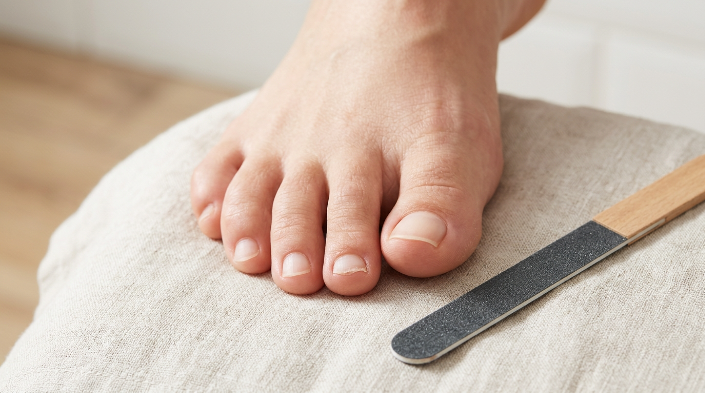
“Uneven” can mean several different things when you’re talking about toenails.
You might notice:
- One side of the nail is longer than the other.
- The free edge looks jagged or wavy.
- The nail surface has ridges or dips.
- One corner grows faster or seems thicker.
- The nail curves differently than neighboring nails.
- The nail becomes rough, brittle, or crumbly.
- The entire nail starts looking distorted.
A slightly uneven edge after clipping is usually very different from a toenail that has slowly changed its thickness, color, or overall shape.
That distinction matters because filing can improve a rough edge, but it cannot treat an infection or repair a problem underneath the nail plate.
Why Do Toenails Become Uneven?
Several everyday and health-related factors can change the appearance of your toenails.
1. Uneven Trimming
One of the simplest causes is the way you cut your toenails.
If you clip one side shorter, cut into the corners, or take several deep cuts at different angles, the finished edge may look crooked.
Repeatedly cutting deeply into the sides can also encourage irritation around the nail and may contribute to ingrown toenail problems.
The American Academy of Dermatology recommends trimming toenails mostly straight across and using a file to smooth rough or uneven edges afterward. Their guide to properly trimming nails also recommends avoiding aggressive back-and-forth filing.
2. Filing Too Aggressively
A nail file can make an uneven toenail look much neater, but too much pressure can create the opposite result.
A very coarse file can remove more nail from one area than another. Repeatedly grinding the top surface can also thin the nail plate.
This is particularly easy to do with:
- Very coarse emery boards
- Metal files
- Electric nail files
- High-speed rotary tools
- Files designed for acrylic or other enhancements
Natural toenails usually need much less abrasion than artificial nail products.
If your goal is simply to correct a slightly crooked edge, you usually need to file the edge, not grind down the entire nail.
3. Tight Shoes and Repeated Pressure
Your shoes can influence how your toenails grow.
A toe that repeatedly hits the front or side of a shoe experiences small amounts of trauma over time. This is common with tight shoes, narrow toe boxes, running shoes that do not fit correctly, and high heels that push the toes forward.
Repeated pressure may contribute to:
- Thickening
- Uneven growth
- Bruising
- Nail lifting
- Surface irregularities
The big toenail is especially vulnerable because it often takes the most pressure.
If the same toenail keeps becoming uneven, take a look at your footwear before assuming your filing technique is the problem.
4. Previous Toe Injuries
Think back to whether you have ever dropped something on your toe, stubbed it badly, or experienced repeated pressure from sports.
An injured nail can grow differently while the damaged area moves toward the tip.
If the area where the nail is produced was significantly injured, the new nail may also develop ridges, uneven thickness, or an unusual shape.
Because toenails grow slowly, a past injury may remain visible for quite a while.
Do not try to “file away” a deep ridge or major deformity. Filing can change the surface temporarily, but it cannot correct damage in the nail-growth area underneath.
5. Dry or Brittle Toenails
Dry nails may split, chip, and break irregularly.
Instead of developing one clean edge, a brittle toenail may lose tiny pieces along the tip, making it look uneven even when you trimmed it correctly.
Frequent exposure to polish remover, repeated pedicures, dehydration of the nail surface, and aggressive buffing can all make brittle nails harder to keep smooth.
Gentle filing is usually better than repeatedly clipping tiny broken corners.
6. Thickened Toenails
A thick nail is harder to cut evenly because standard clippers may not close cleanly around it.
You may end up taking several small cuts, leaving a jagged edge.
Toenails can become thicker for different reasons, including repeated trauma, age-related changes, certain skin conditions, and fungal infection. Mayo Clinic’s guidance on thickened toenails notes that injury, tight-fitting footwear, psoriasis, aging, and fungal infection are among possible causes.
If your toenail is becoming progressively thicker rather than simply having a rough tip, avoid assuming that filing alone will solve it.
7. Fungal Nail Infection
Fungal infection can dramatically change the texture and appearance of a toenail.
A fungal toenail may become:
- Yellow, white, or brownish
- Thick
- Brittle
- Ragged
- Crumbly
- Misshapen
- Partially separated from the nail bed
The NHS guide to fungal nail infections explains that fungal infections commonly affect toenails and may cause thickening, discoloration, brittleness, and crumbling.
A file can temporarily smooth a rough fungal nail, but filing does not cure the infection.
You should also avoid sharing files, clippers, or other pedicure tools when infection is suspected.
8. Natural Changes in Nail Growth
Not every uneven toenail is unhealthy.
Nails are not manufactured like perfectly identical pieces of plastic. Small variations in curve, thickness, and surface texture can occur naturally.
The key is whether the appearance is stable or whether something has recently changed.
A minor irregularity that has looked the same for years is generally less concerning than a nail that suddenly becomes thick, painful, dark, separated, or increasingly distorted.
Uneven Edge vs. Possible Nail Problem
| What You Notice | Possible Explanation | Can You File It? | Best Next Step |
|---|---|---|---|
| Slightly jagged tip | Uneven clipping or minor breakage | Yes, gently | Smooth with a fine file |
| One corner slightly longer | Trimming difference | Yes | File the longer edge lightly |
| Rough edge after clipping | Normal trimming result | Yes | Smooth without over-rounding |
| Brittle, chipped tip | Dryness or repeated damage | Usually | Gentle filing plus nail care |
| Very thick nail | Trauma, aging, fungus, or another condition | Only cautiously | Identify why it is thick |
| Yellow and crumbly nail | Possible fungal infection | Filing will not treat it | Seek appropriate advice |
| Painful or swollen nail | Injury, infection, ingrown nail, or inflammation | No aggressive filing | Get professional evaluation |
| New major shape change | Trauma or nail condition | Do not simply file it away | Consider a dermatologist |
How to Safely Fix a Slightly Uneven Toenail
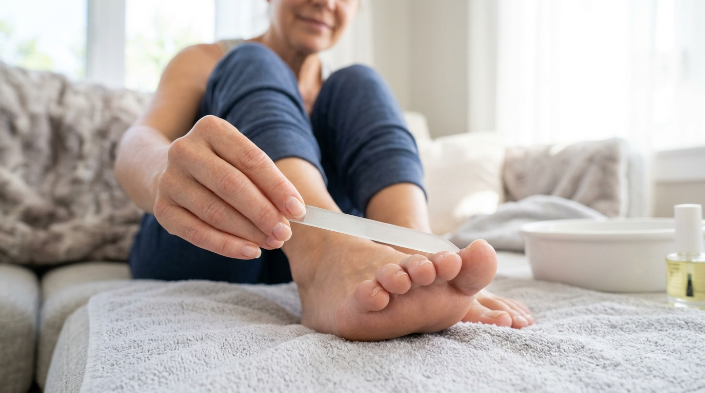
If the nail looks otherwise healthy and you only have a rough or crooked free edge, you can usually tidy it at home.
Step 1: Look at the Nail Before You File
Check for:
- Pain
- Redness
- Swelling
- Bleeding
- Drainage
- Dark discoloration
- Significant yellowing
- Nail lifting
- Severe thickening
If any of these are present, treat the nail as more than a cosmetic filing problem.
Step 2: Clean Your Tools
Use your own toenail clipper and nail file.
Do not share personal nail tools, especially when someone’s nail looks infected.
Reusable tools should be cleaned and thoroughly dried according to their care instructions. Disposable emery boards should be replaced when worn, damaged, or contaminated.
Step 3: Reduce Excess Length First
If the nail is significantly too long, clipping is more efficient than trying to file the entire length away.
Trim mostly straight across.
Instead of making one huge cut on a thick nail, use smaller controlled cuts.
Never tear off a partially clipped section.
Step 4: Smooth the Uneven Edge
Hold the file comfortably and use light pressure.
Concentrate on the area that sticks out rather than filing every part of the nail unnecessarily.
A few controlled strokes may be all you need.
Avoid digging deeply into the corners in an attempt to create a perfectly rounded shape.
Step 5: Stop Once the Edge Feels Smooth
More filing does not always mean a better result.
Once the edge no longer catches on socks and the shape looks reasonably balanced, stop.
Trying to achieve mathematical perfection can lead to over-filing.
Step 6: Moisturize the Surrounding Skin
After trimming and filing, apply moisturizer around the toes if the skin feels dry.
Do not pack creams underneath a lifted nail.
And if the surrounding skin is irritated or broken, avoid applying products that sting or cause more redness.
Which Nail File Is Best for Uneven Toenails?
The ideal file depends on how thick and healthy your toenail is.
Fine or Medium-Fine Emery Board
A basic emery board is inexpensive and works well for ordinary smoothing.
Best for: Normal natural toenails and occasional rough edges.
Cost: Low.
Limitation: It wears down and is difficult to thoroughly sanitize, so replacing it regularly is sensible.
Glass or Crystal Nail File
Glass files tend to provide controlled, gentle smoothing and can be a comfortable choice for natural nails.
Best for: Minor shaping, brittle edges, and people who prefer a reusable tool.
Cost: Higher upfront cost than disposable boards.
Limitation: Glass can break if dropped.
Metal Nail File
Metal files are durable but may feel aggressive on thin or fragile nails.
Best for: Limited controlled use on harder nail edges.
Cost: Usually affordable and reusable.
Limitation: Heavy pressure can remove nail quickly.
Electric Nail File
An electric file can remove material extremely quickly.
That convenience also makes it easier to over-file natural toenails.
For everyday uneven edges, most people do not need an e-file. A manual file gives you more feedback and control.
If you have thick, distorted, painful, or medically complicated toenails, professional assessment is safer than aggressively thinning them with an electric file at home.
Expert Tip
Expert Tip: When correcting an uneven toenail, file only what is actually sticking out. If you keep filing the entire nail every time one corner looks slightly uneven, you may gradually make the nail thinner and harder to maintain.
Should You File the Top of an Uneven Toenail?
Usually, you should be much more cautious with the top surface than with the free edge.
Light buffing can sometimes reduce a tiny superficial rough spot, but aggressively grinding away ridges or thickness can weaken the nail.
A raised ridge may also reflect the way the nail is growing rather than something sitting on top of it.
If you need to remove a large amount of the nail surface to make it “look normal,” that is a sign to stop and figure out why the nail is uneven.
Cosmetic improvement should never require pain, heat, or major thinning.
How to Prevent Toenails From Becoming Uneven
You cannot prevent every nail change, but a few habits can reduce unnecessary damage.
- Trim toenails mostly straight across.
- Smooth sharp edges instead of tearing them.
- Avoid aggressive filing.
- Wear shoes with enough room for your toes.
- Replace shoes that repeatedly press on the same nail.
- Keep your feet clean and dry.
- Do not share nail files or clippers.
- Avoid picking at lifted or broken nail sections.
- Give injured nails time to grow out.
- Pay attention to new changes in color, shape, or thickness.
Good toenail care is less about constantly “fixing” the nail and more about avoiding repeated damage.
DIY Care vs. Professional Pedicure
For a healthy toenail with one slightly crooked edge, home care is usually reasonable.
A professional pedicure may be useful when you simply struggle to shape your nails evenly or cannot comfortably reach your feet.
However, a nail technician is not a substitute for medical diagnosis.
A licensed nail technician can help with cosmetic grooming of healthy nails, but suspicious discoloration, infection, bleeding, major nail separation, or unexplained deformation belongs with a healthcare professional.
People with diabetes, poor circulation, reduced sensation in their feet, or other conditions that increase the risk from foot injuries should be especially cautious about DIY cutting and filing.
Common Mistakes to Avoid
When you’re trying to make uneven toenails look better, avoid these common mistakes:
- Using an extremely coarse file on a natural nail. Faster isn’t always safer.
- Filing until the nail feels hot or sore. Heat and discomfort are signs that you’re doing too much.
- Cutting deeply into both corners. Toenails are generally safer when trimmed mostly straight across.
- Trying to grind away thickening. Find out why the nail is thick first.
- Filing over irritated skin. You can create cuts and increase discomfort.
- Sharing nail tools. Personal grooming tools can carry debris and microorganisms.
- Ignoring progressive discoloration. Yellowing, darkening, crumbling, or lifting may require more than cosmetic care.
- Using an electric file without good control. Natural nail can disappear faster than you expect.
- Trying to make every toenail identical. Small natural differences are normal.
When to See a Nail Technician or Dermatologist
A nail technician can help if your toenails appear healthy but you need assistance shaping, smoothing, or maintaining them neatly.
A dermatologist, podiatrist, or other qualified healthcare professional is more appropriate when the nail itself appears unhealthy.
Arrange an evaluation if you notice:
- Increasing thickness
- Persistent yellow, brown, white, or dark discoloration
- Crumbling
- Nail separation
- Significant distortion
- Bleeding
- Swelling
- Drainage
- Increasing pain
- Red or inflamed skin around the nail
- Difficulty walking because of the nail
- A nail change that continues getting worse
Mayo Clinic notes that nail fungus can cause nails to become thick, discolored, brittle, ragged, misshapen, or separated from the nail bed, and recommends medical attention for worsening changes or symptoms such as swelling or pain.
Do not cover a suspicious nail repeatedly with polish just to hide the change. Knowing what is happening underneath is more important than getting a perfect pedicure.
FAQs
Why is one of my toenails more uneven than the others?
A single toenail may receive more pressure or trauma than the others. The big toe commonly rubs against shoes or gets bumped. Previous injury, trimming habits, and natural differences in nail growth can also make one nail look different.
Can I file an uneven toenail until it is completely smooth?
You can gently smooth a healthy rough edge, but do not aggressively file the top surface or thin a distorted nail just to make it look flat. Excess filing can weaken the nail.
Can toenail fungus cause an uneven shape?
Yes. Fungal nail infections may cause thickening, discoloration, brittleness, crumbling, and distortion. Filing may improve a rough edge temporarily, but it does not treat the infection.
Can tight shoes make toenails grow unevenly?
Repeated shoe pressure can injure the nail and surrounding tissue. If one toe constantly presses against the front or side of your shoe, changing the fit may help prevent further trauma.
Is a glass file better than a metal file for uneven toenails?
For ordinary natural toenails, a glass file can provide gentle, controlled smoothing. Metal files are durable but may be more aggressive, particularly on thin or brittle nails. The best option depends on your nail thickness and how much shaping is actually needed.
Will an uneven toenail eventually grow normally again?
It depends on the cause. A nail affected by temporary trauma may improve as healthy nail grows forward. Ongoing shoe pressure, repeated injury, infection, or damage to the nail-growth area may cause the irregularity to continue.
Should I go to a salon for an uneven toenail?
A nail technician can help shape an otherwise healthy nail. If the nail is painful, swollen, severely thickened, discolored, lifting, bleeding, or crumbly, seek medical evaluation instead of treating it as a routine pedicure issue.
Conclusion
So, why do toenails become uneven? Often, the answer is something manageable—uneven clipping, rough filing, brittle edges, tight footwear, or previous toe trauma. In those situations, careful trimming and gentle filing may be enough to keep the edge neat.
The most important rule is to pay attention to how the nail is changing.
A slightly crooked tip is usually a grooming problem. A nail that is becoming thick, discolored, crumbly, painful, swollen, or increasingly distorted may be telling you something more.
Choose a gentle file, keep your tools clean, avoid aggressive surface filing, and give injured nails time to grow. And when a toenail looks unhealthy rather than simply uneven, skip the DIY correction and have it properly evaluated.
A smooth pedicure is nice—but protecting the health of the nail underneath it should always come first.

