Why Does My Toenail Have a Dent? Causes, Care, and When to Worry

You look down at your toes during a pedicure and suddenly notice something strange: one toenail has a dip, groove, or little dent that was not there before.
So, why does my toenail have a dent?
Sometimes the explanation is simple. Pressure from tight shoes, a past injury, or temporary changes in nail growth can leave a visible indentation. Other times, dents may be connected with skin conditions, illness, nutritional problems, or another issue affecting how the nail grows.
The shape and location of the dent matter. A single groove running across the nail is different from dozens of tiny pin-like pits. Pain, discoloration, swelling, thickening, or nail lifting also changes what you should do next.
This guide explains the most common causes of toenail dents, what different dent patterns may mean, how nail files fit into safe care, and when it is smarter to stop DIY grooming and have the nail checked.
Quick Answer
A toenail can develop a dent after pressure, injury, or a temporary interruption in nail growth. A horizontal groove may be a Beau’s line, while many tiny pits may occur with certain skin conditions. If the dent is painful, discolored, worsening, affecting several nails, or accompanied by other changes, consider professional evaluation.
What Does a Dent in a Toenail Look Like?
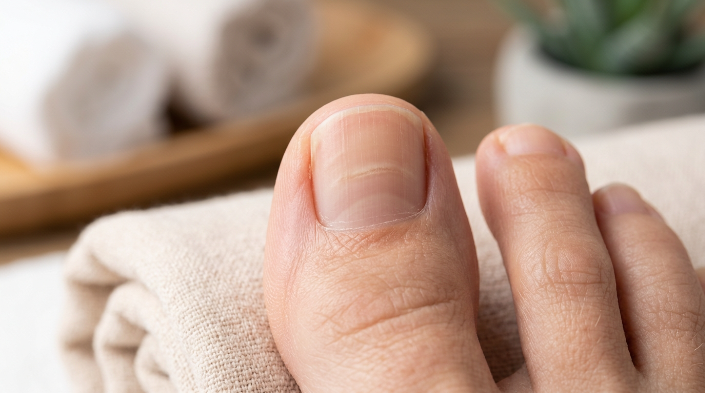
“Dent” is not one specific nail diagnosis. People often use the word to describe several different changes.
Your toenail might have:
- A horizontal groove running from one side to the other
- A small round depression
- Several tiny pin-like pits
- A dip near the center of the nail
- An uneven area after an injury
- A shallow ridge that becomes more visible as the nail grows
- A depressed section combined with discoloration or thickening
Looking at the pattern gives you useful clues.
A deep line that runs across the nail is often different from a ridge running from the cuticle toward the tip. According to the American Academy of Dermatology’s guide to nail changes, deep grooves across a nail can appear when nail growth slows or stops temporarily.
Common Reasons Your Toenail Has a Dent
1. Pressure or Minor Injury
One of the most ordinary causes is trauma.
Your toenail grows from a structure underneath the skin called the nail matrix. Think of the matrix as the nail’s growth center. If it is temporarily disturbed, the nail being produced may develop an uneven or depressed area.
Possible causes include:
- Dropping something on your toe
- Stubbing your toe
- Wearing shoes that repeatedly press against the nail
- Running or hiking in shoes with too little toe room
- Aggressive pedicures
- Picking or pushing too hard near the cuticle
- Repeated pressure on one particular toe
You may not even remember the original incident because toenails grow slowly. By the time the dent becomes obvious, the injury may have happened weeks earlier.
If the nail is otherwise normal and the indentation gradually travels toward the tip as the nail grows, an old injury becomes a reasonable possibility.
2. A Beau’s Line
A noticeable horizontal dent across the toenail may be what doctors call a Beau’s line.
Beau’s lines form when nail growth temporarily slows or stops. The interruption leaves a groove in the nail plate.
The Mayo Clinic’s overview of Beau’s lines explains that these grooves may appear following injury or illness and can also occur with infections, uncontrolled diabetes, circulation problems, high-fever illnesses, nutritional problems, or certain medications.
One groove does not automatically mean you have a serious health problem.
Context matters.
For example, a dent on one big toenail after repeatedly wearing tight running shoes is different from similar deep grooves suddenly appearing across many fingernails and toenails.
3. Nail Pitting
Tiny dents scattered across the surface are usually described as nail pits rather than one large dent.
They may look like someone gently pressed a pin or needle point into the nail several times.
The American Academy of Dermatology notes that pitting can occur in people with conditions such as psoriasis, atopic dermatitis, and alopecia areata.
Do not assume that every tiny irregularity means you have one of these conditions. Nail texture can vary naturally, and trauma may also create uneven areas.
However, repeated or widespread pitting deserves more attention than a single dent caused by obvious pressure.
4. A Previous Illness or Physical Stress
Your nails are constantly growing, but that growth can temporarily change when your body is dealing with significant stress.
A serious illness, high fever, infection, or other physical stress may interrupt nail production enough to leave a horizontal indentation afterward.
Because toenails grow slowly, you might notice the line well after you have recovered.
This is one reason looking at when the dent appeared can be useful. Think back over the previous several months rather than only the past week.
5. Repeated Shoe Pressure
Your favorite shoes can sometimes be part of the problem.
If the front of the shoe repeatedly pushes against a toenail, especially the big toe or second toe, the nail matrix may experience repeated minor trauma.
Watch for shoes that:
- Make your toes touch the front while walking
- Feel tight across the toe box
- Compress your toes together
- Cause nail tenderness after exercise
- Leave pressure marks around the toes
Athletic activities can make this more noticeable because your feet may slide forward repeatedly inside the shoe.
Switching to better-fitting footwear may help prevent additional trauma, although an existing dent still has to grow out with the nail.
6. Nail or Skin Conditions
Certain dermatologic conditions can change the nail surface.
Psoriasis is one example because it can affect both the skin and the nails. Nail changes can include pitting, discoloration, thickening, crumbling, or separation.
This is where self-diagnosis becomes unreliable. Several nail problems can look similar without an examination.
If you have dents along with unexplained skin patches, scaling, nail lifting, or repeated changes in multiple nails, a dermatologist is better equipped to determine the cause.
7. Nutritional or Underlying Health Problems
People sometimes immediately blame vitamin deficiency when they notice a nail dent.
Nutritional problems can affect nails, but appearance alone usually cannot tell you exactly what nutrient is missing.
Medical sources associate Beau’s lines with several possible health factors, including severe nutritional deficiencies in some situations. However, dents may also occur after ordinary injury or illness.
Do not start high-dose supplements simply because one toenail has a dent.
If you are concerned about nutrition because you also have fatigue, dietary restrictions, unexplained weight changes, or other symptoms, discuss those concerns with a healthcare professional.
What Your Toenail Dent Pattern May Suggest
| What You Notice | Possible Explanation | Best First Step |
|---|---|---|
| One horizontal dent on one toe | Old injury or repeated pressure | Protect the toe and monitor growth |
| Horizontal grooves on several nails | Temporary growth interruption | Consider recent illness and medical advice if unexplained |
| Many tiny pits | Nail pitting or skin condition | Consider a dermatologist |
| Dent after obvious trauma | Nail-matrix injury | Protect the nail and monitor |
| Dent plus yellow or thick nail | Infection or another nail disorder may be present | Avoid aggressive filing and seek evaluation if persistent |
| Dent plus redness or swelling | Irritation, injury, or infection | Seek professional care |
| New dark streak or unusual pigment | Requires proper assessment | See a dermatologist |
| Nail becoming loose | Trauma, infection, or another cause | Do not dig or file underneath it |
The table is only a practical guide. The appearance of a nail cannot confirm a diagnosis by itself.
Can You File a Dent Out of a Toenail?
Usually, you should not try to grind a toenail completely flat.
A dent is part of the nail plate. If you file aggressively over the top of the nail to erase the low area, you must remove healthy nail around it too.
That can leave the toenail:
- Thin
- Tender
- Sensitive
- More likely to split
- More vulnerable to further damage
A nail file is better for smoothing the free edge of the toenail rather than trying to erase an unexplained surface change.
The American Academy of Dermatology’s nail-trimming guidance recommends smoothing rough edges with a nail file or emery board and filing in one direction instead of repeatedly sawing back and forth.
Nail File Options for Toenails
| File Type | Typical Cost | Best Use | Main Benefit | Main Limitation |
|---|---|---|---|---|
| Emery board | $2–$6 | Everyday edge smoothing | Cheap and easy to control | Porous and wears out |
| Glass/crystal file | $8–$20 | Gentle finishing | Smooth and reusable | Can break if dropped |
| Metal file | $5–$15 | Firmer nail edges | Durable | Easy to use too aggressively |
| Buffer block | $3–$10 | Very light cosmetic smoothing | Easy to hold | Over-buffing can thin nails |
| Electric nail file | $20–$100+ | Specialized shaping | Removes material quickly | High risk of heat and over-filing |
Prices vary by retailer and quality, so use these as general ranges rather than fixed prices.
For a healthy natural toenail, you rarely need an expensive electric tool simply because you see a dent.
How to Care for a Dented Toenail Safely
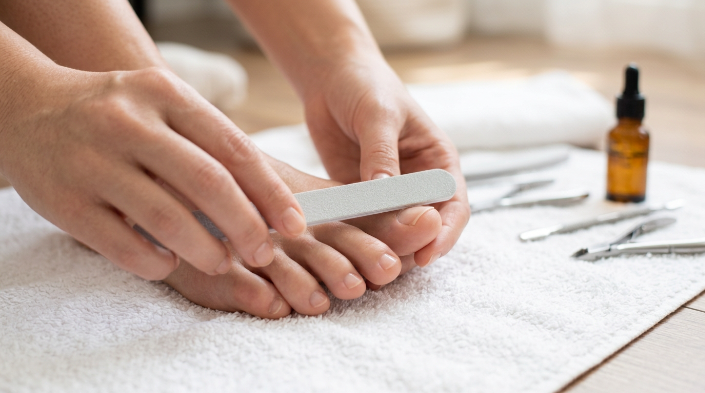
If the toenail is firmly attached, not painful, and does not show signs of infection, simple care is usually the safest approach.
1. Look at the Bare Nail
Remove polish so you can clearly see the shape, color, and surrounding skin.
Check whether the dent is:
- Moving toward the tip
- Becoming deeper
- Appearing on additional nails
- Associated with discoloration
- Surrounded by redness or swelling
2. Take a Photo
A photo gives you something objective to compare later.
Toenails grow slowly, so checking every day will not tell you much. Photographing the nail every few weeks under similar lighting can make changes easier to notice.
3. Keep the Nail Comfortably Short
Trim toenails straight across rather than deeply rounding the corners.
The NHS nail-problem guidance recommends regular trimming and advises against cutting down the sides of toenails, which may increase the risk of ingrown nails.
4. Smooth Only Rough Edges
If the end catches on socks, use a clean manual file.
Use light pressure.
Stop if you feel:
- Pain
- Heat
- Burning
- Tenderness
- Pulling on the attached nail
Do not repeatedly buff the dent itself.
5. Reduce Shoe Pressure
Check the fit of your footwear.
Your toes should have enough room that the nail is not continuously being pushed against the front or top of the shoe.
6. Practice Good Tool Hygiene
Keep nail clippers and reusable files clean and dry.
Do not share personal nail tools.
If a porous file has been used on a suspicious, infected-looking, or bleeding nail, replacing it is generally more practical than continuing to use it on healthy nails.
Expert Tip: Instead of trying to file a toenail dent away, photograph the bare nail once every few weeks. If the dent steadily moves toward the free edge as the nail grows and no new dents appear, you can track the change without thinning the nail.
DIY Care vs. Professional Help
A nail technician can be very helpful for ordinary cosmetic grooming.
For example, a licensed nail professional may help you:
- Shape an otherwise healthy toenail
- Smooth rough edges
- Choose an appropriate file
- Maintain cosmetic polish or enhancements
- Avoid overly aggressive filing techniques
But a nail technician should not be your primary source for diagnosing unexplained nail disease.
A dermatologist or other qualified healthcare professional is a better choice for unexplained pain, infection, persistent discoloration, significant nail distortion, or nail changes associated with skin or health symptoms.
When to See a Nail Technician or Dermatologist
Consider a Nail Technician When:
Your nail looks otherwise healthy and your concern is mainly cosmetic.
Examples include:
- A rough free edge
- Basic shaping
- Choosing a gentler nail file
- Removing or maintaining cosmetic nail products
Tell the technician about the dent before any aggressive buffing or product application.
Consider a Dermatologist or Healthcare Professional When:
Seek medical evaluation if you notice:
- Deep dents appearing repeatedly
- Similar grooves on several nails
- Numerous tiny pits
- Persistent pain
- Red, warm, or swollen skin
- Pus or drainage
- Significant nail lifting
- Thickening or crumbling
- Unexplained yellow, green, brown, or black discoloration
- A new or changing dark streak
- Bleeding without an obvious reason
- Nail changes combined with a rash or other skin symptoms
- A nail change that does not seem to grow out
The American Academy of Dermatology emphasizes that changes in nail color, texture, or shape can sometimes indicate an underlying condition and deserve professional assessment.
Do not use aggressive filing to hide a suspicious nail change before getting it examined.
Common Mistakes to Avoid
- Trying to grind the dent completely flat. This may unnecessarily thin healthy nail around the indentation.
- Using an electric file without experience. Motorized files remove material quickly and can create heat before a beginner realizes how much nail has been removed.
- Digging under the nail. Sharp tools or files underneath the nail can injure the nail bed and surrounding skin.
- Ignoring shoe pressure. If the same toe repeatedly hits your shoe, cosmetic filing will not address the source of the trauma.
- Sharing nail files. Personal grooming tools may carry nail debris and microorganisms between users.
- Assuming every dent means vitamin deficiency. Nail dents have many possible causes.
- Assuming every dent is harmless. Multiple pits, repeated grooves, pain, swelling, unusual color, or significant distortion deserve more attention.
- Covering a suspicious nail immediately with polish or enhancements. Seeing how the bare nail changes over time can provide useful information.
FAQs
Why does my big toenail have a dent in the middle?
A dent in the middle of a big toenail may follow pressure, an old injury, or a temporary interruption in nail growth. Tight shoes are a common source of repeated pressure on big toes. If the dent is deep, painful, discolored, or keeps returning, consider professional evaluation.
Can tight shoes cause dents in toenails?
Yes. Repeated shoe pressure can traumatize the nail and the area where it grows. Running, hiking, or walking in shoes with too little toe room may make this more likely.
Will a dent in my toenail grow out?
A dent caused by a temporary event often moves toward the tip as new nail grows from the base. Toenails grow slowly, so this process can take many months.
Are toenail dents a vitamin deficiency?
Not necessarily. Severe nutritional deficiencies can affect nail growth, but injury, pressure, illness, skin conditions, and several other factors can also cause nail changes. One dent cannot reliably diagnose a deficiency.
Why do I have tiny dents all over my toenail?
Multiple tiny depressions are usually described as nail pitting. Pitting can occur with conditions such as psoriasis and other inflammatory skin disorders. If you notice many pits or changes across several nails, a dermatologist can help identify the cause.
Should I buff out dents in my toenails?
Usually not. Aggressive buffing removes nail material from the surrounding surface and can make the nail too thin. Gentle filing is better reserved for rough free edges and snags.
When should I worry about a dented toenail?
Pay closer attention if the dent is painful, keeps returning, affects several nails, appears with swelling or drainage, or occurs alongside thickening, lifting, significant discoloration, or skin changes.
Conclusion
If you have been wondering, “Why does my toenail have a dent?”, start by looking at the pattern rather than immediately reaching for a nail file.
A single dent may result from ordinary pressure or an old injury. A horizontal groove can reflect a temporary interruption in nail growth, while many tiny pits may suggest a different type of nail change.
For simple cosmetic care, keep your toenails clean, trim them straight across, wear comfortable shoes, and use a gentle file only to smooth rough edges.
Most importantly, do not aggressively file away an unexplained change just to make the nail look normal. If the dent is persistent, painful, worsening, appearing on several nails, or accompanied by discoloration, swelling, lifting, or other symptoms, let a dermatologist or healthcare professional take a closer look.
Your nail may simply need time to grow out—but paying attention to the change is the smartest first step.