
Why Does My Toenail Have a Line Across It?

You notice a line running across your toenail during a pedicure, and suddenly you cannot stop looking at it. Maybe it is a shallow groove. Maybe it feels like a dent. Or perhaps the line seems lighter or darker than the rest of your nail.
So, why does my toenail have a line across it? A horizontal line can appear after pressure, an injury, illness, or another temporary interruption in nail growth. A deeper groove is often called a Beau’s line. Other types of lines can have different causes, so the appearance of the nail matters.
The good news is that one isolated line is not automatically a reason to panic. But a new, deep, painful, discolored, or recurring line deserves more attention.
Here is how to tell what you may be seeing, what you can safely do at home, whether a nail file can help, and when it is smarter to have the nail professionally examined.
Quick Answer
Why does my toenail have a line across it? A horizontal groove may be a Beau’s line, which can form when nail growth temporarily slows or stops after injury, pressure, illness, or physical stress. Mild lines often grow forward with the nail, but unexplained, recurring, painful, or discolored changes should be professionally evaluated.
What Does a Line Across a Toenail Mean?
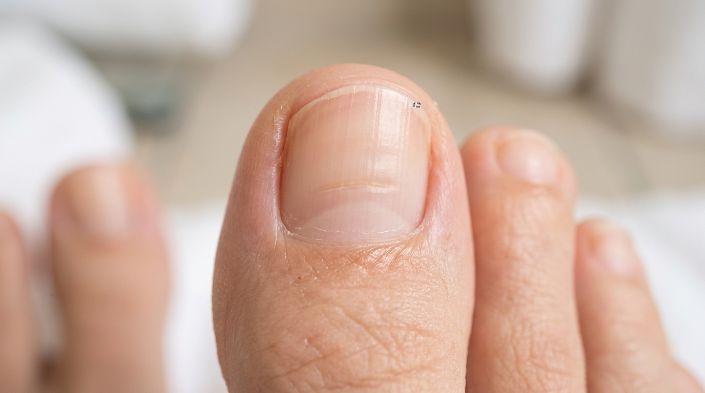
A line that travels from one side of the toenail to the other is different from a vertical ridge that runs from the cuticle toward the tip.
Horizontal lines can vary quite a bit.
You might notice:
- A shallow ridge you can barely feel
- A deeper groove or dent
- A white line without a physical groove
- More than one horizontal line
- The same type of line across several toenails
- A line combined with thickening or discoloration
One of the most common names associated with a noticeable horizontal groove is Beau’s line.
The American Academy of Dermatology’s guidance on nail changes explains that deep grooves running across a nail can appear when something temporarily slows or stops nail growth. Illness, injury, and major physical stress are among the possible triggers.
That does not mean every faint line on your toenail is a Beau’s line. The depth, color, number of nails affected, and other symptoms all provide useful clues.
What Are Beau’s Lines?
Beau’s lines are horizontal dents or grooves that run across fingernails or toenails.
Your toenail is constantly forming new nail material at the nail matrix, the growth area underneath the skin near the base of the nail.
If something temporarily interferes with that growth, the section produced during that period may be thinner or depressed. As your toenail continues growing, the groove slowly moves toward the tip.
Mayo Clinic also describes Beau’s lines as grooves that can form when nail growth temporarily stops because of illness or injury.
This explains something that surprises many people: the event that caused the line may have happened weeks or months before you noticed it.
Toenails grow slowly, so the timing is not always obvious.
Common Reasons You May Have a Horizontal Toenail Line
Previous Toe Injury
A toe injury can temporarily disturb the nail matrix.
Possible examples include:
- Stubbing your toe hard
- Dropping something on your foot
- Sports-related impact
- Repeatedly hitting the front of a shoe
- Aggressive clipping or pedicure work near the nail base
You may not remember a minor injury by the time the groove grows far enough to become noticeable.
If only one toenail is affected, especially a big toenail that takes a lot of shoe pressure, localized trauma becomes an important possibility.
Tight or Poorly Fitting Shoes
You do not need one dramatic injury to stress a toenail.
Repeated pressure from shoes can irritate the nail over time. Running shoes, work boots, high heels, or footwear with a narrow toe box may repeatedly push against the nail.
Check whether your toes have enough room to move comfortably.
If your nail is constantly bumping the shoe, switching footwear may be more useful than trying to polish, buff, or file away the visible line.
A Previous Illness or Fever
A significant illness can temporarily affect nail growth.
Because toenails grow slowly, a horizontal groove may appear well after you have recovered.
The NHS notes that deep lines or grooves across nails, known as Beau’s lines, may occur when you have been ill and can grow out over time.
A single old ridge following a known illness may therefore be less concerning than repeated new grooves with no obvious explanation.
Major Physical Stress
Your body does not treat nail growth as a top priority during significant physical stress.
An operation, serious infection, major illness, or another substantial physical event may temporarily change how the nail grows.
Again, the line usually records a past event rather than something that happened yesterday.
Certain Medications or Treatments
Some medicines and medical treatments can affect normal nail growth.
Chemotherapy is a well-known example. Other medications may also influence nail appearance depending on the individual and treatment involved.
If horizontal lines appeared after starting a medication, do not stop the medicine on your own. Ask the healthcare professional who prescribed it whether the nail change could be related.
Skin or Nail Conditions
Not every irregular toenail comes from Beau’s lines.
Psoriasis, eczema around the nail, fungal infections, and other nail disorders can change nail texture, thickness, color, or shape.
Fungal nails, for example, are more commonly associated with changes such as thickening, discoloration, brittleness, or crumbling rather than one clean horizontal groove.
A nail that has several changes at once is worth examining more carefully.
One Toenail vs. Several Toenails
The number of nails affected can be useful.
| What You Notice | Possible Consideration | Practical Next Step |
|---|---|---|
| One groove on one toenail | Local injury or repeated shoe pressure may be involved | Monitor the nail and reduce pressure |
| Same groove across several nails | A broader interruption in nail growth may be possible | Consider recent illness or physical stress |
| Repeated grooves | Nail growth may be getting interrupted more than once | Discuss with a healthcare professional |
| Groove plus pain or swelling | Injury, inflammation, or infection may be present | Avoid cosmetic treatment and seek evaluation |
| Groove plus major color change | May not be a simple cosmetic ridge | Have the nail professionally checked |
| Nail lifting, crumbling, or thickening | Another nail condition may be involved | Consider a dermatologist or podiatrist |
This table is only a guide. Nail appearance alone cannot diagnose the underlying cause.
Can You File Away a Line Across Your Toenail?

Usually, you should not try to file a horizontal groove completely flat.
The line is part of the nail plate. If you aggressively file the surrounding nail until the groove disappears, you may thin healthy nail instead of fixing the cause.
That can leave the toenail:
- Tender
- Flexible
- More likely to split
- Easier to damage
- Sensitive under pressure from shoes
A nail file is better for smoothing a rough free edge at the tip of the toenail than grinding down the nail surface.
Which Nail File Is Best?
If your toenail needs ordinary edge maintenance, choose a file that gives you control.
| Nail File Type | Best Use | Main Consideration |
|---|---|---|
| Fine emery board | Light everyday smoothing | Inexpensive but wears out quickly |
| Glass file | Gentle finishing and reusable home care | Usually costs more than disposable files |
| Fine metal file | Durable edge maintenance | Can remove nail quickly if used aggressively |
| Coarse file | Very thick free edges | Easy to over-file a normal or thin nail |
| Electric nail file | Specialized shaping or thick nails | Requires more skill and can cause damage if misused |
For a healthy natural toenail, gentle manual filing is usually easier to control.
The AAD recommends keeping nails shaped and snag-free with a file and also emphasizes keeping nails clean and dry.
Do not use an aggressive file simply because the horizontal line bothers you cosmetically.
Expert Tip:
Expert Tip: Treat the cause, not the groove. If the line is growing forward with your toenail, leave the nail surface alone and focus on protecting it from shoe pressure, picking, and aggressive filing.
Safe At-Home Care While the Line Grows Out
If the toenail is comfortable, normally colored, attached to the nail bed, and the line appears to be growing forward, basic care may be all you need.
1. Keep the Toenail Clean and Dry
Wash your feet normally and dry them carefully.
Persistent moisture can make the environment around your toenails more favorable to fungal and bacterial growth.
2. Trim Straight Across
Avoid digging down into the corners.
The American Academy of Dermatology’s nail-trimming guidance recommends careful trimming practices that help protect the nail and surrounding skin.
Leave enough nail that you are not cutting into tender skin.
3. Smooth Only Rough Edges
After clipping, use a clean fine file to remove sharp areas.
A few controlled strokes are enough.
Do not keep filing simply because you can still see the horizontal groove.
4. Check Your Shoes
Your longest toe should not constantly hit the front of your shoe.
If your toenails feel sore after walking, running, or working, your footwear deserves a closer look.
5. Avoid Picking at the Groove
A dent can make the surface tempting to pick.
Do not scrape the line with a cuticle pusher, clipper tip, metal file, or other sharp tool.
You could create a crack or opening where none existed before.
6. Give It Time
A damaged section of nail cannot instantly transform back into perfectly smooth nail.
It generally has to grow forward until it can eventually be trimmed away.
Because toenails grow slowly, visible improvement takes patience.
Should You Cover the Line With Nail Polish?
If the nail is otherwise healthy, regular polish may make a mild ridge less noticeable.
However, polish should not be used to hide a nail you actually need to monitor.
Consider leaving the nail bare if you notice:
- New discoloration
- Rapid changes
- Nail lifting
- Thickening
- Crumbling
- Pain
- Swelling
- Drainage
Being able to see the nail clearly makes it easier to notice whether the condition is improving or changing.
Avoid aggressively buffing the surface simply to create a smoother polish finish.
Hygiene and Nail Tool Safety
Toenail tools come into contact with nail debris and surrounding skin, so basic hygiene matters.
Keep personal nail files, clippers, and other tools clean and dry.
Avoid sharing them, particularly if anyone has a suspected fungal nail or skin infection.
Disposable emery boards are inexpensive but difficult to thoroughly sanitize once heavily used. Glass and some metal files can be easier to clean, depending on their construction and manufacturer instructions.
If you use salon services, choose a salon that follows proper cleaning and disinfection procedures.
A cosmetic service should never involve cutting, drilling, or filing into painful, swollen, bleeding, or infected-looking tissue.
Common Mistakes to Avoid
When a toenail suddenly looks unusual, it is easy to become too aggressive with DIY care.
Avoid these common mistakes:
- Grinding the ridge flat. This can thin otherwise healthy nail.
- Digging underneath the nail. Sharp tools can injure the nail bed.
- Cutting the toenail extremely short. This may irritate surrounding skin.
- Rounding deeply into the corners. This may increase ingrown-nail problems.
- Picking at the groove. You can turn a harmless uneven area into a split.
- Using the same file on a suspicious nail and healthy nails. This is poor hygiene when infection is possible.
- Assuming every horizontal line is fungus. Different nail changes have different causes.
- Covering a worsening nail with polish for months. You may miss important changes.
- Treating pain, pus, or swelling as a beauty problem. Those symptoms need more than cosmetic care.
When to See a Nail Technician or Dermatologist
A nail technician can help with cosmetic grooming of a healthy nail, such as safely shortening the free edge or smoothing minor roughness.
However, a nail technician is not the right person to diagnose an unexplained medical nail change.
A dermatologist, podiatrist, or other qualified healthcare professional is more appropriate when you notice:
- A deep horizontal groove with no obvious explanation
- Lines repeatedly appearing
- Several nails changing at the same time
- Significant yellow, brown, black, white, or green discoloration
- Increasing nail thickness or crumbling
- Nail separation
- Pain or tenderness
- Redness or swelling
- Warm skin around the nail
- Bleeding
- Drainage or pus
- A nail changing shape rapidly
- An unusual dark streak or pigment spreading into nearby skin
The NHS advises seeking medical advice for unexplained changes in nail shape or color and for sore, red, swollen, or warm skin around a nail.
If you have diabetes, poor circulation, reduced sensation in your feet, or another condition that makes foot injuries higher risk, professional foot care may also be safer than aggressive DIY trimming or filing.
FAQs
Is a horizontal line in my toenail serious?
Not always. One horizontal line can develop after injury, shoe pressure, illness, or a temporary interruption in nail growth. However, deep, recurring, unexplained, painful, or discolored lines should be professionally evaluated.
What does a Beau’s line look like on a toenail?
A Beau’s line usually looks like a horizontal dent or groove running from one side of the nail toward the other. It is a physical depression rather than simply a painted-looking line of color.
Can tight shoes cause a line across my toenail?
Repeated shoe pressure can injure or stress a toenail, so footwear may contribute to localized nail changes. If one toenail repeatedly hits the front of your shoe, consider switching to footwear with more toe room.
Will a horizontal toenail line grow out?
If the nail matrix has returned to normal growth, the affected section can gradually move toward the tip as new nail grows behind it. Toenails grow slowly, so this process may take many months.
Should I buff Beau’s lines?
Avoid aggressive buffing. Removing enough surface nail to completely flatten a deep groove may leave the surrounding nail too thin. Gentle cosmetic smoothing should never cause tenderness or substantially reduce nail thickness.
Can toenail fungus cause lines?
Fungal infections can create abnormal nail texture, but they more often cause combinations of thickening, brittleness, crumbling, or discoloration. A horizontal groove alone does not prove you have fungus.
Why do I have horizontal lines on several toenails?
Several nails developing similar grooves may suggest that nail growth was affected around the same time by something broader than one local toe injury. Significant illness, physical stress, certain treatments, or other health factors can sometimes be involved, so unexplained changes across several nails are worth discussing with a healthcare professional.
Conclusion
If you have been asking, “Why does my toenail have a line across it?”, start by looking at the type of line and the rest of the nail.
A horizontal groove may be a Beau’s line caused by a temporary interruption in nail growth. Injury, repeated shoe pressure, illness, and other physical stresses are among the possible triggers.
Your safest next step is usually simple: protect the nail, keep it clean, trim it carefully, and avoid trying to grind the groove away with a nail file.
Watch whether the line gradually moves toward the tip as the nail grows. If it keeps returning, appears on several nails, changes color, hurts, or comes with swelling, thickening, lifting, or drainage, stop treating it as a cosmetic issue and arrange a professional evaluation.
The goal is not to make every toenail perfectly smooth today. It is to help the next section of nail grow as safely and normally as possible.

