
What Causes Toenail Deformities? Common Reasons Your Nails Change Shape

A toenail that suddenly becomes thick, curved, ridged, lifted, or oddly shaped can be hard to ignore. You may wonder whether it is just a cosmetic problem, damage from shoes, a fungal infection, or something that deserves medical attention.
So, what causes toenail deformities? Common causes include repeated pressure or injury, fungal infections, improper trimming, skin conditions such as psoriasis, aging, damage to the nail growth area, and, less commonly, underlying health conditions.
The appearance of the nail can give you clues, but shape alone cannot confirm the cause. This guide explains the most common reasons toenails become deformed, which changes may be manageable with simple nail care, how nail files and other tools should be used safely, and when it is smarter to stop DIY care and see a professional.
Quick Answer
Toenail deformities can be caused by repeated shoe pressure, injuries, fungal infections, improper trimming, psoriasis, aging, or damage to the nail matrix where new nail grows. Some medical conditions can also affect nail shape. A toenail that becomes painful, swollen, severely thickened, dark, lifted, or suddenly misshapen should be professionally evaluated.
What Is a Toenail Deformity?
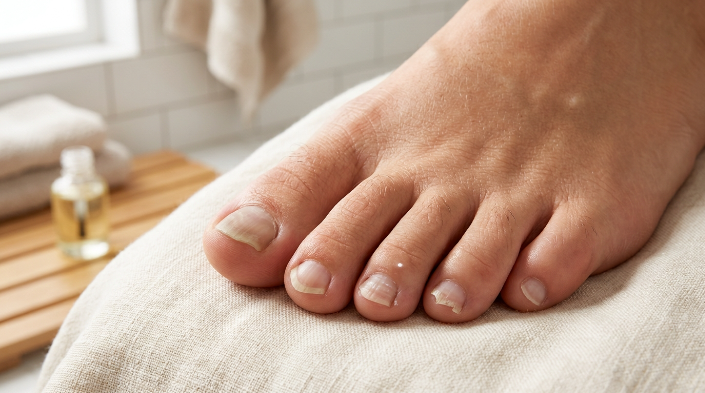
A toenail deformity simply means the nail has changed from its usual shape, thickness, surface, or growth pattern.
That might look like:
- A nail that curves more than usual
- A thick or bulky toenail
- Deep ridges or grooves
- A nail growing sideways or unevenly
- A brittle or crumbling edge
- A nail lifting away from the nail bed
- A nail becoming unusually narrow, wide, or distorted
- An overgrown nail that becomes horn-like
A small change does not automatically mean something serious is wrong. Toenails deal with daily pressure from shoes, workouts, accidental bumps, polish, pedicures, and trimming.
Still, a new or unexplained change deserves attention because toenails can also reflect infection, skin disease, injury to the growth center, or other health concerns.
What Causes Toenail Deformities?
Several different problems can change the way a toenail grows. Sometimes more than one cause is involved.
1. Repeated Pressure From Shoes
One of the easiest causes to overlook is everyday pressure.
Shoes that are too short, narrow, or tight through the toe box can repeatedly push against the nail. Running shoes, pointed heels, work boots, and snug athletic footwear may all create friction if they do not fit well.
Over time, repeated pressure can cause:
- Thickening
- Curving
- Surface ridges
- Small areas of discoloration
- Lifting
- Uneven growth
You do not need one dramatic injury for this to happen. Hundreds of small impacts against the front of a shoe can irritate the nail and the tissue underneath it.
Check whether your longest toe has enough room to move comfortably inside your everyday shoes. If your toenail repeatedly touches the front of the shoe when walking downhill, running, or exercising, footwear may be contributing.
2. A Previous Toenail Injury
A stubbed toe, dropped object, sports injury, or aggressive pedicure can temporarily change nail growth.
The visible nail plate is produced by tissue near its base called the nail matrix. Think of the matrix as the nail’s growth center.
If the matrix is injured, the new nail may grow with:
- A ridge
- A groove
- Extra thickness
- A split
- An uneven surface
- A permanently altered shape in more serious injuries
Minor trauma may simply grow out.
Toenails grow slowly, however, so you may continue seeing the damaged section for many months. NailPrime’s guide explaining why toenails grow slowly can help put that long recovery period into perspective.
If a nail was badly crushed, torn off, or repeatedly damaged, its final shape may not match the original nail perfectly.
3. Toenail Fungus
Fungal nail infection, also called onychomycosis, is another common reason a toenail becomes misshapen.
According to the American Academy of Dermatology’s guide to nail fungus symptoms, fungal infection can make a toenail thick, discolored, brittle, crumbly, lifted, or visibly misshapen.
Possible signs include:
- Yellow, white, brown, or darker discoloration
- Thickening
- Crumbling at the edge
- Buildup underneath the nail
- Separation from the nail bed
- Increasing distortion
- More than one affected nail
Fungal nails can look similar to nails damaged by trauma or psoriasis, so appearance alone is not always enough for diagnosis.
Do not assume every thick or yellow toenail is fungus. A dermatologist may examine the nail or test a nail clipping before recommending treatment.
Also, filing away the thick part does not remove the underlying infection. The fungi can remain inside the nail and tissue underneath it.
4. Improper Toenail Trimming
Toenail shape can also be influenced by how you trim it.
Cutting extremely short, digging into the sides, or rounding the corners deeply may irritate the surrounding skin and increase the chance that an edge presses into the nail fold.
NailPrime’s guide to the most common toenail trimming mistakes explains why aggressive corner cutting, dull tools, and over-filing can create unnecessary problems.
For routine grooming, the American Academy of Dermatology’s nail-trimming guidance recommends trimming toenails straight across and smoothing rough edges with a nail file.
Avoid carving down the sides just because the nail looks curved.
That may make the nail appear neater temporarily while creating more irritation as it grows.
5. Nail Psoriasis and Other Skin Conditions
Psoriasis can affect toenails as well as skin.
Nail psoriasis may cause:
- Tiny pits or dents
- Yellow, white, or brown discoloration
- Crumbling
- Thickened areas
- Buildup beneath the nail
- Nail lifting
- Uneven texture
The American Academy of Dermatology notes that nail psoriasis can sometimes occur even when obvious psoriasis plaques are not present on the skin.
This is one reason it is risky to diagnose a nail problem based only on photos or appearance.
A fungal infection and nail psoriasis can look surprisingly similar, yet they require different treatment.
6. Aging and Naturally Thick Toenails
Toenails often become thicker, harder, and slower-growing over time.
Slow growth means damage takes longer to grow out. Years of pressure from shoes or minor injuries may also gradually change the way a toenail looks.
Some people naturally develop more curved or thicker nails than others.
A thicker nail is not automatically unhealthy, especially when it:
- Has changed gradually
- Does not hurt
- Is not lifting
- Has no surrounding redness or swelling
- Has no unexplained dark area
- Can still be trimmed safely
However, a nail that becomes dramatically thicker or more distorted deserves closer attention.
7. Severe Overgrowth or Curving
Some toenails become extremely thick and curve as they grow.
A very overgrown, claw-like, or horn-shaped nail can occur after years of neglect, repeated trauma, circulation problems, certain skin conditions, or inherited tendencies.
The American Academy of Dermatology refers to severe thick overgrowth as onychogryphosis and recommends professional care because these nails can be difficult to trim safely.
Trying to flatten or thin a severely deformed nail with an aggressive file at home can create heat, pain, splitting, or accidental injury.
8. Health Conditions That Affect Nail Growth
Most uneven toenails are not signs of a major illness.
Still, certain nail changes can occasionally be associated with problems elsewhere in the body.
The American Academy of Dermatology’s guide to nail changes that deserve evaluation explains that unusual grooves, extreme curving, spoon-shaped nails, severe overgrowth, and some color changes may sometimes occur alongside nutritional deficiencies or heart, lung, liver, circulation, or other health problems.
This does not mean you should diagnose yourself from your toenails.
It means unexplained or dramatic changes are worth mentioning to a healthcare professional, especially when several nails change at once or you have other symptoms.
What Different Toenail Changes May Suggest
| Toenail change | Possible causes | Best next step |
|---|---|---|
| Thick and yellow | Fungus, repeated trauma, aging | Keep clean and dry; consider medical evaluation if persistent |
| Curved downward | Natural shape, repeated pressure, severe overgrowth, less commonly health conditions | Check shoe fit; seek care if new or worsening |
| Crumbly edge | Fungus, trauma, psoriasis | Avoid aggressive filing; get evaluated if it spreads |
| Deep horizontal groove | Previous injury or temporary interruption in growth | Monitor as it grows out; seek care if unexplained |
| Nail lifting | Trauma, fungal infection, psoriasis | Keep protected and avoid digging underneath |
| Very thick horn-like nail | Long-term pressure, skin disease, circulation issues, inherited tendency | Professional trimming is usually safer |
| Dark streak or unexplained dark area | Trauma or pigmentation, but some changes require medical evaluation | Have a new or changing dark streak checked promptly |
| Red, swollen skin around nail | Ingrown nail or infection | Stop cosmetic treatment and seek care if worsening |
The pattern matters.
A small ridge after stubbing one toe tells a different story from five toenails becoming thick and yellow at the same time.
Can Nail Files Fix a Deformed Toenail?
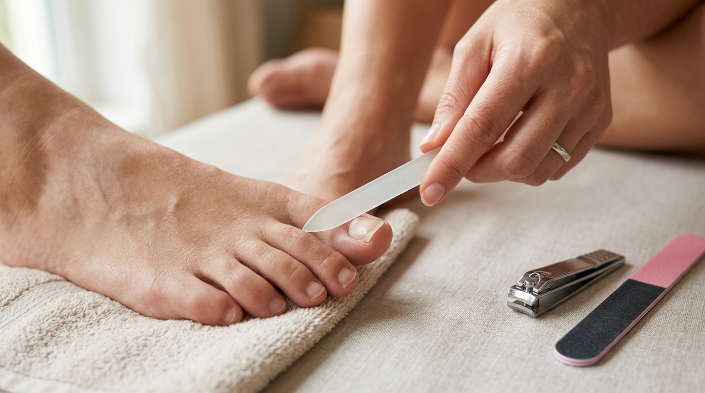
A nail file can improve a rough edge, but it cannot fix the medical reason a toenail is growing abnormally.
For normal grooming, files are useful for:
- Smoothing sharp edges
- Removing tiny snags
- Refining the free edge after clipping
- Making healthy toenails more comfortable inside socks
They should not be used to grind away:
- Unexplained thickening
- A deeply curved sidewall
- An infected-looking nail
- A nail that is separating
- Painful tissue
- Dark discoloration
For healthy natural nails, a gentler file is usually easier to control. NailPrime’s guide to choosing a nail file for natural nails explains the differences among glass, emery, ceramic, and other file types.
A very coarse file removes material quickly but also makes it easier to go too far.
Expert Tip: If you are filing a toenail because it looks medically abnormal rather than because the edge simply feels rough, stop and figure out the cause first. Cosmetic smoothing should never replace diagnosis.
How to Care for a Mildly Misshapen Toenail at Home
If the nail is comfortable, attached, and otherwise looks healthy, simple maintenance may be reasonable.
1. Check your footwear
Make sure your toes are not compressed.
You should be able to wiggle them without the nail repeatedly striking the inside of the shoe.
2. Trim carefully
Use clean, sharp toenail clippers.
For longer nails, shorten the nail gradually rather than forcing one large cut. NailPrime’s guide on how to trim long toenails properly walks through the technique in detail.
3. Keep the edge mostly straight
Do not dig deeply into the corners.
Leave a small visible free edge rather than cutting the nail flush with the skin.
4. File only rough spots
Use light pressure and a clean file.
Stop once the snag is smooth.
5. Keep tools personal
Do not share nail files, clippers, nippers, towels, or similar grooming items when infection is possible.
Fungi that cause nail infections can spread through contaminated personal items and damp shared environments.
6. Watch how the new nail grows
Because toenails grow slowly, improvement is gradual.
Take a clear photo once a month if you want to compare the nail objectively rather than checking it every day.
DIY Care vs. Professional Care
| Situation | DIY care | Nail technician | Dermatologist or podiatrist |
|---|---|---|---|
| Healthy nail with a rough edge | Usually appropriate | Appropriate | Usually unnecessary |
| Mild cosmetic shaping | Appropriate | Appropriate | Usually unnecessary |
| Thick but comfortable healthy nail | Sometimes | May help with grooming | Consider if difficult to cut |
| Possible fungus | Not enough for diagnosis | Should not diagnose it | Best choice |
| Painful ingrown edge | Avoid digging | Not appropriate for treatment | Best choice |
| Severe curving or overgrowth | Avoid aggressive filing | Limited role | Best choice |
| Nail lifting or crumbling | Avoid DIY thinning | Cosmetic services should pause | Best choice |
| New unexplained dark streak | Do not cover and ignore | Not appropriate for diagnosis | Prompt dermatology evaluation |
A nail technician can be helpful for cosmetic care of healthy nails.
A technician is not the right person to diagnose an unexplained nail deformity, infection, circulation problem, or suspicious color change.
When to See a Nail Technician or Dermatologist
Choose a nail technician when your toenails are healthy and you simply want neat shaping, filing, polish, or routine pedicure maintenance.
Consider a dermatologist, podiatrist, or other healthcare professional when you notice:
- Increasing pain
- Redness or swelling
- Pus or drainage
- Bleeding around the nail
- A nail separating from the nail bed
- Severe thickening
- Rapidly worsening shape changes
- Multiple nails changing together
- A nail that becomes very difficult to cut
- Persistent yellowing or crumbling
- A new or changing dark streak
- A deformity that appeared without an obvious injury
The AAD specifically recommends evaluation for unexplained changes in nail color, texture, or shape because some changes need more than cosmetic care.
If you have diabetes, reduced sensation in your feet, circulation problems, or a weakened immune system, be especially cautious about cutting, grinding, or digging around an abnormal toenail.
Common Mistakes to Avoid
- Assuming every thick nail is fungus. Trauma, psoriasis, aging, and other problems can look similar.
- Trying to file the deformity away. Filing changes the surface, not the underlying cause.
- Using an extremely coarse file on a natural toenail. It removes nail quickly and gives you less margin for error.
- Cutting down the sides of a curved nail. This may irritate the nail fold or contribute to an ingrown edge.
- Ignoring shoe pressure. Repeated trauma can continue even when your pedicure technique is perfect.
- Sharing nail tools. Contaminated grooming tools can spread fungal infections.
- Covering an unexplained dark change with polish for months. A new or changing dark streak deserves medical attention.
- Continuing a pedicure when the toe hurts or bleeds. Pain is a reason to stop, not a reason to trim more.
- Expecting instant improvement. A damaged toenail has to grow forward before the old distorted section disappears.
FAQs
Can a deformed toenail grow back normally?
Yes, sometimes. If the cause was temporary pressure, minor injury, or improper grooming and the nail matrix remains healthy, new nail may gradually grow normally. Significant damage to the nail matrix can cause longer-lasting changes.
Why is only one toenail deformed?
A single affected nail often points toward a local cause such as repeated shoe pressure, an old injury, an ingrown edge, or infection limited to that toe. However, appearance alone cannot confirm the cause.
Why is my big toenail thick and curved?
Repeated pressure, previous trauma, fungal infection, aging, or severe overgrowth can all contribute. If the nail keeps becoming thicker, painful, discolored, or difficult to trim, have it evaluated.
Can tight shoes permanently change toenail shape?
Repeated pressure can damage the nail or its growth area over time. Mild changes may improve after the pressure stops, while deeper or repeated injuries can produce longer-lasting distortion.
Can I file down a thick toenail?
You can gently smooth a healthy rough edge, but avoid aggressively thinning a nail when you do not know why it is thick. Fungal infection, psoriasis, trauma, and other conditions may need specific treatment.
Does toenail fungus always cause deformity?
No. Early fungal infection may begin with a small color change. As it progresses, the nail may become thick, brittle, lifted, crumbly, or misshapen.
Should I go to a salon for a deformed toenail?
A salon is appropriate for routine grooming of healthy nails. Painful, infected, dramatically thickened, crumbling, lifting, or unexplained nail changes should be assessed medically rather than treated as a normal pedicure problem.
Conclusion
What causes toenail deformities depends on the pattern of the change. Tight shoes, repeated injuries, fungal infections, trimming mistakes, psoriasis, aging, and damage to the nail matrix are common possibilities. Less commonly, unusual nail changes may accompany broader health problems.
For a mildly uneven but healthy nail, start with simple care: wear properly fitting shoes, trim straight across, use clean tools, and file only rough free edges.
More importantly, know when cosmetic care has reached its limit. Pain, swelling, drainage, severe thickening, lifting, unexplained discoloration, or a rapidly changing nail deserves professional attention.
Treat your toenail’s shape as useful information. Protect the nail first, avoid aggressive DIY fixes, and get the cause checked when something does not look or feel right.

