
What Is Nail Dehydrator Used For? Complete Nail Prep Guide

Quick Answer
A nail dehydrator is used before gel, acrylic, builder gel, or other nail enhancements to temporarily remove surface oil, moisture, and residue from the natural nail plate. This creates a cleaner surface for better adhesion and can help reduce premature lifting when the rest of the application is done correctly. For broader product-safety guidance, see the FDA nail care product guidance.
What nail dehydrator helps with
- Removes surface oil: It helps clear natural oils that may interfere with adhesion.
- Reduces surface moisture: The liquid evaporates quickly and leaves the nail temporarily dry.
- Improves nail prep: It creates a cleaner surface before primer, base coat, gel, or acrylic.
- Helps limit lifting: Better preparation can reduce one common cause of early product separation.
- Supports longer wear: Good prep gives the nail system a better chance to stay attached.
One important tip
- Use only a thin coat and follow the instructions for your specific dehydrator, primer, and nail system.
When I first started paying closer attention to nail prep, dehydrator seemed like one more bottle in an already crowded routine. Once I understood its job, the order of the entire manicure made more sense.
This guide explains what nail dehydrator is used for, when you need it, how to apply it, and how it differs from primer. I’ll also cover common mistakes and safety points that matter for at-home manicures in 2026.
In This Guide
- What is a nail dehydrator?
- What is nail dehydrator used for?
- When should you use nail dehydrator?
- Nail dehydrator vs primer: what is the difference?
- How do you use nail dehydrator correctly?
- Does nail dehydrator prevent lifting?
- Can nail dehydrator damage your nails?
- Do you really need a nail dehydrator?
- Frequently asked questions
What Is a Nail Dehydrator?
A nail dehydrator is a preparation liquid used on the natural nail before many artificial nail products. Its main purpose is to temporarily remove surface oil, moisture, and residue that can interfere with adhesion.
Simple definition: A nail dehydrator is a fast-evaporating nail-prep product that leaves the natural nail surface temporarily cleaner and drier before another nail product is applied.
The word “dehydrator” can sound harsher than the product’s actual purpose. It isn’t designed to permanently remove moisture from your nails.
Instead, it changes the nail surface for a short period. That temporary window is useful when you’re about to apply primer, base coat, gel, acrylic, or another enhancement.
How does nail dehydrator work?
Most nail dehydrators use fast-evaporating solvents or cleansing ingredients. The exact formula varies by brand, so the ingredient label and directions matter.
When you brush a thin layer over the nail plate, the liquid picks up or displaces surface contamination and then evaporates. The nail usually looks matte rather than shiny afterward.
- Before dehydrator: The nail may contain natural oil, moisture, dust, or residue from preparation.
- After dehydrator: The surface is cleaner and temporarily less oily.
- Next step: You apply the primer, base, or enhancement specified by your nail system.
What Is Nail Dehydrator Used For?
Nail dehydrator is mainly used to improve the preparation of the natural nail before products that need strong adhesion. Think of it as preparing the surface rather than creating the bond itself.
1. Removing natural oils before application
Natural nails don’t stay perfectly oil-free throughout the day. Skin oils can transfer onto the nail plate through normal touching and handling.
A dehydrator helps remove that surface oil immediately before application. This gives the next product a cleaner surface to contact.
2. Reducing temporary surface moisture
Water or moisture on the nail can make consistent product application harder. A nail dehydrator helps leave the surface temporarily dry before the enhancement goes on.
This doesn’t mean you should try to “dry out” healthy nails for long periods. The goal is controlled preparation immediately before application.
3. Preparing nails for gel polish
For gel manicures, dehydrator may be used after shaping, cuticle-area preparation, and removal of surface dust. The next step depends on the gel system.
Some systems call for dehydrator followed by primer and base coat. Others use fewer preparation products, so always check the manufacturer’s instructions.
4. Preparing nails for acrylic or enhancements
Acrylic and other nail enhancements depend heavily on clean preparation. Dehydrator is commonly used before the bonding or primer stage in these routines.
- Acrylic enhancements
- Gel extensions
- Builder gel
- Polygel systems
- Some press-on or nail-tip applications
Compatibility matters more than simply adding more prep products. Products from unrelated systems shouldn’t automatically be layered together.
When Should You Use Nail Dehydrator?
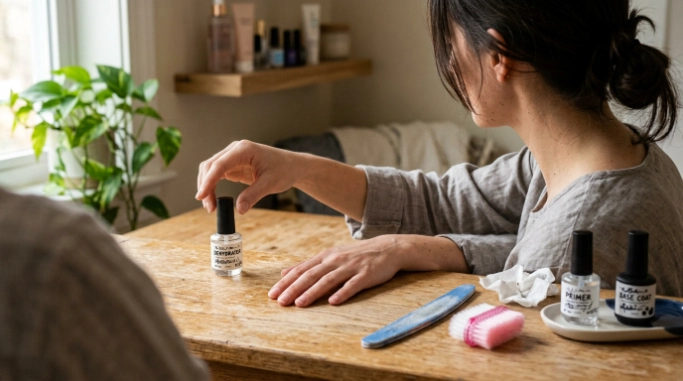
You normally use nail dehydrator near the end of natural-nail preparation and before your adhesion products. The nail should already be shaped, cleaned, and free of loose dust.
Where does dehydrator go in nail prep?
A common enhancement-prep sequence looks like this:
- Wash or sanitize your hands as appropriate and let the nails dry fully.
- Remove old product if necessary.
- Shape the free edge.
- Carefully prepare the cuticle area without cutting healthy living skin.
- Lightly prepare the nail surface only if your system requires it.
- Remove all visible filing dust.
- Apply a thin layer of nail dehydrator.
- Allow it to evaporate as directed.
- Apply primer if your system requires one.
- Continue with the recommended base or enhancement product.
A mistake I often see in home routines is touching the nail after dehydrating it. That can transfer skin oil straight back onto the surface you just cleaned.
Once the prep stage begins, I treat the nail plate like a clean working surface. I avoid touching it until the enhancement has been applied.
Should you dehydrate nails before every manicure?
Not necessarily. Traditional nail polish, gel systems, acrylic systems, and press-on products can all have different preparation instructions.
If the manufacturer doesn’t call for a dehydrator, adding one isn’t automatically better. Follow the system you’re using rather than assuming every manicure needs the same routine.
Nail Dehydrator vs Primer: What Is the Difference?
Nail dehydrator and nail primer are not the same product. Dehydrator primarily cleans and temporarily dries the surface, while primer is designed to help the next product bond to it.
| Product | Main purpose | Typical position | Does it create adhesion? |
|---|---|---|---|
| Nail dehydrator | Removes surface oil, moisture, and residue | Before primer or base | Indirectly supports adhesion through cleaner prep |
| Nail primer | Promotes bonding between nail and enhancement | Usually after dehydrator | Yes, that is its primary job |
| Isopropyl alcohol | Cleans surface residue and oils | Varies by system | No |
| Acetone | Strong solvent commonly used for removal and cleaning | Only when specifically appropriate | No |
Do you need both dehydrator and primer?
You may need both when the nail system specifically calls for them. They perform different jobs, which is why professional-style systems often include both steps.
However, some products are designed to work without a separate primer. Others combine preparation functions into one product.
Acid primer vs acid-free primer
Primer formulas also differ from one another. Some professional nail primers contain stronger acids, while many systems use acid-free bonding products.
Never assume stronger means better. Use the primer designed for your enhancement system and follow its label carefully.
How Do You Use Nail Dehydrator Correctly?
The best way to use nail dehydrator is with a thin, controlled application on the natural nail plate. More product doesn’t create better preparation.
Step-by-step nail dehydrator application
- Finish your dry prep: Complete shaping and any required gentle surface preparation first.
- Remove dust: Clear filing dust from the nail and surrounding area.
- Avoid touching: Keep fingertips away from the prepared nail surface.
- Wipe the brush: Remove excess liquid on the bottle neck before application.
- Apply a thin layer: Cover the natural nail without flooding surrounding skin.
- Let it evaporate: Wait according to the product directions.
- Continue immediately: Apply the next required prep or enhancement product.
Common nail dehydrator mistakes
Most problems come from application habits rather than a lack of product. Avoid turning a simple preparation step into an aggressive one.
- Using too much: A soaked nail doesn’t need to be the goal.
- Flooding the skin: Keep prep liquids on the nail plate whenever possible.
- Touching the nail afterward: This can put oil back onto the prepared surface.
- Skipping dust removal: Dehydrator isn’t a substitute for removing visible filing debris.
- Mixing incompatible systems: Random combinations can perform differently from a manufacturer’s tested system.
- Repeated applications: Reapplying unnecessarily can expose the nail and skin to more solvent than needed.
Does Nail Dehydrator Prevent Lifting?
A dehydrator can help reduce lifting caused by oil, moisture, or poor surface preparation. It cannot fix every reason gel, acrylic, or builder products lift.
What causes nail enhancements to lift?
Lifting is usually a system problem rather than a single-product problem. Several factors can affect how well an enhancement stays attached.
- Oil or contamination on the natural nail
- Product touching the cuticle or surrounding skin
- Incomplete nail preparation
- Incorrect primer or base application
- Using incompatible products
- Improper gel curing
- Overly thick product application
- Mechanical stress on long enhancements
- Picking or using nails as tools
This is why I wouldn’t treat dehydrator as a magic anti-lifting product. It addresses one important part of the process: creating a clean surface before bonding begins.
What if your nails are naturally oily?
People often describe certain nails as “oily” when enhancements repeatedly lift despite careful application. A good dehydrator may be especially useful when surface oil appears to be contributing to the problem.
Still, repeated lifting deserves a look at the whole routine. Check your cuticle-area prep, product compatibility, application thickness, lamp compatibility, and curing instructions.
Can Nail Dehydrator Damage Your Nails?
Nail dehydrator is intended for brief surface preparation, but solvent-based products can irritate or dry the nail and surrounding skin when misused. Use the smallest amount needed and keep it away from broken or irritated skin.
The OSHA guidance for nail salon chemical hazards recommends following product labels and safety information while limiting unnecessary chemical exposure.
Can nail dehydrator make nails dry or brittle?
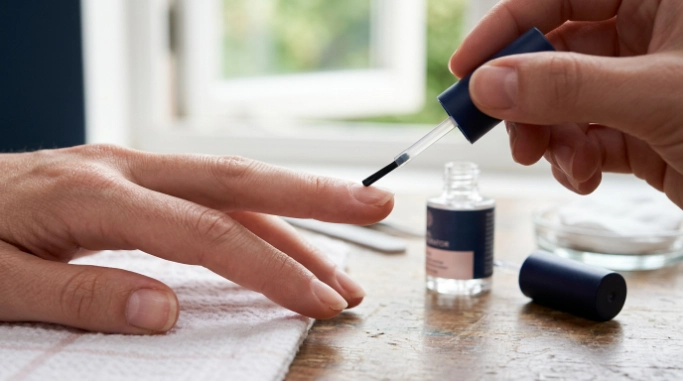
Frequent exposure to strong solvents may contribute to dryness, especially when combined with repeated polish removal and aggressive filing. That doesn’t mean normal dehydrator use automatically damages healthy nails.
The bigger concern is overuse. Applying multiple coats or repeatedly dehydrating the same nail isn’t usually necessary unless the product instructions tell you otherwise.
What if dehydrator touches your skin?
Try to keep the liquid on the nail plate rather than the cuticle or sidewalls. Stop using a product if you develop persistent burning, redness, swelling, itching, blistering, or another unusual reaction.
Nail cosmetics can cause irritant or allergic contact dermatitis in some people, as explained in DermNet’s nail cosmetics allergy guidance.
Health note: If irritation is severe, keeps returning, or involves swelling, blistering, nail separation, or signs of infection, stop the service and consult a dermatologist or healthcare professional.
Keep prep products away from damaged nails
Don’t apply nail dehydrator over cuts, bleeding skin, or a painful nail area unless a qualified professional has advised you otherwise. Cosmetic nail application shouldn’t be used to cover a possible infection or unexplained nail problem.
- Stop if the product causes strong burning.
- Don’t use it to treat fungus or another nail condition.
- Keep bottles closed when not in use.
- Use products in a ventilated area.
- Follow storage and flammability warnings on the label.
Do You Really Need a Nail Dehydrator?
You need a nail dehydrator when your nail system recommends it or when it forms part of a compatible preparation routine. You don’t need to add one simply because another manicure tutorial uses it.
When a dehydrator is especially useful
- You are applying acrylic, builder gel, or another enhancement that calls for dehydrator.
- You have repeated lifting linked to surface contamination or oily nail plates.
- Your professional nail system includes a separate dehydrator step.
- You want a consistent prep routine before a bonding product.
When you may be able to skip it
- Your specific system states that dehydrator isn’t required.
- Your prep or bonding product already performs the required cleaning step.
- You are applying a conventional polish that doesn’t call for specialized enhancement prep.
- Your nails or surrounding skin are irritated and you need to stop cosmetic application.
In 2026, there are countless prep combinations sold for home manicures. I still prefer the simplest rule: use the fewest products needed to follow one compatible system correctly.
Adding an extra bottle isn’t automatically an upgrade. Better technique usually matters more than stacking unnecessary preparation products.
Frequently Asked Questions About Nail Dehydrator
Do you use nail dehydrator before or after primer?
Nail dehydrator normally goes before primer because it prepares and cleans the natural nail surface. Primer then helps promote adhesion between the prepared nail and the enhancement, although your manufacturer’s directions should always take priority.
Can you use nail dehydrator without primer?
Yes, some nail systems use dehydrator without a separate primer. Whether that is appropriate depends on the gel, base, acrylic, or enhancement system you’re applying, so don’t assume primer is always mandatory.
Can rubbing alcohol replace nail dehydrator?
Isopropyl alcohol can remove some surface oil and residue, but it isn’t automatically equivalent to every commercial nail dehydrator. Purpose-made dehydrators may use different solvent combinations, so use the preparation method recommended for your nail system.
Can acetone be used as a nail dehydrator?
Acetone is a strong solvent that can remove oil and moisture from the surface, but that doesn’t make it a universal replacement for dehydrator. Acetone can also dry the surrounding skin, so follow your product system instead of improvising.
How long should nail dehydrator dry?
Most dehydrators are designed to evaporate rather than cure under a lamp, but exact instructions vary. Wait until the product has evaporated as directed on the label before applying your primer, base coat, or enhancement.
Does nail dehydrator need a UV or LED lamp?
Most standard nail dehydrators air-dry and don’t require a UV or LED lamp. A lamp is generally used later for compatible gel products, but always check the label because nail systems can differ.
Why is my gel still lifting after using dehydrator?
Dehydrator only addresses part of the adhesion process. Lifting can also come from cuticle contamination, product touching skin, incompatible products, incorrect application thickness, curing problems, or physical stress on the enhancement.
The main takeaway: Nail dehydrator is used to create a temporarily clean, dry nail surface before products that depend on good adhesion. It works best as one controlled step in a complete preparation system, not as a cure for every lifting problem.
If your manicure keeps lifting, review each stage from nail preparation through application and curing. A consistent routine usually tells you more than simply adding another prep product.

