
When to Use Nail Dehydrator: The Complete Nail Prep Guide

Quick Answer
Use nail dehydrator near the end of your nail-prep routine, after shaping, cuticle cleanup, light buffing if your system requires it, and dust removal. Apply it before primer, base coat, gel, acrylic, or another enhancement according to your product system’s instructions. The FDA nail-care guidance also recommends following product labels and safety warnings carefully.
The usual order
- Prep first: Shape the nails and complete gentle cuticle-area cleanup.
- Remove dust: Make sure filing and buffing residue is gone.
- Dehydrate: Apply a thin amount to the natural nail plate and let it air-dry.
- Prime next: Use primer only when your gel, acrylic, dip, or enhancement system calls for it.
- Apply product: Continue with your base coat or enhancement without touching the prepared nail.
One important rule
- Check your system: Not every manicure requires a separate dehydrator, so follow the manufacturer’s instructions rather than adding products automatically.
If you’re wondering when to use nail dehydrator, timing matters almost as much as the product itself. I think of dehydrator as one of the final prep steps, not something I reach for at the beginning of a manicure.
Used correctly, it temporarily removes surface oil and moisture before your nail product goes on. This guide explains exactly where it fits for gel, acrylic, BIAB, dip powder, press-ons, and regular polish.
In This Guide
- What is a nail dehydrator?
- When should you use nail dehydrator?
- What order should nail dehydrator, primer, and base coat go in?
- When should you use dehydrator for different nail services?
- Do you always need nail dehydrator?
- How do you apply nail dehydrator correctly?
- What nail dehydrator mistakes should you avoid?
- Frequently asked questions
What Is a Nail Dehydrator?
A nail dehydrator is a nail-prep liquid designed to temporarily remove surface moisture and oils from the natural nail plate. It helps create a cleaner surface before another nail product is applied.
It isn’t the same as primer. Dehydrator prepares the surface, while primer is designed to support adhesion in systems that require it.
What does nail dehydrator actually do?
Natural nails aren’t completely dry surfaces. Small amounts of moisture, skin oils, hand cream, soap residue, and other contaminants may remain after normal cleaning.
A dehydrator uses fast-evaporating ingredients to reduce that moisture and oil temporarily. Many formulas leave the nail looking more matte after they evaporate.
Think of it as a final preparation step rather than a treatment. It doesn’t permanently change the nail or replace correct filing, cuticle work, or cleaning.
- Removes temporary surface oil: Helpful when oil may interfere with adhesion.
- Reduces surface moisture: Useful immediately before certain enhancement systems.
- Creates a clean prep stage: It gives primer or base product a prepared surface.
- Air-dries quickly: Most standard dehydrators don’t require a curing lamp, but always check the label.
Is dehydrator the same as nail primer?
No. This is one of the most common nail-prep mix-ups.
Dehydrator removes oil and moisture. Primer acts as an adhesion-promoting step between the natural nail and certain enhancement products.
| Product | Main purpose | Typical timing | Always required? |
|---|---|---|---|
| Nail dehydrator | Temporarily removes surface oil and moisture | After prep and dust removal | No |
| Nail primer | Promotes adhesion for compatible systems | Usually after dehydrator | No |
| Base coat | Provides the foundation for polish or gel | After required prep products | Depends on the system |
The exact chemistry differs by brand. That’s why I don’t recommend treating dehydrator, primer, bonder, and base coat as interchangeable products.
When Should You Use Nail Dehydrator?
Use nail dehydrator after your physical nail prep is finished and immediately before the adhesion steps in your system. In most routines, that means dehydrator comes after shaping, gentle buffing, cuticle-area cleanup, and dust removal.
This timing keeps the nail plate prepared close to the moment you apply primer or base product. Waiting too long or touching the nail afterward can reintroduce oils.
A simple nail-prep sequence
- Remove old product safely. Don’t peel or force enhancements from the nail.
- Shape the free edge. Finish your filing before chemical prep products.
- Clean the cuticle area gently. Avoid cutting or damaging living skin.
- Buff only if required. Use the grit and technique recommended for your system.
- Remove all dust. Pay attention to sidewalls and the cuticle area.
- Apply dehydrator. Use a thin, controlled amount on the natural nail.
- Let it evaporate. Most formulas dry quickly without a lamp.
- Apply primer if required. Follow the exact product instructions.
- Continue with base or enhancement product. Don’t touch the prepared nail with your fingers.
Should nail dehydrator go before or after buffing?
Usually, dehydrator goes after buffing. Buffing afterward would create fresh dust and interfere with the clean surface you just prepared.
The same principle applies to filing. Finish the dusty steps first, clean the nail, then use dehydrator.
Should you use dehydrator before primer?
When a system calls for both products, dehydrator normally comes first. The common sequence is dehydrator → primer → base or enhancement product.
However, product systems can differ. Follow the instructions supplied with the exact gel, acrylic, dip, or prep products you’re using.
Section Takeaway: Finish your physical prep first. Use dehydrator close to product application, and don’t touch the nail afterward.
What Order Should Nail Dehydrator, Primer, and Base Coat Go In?
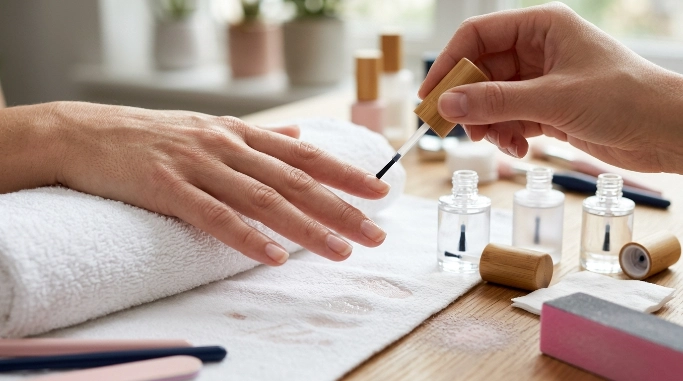
For systems that require all three, the typical order is nail dehydrator first, primer second, and base coat third. Each product has a different job.
Getting the order wrong can make troubleshooting difficult. More prep product doesn’t automatically mean better adhesion.
Step 1: Nail dehydrator
Apply dehydrator to the natural nail after dust and visible residue are removed. Keep the liquid mainly on the nail plate and away from surrounding skin.
Give it time to evaporate according to the label. Don’t cure a normal air-drying dehydrator unless the manufacturer specifically says to do so.
Step 2: Nail primer
Primer follows when your system requires it. Some primers are acid-free, while others contain ingredients that need more careful professional handling.
The FDA notes that methacrylic acid is used in some nail primers and that certain products may be labeled for professional use. You can read the agency’s broader nail product safety information before working with unfamiliar formulas.
Step 3: Base coat or enhancement
Once the required prep layers are ready, continue with your system’s base, builder product, acrylic, dip liquid, adhesive, or other enhancement step. Follow brand-specific curing and application directions.
I like to have every bottle and tool open and ready before dehydrating. That reduces the chance of touching the nails while searching for the next product.
When Should You Use Dehydrator for Different Nail Services?
Dehydrator isn’t equally important for every manicure type. Its usefulness depends on the product system, nail condition, and manufacturer’s instructions.
Here’s the practical breakdown I use when deciding whether it belongs in the routine.
Gel polish
Many gel systems use a dehydrator before primer or base coat, especially when lifting has been a problem. Other brands build the prep process into their cleanser or base system.
Don’t add extra prep products unless they’re compatible. The American Academy of Dermatology also recommends careful gel practices because repeated gel services can contribute to brittleness, peeling, and cracking in some people.
For broader gel-care guidance, see the American Academy of Dermatology’s gel manicure tips.
Acrylic nails
Dehydrator is commonly used before acrylic application because clean nail prep is important for adhesion. Primer may follow, depending on the acrylic system.
Don’t let strong prep liquids pool near the skin. Apply controlled amounts and use products in a well-ventilated area.
Builder gel and BIAB
Builder gel and BIAB systems often depend heavily on careful natural-nail preparation. A compatible dehydrator may be used after dust removal and before primer or base.
Some builder systems have their own dedicated bonding products. Mixing several brands can make adhesion less predictable.
Dip powder
Dip systems often include a dedicated prep liquid or dehydrating step. Use that product in the order specified by the manufacturer.
Don’t automatically add a separate primer from another system. Dip liquids are formulated to work together in a specific sequence.
Gel extensions and Gel-X style tips
A dehydrator may help prepare the natural nail before the extension adhesive or gel system. It normally belongs after physical prep and before the system’s bonder or primer.
Keep cured or uncured gel products away from skin whenever possible. Clean application is important both for retention and skin safety.
Press-on nails
For press-ons, removing surface oil can help adhesive grip a clean nail. Some press-on systems recommend alcohol wipes rather than a separate professional dehydrator.
Follow the press-on brand’s directions before adding primer. Strong primers aren’t automatically appropriate for nail glue or adhesive tabs.
Regular nail polish
A dedicated dehydrator is usually optional for standard polish. A clean, oil-free nail and suitable base coat are enough for many traditional manicures.
If you do use dehydrator, make sure the formula is intended for that purpose. Avoid unnecessary repeated exposure simply because more prep feels better.
Section Takeaway: Dehydrator is common with gels and enhancements, but it isn’t universal. The product system should decide the final routine.
Do You Always Need Nail Dehydrator?
No. You don’t automatically need a separate nail dehydrator for every manicure. Some systems specifically include one, while others are designed without it.
The safest approach is to treat dehydrator as a targeted prep tool rather than a mandatory bottle.
When dehydrator may be especially useful
- Oil-prone nail plates: Surface oil may interfere with some enhancement systems.
- Repeated lifting: Correct dehydration may help when inadequate prep is part of the problem.
- Humid conditions: Moist environments can make careful prep more important.
- Structured enhancements: Acrylic, builder gel, and extensions often use more complete prep systems.
- After hand products: Lotion, cuticle oil, and creams can leave residue that should be removed before application.
When you may not need it
- Your product instructions exclude it: Don’t add extra chemistry without a reason.
- You’re using ordinary polish: A clean nail and base coat may be enough.
- Your nails or surrounding skin are irritated: Avoid adding potentially drying or irritating products.
- Your system has its own prep liquid: That product may already perform the required preparation step.
If lifting keeps happening despite correct prep, don’t assume the solution is more dehydrator. Product compatibility, curing, nail structure, cuticle residue, application thickness, and daily wear can all matter.
How Do You Apply Nail Dehydrator Correctly?
Apply nail dehydrator in a thin, controlled layer on the natural nail plate. You don’t need to flood the nail or soak the surrounding skin.
Most formulas evaporate quickly. Always follow the bottle’s directions because ingredients and drying times vary.
Step-by-step application
- Finish shaping and any required light buffing.
- Remove dust from the nail plate and sidewalls.
- Make sure the nail is free from lotion and cuticle oil.
- Remove excess liquid from the applicator brush if needed.
- Apply a thin layer to the natural nail only.
- Avoid the cuticle and surrounding skin.
- Let the product air-dry for the labeled time.
- Don’t touch the nail after it dries.
- Continue immediately with the next required prep step.
How much dehydrator should you use?
Usually, a thin coat is enough. Applying a thick layer doesn’t necessarily improve adhesion and may increase unnecessary skin exposure.
If the brand recommends a second application for oil-prone nails, follow that instruction. Don’t create your own stronger routine by repeatedly coating the nail.
How long should nail dehydrator dry?
Many professional dehydrators evaporate within seconds, but there isn’t one universal drying time. Use the product label rather than a fixed internet rule.
The nail commonly looks matte after evaporation. That appearance can be a useful visual cue, but the manufacturer’s directions still come first.
What Nail Dehydrator Mistakes Should You Avoid?
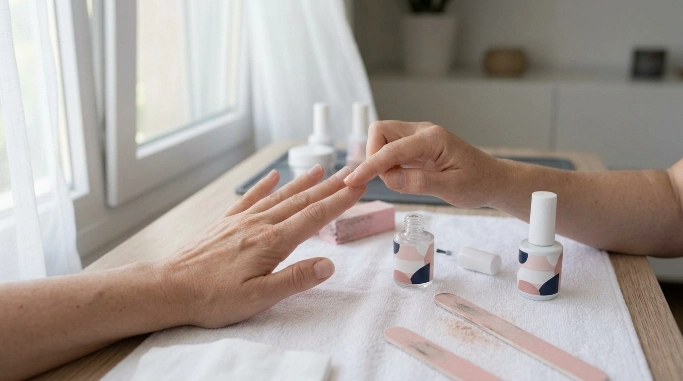
The biggest mistakes are using dehydrator too early, touching the nail afterward, applying too much, and assuming it can fix every adhesion problem. Good prep is a system, not one miracle step.
Safety matters too. Nail products may contain solvents or reactive ingredients, so ventilation, clean application, and label directions are important.
Common mistakes
- Using it before filing: Filing afterward puts dust back on the prepared nail.
- Touching the nail: Fingertips can transfer oils straight back to the surface.
- Flooding the cuticle: Prep products should not be allowed to pool on skin.
- Using more for better hold: Extra product doesn’t automatically improve adhesion.
- Mixing random systems: Dehydrator, primer, bonder, and base products may not be designed to work together.
- Ignoring irritation: Burning, persistent redness, swelling, or rash isn’t a normal prep result.
Can nail dehydrator damage natural nails?
Used according to its label, a dehydrator is intended as a short prep step. Repeated exposure to harsh solvents or unnecessary overuse may leave nails or surrounding skin feeling dry.
If your nails are already thin, painful, peeling, or damaged, don’t try to solve the problem with stronger prep. The American Academy of Dermatology’s artificial nail guidance discusses ways to reduce nail damage.
Health note: Stop using a nail product if you develop persistent burning, redness, swelling, blistering, or another concerning reaction. A dermatologist or other qualified healthcare professional can assess ongoing nail or skin problems.
Why ventilation matters
Nail products can release vapors, and salon professionals may have repeated exposure during the workday. Keep bottles closed when you’re not using them and work where air can circulate.
For professionals, OSHA’s nail salon safety guidance covers chemical, biological, and workplace hazards associated with nail services.
Section Takeaway: Use the smallest effective amount, keep prep liquids off skin, maintain ventilation, and follow the exact product system rather than improvising.
Frequently Asked Questions About When to Use Nail Dehydrator
Do you put nail dehydrator on before or after primer?
Apply nail dehydrator before primer when your nail system requires both. The dehydrator removes temporary surface oils and moisture first, while the compatible primer supports adhesion before the base coat or enhancement.
Do you use nail dehydrator before or after buffing?
Use dehydrator after buffing and after removing the resulting dust. If you buff after dehydration, you contaminate the freshly prepared surface with filing particles and need to clean the nail again.
Do you cure nail dehydrator under a UV or LED lamp?
Most conventional nail dehydrators air-dry and don’t need a UV or LED lamp. Product formulas vary, though, so read the label and follow the manufacturer’s drying instructions.
Can you use nail dehydrator without primer?
Yes, if your nail system calls for dehydrator but doesn’t require a separate primer. Primer isn’t mandatory for every manicure, and adding an unapproved primer may cause compatibility problems.
Should I use nail dehydrator before gel polish?
Use it if your gel system recommends a dehydrator or if it’s part of the brand’s normal prep procedure. Apply it after physical prep and dust removal, then follow with the recommended primer or base product.
Should I use nail dehydrator before press-on nails?
You can use a compatible dehydrating prep when the press-on system recommends one. Many kits simply call for an alcohol prep wipe, so don’t assume a strong salon primer or dehydrator is necessary.
Can you use nail dehydrator every time you do your nails?
You can use it during services that call for it, but there’s no benefit to using it more often than necessary. Follow the product label and give irritated, peeling, or damaged nails appropriate care before applying another enhancement.
When Should Nail Dehydrator Go in Your Routine?
The easiest rule to remember is simple: use nail dehydrator near the end of prep, before primer or your next adhesion step. Finish filing, shaping, cuticle-area prep, and dust removal first.
Then apply a thin layer, let it evaporate, and avoid touching the nail. Move directly into the next step recommended by your nail system.
As of 2026, there are many gel, acrylic, BIAB, dip, and press-on systems with different prep instructions. Following the exact system matters more than copying a universal routine from another product line.
If your manicure keeps lifting, examine the whole process before adding more prep liquid. Clean application, compatible products, correct curing, gentle preparation, and proper aftercare all play a part.

