
Can You Use Nail Dehydrator on Press Ons?

Quick Answer
Yes, you can use nail dehydrator before applying press-on nails. Apply a thin layer to your clean natural nails, let it air-dry completely, then add your glue or adhesive tabs. Follow your product label and general nail product safety guidance, and avoid getting dehydrator on irritated skin.
Best way to use dehydrator with press-ons
- Prep first: Shape the natural nails and gently clear dead cuticle from the nail plate.
- Remove surface oil: Clean away dust, lotion, oil, and other residue before applying dehydrator.
- Use a thin coat: Brush dehydrator across the natural nail plate without flooding the surrounding skin.
- Let it air-dry: Most nail dehydrators evaporate quickly and do not need a curing lamp.
- Add adhesive next: Apply the press-on using glue or tabs only after the nail feels completely dry.
One important distinction
- Natural nail, not plastic: Unless the press-on manufacturer specifically recommends it, keep dehydrator on your natural nail rather than brushing it over the artificial tip.
If you’re asking, “Can you use nail dehydrator on press ons?” the answer is yes, but placement matters. The dehydrator belongs in the natural-nail preparation stage before you attach the press-on.
I find that people often focus on buying stronger glue when the real problem is oily or poorly prepared nails. Good prep gives the adhesive a cleaner surface to grab.
In This Guide
- What Does Nail Dehydrator Do for Press-On Nails?
- Should You Use Nail Dehydrator Before Press-On Glue?
- How Do You Use Nail Dehydrator for Press-Ons?
- Nail Dehydrator vs Alcohol vs Primer
- Can You Use Dehydrator With Adhesive Tabs?
- Why Are My Press-Ons Still Popping Off?
- Can Nail Dehydrator Damage Natural Nails?
- How Should You Remove Press-Ons Safely?
- Frequently Asked Questions
- Final Takeaway
What Does Nail Dehydrator Do for Press-On Nails?
A nail dehydrator temporarily removes surface moisture and oils from the natural nail plate. That creates a cleaner, drier surface for press-on adhesive.
Definition: A nail dehydrator is a fast-evaporating nail-prep product designed to reduce surface oil and moisture before an adhesive, gel, acrylic, or other nail system is applied.
Your natural nails constantly encounter hand cream, cuticle oil, soap, skin oils, and water. Even a thin invisible film can reduce how evenly nail glue contacts the nail plate.
Does dehydrator make press-ons last longer?
It can improve adhesion when excess surface oil or moisture is contributing to lifting. It cannot compensate for a poorly fitting press-on, weak adhesive, or incorrect application.
- Cleaner contact: Less oil sits between the glue and natural nail.
- More even bonding: Adhesive can spread over a dry surface more consistently.
- Less early lifting: Good prep may reduce lifting around the sidewalls and cuticle area.
- Faster preparation: Most dehydrators evaporate within moments rather than leaving a wet layer.
The dehydrator itself does not glue anything together. Think of it as surface preparation rather than an adhesive.
Should You Use Nail Dehydrator Before Press-On Glue?
Yes, nail dehydrator normally goes on before traditional press-on nail glue. Let the dehydrator evaporate completely before adding adhesive.
The order matters because you want glue touching a clean nail plate. Applying oil, lotion, or another slippery product after dehydrating defeats that purpose.
What order should nail prep follow?
- Choose and size all press-on nails before using glue.
- Wash and completely dry your hands if needed.
- Gently push back the cuticle area without cutting healthy skin.
- Remove loose dead tissue from the nail plate.
- Lightly buff only if your press-on system recommends it.
- Remove all filing dust.
- Apply a thin layer of nail dehydrator.
- Allow it to air-dry fully.
- Apply nail glue according to its instructions.
- Position and press down the artificial nail firmly.
Don’t over-buff in an attempt to create stronger adhesion. The American Academy of Dermatology notes that repeated aggressive preparation of natural nails can contribute to thinning and damage, so gentle prep is the better approach. You can review its artificial-nail care recommendations.
Should dehydrator go underneath the press-on too?
I would not automatically brush nail dehydrator onto the plastic press-on. Different tips use different plastics, finishes, and coatings, while dehydrator formulas also vary.
If a press-on brand tells you to clean the underside, use the method specified by that brand. Don’t assume a product intended for the natural nail is safe for every artificial tip.
How Do You Use Nail Dehydrator for Press-Ons?

Use the smallest amount needed to cover the natural nail plate. More dehydrator does not mean stronger adhesion.
Step 1: Size the press-ons before prep
Match each press-on from sidewall to sidewall before opening the glue. A tip that is too narrow or too wide can lift even when the nail underneath is perfectly dehydrated.
Lay the selected nails in finger order. This avoids touching your prepared natural nails repeatedly while searching for sizes.
Step 2: Keep oils away from the nail plate
Finish cuticle oil, hand cream, and moisturizing treatments before your final cleaning step, or save them until after the press-ons are secure. Oils left on the nail can weaken adhesive contact.
- Avoid touching the nail plate with your fingertips after cleaning.
- Remove filing dust with a lint-free pad or appropriate prep wipe.
- Make sure the nails are completely dry before continuing.
Step 3: Apply one thin coat
Wipe excess liquid from the brush against the bottle neck. Paint a thin coat over the nail plate while staying away from broken or irritated skin.
Most traditional dehydrators air-dry quickly. Unless your manufacturer specifically says otherwise, they do not need UV or LED curing.
Step 4: Apply the adhesive
Follow the amount and placement recommended by your nail-glue manufacturer. Too much glue can flood the sidewalls, while too little may leave gaps.
Apply the press-on at the recommended angle and hold it firmly without sliding it around. Stable pressure helps the adhesive spread evenly.
Nail Dehydrator vs Alcohol vs Primer: Which Do Press-Ons Need?
Dehydrator, alcohol, and primer are not automatically interchangeable. For standard press-ons, the goal is usually a clean, oil-free natural nail rather than using every prep chemical available.
| Prep Product | Main Purpose | Useful for Press-Ons? | Important Note |
|---|---|---|---|
| Nail dehydrator | Temporarily reduces surface oil and moisture | Yes, especially on oily nails | Apply lightly and let it evaporate |
| Isopropyl alcohol prep | Cleans surface oil, dust, and residue | Often yes | Common press-on prep method when the brand recommends it |
| Nail primer | Promotes bonding in specific nail systems | Only when compatible with the adhesive system | Do not add automatically unless directions call for it |
Can alcohol replace nail dehydrator?
For many press-on routines, an alcohol prep wipe is enough to remove surface oils. Professional nail artists interviewed by Allure also recommend degreasing the natural nail before application, including with alcohol-based prep; see its press-on application guidance.
A dedicated dehydrator can be useful if your nails become oily quickly or your chosen system specifically recommends one. Follow the adhesive and prep-product instructions rather than layering products at random.
Do press-ons need primer?
Traditional glue-on press-ons generally do not require primer unless the manufacturer says they do. Primer is more commonly associated with specific enhancement systems where chemical bonding is part of the process.
Some bottles combine multiple preparation functions under terms such as “prep,” “bond,” or “primer.” Read the label instead of relying only on the product name.
Can You Use Dehydrator With Press-On Adhesive Tabs?
Yes, a clean and dry nail surface can also help adhesive tabs make better contact. Dehydrator is optional rather than mandatory for every tab manicure.
Tabs are often chosen for shorter wear or easier removal. That means you may not need an aggressive preparation routine.
Best prep for adhesive tabs
- Clean: Remove lotion, oil, dust, and old adhesive.
- Dry: Let the natural nail dry completely.
- Dehydrate if needed: Use a thin coat if your nails are naturally oily.
- Choose the right tab: The adhesive should fit the nail without touching surrounding skin.
- Press firmly: Good pressure improves contact between the surfaces.
For a reusable press-on set, tabs can make removal easier than strong nail glue. They also reduce the amount of hardened glue that must be cleaned from the underside.
Why Are My Press-Ons Still Popping Off After Dehydrator?
If press-ons still lift after using dehydrator, surface oil may not be the main problem. Fit, adhesive coverage, daily water exposure, and application technique can matter just as much.
Check these common causes
- Wrong size: A press-on that is too small cannot sit flat across the natural nail.
- Curve mismatch: A strongly curved artificial nail may leave gaps on a flatter nail bed.
- Cuticle overlap: Press-ons touching skin can lift as the nail moves.
- Incomplete glue coverage: Air gaps reduce the bonding area.
- Too much glue: Excess adhesive can flood the skin and create messy edges.
- Water too soon: Long soaking soon after application may interfere with some adhesives.
- Oil after prep: Touching the nails or applying cuticle oil before attachment can reintroduce residue.
Does stronger glue fix everything?
No. Stronger glue cannot correct a press-on that does not fit the natural nail.
My preferred approach is to solve fit first, prep second, and glue third. That sequence usually makes troubleshooting far easier than repeatedly adding more adhesive.
Can Nail Dehydrator Damage Natural Nails?
Used according to directions, nail dehydrator is intended as a temporary surface-prep product. Problems become more likely when it contacts irritated skin, is overused, or gets combined with unnecessary harsh preparation.
The FDA advises consumers to follow nail-product labels and pay attention to warnings because nail products can cause irritation or allergic reactions in some people. Stop using a product if you experience persistent burning, swelling, rash, or significant discomfort.
When should you skip dehydrator and press-ons?
- There is an open cut or bleeding around the nail.
- The nail plate is painfully thin or heavily peeled.
- You see unexplained discoloration or separation from the nail bed.
- The skin is swollen, warm, tender, or producing drainage.
- You previously reacted to the same prep product or adhesive.
Press-on nails themselves can also create problems when moisture becomes trapped underneath a lifted artificial nail. Cleveland Clinic discusses infection, allergic reaction, and nail damage among the potential risks of press-on nails.
Health note: If you have pain, swelling, pus, spreading redness, persistent nail separation, or a suspected allergic reaction, stop the manicure and contact a dermatologist or other qualified healthcare professional.
How Should You Remove Press-Ons Without Damaging Your Nails?
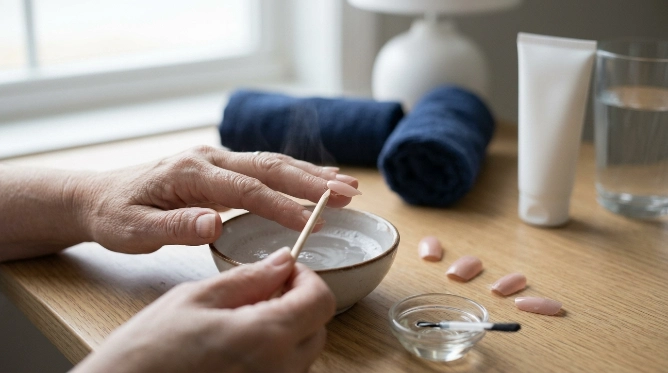
Good removal matters as much as good preparation. Dehydrator can improve adhesion, so never compensate by forcing strongly bonded press-ons off.
For adhesive tabs
Follow the tab manufacturer’s removal directions. Warm soapy water and oil are commonly used to help loosen temporary adhesive systems.
For nail glue
Strong glue may require more patience or a compatible remover. Healthline’s medically reviewed press-on removal guide describes warm soapy water, oil-assisted removal, and acetone-based methods depending on the adhesive strength.
- Never pry: If the press-on resists, continue softening the adhesive.
- Avoid peeling: Pulling can remove surface layers of the natural nail.
- Work gently: Use an orangewood stick only after the edges begin releasing.
- Moisturize afterward: Replace moisture around the nail and cuticle after removal.
If your natural nail looks rough after removal, resist the urge to aggressively buff it smooth. Repeated filing can make a thin nail even weaker.
Frequently Asked Questions
Can I put nail dehydrator directly on a press-on nail?
Usually, nail dehydrator should be applied to your natural nail rather than the artificial press-on. Plastic compositions and coatings differ, so use dehydrator on the press-on itself only when that press-on manufacturer specifically recommends it.
Do I use nail dehydrator before or after nail glue?
Use nail dehydrator before nail glue. Apply a thin coat to the natural nail, allow it to air-dry completely, and then apply the adhesive according to the glue manufacturer’s instructions.
Do I need both alcohol and nail dehydrator for press-ons?
Not always. Alcohol can clean surface oils and residue, while a dedicated dehydrator provides an extra drying step. Using both may be useful in some systems, but follow your product instructions rather than assuming more prep is better.
Can I use nail dehydrator with sticky-tab press-ons?
Yes. Dehydrator can create a dry, oil-free natural nail for adhesive tabs, particularly if your nail plate becomes oily quickly. A regular prep wipe may already be sufficient for many short-wear tab applications.
Does nail dehydrator make press-ons last two weeks?
No product can guarantee a specific wear time. Dehydrator may improve adhesion, but longevity also depends on nail fit, adhesive quality, application, water exposure, nail growth, and how much stress your hands experience.
Can I use nail primer after dehydrator for press-ons?
Only use primer if your press-on adhesive system calls for it. Dehydrator and primer have different jobs, and adding an incompatible primer may not improve traditional press-on glue performance.
Should I use dehydrator every time I reapply a press-on?
You can use it during a new application when the natural nail is healthy and your product directions support it. Avoid repeatedly dehydrating or filing an already irritated, peeling, or damaged nail plate.
Final Takeaway: Should You Use Nail Dehydrator on Press-Ons?
Yes. In 2026, nail dehydrator remains a useful optional prep step for glue-on and adhesive-tab press-ons, especially when natural nails are oily or prone to early lifting.
The important detail is where you use it. Apply a light coat to the natural nail plate, let it air-dry, and then attach the correctly sized press-on using your chosen adhesive.
- Size your press-ons before starting.
- Keep natural nails clean, dry, and free of oil.
- Use only a thin coat of dehydrator.
- Keep prep products away from irritated skin.
- Don’t automatically add primer unless your system requires it.
- Never force strongly bonded press-ons off.
A dehydrator can improve your prep, but it is only one part of a long-lasting set. Correct sizing, controlled glue application, gentle nail preparation, and careful removal matter just as much.
