
Why Are Nails Lifting After Dehydrator?

Quick Answer
If your gel, acrylic, builder gel, or press-on nails still lift after using dehydrator, the dehydrator usually isn’t the only issue. Lifting often comes from leftover cuticle, oil contamination, poor product placement, incompatible primer, over-buffing, or product touching the skin. A dehydrator only removes temporary surface moisture and oil; it can’t correct the rest of the prep. Follow your product directions and the FDA’s nail product safety guidance when using primers and other nail chemicals.
Common reasons nails still lift
- Hidden cuticle: Thin dead tissue left on the nail plate creates a weak layer under your enhancement.
- Oil contamination: Touching the nail after prep can transfer enough oil to weaken adhesion.
- Too much product: Flooded gel or acrylic near the cuticle can lift as the nail grows.
- Primer mismatch: Some systems need a specific bonder or primer after dehydration.
- Over-prepping: Aggressive filing can thin and damage the natural nail instead of improving retention.
- Application problems: Incorrect curing, tip sizing, structure, or product thickness can cause lifting despite perfect dehydration.
How to verify the cause
- Notice where lifting starts. Cuticle lifting, sidewall lifting, free-edge lifting, and full-product popping usually point to different mistakes.
A nail dehydrator can improve adhesion, but it isn’t a magic fix for retention. When someone tells me, “I dehydrated the nail and it still lifted,” I look at the entire prep and application process.
The location and timing of the lift often reveal more than the dehydrator itself. This guide breaks down those clues so you can correct the actual problem instead of applying more prep chemicals.
In This Guide
- What Does Nail Dehydrator Actually Do?
- Why Are My Nails Still Lifting After Dehydrator?
- What Does the Location of the Lifting Tell You?
- Can Too Much Nail Dehydrator Cause Lifting?
- What Is the Correct Nail Prep Order?
- Does the Cause Change for Gel, Acrylic, and Press-Ons?
- What If the Natural Nail Is Actually Lifting?
- Frequently Asked Questions
- Final Takeaway
What Does Nail Dehydrator Actually Do?
A nail dehydrator is a nail-prep product designed to temporarily remove surface oil and moisture from the natural nail plate. That cleaner, drier surface can help the next product form a stronger bond.
It is normally applied after basic nail preparation and before the primer, bonder, base gel, adhesive, or enhancement specified by your system.
Definition: Nail dehydration is surface preparation. It does not permanently dry the nail, create the entire adhesive bond, or replace mechanical preparation and correct product application.
Dehydrator and primer are not the same thing
A dehydrator mainly cleans and dries the surface. A primer or bonder is designed to improve how the enhancement interacts with that prepared surface.
Some products combine functions, while other systems require separate steps. Always follow the instructions for the exact system you’re using.
- Dehydrator: reduces temporary surface oil and moisture.
- Primer: prepares the nail for stronger product adhesion.
- Bonder: creates or supports an adhesive layer in certain gel systems.
- Base coat: provides the foundation for many gel applications.
The FDA notes that certain nail primers can contain methacrylic acid and that nail products should be used according to their labeling. Avoid getting prep products on surrounding skin.
Why Are My Nails Still Lifting After Dehydrator?

If the enhancement lifts even though you used dehydrator, something else is interrupting the bond. I would troubleshoot contamination and prep before blaming the dehydrator.
1. Invisible cuticle is still on the nail plate
This is one of the first areas to check when lifting begins near the cuticle. Dead cuticle tissue can remain attached to the nail even after the visible cuticle has been pushed back.
Gel or acrylic then attaches partly to dead tissue instead of a clean nail plate. As that tissue releases, the enhancement releases with it.
- Gently push back the proximal nail fold area.
- Remove only loose, nonliving tissue from the nail plate.
- Keep aggressive cutting away from living skin.
- Dust thoroughly before applying prep liquids.
The American Academy of Dermatology advises against cutting or aggressively disturbing cuticles because they help protect the nail area from infection. See its guidance for reducing artificial-nail damage.
2. The nail became contaminated after dehydration
Once the natural nail is prepared, touching it with your fingers can put skin oil back on the surface. Hair, dust, lotion, cuticle oil, and makeup can do the same.
This is easy to miss. Even leaning a prepared fingertip against your palm can undo part of your prep.
- Don’t touch the nail plate after final prep.
- Keep cuticle oil away until the manicure is complete.
- Use clean, lint-free materials when required.
- Keep your work surface and tools clean.
3. Product is touching the skin
Gel, builder gel, acrylic, or adhesive should not be sitting on the cuticle or sidewall skin. Product attached to skin cannot maintain the same bond as product correctly attached to the nail.
As the skin moves and the nail grows, that edge can separate. The small opening may then spread into a larger lifted area.
4. Your primer or base is incompatible with the system
Using more products doesn’t automatically create better adhesion. Mixing unrelated primer, base, glue, gel, and acrylic systems can sometimes produce unpredictable retention.
Follow the manufacturer’s recommended preparation sequence first. Only change one variable at a time when troubleshooting.
5. The enhancement itself has an application problem
A perfect nail plate can still develop lifting if the enhancement is incorrectly applied. Structure and curing matter just as much as prep.
- Gel: incorrect curing, thick application, skin contact, or an unsuitable lamp can affect retention.
- Acrylic: poor product ratio, weak structure, or product placed over contaminated areas can lift.
- Tips: an incorrect size, trapped air, or poor adhesive coverage can create separation.
- Press-ons: gaps between the press-on and natural nail can weaken the bond.
Section Takeaway: Dehydrator prepares one part of the bonding surface. Long-lasting retention still depends on clean prep, compatible products, controlled application, and correct curing or polymerization.
What Does the Location of the Lifting Tell You?
The place where lifting begins is one of the best troubleshooting clues. I recommend checking each failed nail before removing everything.
| Where lifting starts | Common possibilities | What to check first |
|---|---|---|
| Cuticle area | Residual cuticle, skin contact, flooding, oil contamination | Cuticle prep and product margin |
| Sidewalls | Skin contact, incomplete prep, poor tip fit | Sidewall cleaning and sizing |
| Free edge | Impact, flexibility mismatch, weak sealing, excessive length | Length, structure, and edge application |
| Entire enhancement pops off | Contamination, incompatible products, insufficient prep | Full preparation sequence |
| Random pocket in the middle | Application gap, trapped air, damaged product | Application technique |
Timing matters too
If nails pop off almost immediately, investigate contamination, prep, compatibility, and curing first. If they stay secure for a while and later break down at stress points, structure and daily wear may be more important.
A single lifting pattern isn’t a diagnosis. Look for a repeated pattern across several manicures before changing multiple products.
Can Too Much Nail Dehydrator Cause Lifting?
Using extra dehydrator usually doesn’t compensate for poor preparation. Repeated applications may unnecessarily expose the nail and surrounding skin to drying solvents.
The better rule is simple: use the amount and method recommended by the manufacturer, let it air-dry as directed, and continue with the correct next step.
More prep isn’t always better
Over-buffing is a bigger concern than many beginners realize. Artificial-nail prep often requires removing surface shine, not aggressively thinning the natural nail.
Excessive filing can leave nails weak, sore, or flexible. Dermatologists note that artificial-nail preparation and removal can contribute to thinning and brittleness.
- Don’t keep filing because a nail looks “too smooth.”
- Don’t repeatedly flood the nail and skin with dehydrator.
- Don’t combine several strong primers without system instructions.
- Don’t treat burning or pain as proof that a product is working.
If a primer, dehydrator, gel, or glue causes significant burning, redness, swelling, blistering, or persistent itching, stop using it. Nail cosmetic ingredients can cause irritant or allergic reactions.
What Is the Correct Nail Prep Order?
A reliable prep routine moves from mechanical preparation to cleaning and then chemical preparation. Exact steps vary by product system.
- Start with clean hands and nails. Remove old product properly and inspect the natural nail.
- Shape the free edge. Complete major filing before chemical prep.
- Manage the cuticle area carefully. Remove loose dead tissue from the plate without cutting healthy skin.
- Remove surface shine only if your system requires it. Use gentle, even pressure.
- Remove dust completely. Pay attention to sidewalls and the cuticle area.
- Apply nail dehydrator. Keep it on the nail plate and allow it to air-dry according to the label.
- Apply primer or bonder if required. Use a thin, controlled amount.
- Apply the enhancement. Avoid the surrounding skin and follow the product’s curing or setting instructions.
Do you need dehydrator twice?
Usually, you should follow the product label rather than creating a fixed “two coats for everyone” rule. Nail condition, formulation, and system requirements vary.
If one nail is repeatedly troublesome, first look for contamination or prep differences. Automatically adding more dehydrator may hide the real mistake.
Should you wash your hands after dehydrator?
No. Washing after dehydration puts water back into the preparation process and may introduce soap residue or contamination.
Complete wet cleaning before your final nail prep. Once the nail is ready for bonding, avoid unnecessary contact.
Section Takeaway: The most consistent routine is clean nail plate → controlled surface prep → dust removal → dehydrator → system-specific primer or bonder → enhancement.
Does the Cause Change for Gel, Acrylic, and Press-Ons?
Yes. The purpose of dehydration is similar, but each system can fail for different reasons.
Gel polish and builder gel
Gel retention depends on surface preparation, compatible base products, controlled application, and proper curing. Avoid getting uncured gel on the skin.
Using the correct lamp and curing instructions for the product matters. Don’t assume every gel has the same cure requirements.
Acrylic nails
Acrylic lifting can come from contamination, poor cuticle preparation, product touching the skin, or application and structure problems. Primer requirements also differ between systems.
The FDA specifically discusses methacrylic acid in some nail primers and advises consumers to follow warnings and directions carefully.
Press-on nails and full-cover tips
With press-ons, dehydration helps only if the tip fits correctly and the adhesive contacts the nail evenly. A tip that’s too curved, too flat, or too small may lift despite excellent prep.
- Choose a tip that covers the nail without forcing it.
- Remove oil from the natural nail.
- Prepare the inside of the tip when your system requires it.
- Avoid air pockets when applying adhesive.
- Keep glue or gel away from surrounding skin.
Dip systems
Dip systems depend on their adhesive liquids as well as nail preparation. Follow the brand’s step order instead of substituting random primer products.
If the surrounding skin becomes itchy, swollen, or irritated, stop and investigate rather than repeatedly reapplying the system.
What If the Natural Nail Is Actually Lifting?
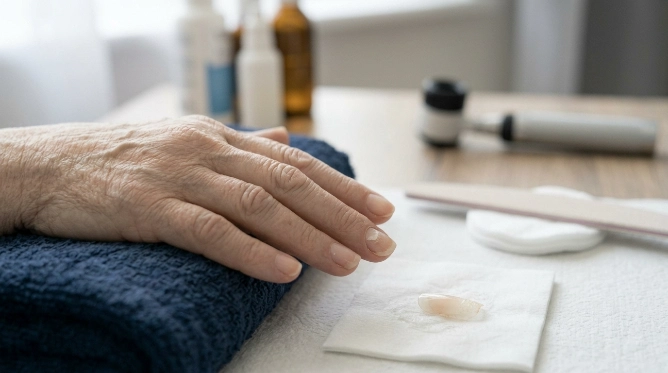
There’s an important difference between an enhancement lifting off the nail and the natural nail plate separating from the nail bed. Natural nail separation is called onycholysis.
If the natural nail itself looks white or hollow underneath and appears detached from the skin below, don’t treat it as a simple retention problem.
Why natural nails can separate
Trauma, nail products, infections, skin conditions, and allergic or irritant reactions can contribute to nail changes. Nail cosmetics themselves can occasionally be associated with onycholysis.
DermNet notes that nail cosmetic allergy can cause conditions including onycholysis and inflammation. Its nail cosmetics allergy guidance also describes redness, swelling, itching, blistering, and reactions associated with artificial-nail ingredients.
Health note: A cosmetic lifting problem and a medical nail separation aren’t the same. A dermatologist or other qualified healthcare professional should assess unexplained, painful, discolored, worsening, or persistent nail separation.
Don’t glue a separated natural nail back down
A detached natural nail shouldn’t simply be sealed to the underlying skin with enhancement product. Moisture and debris can become trapped in separated areas.
Keep the area protected and avoid digging under it. The American Academy of Dermatology recommends medical evaluation for concerning nail changes, including nail lifting; see its nail changes guide.
Watch for allergy signs
Acrylates and related nail cosmetic ingredients can trigger allergic contact dermatitis in sensitized people. Reactions may affect the fingers, but they can also appear around the face or eyelids.
- Persistent itching or burning
- Red or swollen fingertips
- Blistering or peeling skin
- Skin cracking around the nails
- Nail separation or unusual nail changes
If those symptoms appear, continuing to expose yourself to the suspected product isn’t a good retention strategy. Stop using it and seek professional medical advice when appropriate.
Section Takeaway: If only the enhancement lifts, troubleshoot prep and application. If the natural nail separates from the nail bed, treat it as a nail-health concern rather than simply adding more dehydrator or primer.
Frequently Asked Questions
Why do my gel nails lift even after dehydrator and primer?
Dehydrator and primer can’t compensate for cuticle left on the nail, skin contact, contamination, incompatible products, or incorrect curing. Check where the lifting begins and review the full prep process. If several nails fail the same way, change one part of your routine at a time.
Can I use alcohol instead of nail dehydrator?
Some nail systems use cleansers or alcohol during preparation, but that doesn’t mean alcohol and every commercial dehydrator are identical. Follow the instructions for your gel, acrylic, tip, or adhesive system. Mixing prep methods without checking compatibility can make troubleshooting harder.
Why do nails lift at the cuticle first?
Cuticle-area lifting often points to dead tissue remaining on the nail plate, product touching skin, contamination, or gel flooding the cuticle. Keep your product slightly away from the skin and make sure the nail plate is properly prepared before dehydration.
Should nail dehydrator feel sticky?
A typical dehydrator often leaves the nail looking temporarily dry rather than creating the tacky bonding layer associated with some primers or bonders. Formulas differ, though. Judge the product by its instructions instead of assuming every prep liquid should look or feel the same.
Can nail dehydrator damage natural nails?
Use it only as directed and avoid unnecessary contact with surrounding skin. Repeated exposure to strong solvents can be drying, while aggressive filing and removal can also damage nails. If you experience pain, persistent irritation, swelling, or splitting, stop and assess the routine.
Why do my press-ons pop off after using dehydrator?
The problem may be tip fit, insufficient adhesive coverage, air pockets, contamination after prep, or exposure to water too soon. A dehydrator prepares the nail surface, but it can’t correct a press-on that doesn’t match the natural nail’s width or curvature.
Do I need primer after nail dehydrator?
It depends on the system. Some gel, acrylic, and extension products call for both dehydrator and primer, while others use a different bonder or no separate primer. Follow your manufacturer’s sequence rather than automatically adding another chemical-prep step.
Final Takeaway
If your nails are lifting after dehydrator, don’t assume you need a stronger dehydrator. Think of dehydration as one part of a chain.
Successful retention starts with a clean nail plate, careful cuticle-area prep, minimal contamination, and the correct products applied in the correct order.
- Check where the lift starts.
- Remove dead tissue from the nail plate carefully.
- Avoid touching prepared nails.
- Keep enhancement products off the skin.
- Use compatible dehydrator, primer, base, and enhancement products.
- Follow curing and application instructions exactly.
- Stop if you develop significant irritation or signs of natural nail separation.
As of 2026, the core troubleshooting principle hasn’t changed: dehydrator helps adhesion, but it can’t rescue poor prep or incorrect application. Fix the weakest step in the routine, and your retention usually becomes much easier to understan

