
Why Nail Polish Gets Thick and How to Fix It Without Ruining the Bottle

If your polish has turned slow, stringy, or goopy, the short answer is this: nail polish usually gets thick because the solvents in the formula slowly evaporate, leaving behind a denser mix of pigment, resins, and film-formers. That can happen faster if the bottle is opened often, stored badly, or has dried polish around the neck that stops the cap from sealing well.
The good news is that thick polish is often salvageable. The bad news is that the wrong fix—especially acetone or remover—can make the formula worse. If you want the bottle back in usable shape, the goal is to restore flow without stripping out too much of what makes the polish apply evenly.
Quick answer: why nail polish gets thick
Regular nail polish is a solvent-based product. When it sits in the bottle, those solvents keep the polish fluid. Over time, some of that liquid escapes, and the polish becomes more concentrated. That is why a bottle can go from smooth to syrupy, then to sticky or stringy.
This is not always a sign the polish is “bad.” It often just means the formula has lost enough solvent that the viscosity changed. In plain English: the polish got less runny.
If you are deciding what to do next, use this simple rule:
- Slightly thick but still smooth? Try mixing first, then thin if needed.
- Thick, slow, or stringy? Thin it in very small increments and test after each addition.
- Separated into layers? Mix gently first, then reassess.
- Clumpy, rubbery, or mostly solid? Stop and discard it.
That decision tree matters because not every bottle needs the same fix. Some just need a little solvent restored. Others are too far gone to save without ruining the manicure.
Thick, separated, stringy, or dried out: what are you actually seeing?
Before you try to fix anything, identify the texture. The right response depends on what the bottle is doing.
| What it looks like | What it usually means | Best next step |
|---|---|---|
| Thick but still liquid | Solvent loss, mild age, or poor storage | Try nail polish thinner |
| Stringy or gooey | More advanced solvent loss | Thin carefully in very small amounts |
| Separated into layers | Pigment has settled; formula may still be usable | Mix gently first, then assess thickness |
| Clumpy with chunks | Partial drying or degraded formula | Test thinning, but be ready to discard |
| Hard, rubbery, or mostly solid | Too far gone | Replace it |
A separated bottle is not the same as a thick bottle. Separation can happen even when the polish is still healthy enough to save. Glitter shades and heavily pigmented formulas often settle more obviously, so a bottle that looks “broken” may only need gentle mixing.
A dried-out bottle is different. If the polish no longer moves freely at all, or if it has formed rubbery pieces, thinning may not restore the original performance.
The most likely reasons your polish thickened, from most common to less common
1. Solvent evaporation
This is the big one. Every time the bottle is opened, a little solvent can escape. Even brief exposure adds up over time, and once enough liquid is lost, the polish becomes thicker and harder to spread.
2. Repeated opening and long application time
If you paint slowly, leave the bottle open while doing both hands, or pause between coats, the formula spends more time exposed to air. That gives solvents more chances to evaporate.
3. Bottle-neck buildup

Dried polish around the neck can make the cap seal poorly. It can also contaminate the fresh product each time you close the bottle. A sticky neck is one of the easiest ways to turn a usable polish into a goopy one.
4. Age and storage conditions
Old polish is more likely to thicken, separate, or lose its original finish. Heat, sunlight, and temperature swings can speed that process. Nail polish can also become less stable as it ages, which is one reason older bottles are more likely to turn thick and clumpy or separate into layers.
5. Formula differences
Some formulas thicken faster than others. Heavily pigmented creams, glitters, and older formulas often show viscosity changes sooner than thinner, more sheer polishes. That does not automatically mean they are defective; it just means they are less forgiving once solvent loss starts.
Why polish can thicken even when the bottle is closed
A tightly closed cap helps, but it is not a perfect seal forever. Tiny amounts of solvent can still be lost over time, especially if the bottle is old, the neck has residue, or the cap was not fully tightened after the last use.
Temperature also matters. If polish is stored in a warm bathroom, near a sunny window, or in a car, the formula is under more stress. Heat does not just “dry” polish in the bottle the way open air does, but it can make the formula less stable and speed up thickening.
That is why a bottle can look untouched and still become sluggish. Closed does not mean unchanged.
What not to use: acetone, remover, or proper thinner?
Here is the practical comparison.
| Product | Can it thin polish? | Main downside | Best use |
|---|---|---|---|
| Nail polish thinner | Yes | Requires a separate product | Safest formula-preserving fix |
| Acetone | Sometimes, temporarily | Can alter the formula and over-thin it fast | Only in a pinch, and with caution |
| Nail polish remover | Not ideal | Often contains acetone plus additives that can interfere with polish performance | Avoid for rescue work |
The safest option is a real nail polish thinner. It is made to restore flow without changing the formula as aggressively as acetone or remover can. That matters because polish is a balanced mixture. If you add the wrong solvent, you may get a bottle that looks thinner but applies worse, dries oddly, or loses opacity.
Acetone is riskier because it is strong and fast-acting. In a bottle of polish, that can mean the formula shifts too quickly, becomes too thin, or loses the balance that helps it level on the nail. Nail polish remover is even less ideal for rescue work because it is usually not just solvent; it may also contain additives that are meant for removing polish from nails, not preserving a bottle’s formula.
In very limited cases, a tiny amount of acetone may seem to help a polish that is only slightly thick and you have no thinner available. But that should be treated as a last resort, not a normal fix. If you use it at all, use the smallest possible amount, test immediately, and stop if the polish turns watery, streaky, or oddly separated.
How to fix thick nail polish step by step
1. Check the neck and cap first
Wipe dried polish from the bottle neck and the cap threads. If the seal is dirty, the polish may keep thickening no matter what you add.
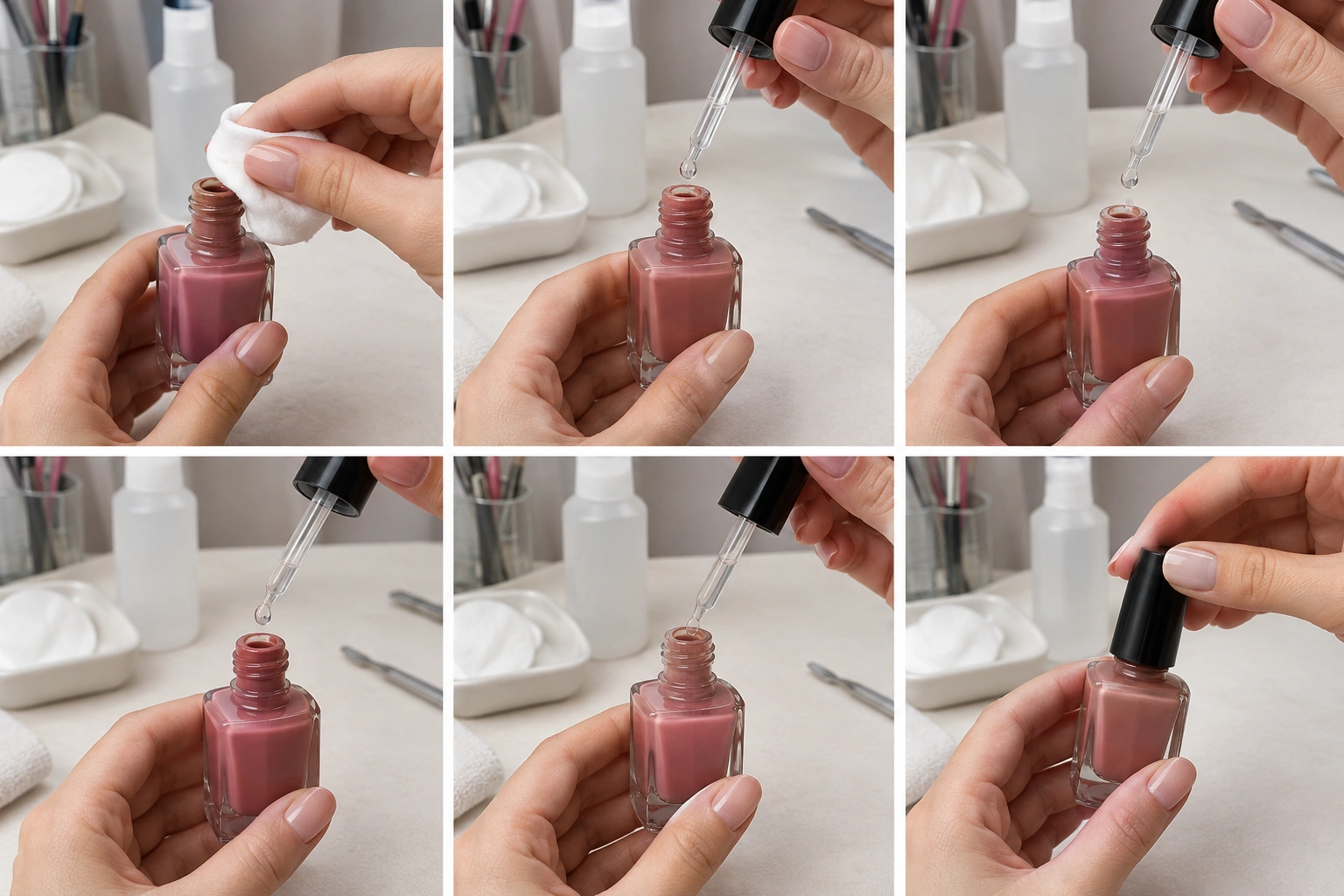
2. Mix gently
Roll the bottle between your hands or turn it slowly. Do not shake hard. Aggressive shaking can trap air and make application worse, especially if the polish already has a thick, uneven texture.
3. Add nail polish thinner in very small increments
This is the most important step. Add only a few drops at a time, then stop. For a standard bottle, start with a small amount rather than trying to “fix” it all at once. If the polish is only slightly thick, a tiny addition may be enough. If it is very goopy, you may need more than one round, but each round should still be small.
A practical method:
– add a few drops of thinner
– close the bottle
– roll it gently for a few seconds
– let it sit briefly so the thinner can distribute
– test the flow again
Repeat only if the polish is still too thick. The goal is to creep up on the right consistency, not overshoot it.
4. Let it sit, then test again
After adding thinner, give the bottle time to settle. Then roll it gently again and check the brush. The polish should flow off the brush in a smooth, even bead instead of clinging in long strings.
What success looks like:
– the brush loads evenly
– the polish moves without dragging
– the color lays down smoothly instead of clumping
What failure looks like:
– the polish turns watery
– it looks patchy or sheer
– it separates again right away
– it still feels gummy after mixing
5. Test on a nail or swatch
A bottle can look fine in the neck and still apply poorly. Put a small amount on a nail or swatch and see whether it levels, covers evenly, and dries normally.
If it still drags, strings, or leaves bald spots, add only a little more thinner and test again. If the polish keeps refusing to level after careful thinning, it is probably beyond a simple rescue.
How much thinner should you add?
There is no universal number that fits every bottle, because formulas vary. The safest rule is simple: add a small amount, mix, test, and repeat only if needed.
Use this decision framework:
- If the polish is only slightly thick: one small addition may be enough.
- If the polish is slow but still liquid: thin gradually, because over-thinning can make the polish sheer or patchy.
- If the polish is stringy or clumpy: add thinner in very small increments and test after each addition.
- If the polish is still not improving after a few careful rounds: stop and reassess instead of forcing more thinner into it.
A good rescue process is gradual, not instant. If you add too much thinner at once, you can overshoot the usable range and end up with a bottle that covers poorly or dries unevenly. That is why testing after each addition matters.
Over-thinning has real trade-offs. The polish may lose opacity, take longer to level, or dry with a weaker finish. That is especially frustrating with one-coat colors, where the whole point is coverage.
Thick polish vs. separated polish vs. dried-out polish
These problems are related, but they do not behave the same way.
- Thick polish is still fluid, just sluggish. It is usually the easiest to rescue.
- Separated polish may look broken in the bottle, but the formula can still be usable if it recombines with gentle mixing.
- Dried-out polish has usually lost too much solvent to return to a normal finish, even if it softens a little with thinner.
That difference affects both the rescue process and the final manicure. Thick polish can often be restored to a brushable texture. Separated polish may need mixing before thinning. Dried-out polish often stays lumpy, rubbery, or unreliable even after you try to fix it.
Thick polish application fixes: how to make it go on better
Even after you rescue the bottle, thick polish can still apply differently. A few technique changes can help:
- Use thinner coats. Heavy coats make thick polish more likely to drag and pool.
- Reload the brush more often. Thick polish does not spread as far, so smaller passes usually work better.
- Avoid pressing the brush down too hard. That can leave ridges and streaks.
- Work quickly but smoothly. Long pauses let polish set before it levels.
- Watch for drag marks. If the brush starts pulling the layer underneath, stop and reload instead of brushing back and forth.
- Cap the free edge lightly. Thick polish can bunch at the tip if you overload the brush.
These fixes do not replace thinning, but they can make a borderline bottle much easier to use.
When thick polish is still usable and when to throw it away
Keep trying to save the bottle if:
– it is thick but still fully liquid
– the polish mixes back together
– thinning improves brush flow
– the color and finish still look normal on the nail
Replace it if:
– it is hard, rubbery, or mostly dried out
– it stays clumpy after careful thinning
– the bottle no longer mixes into a smooth formula
– the polish applies so unevenly that it wastes more time than it saves
– it still looks stringy, patchy, or separated after a few small thinning attempts
A practical stop-and-discard threshold helps here: if you have added thinner in small increments, mixed after each addition, and the polish still does not become brushable, stop. At that point, more thinner is more likely to make the manicure worse than better.
A nearly empty bottle that has thickened badly is often the clearest “replace it” case. There may simply not be enough product left to restore a reliable consistency.
How to prevent nail polish from getting thick again
A few habits make a real difference:
- Close the cap tightly right away. Even a small amount of air can contribute to thickening over time.
- Clean the bottle neck after each use. This helps the cap seal properly.
- Store polish in a cool, dark place. Avoid sunny windows and warm bathrooms.
- Keep bottles upright. This reduces leaks and keeps the neck cleaner.
- Avoid leaving bottles open while painting. Work in a way that keeps the bottle open for the shortest practical time.
- Do not let dried polish build up on the threads. That residue can interfere with the seal and speed up thickening.
- Use the bottle before it gets too old. Even well-stored polish can gradually lose performance over time.
If you want to keep your manicure routine efficient, this also pairs well with learning how long nail polish takes to dry completely, because slower application often means more time with the bottle open.
When to see a nail technician or dermatologist
A nail technician can help if you are unsure whether a bottle is worth saving, especially with expensive or specialty formulas. They can also tell you whether a product is behaving normally for its type.
A dermatologist is not needed for a thick bottle of polish alone. But if your nails or surrounding skin are reacting badly to a product, or if you have irritation that seems tied to nail cosmetics, get professional medical advice rather than guessing.
FAQ
Can I use acetone to thin nail polish?
You can, but it is not the best choice. Acetone may thin the polish temporarily, but it can alter the formula and affect coverage or finish. A dedicated nail polish thinner is safer for restoring consistency.
Is nail polish remover the same as thinner?
No. Remover often contains acetone and other ingredients that are not designed to preserve the polish formula. It may seem to work at first, but it can make the bottle behave unpredictably.
Why does my polish get thick even if I only used it once or twice?
Sometimes the bottle was already close to thickening, or the cap was not sealed perfectly. A little air exposure, bottle-neck residue, or warm storage can push a borderline formula over the edge.
How do I know if it is beyond saving?
If the polish is rubbery, fully dried, or still clumpy after careful thinning and mixing, it is usually time to replace it.
Can shaking fix thick polish?
Not really. Gentle rolling or slow mixing is better. Hard shaking can add bubbles and make the formula less pleasant to apply.
Does gel polish thicken for the same reason?
Not exactly. Gel polish has its own chemistry, but it can still suffer from air exposure and poor storage. Regular polish and gel polish should not be treated the same way.
How much thinner is too much?
If the polish starts looking watery, sheer, or weak in coverage, you have gone too far. Stop as soon as the brush flow looks smooth and the polish still covers normally.
Should I just buy a new bottle?
If the polish is a favorite and still mostly liquid, it is worth trying to save. If it is old, clumpy, and inconsistent after thinning, replacement is usually the faster and less frustrating option.

