
How Much to Tip at a Nail Salon: A Practical Guide for Every Service

If you want the short answer, tip 15% to 20% at a nail salon, with 20% being the safest standard when the service is solid and you’re happy with the result. A simple rule that works in real life:
– 15% = acceptable baseline if the service was fine and you’re budgeting carefully
– 20% = standard if the appointment went well
– 25% or more = for standout service, extra time, or highly detailed work
If you’re standing at the checkout counter doing quick math, tip about $5 on a $25 service, $10 on a $50 service, and $15 on a $75 service if you’re aiming for roughly 20%.
How Nail Salon Tipping Usually Works
In most salons, the service price does not include the tip, so the tip is added at the end. That’s the basic etiquette framework: you pay for the service, then leave an extra amount to recognize the technician’s work. One practical note from V Beauty Pure’s salon etiquette guide is that the tip is generally added separately rather than built into the listed price.
A few things affect the final amount:
– the type of service
– how long the appointment took
– whether the work was simple or detailed
– whether one or more technicians helped
For example, a quick polish change and a full set of acrylics are not equal in time or effort, so the tip usually shouldn’t be identical either.
Standard Tip Percentages: 15%, 20%, or 25%?
The cleanest way to decide is to think in tiers.
15%: the low end of normal
This is the practical floor for a decent appointment. It’s a fair choice if:
– the service was fine but not memorable
– the salon experience was average
– you’re keeping the total cost under control
20%: the standard choice
This is the number most people can use without overthinking. It’s a strong default when:
– the technician was efficient and careful
– the result looks good
– the appointment matched your expectations
25% or more: for exceptional work
A higher tip makes sense when:
– the appointment ran long because of detailed work
– you requested intricate nail art
– the technician corrected a problem gracefully
– the service felt especially attentive or polished
That doesn’t mean you have to tip extra every time the salon is busy. The higher range is best reserved for work that genuinely took more skill, time, or care than usual.
How Much to Tip for Different Nail Services
Different services carry different expectations because they vary in time, complexity, and materials. That’s a good reason your tip should also flex a little.
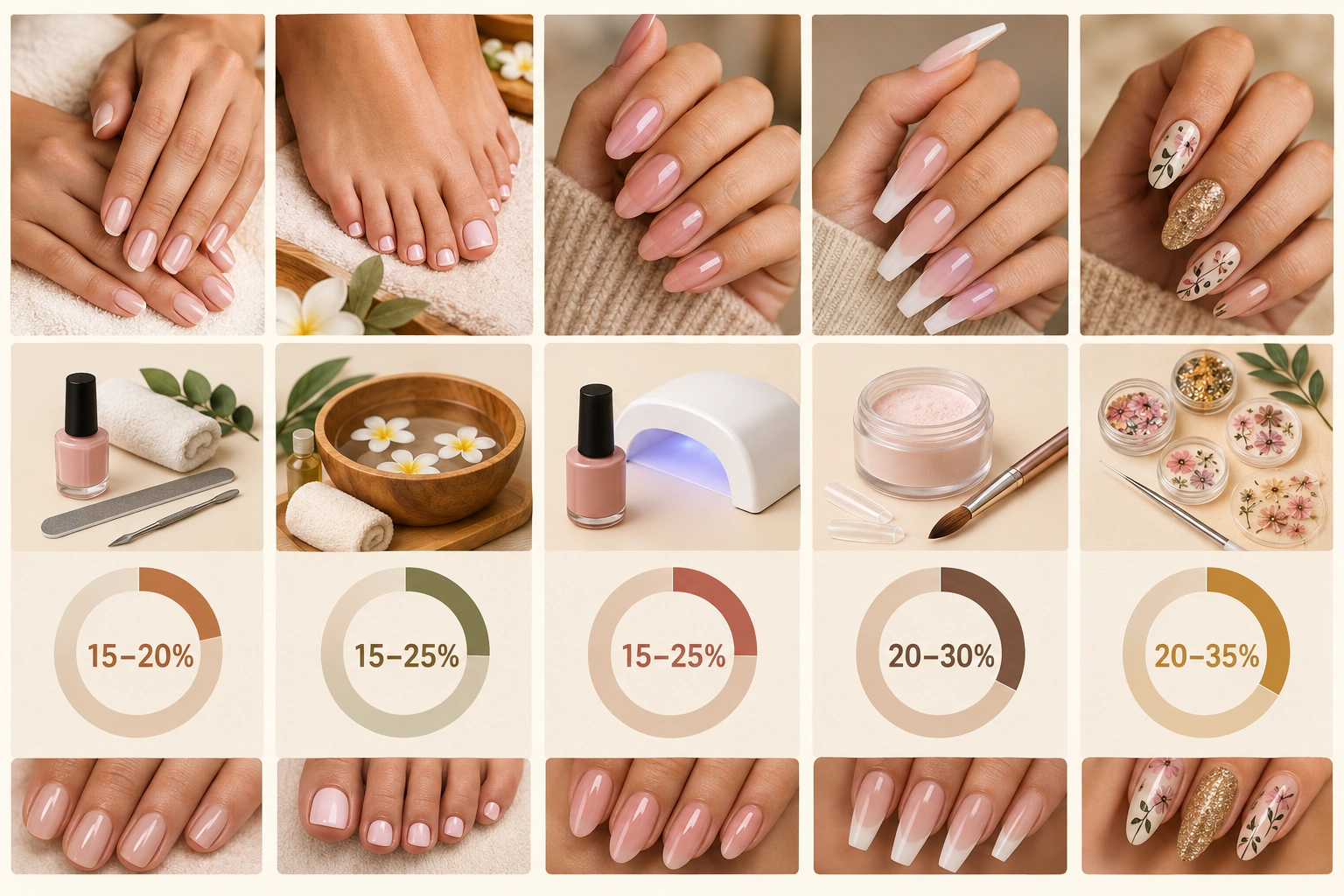
| Service type | Typical tip range | Practical note |
|---|---|---|
| Basic manicure | 15%–20% | Use the standard range |
| Pedicure | 15%–20% | Often tipped similarly to manicures |
| Gel manicure | 15%–20% | More time than a basic polish service |
| Acrylic nails | 20% | Often more technical and time-consuming |
| Dip powder | 15%–20% | Similar to other enhancement services |
| Nail art | 20%–25%+ | Increase for detailed hand-painted work |
| Removal or repair | 15%–20% | Round up if the service is short |
| Add-on service | Tip on the add-on too | Treat it as part of the visit |
Manicure
For a standard manicure, 15% to 20% is the usual range. If the service is quick and straightforward, 15% is reasonable. If the tech is especially careful with shaping, cuticle work, or polish application, 20% feels more appropriate.
Pedicure
Pedicures are often tipped in the same range as manicures. Some people choose to tip a little more simply because pedicures tend to take longer and involve more hands-on work, but there’s no need to force a higher percentage if the service was basic.
Gel nails
Gel services usually deserve at least the standard tip because they take more time than a basic polish change. If the gel application included careful prep, clean edges, and a smooth finish, 20% is a comfortable choice.
How much to tip for acrylic nails
Acrylic services often involve more skill, more steps, and more time. That’s why many people lean toward 20% for acrylic nails, especially if the set required shaping, fills, or correction work.
Nail art
This is where tipping can move above the baseline. A simple accent nail is one thing; detailed hand-painted art or a custom design is another. If the art clearly took extra time and precision, 25% is a fair way to acknowledge that.
Removals and repairs
These services can be short, but they still take attention. If the appointment was quick, a rounded-up cash tip is often easier than calculating a tiny percentage. For a small repair or removal, it’s perfectly normal to leave a modest tip that still feels respectful.
Real-Dollar Tip Examples for Common Nail Salon Prices
Percentages sound simple until you’re at the register. These examples make the math easier.
- $30 basic manicure
- 15% = $4.50
- 20% = $6
-
A practical tip: $5 or $6
-
$50 pedicure
- 15% = $7.50
- 20% = $10
-
A practical tip: $8 to $10
-
$70 gel manicure with nail art
- 20% = $14
- 25% = $17.50
-
A practical tip: $15 to $18
-
$90 acrylic fill with a $10 discount
If the discounted total is $80, then 20% is $16.
That’s a clean example of why the final amount matters. -
$25 polish change
- 20% = $5
- If math feels awkward, rounding to $5 is simple and fair
A useful habit: if the percentage gives you an odd amount, round to the nearest dollar or two. That keeps tipping easy without turning the checkout into a math test.
When to Tip More: Extra Time, Skill, or Special Requests
Tip more when the service clearly asked for more than the standard appointment.
Good reasons to increase the tip:
– detailed nail art
– a long appointment that required patience
– careful correction of a previous nail issue
– extra attention to shaping or symmetry
– a technician who handled special requests smoothly
A realistic example: if your gel manicure normally costs $45 and you added detailed art that took extra time, moving from a $9 tip at 20% to an $11 or $12 tip at around 25% is a reasonable way to acknowledge the extra work.
The key question is simple: Did this appointment require noticeably more skill, time, or patience than a standard service? If yes, tip up.
How to Tip for Multiple Technicians or Split Services
If different staff members handle different parts of your visit, it’s usually best to tip them separately. That keeps the tip aligned with the actual work each person did.
A common example:
– one technician does the manicure
– another does the pedicure
– a third person adds nail art or a repair
In that case, don’t guess one total tip and hope it covers everyone. Split the tip so each person gets recognized for the service they provided.
A simple approach:
1. Identify who did what.
2. Estimate each service’s value.
3. Tip each technician based on their part of the visit.
If the salon uses a shared payment system, ask the front desk how they prefer tips to be handled. That avoids awkwardness and helps make sure the right person gets the right amount.
Do You Tip on the Full Price or the Discounted Price?
In most cases, tip on the amount you actually paid after discounts, coupons, package pricing, or membership pricing. That’s the most practical rule because it reflects the real transaction.
So if a service is normally $90 but your coupon brings it to $80, a 20% tip would be $16, not $18.
For package deals and memberships, use the same rule: tip on the discounted or paid amount for that visit unless the salon clearly says otherwise.
That said, if the salon’s policy says something different, follow the salon’s guidance.
Cash Tip vs. Card Tip: What’s Better?
Cash is often preferred because it’s immediate and simple for the technician to receive. That said, card tipping is completely acceptable when cash isn’t available.
Here’s the trade-off:
– Cash tip: fast, direct, easy for the technician
– Card tip: convenient if you didn’t bring cash
If you do tip by card, make sure the amount is entered clearly before you sign.
What If the Service Was Mediocre or Bad?
This is where people overthink the etiquette. You do not have to tip generously for poor service. If the service was clearly below standard, reducing the tip is reasonable.
A fair approach:
– Minor issues: tip less, but don’t necessarily skip it entirely
– Major problems: leave a smaller tip or none, depending on what happened
– Serious dissatisfaction: speak to the manager or front desk before you leave
The goal is to match the tip to the service, not to punish a technician for a small mistake that could be fixed. If the issue is significant, a calm conversation is usually more useful than silently leaving a tip you feel unhappy about.
Tipping the Salon Owner and Handling Add-Ons
If the salon owner does your nails, tipping is still often appropriate. Local custom and the quality of the service matter here, so there isn’t one universal rule. If the owner performed the service and it was excellent, a standard tip is still a polite gesture.
Add-ons should be handled as part of the visit:
– nail art
– repairs
– removal
– extra shaping
– specialty finishes
If the add-on took noticeable time, include that in your tip calculation. The simplest method is to tip based on the total amount you paid for the full appointment, including the extras.
Quick Decision Rule You Can Use Every Time
If you want one easy formula, use this:
- 15% if the service was okay and you’re being budget-conscious
- 20% if the service was good and you’re satisfied
- 25% if the work was detailed, time-consuming, or exceptional
Then adjust for:
– multiple technicians
– discounts or package pricing
– add-ons like nail art
– poor service or standout service
That approach keeps you from overthinking the receipt while still tipping in a way that feels fair.
FAQ: Nail Salon Tipping Questions
Do you tip on the pre-tax or post-tax total?
Most people tip on the service total before tax. If you want the simplest rule, tip on the amount you were charged for the service itself, not the tax.
Should I tip more for a pedicure than a manicure?
Not automatically. Tip based on the time, effort, and quality of the service rather than the label alone.
Do I tip each technician separately?
Yes, if different people handled different services, separate tips are the cleanest approach.
Is cash required?
No. Cash is often preferred, but card tipping is acceptable if that’s what you have.
What about coupons or membership discounts?
Usually tip on the discounted amount you actually paid unless the salon tells you otherwise.
How much should I leave for nail art?
If the design was simple, the standard range may be enough. For detailed custom art, moving above 20% is often reasonable.
What if the owner did my nails?
Tipping can still be appropriate. Use the same service-based judgment you would for any technician.
Can I round up instead of calculating exactly?
Yes. For smaller services, rounding to a clean dollar amount is often the easiest and most natural choice.
Is it rude not to tip if I’m unhappy?
If the service was truly poor, a reduced tip is understandable. If the issue was significant, it’s better to address it directly with the salon.
How much should I tip at a nail salon if I’m unsure?
Use 20%. It’s the most reliable default.

