
How Much to Tip at a Nail Salon: A Practical Guide for Manicures, Pedicures, and More

If you want the short answer, tip 10% to 20% at a nail salon, with 15% to 20% being the most common practical range for a standard service. That range is a common etiquette baseline for manicures, pedicures, gel nails, and acrylic services.
If the service was solid and you’re happy with the result, 20% is the easiest default. If the appointment was simple, quick, or you’re working with a tighter budget, 15% is still a respectful tip. For especially detailed work, long appointments, or a technician who went out of their way to help, it’s reasonable to tip more.
- 15% = standard, acceptable tip
- 18% = a little extra appreciation
- 20% = strong service, common “thank you” amount
- Above 20% = exceptional work, complex nail art, or a technician who truly went beyond the basics
Quick Answer: How Much to Tip at a Nail Salon
If you only remember one thing, remember this:
- Basic manicure or pedicure: tip 15% to 20%
- Gel, acrylic, or detailed nail art: usually 20% or more if the work is more time-consuming
- If you’re unsure: round to a number that feels clean and fair, such as $8, $10, $15, or $20, depending on the bill
A tip is usually given in addition to the service price, not built into it. In practice, that means the tip is added at the end of the appointment rather than included in the posted price.
That means a $40 manicure and a $100 acrylic set should not get the same flat tip unless the salon’s structure makes that the norm. Percentage-based tipping scales more fairly with price and complexity.
How to Calculate the Right Tip
The easiest formula is:
Service total × tip percentage = tip amount
A few quick examples:
- $35 manicure at 15% = $5.25 tip
- $35 manicure at 20% = $7 tip
- $60 pedicure at 18% = $10.80 tip, usually rounded to $11
- $75 gel manicure at 20% = $15 tip
- $100 service at 15% = $15 tip
- $100 service at 20% = $20 tip
If math at checkout makes you freeze, use this shortcut:
- 15% = multiply by 0.15
- 18% = multiply by 0.18
- 20% = multiply by 0.20
Then round to the nearest dollar if the salon does not need exact change. Rounding up is common and makes the exchange easier for everyone.
A simple decision rule
Use this when you’re standing at the register:
- Good service, no surprises: tip 15% to 18%
- Great service or detailed work: tip 20%
- Exceptional work or extra time: tip more than 20% if your budget allows
For a quick reference on nail service types and what they usually involve, our guide to what is a full set at a nail salon can help you understand why some appointments take longer and deserve a larger tip.
Typical Tip Amounts for Manicures, Pedicures, Gel, and Acrylic Services
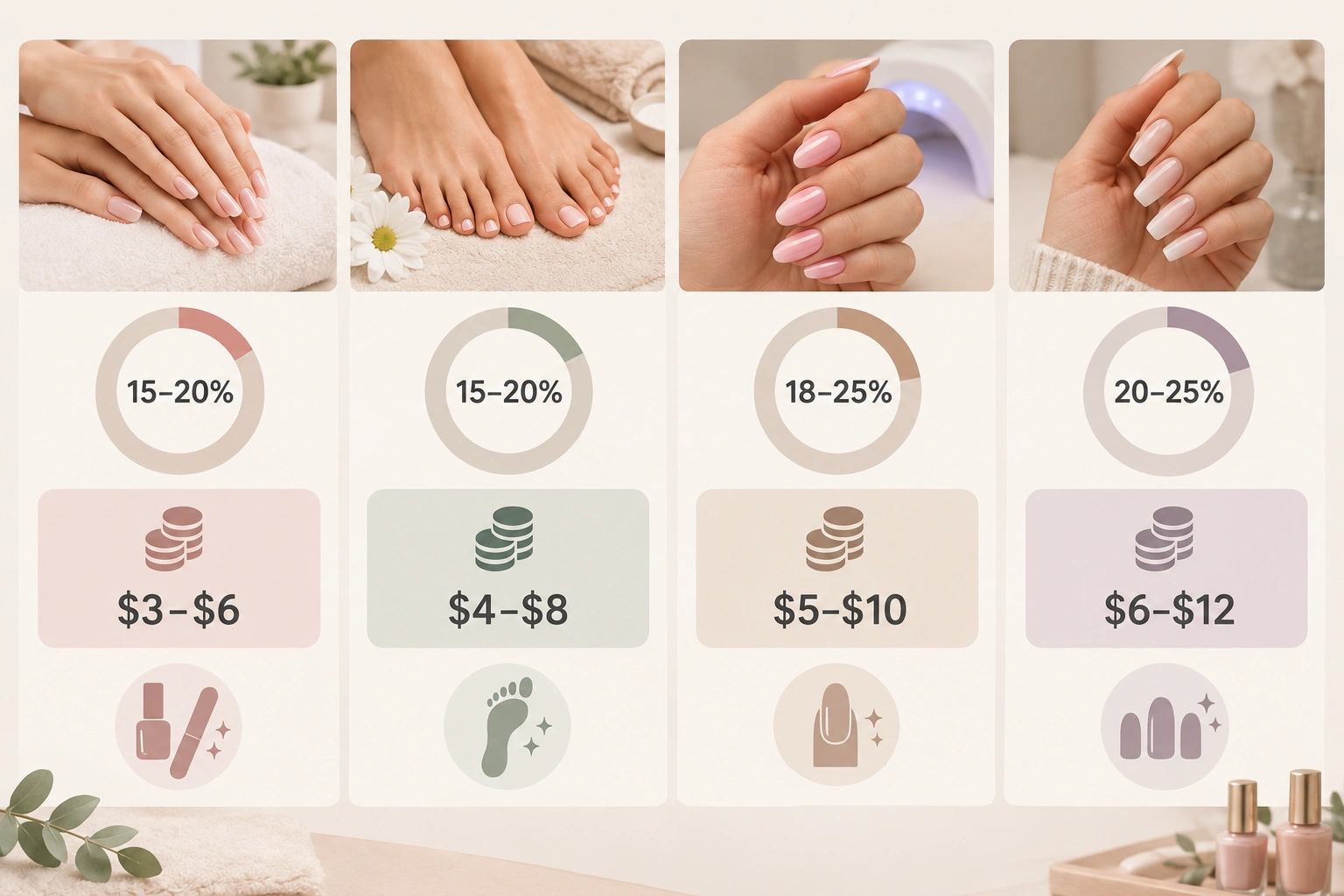
The exact dollar amount depends on your salon’s pricing, but these examples show the range most people use in real life.
| Service Price | 15% Tip | 18% Tip | 20% Tip |
|---|---|---|---|
| $25 | $3.75 | $4.50 | $5 |
| $40 | $6 | $7.20 | $8 |
| $50 | $7.50 | $9 | $10 |
| $60 | $9 | $10.80 | $12 |
| $75 | $11.25 | $13.50 | $15 |
| $100 | $15 | $18 | $20 |
Basic manicure
For a straightforward manicure, 15% to 20% is the usual range. If the appointment was quick and routine, 15% is fine. If your tech was careful with cuticles, shaping, and polish application, 18% to 20% is a better reflection of the work.
Pedicure
Pedicures often take more time than a basic manicure, especially if there’s exfoliation, foot massage, or extra cleanup. That’s why many clients tip closer to 18% to 20% for a pedicure, especially when the service feels more hands-on.
Gel nails
Gel services usually involve extra prep, curing, and removal considerations. Because of the added time and technique, 20% is a very normal tip if the result is clean and durable.
Acrylic nails or full sets
Acrylics often take longer than a simple polish change, and the skill level can be higher. If the set required shaping, balancing, fills, or corrections, a 20% tip is a fair baseline. If the work was especially detailed, a little more is reasonable.
Nail art
Nail art is where a flat dollar tip can undershoot the effort. A simple percentage works well, but if the design was detailed, hand-painted, or took significant extra time, it’s common to tip above the usual amount.
When to Tip More or Less
Tipping is not meant to be a perfect scorecard. It’s a practical way to acknowledge time, skill, and attention.
Tip more when:
- the appointment took longer than expected
- the technician handled detailed shaping or repairs
- you asked for custom nail art
- the service felt careful and unrushed
- the tech fixed a problem without making you feel awkward
Tip less when:
- the service was rushed or incomplete
- the result had clear issues you had to correct
- the salon experience was poor enough that you would not return
If the service was genuinely disappointing, a lower tip can reflect that experience. If the problem was significant, though, it is usually better to address it separately with the salon rather than using the tip alone as a complaint. A smaller tip may make sense for a minor issue, but it should not replace a direct conversation when the service needs to be corrected.
How to Tip for Add-Ons, Nail Art, and Special Requests
Add-ons can change the tipping picture because they add labor, not just polish.
Examples include:
– French tips
– chrome
– glitter fades
– repairs
– detailed line work
– length adjustments
– custom shaping
If the add-on clearly took extra time or skill, tip based on the full service total, not just the base manicure price. That keeps the tip aligned with the actual work performed.
For especially detailed nail art, a percentage tip still works, but some clients also add a little extra on top if the design was complex. That can be useful when the artistic effort is obvious and you want to reward it directly.
Practical example
If your base gel manicure is $50 and nail art adds $20, tipping 20% on the $70 total gives you a $14 tip. If the art was elaborate and took a lot of time, you might round up to $15 or $18.
Should You Tip on the Full Price or the Discounted Price?
This is one of the most common questions, especially when coupons or promotions are involved.
The practical rule
If the salon gives you a discount, the most common approach is to tip on the amount you actually paid. That is the simplest and most defensible rule because it matches the real transaction.
When some clients tip on the original price
If the discount was large and you still received full service, some people choose to tip on the pre-discount amount as a way to be more generous. That is not required, but it can be a nice gesture if the service was excellent.
Decision framework
- Small discount, normal service: tip on the discounted total
- Large coupon, great service: tip on the original total if you want to be extra fair
- Package deal with multiple services: tip based on the service total or what the salon says is customary
If a salon has a policy, follow that first. If not, the discounted total is the cleanest default.
Cash vs. Card Tips at Nail Salons
Cash is often preferred because it can go directly to the technician right away. But card tipping is absolutely acceptable when cash is inconvenient.
Cash tip
Pros:
– easy for the technician to receive
– no extra processing delay
– simple if you already brought the right amount
Cons:
– requires planning ahead
– not everyone carries cash
Card tip
Pros:
– convenient
– easy to calculate
– useful when you did not bring cash
Cons:
– may be processed through the salon system
– not always as immediate for the technician
Best practice
If you can, bring cash for the tip. If you can’t, add it to the card. If the salon uses a payroll or shared tip system, ask at checkout how tips are distributed so the right people are recognized.
For a safer, smoother salon visit overall, you may also want to read our guide on how to find a safe nail salon. A clean, well-run salon usually makes tipping and checkout much easier too.
How to Tip Multiple Nail Technicians or Assistants
When more than one person helps with your appointment, the cleanest approach is to make sure each person is recognized for their part.
Common situations
- one technician removes old product, another applies the new set
- an assistant does prep while the main tech finishes the service
- one person handles the manicure and another handles the pedicure
If the salon clearly divides labor, tip each person separately when possible. That avoids the awkward “who got what?” problem.
Simple rule
- If one person did most of the service: tip that person the main amount
- If two people split the work evenly: divide the tip or give each a smaller amount based on the portion they performed
- If the salon runs a shared-service model: ask at checkout how tips are usually handled
A concrete example: if you planned to tip $20 for a split service, you might give $14 to the base technician who did most of the appointment and $6 to the add-on artist who handled the extra design work. If the work was split more evenly, a $10 and $10 split can make sense.
If a salon uses a shared tip pool, follow the salon’s system rather than trying to divide it yourself.
Do You Tip the Salon Owner?
This is where etiquette gets a little less uniform.
In many salons, owner-technicians are tipped the same way as other technicians if they personally perform the service. In owner-operated businesses, the rule is straightforward: tip owner-technicians who accept tips, but do not tip owners who explicitly decline them.
Best decision rule
- If the owner performed the service and the salon accepts tips: tipping is usually appropriate
- If the owner says they do not accept tips: respect that
- If you are unsure: ask discreetly at checkout or follow the salon’s posted policy
The key is not to assume. A quick, quiet question is better than guessing and feeling awkward later.
Common Nail Salon Tipping Mistakes to Avoid
A few small mistakes create most of the confusion:
1. Tipping from the wrong total
If you used a coupon or discount, check whether the salon expects the tip on the discounted amount or the original amount. When in doubt, use the amount you actually paid.
2. Forgetting add-ons
If you asked for nail art, extra shaping, or a more complex service, don’t tip as if it were a basic polish change.
3. Tip splitting confusion
If multiple people helped, make sure the tip reaches the right hands. Don’t leave one combined tip if the salon clearly expects separate tips.
4. Using a flat amount that is too small for a large service
A $5 tip may be fine on a very inexpensive service, but it can look thin on a $100 appointment.
5. Assuming cash is required
Cash is nice, not mandatory. If card is your only option, use it.
6. Ignoring local custom
Tipping expectations can vary by region and by salon culture. If you are traveling or visiting a new area, it helps to notice what the salon staff or local regulars seem to do.
When to See a Nail Technician or Dermatologist
If your nails or skin are irritated, painful, or reacting badly after a salon visit, pause future services and get professional advice. A nail technician can help with service-related concerns, while a dermatologist is the better choice for ongoing skin or nail problems.
The Bottom Line
If you want a simple answer to how much to tip at nail salon appointments, use 15% to 20% of the service total. For standard service, 18% to 20% is a comfortable, modern choice. For complex work, detailed nail art, or appointments that took extra time, tipping a little more is fair. And if the service was discounted, split among multiple people, or performed by the salon owner, use the practical rules above to decide without second-guessing yourself.
The goal is not to memorize a perfect formula. It’s to leave the salon feeling confident that you tipped in a way that matches the service you received.

