
How to Ask for Nail Art at a Salon Without Miscommunication

Walking into a salon with a nail art idea can feel oddly intimidating, especially if you do not know the technical terms. The good news is that you do not need to speak like a nail technician to get a great result. You just need to be clear about the look you want, the parts you are flexible on, and the limits of your time, budget, and nail length.
A good appointment often starts when the client and technician are picturing the same general result. That does not mean the exact design is always possible. It does mean you can usually get very close if you communicate well before the service begins.
What to Say When You Want Nail Art at a Salon
You can keep your request simple. A clear sentence is often better than a long explanation.
Try phrases like:
- “I’d like nail art on these nails.”
- “I want something similar to this photo, but simpler.”
- “Can you do a design like this in these colors?”
- “I’m hoping for a floral look on two accent nails.”
- “I’d like a glossy nude base with black line art.”
If you do not know the nail terms, describe the visual instead. Say what you can see: stripes, stars, flowers, French tips, glitter, chrome, dots, hearts, or abstract swirls. A technician can usually translate plain language into the right service.
For example, instead of saying “I want a negative-space minimalist set,” you could say, “I want a sheer base with a few thin white lines and no full coverage on every nail.” That gives the technician a useful picture without forcing you to know salon jargon.
If you are booking online or by phone, mention that you want nail art before the appointment begins. That gives the salon a chance to tell you whether they need extra time or a specific tech for the design.
How to Show a Reference Photo the Right Way
A photo is helpful, but it should not be your only communication tool. The best approach is to use the photo as a starting point, then point out exactly what you want from it.
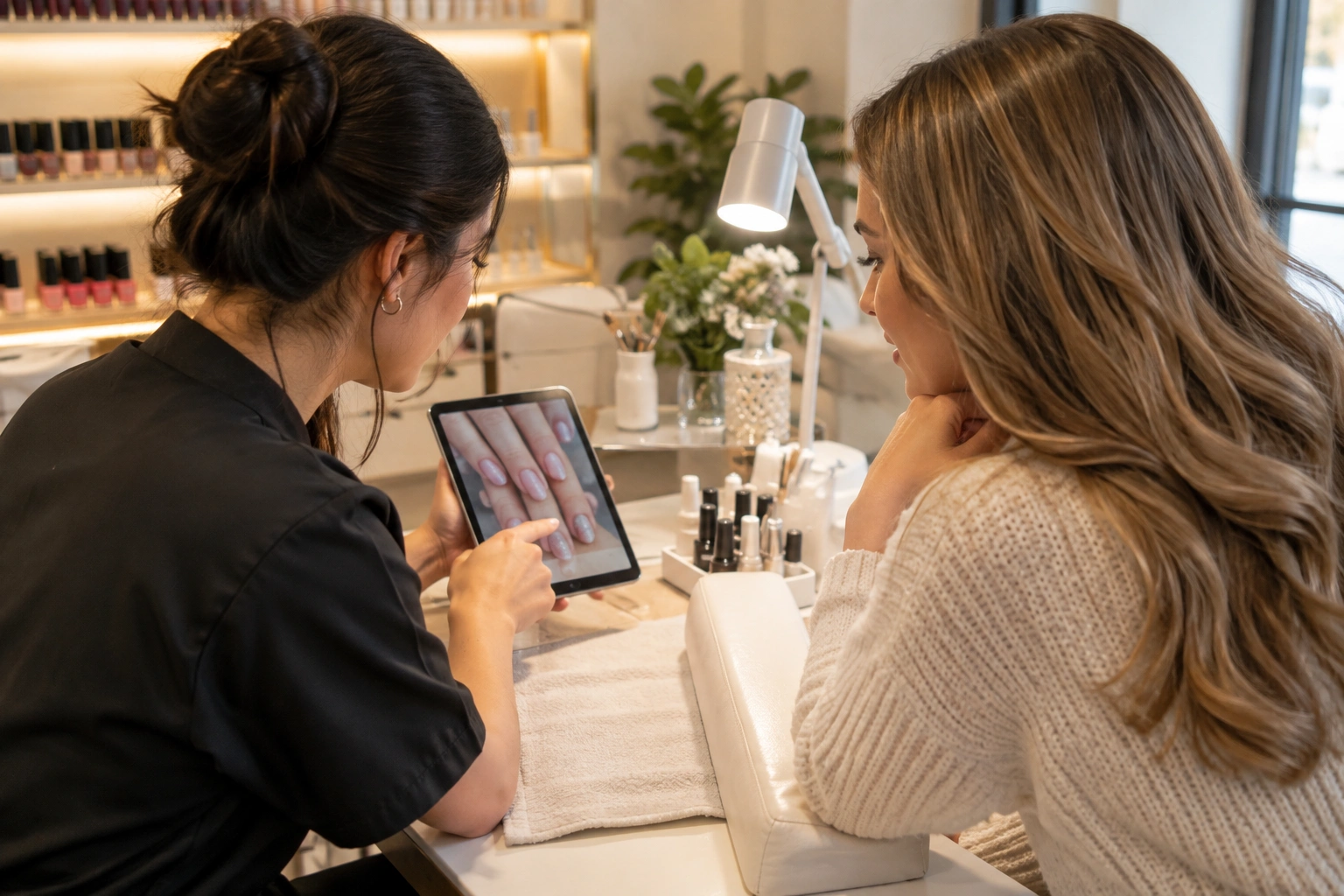
Bring one strong reference photo if you can. If you bring several, make sure they all point in the same direction. If one image has almond-shaped nails and another has square nails, say which part you want from each. A mix of very different photos can make the goal harder to read, so it helps to choose one main inspiration and then add only a few supporting images if needed.
A useful way to explain the photo is to be specific about the parts you like:
- “I like the color palette in this one.”
- “I want the shape from this photo.”
- “I only want the design on two nails.”
- “I like the pattern, but not the length.”
- “I want this idea, but with softer colors.”
- “I like the overall vibe, not the exact flowers.”
If you want the design to be inspired by a photo rather than copied exactly, say that directly. You could tell the technician, “I love this as inspiration, but I’d like your own version of it,” or “Can you do something similar without duplicating it exactly?” That keeps the request clear and also addresses uniqueness concerns in a practical way.
That level of specificity helps the technician understand what matters most to you. You are not asking them to copy every detail perfectly. You are giving them a target.
If you are trying a new salon, it can also help to look at the salon’s social media first. If you cannot find what you want online, you can show the receptionist the design and ask whether they can pair you with a technician best suited for it.
The Details You Should Specify Before the Service Starts
Once the technician understands the general look, confirm the details that affect the final result. This is the part that prevents “I thought you meant…” moments.
Color
Name the base color and the accent colors. If you want soft pink, say soft pink rather than “light.” If you want the design to feel bold, say that too. Color expectations can shift quickly when a salon has many shades that look similar in the bottle.
Placement
Say whether the art should go on all nails or only a few. Accent nails can keep the design more affordable and less busy. A full set creates a stronger visual impact, but it also takes more time and usually more precision.
Shape and length
Nail art often looks different on short square nails than on long almond or coffin nails. If you know your preferred shape, mention it before the art is planned. Some designs need more space to read clearly, especially detailed florals, character art, or layered patterns.
Finish
Glossy, matte, and chrome all change the final effect. A matte top coat can sometimes soften the look of a design, while gloss may make colors appear sharper. If the reference photo has a particular finish, say so.
Base service
Tell the technician whether you are wearing natural nails, gel polish, acrylics, BIAB, or another enhancement. That matters because the surface, length, and durability all affect how the art is applied and how it will wear.
How to Ask Whether the Design Will Work on Your Nails
This is one of the most useful questions you can ask before the service begins: “Will this work on my nail length and shape?”
That single question can save you from disappointment. A design that looks balanced on long extensions may look crowded on short natural nails. Similarly, a very detailed pattern may need more surface area than you currently have.
Here is a practical way to check feasibility:
- Ask whether the design works on your current nail length.
- Ask whether it needs extensions, gel, acrylics, or a different base.
- Ask whether the design will still look clear if it is scaled down.
- Ask whether the salon can simplify the idea without losing the overall feel.
If you are choosing between natural nails and extensions, think about the design itself. Natural nails are often great for simpler art, clean lines, dots, and accent details. Extensions can give you more room for detailed art and a more dramatic shape. That said, more length is not automatically better. If you use your hands a lot, a shorter, cleaner design may be easier to wear.
How to Talk About Price, Time, and Complexity
Nail art is not priced only by polish color. Complexity matters. A simple design like dots, a French tip, or a single accent nail usually takes less time than hand-painted flowers, detailed line art, chrome, or layered embellishments.
A helpful question is: “Is this considered a simple add-on or a more detailed custom design?”
That opens the door to a realistic conversation about both time and cost. If a design needs extra appointment time, you want to know that before the service starts, not when the technician is halfway through the second hand.
Use this rule of thumb:
- If the design is clean and minimal, ask whether it is included or a small add-on.
- If the design has multiple colors, tiny details, rhinestones, charms, chrome, or hand-painted art, ask whether it is a custom art service.
- If you are switching from one accent nail to a full set, ask whether that changes the price.
- If you are on a schedule, ask how much extra time the art may require.
You do not need an exact minute-by-minute promise. You do need enough information to decide whether the appointment fits your budget and calendar. If the salon cannot give a firm estimate, ask for the safest planning assumption so you are not rushed.
Simple Nail Art vs. Detailed Custom Nail Art
Here is a quick way to think about what you are requesting.
| Choice | Best for | Trade-off |
|---|---|---|
| Simple nail art | Clean looks, shorter appointments, lower cost | Less visual detail |
| Detailed custom nail art | Statement designs, hand-painted art, special occasions | More time, more cost, more room for variation |
| Photo + verbal explanation | Clear direction and fewer misunderstandings | Takes a few extra minutes to discuss |
| Photo only | Quick inspiration | Technician may not know what parts matter most |
| Natural nails | Low-maintenance everyday wear | Less space for large or intricate designs |
| Extensions/acrylics | More room for shape and detailed art | More upkeep |
This table is not about making one choice “better” than another. It is about matching the design to the reality of your appointment.
What to Do If the Salon Can’t Copy the Design Exactly
This happens more often than people expect, and it is not a failure. It usually means the salon is being honest about time, skill set, or the limits of your nail length.
A good response is to ask for the closest workable version. You might say:
- “What part of this can you realistically do today?”
- “Can we simplify it and keep the same color palette?”
- “Could we keep the shape and change the details?”
- “What would you suggest for short nails?”
That keeps the conversation collaborative instead of confrontational.
If the reference is very detailed, try choosing the most important element first. Maybe the main priority is the color story. Maybe it is the floral motif. Maybe it is the negative space. Once you know the must-have piece, the technician can adjust the rest.
This is where a consultation helps. If you are not familiar with nail services, asking for a quick consult before you commit is reasonable. It gives the technician a chance to explain what will and will not translate well on your nails.
Salon Etiquette for First-Time Nail Art Clients
A little preparation can make the appointment smoother for both of you.
Try to arrive with clean nails and remove old polish if the salon has asked you to do that in advance. Be ready to explain your preferences quickly, especially if the technician is asking about color, shape, and finish before they start.
It also helps to be honest about what you are flexible on. If you care most about the overall mood of the design, say so. If you want the exact placement of every detail, say that too.
If you change your mind mid-service, ask before the technician keeps going. A quick, polite check-in is usually easier to handle than a major change after the design is already underway.
How to Confirm Everything Before the Technician Starts
Before the first brush stroke, repeat back the plan in plain language.
You can say:
- “Just to confirm, we’re doing a nude base, white tips, and two floral accent nails.”
- “So the design will be similar to this photo, but simpler and on short nails.”
- “We agreed on glossy finish, almond shape, and gold details on the ring fingers.”
This quick recap catches mistakes early. It also gives the technician a chance to correct anything you misunderstood. If you are unsure about the design placement, this is the moment to ask. Once the art is underway, changes are harder and may take longer.
Common Mistakes to Avoid When Requesting Nail Art
A few small habits cause most nail art disappointments.
Being too vague
“Something cute” is not enough. Cute can mean florals, bows, rhinestones, pastels, or abstract swirls. The technician needs a direction.
Bringing too many conflicting images
Three photos that all look different can be harder to work from than one strong reference. If you use multiple images, explain what you want from each one.
Forgetting to mention nail shape or length
A design that looks balanced on long coffin nails may not work the same way on short squares. Always mention your current length or the shape you want.
Waiting until halfway through to speak up
If the base color is wrong or the design is heading in the wrong direction, say so early and kindly.
Skipping the pricing question
If the design is detailed, ask about extra charges before the service starts. That is simply smart planning.
Assuming the photo is an exact promise
A reference photo is a guide, not a contract. Lighting, nail length, hand shape, and salon technique all affect the final look.
For broader salon etiquette on speaking up about shape or color concerns, it is reasonable to say something if you are unhappy with the result.
Helpful Phrases for a Smooth Salon Conversation
Keep these in your pocket:
- “Can you do something similar to this?”
- “What part of this design is realistic for my nails?”
- “I’m flexible on the details, but I want the same overall feel.”
- “How much extra time would this take?”
- “Is this a simple add-on or a custom art service?”
- “Could we do this on two accent nails instead of all ten?”
- “If the exact design won’t work, what would you suggest instead?”
- “Can we confirm the shape, colors, and finish before you start?”
These phrases are polite, direct, and easy to adapt. They also give the technician room to do good work, which usually leads to a better result.
The main goal is simple: get the design you want without guessing. Clear photos, plain language, and a quick confirmation before the service starts will take you a long way.

