
What Age Can Kids Wear Nail Polish? A Parent-Friendly Safety Guide

If you’re wondering what age kids can wear nail polish, the honest answer is: there isn’t one universal “magic age.” A practical starting point for occasional use is often around preschool age, or whenever a child can avoid mouthing their hands, sit still for application, and tolerate adult supervision.
Some children can wear polish earlier than others, but the safer question is whether the child is ready for the product, the supervision, and the removal process.
As a licensed nail technician and a mom, I usually think about three things: how old the child is, how they behave with their hands, and what kind of polish you’re using. A toddler who still mouths fingers is a very different situation from a school-age child who can sit still, avoid picking at polish, and tolerate a quick, gentle removal.
For younger kids, especially toddlers, I lean toward kid-specific, low-odor, easier-to-remove formulas and close adult supervision. For older children and teens, the decision becomes more about skin sensitivity, how often they want polish on, and whether they’re choosing regular polish, peel-off polish, gel, or press-ons.
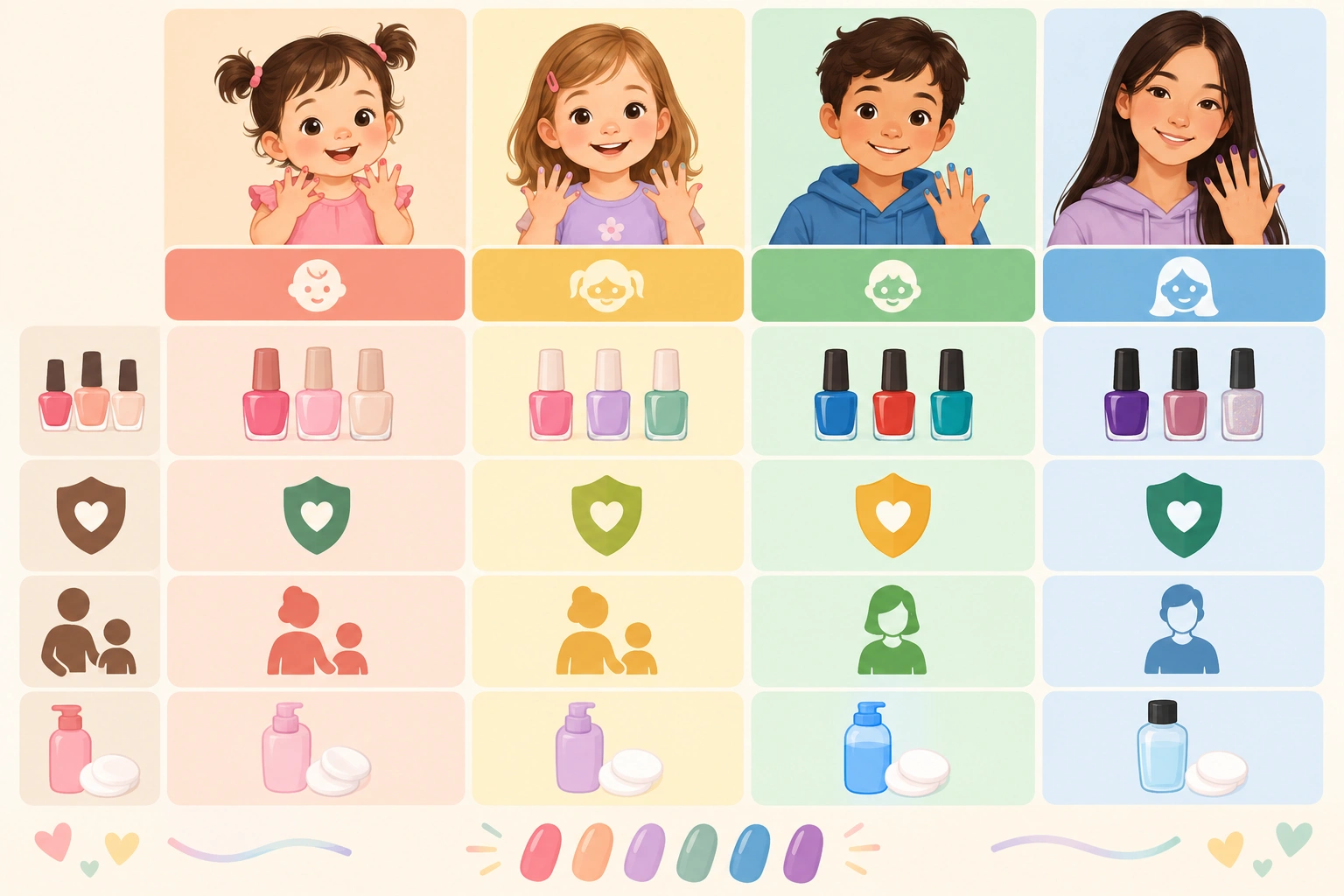
Quick Answer: What Age Can Kids Wear Nail Polish?
There is no single minimum age that works for every child or every polish. A practical parent rule is this:
- Toddlers: possible occasionally, but only if they do not mouth their hands and an adult handles the whole process
- Preschoolers: often a good starting point for occasional fun, if they can keep hands away from their mouth
- School-age kids: usually the easiest age group for regular, simple polish use
- Teens: can usually choose more options, but stronger formulas and longer wear come with more removal trade-offs
A simple readiness test helps more than a birthday does:
- Can your child sit still long enough for application and drying?
- Do they still chew nails or suck fingers?
- Is their skin calm, with no rash or broken skin around the nails?
- Will an adult handle application and removal?
- Are you using a formula that matches their age and sensitivity?
If the answer to several of those is “no,” I’d wait or switch to a more kid-friendly option.
Is Nail Polish Safe for Toddlers and Young Children?
For toddlers, the main concerns are not dramatic, but they are real.
The biggest toddler risks
- Hand-to-mouth behavior: toddlers touch everything, then put their fingers in their mouths.
- Skin irritation: little hands can react to fragrance, solvents, or frequent polish use.
- Messy application and removal: toddlers rarely hold still long enough for clean results.
- Choking/ingestion concerns: polish bottles, remover, and small nail accessories should stay out of reach.
That’s why I’m much more cautious with toddlers than with older children. A toddler wearing polish once for a family event is different from a toddler wearing it constantly.
If you do use polish on a young child, keep the session short, use very thin coats, and supervise the whole time.
Age-by-Age Guidance: Toddlers, Preschoolers, School-Age Kids, and Teens
Here’s the most useful way to think about it: not “Can they wear polish?” but “What kind of polish and how much supervision makes sense?”
| Age group | Typical fit | Safer polish style | Supervision | Best use case |
|---|---|---|---|---|
| Toddlers | Sometimes, but only occasionally | Water-based or kid-specific, low-odor formulas | Very close adult supervision | Birthday parties, holidays, photos |
| Preschoolers | Often okay in short sessions | Kid-specific polish, peel-off formulas | Adult applies and removes | Occasional fun with simple colors |
| School-age kids | Usually a good fit | Regular polish or kid-friendly polish | Adult supervision recommended | Weekends, events, low-key nail fun |
| Teens | Usually yes, with judgment | Regular polish, gel, or press-ons depending on goals | Some independence, but guidance still helps | School events, style preferences, longer wear |
Toddlers
Toddlers are the group I treat most carefully. If they still mouth their fingers, I prefer short-wear, easy-removal polish over anything long-lasting. The goal is not perfect nails; it’s minimizing exposure and stress.
Preschoolers
This is often the “fun but supervised” stage. Many preschoolers can enjoy polish for a special occasion if the activity stays brief. One or two colors is plenty. That keeps the process manageable and avoids turning it into a long, frustrating session.
School-age kids
School-age children usually handle nail polish best because they can follow simple directions: keep hands still, don’t touch wet nails, and let an adult remove polish later. If a child is sensitive or prone to picking, though, I’d still favor easier-removal formulas.
Teens
Teens can usually wear a wider range of products, but they should understand the trade-offs. A longer-lasting option may look great for a week or two, yet removal can be harsher on nails if it’s done too often or too aggressively.
What Makes a Nail Polish Safer for Kids?
Labels can be confusing, so let’s translate them.
Ingredients and product features to watch
When you’re choosing nail polish for kids, it helps to look beyond marketing labels and check for ingredients or product features that may be more irritating:
- Formaldehyde and formaldehyde resin: used in some nail products and commonly avoided by parents who want to limit stronger chemical exposures
- Toluene: a solvent with a stronger smell that some families prefer to avoid
- Dibutyl phthalate (DBP): another ingredient often left out of kid-focused formulas
- Camphor: can be irritating in some products
- Fragrance: may bother children with sensitive skin or scent sensitivity
- Strong solvents and removers: especially if your child has dry or reactive skin
“Non-toxic”
This usually means the formula avoids certain ingredients that people often want to limit. It does not mean the polish can be eaten, swallowed, or used without supervision.
Water-based polish
Water-based formulas are often easier to remove and may be a better fit for younger children. The trade-off is durability: they usually chip faster than regular polish.
3-free, 5-free, 7-free
These labels mean the formula leaves out certain ingredients commonly associated with concern in nail products. That can be helpful, but it’s not a guarantee that the polish is ideal for every child. A child can still react to another ingredient, fragrance, or remover.
Fragrance-free and low-odor
For kids with sensitive skin or families who want to reduce strong smells, these are worth looking for. Lower odor can also make the experience easier for younger children who dislike strong scents.
Dermatologist-tested
This can be reassuring, but it still doesn’t replace watching your child’s skin. If redness or itching shows up, stop using the product.
One important reality check: “safer” is not the same as “risk-free.” Even gentler formulas can irritate skin or trigger allergy symptoms in some children.
Water-Based vs. Regular vs. Peel-Off vs. Gel: Which Is Best by Age?
Water-based polish
Best for: toddlers, preschoolers, and sensitive kids
Why parents like it:
– easier removal
– often lower odor
– less need for harsh remover
Trade-off:
– chips faster
– may not last through active play
Regular nail polish
Best for: school-age kids and teens
Why it works:
– more durable than many kid-specific formulas
– familiar finish and color range
Trade-off:
– usually needs remover
– stronger smell than water-based options
Peel-off polish
Best for: younger kids or occasional wear
Why it’s useful:
– easy removal
– less scrubbing
– good for short events
Trade-off:
– may lift early if the child is active or picks at it
Gel polish
Best for: older teens, with caution
Why teens like it:
– long wear
– glossy finish
– fewer chips
Trade-off:
– removal is more involved
– can be harder on nails if used often
– not my first choice for younger children
If your child wants polish only for a weekend party, a peel-off or water-based option usually makes more sense than a long-wear formula. If a teen wants something that lasts through school and sports, regular polish or press-ons may be a better balance than gel, depending on how gentle the removal will be.
How to Apply Nail Polish Safely on a Child
A safe, calm routine matters more than fancy nail art.
A simple at-home process
- Wash and dry hands first.
- Check nails and cuticles for redness, cuts, or irritation.
- Use thin coats instead of thick ones.
- Keep the room ventilated.
- Let each coat dry before the next one.
- Keep bottles closed when not in use.
- Store polish and remover out of reach.
Thin layers are worth it because thick polish takes longer to dry and is more likely to smudge, which leads to extra touching and picking. For children, simple is usually better than elaborate.
If the child is very young, I also recommend choosing one or two colors instead of a full nail-art session. That keeps the experience short and reduces the chance of frustration.
How to Remove Nail Polish Safely Without Damaging Nails
Removal is where a lot of the damage can happen, so the method should match the formula.
Water-based polish
- Soak or wipe with warm water first, if the brand allows it.
- Gently loosen the polish rather than scrubbing hard.
- If it does not lift easily, stop and follow the product directions.
Regular polish
- Use a small amount of gentle remover on cotton.
- Press it on the nail for a few seconds.
- Wipe in one direction instead of rubbing back and forth.
- Repeat if needed rather than scraping.
Gel polish
- Gel usually needs a more involved removal process.
- Follow the product directions carefully.
- Do not peel or force it off, because that can damage the nail surface.
Gentle removal habits
- Choose the mildest remover that works for the formula.
- Avoid scraping polish off with tools.
- Don’t over-buff a child’s nails.
- Stop if the skin starts to sting or look dry.
Acetone can be very drying, so I prefer to reserve it for situations where a stronger remover is truly needed, and even then, I use it carefully. For younger children, a water-based or peel-off formula can save a lot of hassle because it reduces the need for stronger solvents.
If polish is stubborn, don’t keep rubbing harder and harder. That often does more harm than the polish itself.
Can Nail Polish Damage a Child’s Nails Over Time?
Occasional polish is usually not the main problem. The bigger issue is frequent wear plus rough removal. Over time, repeated scraping, buffing, and strong remover use can leave nails dry, flaky, or more prone to peeling.
That’s why I prefer:
– occasional use over constant wear
– gentler formulas for younger kids
– careful removal instead of peeling or scraping
– breaks between manicures when nails look dry
Allergies, Eczema, and Signs Nail Polish Is Not a Good Fit
Some children do fine with polish once in a while and react badly when they use it more often. Watch for:
- redness around the nail
- itching
- swelling
- rash
- peeling skin
- burning or stinging after application or removal
If your child has eczema or generally sensitive skin, patch testing a product on a small area first can be helpful. That doesn’t guarantee a reaction-free experience, but it may give you an early warning before you paint all ten fingers.
If the skin is already irritated, broken, or inflamed, I would skip polish entirely until things calm down.
When Kids Should Not Wear Nail Polish
There are times I would simply say no for now:
- broken skin around the nails
- infected nails
- active rash or irritation
- open cuts or hangnails that are bleeding
- a child who keeps putting fingers in the mouth and cannot stop
- repeated reactions to polish or remover
Polish should not be used as a cover-up for a nail problem. If something looks infected or keeps coming back, that needs a professional opinion, not another coat of color.
Tips for Teens: Regular Polish, Gel, or Press-Ons?
Teens usually want one of three things: longer wear, less chipping, or a more polished look for events.
Regular polish
Best if they want:
– easier removal
– lower commitment
– less chance of damage from repeated removal
Gel polish
Best if they want:
– longer wear
– a glossy, salon-style finish
But gel is not the low-maintenance option it seems to be. The removal process matters, and frequent gel use can be rough on nails if it becomes a habit.
Press-ons
Best if they want:
– a temporary style change
– an event look without painting
– less waiting time
Trade-off:
– sizing and fit matter
– some adhesives can irritate sensitive skin
– not ideal if the teen picks at them
For teens, I usually suggest choosing the option that matches how long they actually want the look to last. If it’s just for a school dance, press-ons or regular polish may be smarter than gel.
Press-Ons vs. Painted Nails for Kids
For younger kids, painted nails are usually the simpler choice. They’re easier to apply, easier to adjust, and usually easier to remove gently.
Press-ons can work better for older kids and teens who want a temporary style for a special event, but they come with a few extra concerns:
– the fit has to be right
– adhesives can bother sensitive skin
– they may pop off if a child picks at them
– removal can be more annoying than regular polish if the glue is stubborn
So, for most kids, painted nails are the lower-hassle option. Press-ons make more sense when a child is old enough to tolerate the fit, the adhesive, and the removal process.
Parent Checklist for Choosing Nail Polish Safely
Before you buy or apply anything, ask:
- Is my child old enough to sit through the process?
- Do they still mouth fingers or chew nails?
- Is there any broken skin, rash, or irritation?
- Does the product suit their age and sensitivity?
- Will I be the one applying and removing it?
- Do I have a gentle remover if needed?
- Can I keep bottles and small accessories out of reach?
- Is the room ventilated enough for the product I chose?
If you can’t answer those comfortably, it’s probably better to wait or choose a gentler formula.
When to See a Pediatrician or Dermatologist
Reach out if your child has:
– repeated redness, itching, or swelling after polish use
– a rash that doesn’t settle
– painful nails or skin around the nails
– signs of infection
– eczema that flares after nail products
– a reaction that gets worse each time
A pediatrician or dermatologist can help figure out whether the problem is the polish, the remover, or something else entirely.
FAQ
What age can kids wear nail polish for the first time?
There is no universal minimum age. A practical starting point for occasional use is often around preschool age, as long as the child can avoid mouthing their hands and an adult supervises application and removal.
Is nail polish safe for toddlers?
It can be used occasionally, but toddlers are the highest-maintenance age group because they often put their fingers in their mouths and may not sit still for application or removal.
What nail polish ingredients should parents avoid?
Common ingredients parents often try to limit include formaldehyde, formaldehyde resin, toluene, dibutyl phthalate (DBP), camphor, and added fragrance.
Is water-based nail polish better for kids?
Often yes, especially for younger children, because it is usually easier to remove and may have less odor. The downside is that it tends to chip faster.
Can nail polish damage a child’s nails?
Occasional use usually isn’t the main issue. Frequent wear plus harsh removal can dry out nails and make them more prone to peeling or damage.
The Bottom Line
So, what age can kids wear nail polish? There’s no universal minimum age. The safer answer depends on the child’s habits, skin sensitivity, and the type of polish you choose. Toddlers may be able to wear polish occasionally with close supervision and very gentle formulas. Preschoolers are often a practical starting point for occasional use. School-age kids usually do well with simple, short sessions. Teens usually have more flexibility, but they still benefit from choosing products with removal in mind.
If you keep the process short, use kid-friendly formulas when needed, and watch for skin reactions, nail polish can be a fun, age-appropriate treat rather than a stressful one.

