
Why Are My Toenails Blue? Causes, Warning Signs, and What to Do

Looking down and noticing a blue toenail can be unsettling—especially when you do not remember hurting your toe.
So, why are my toenails blue? Sometimes the explanation is fairly simple, such as a bruise under one nail, pressure from tight shoes, cold temperatures, or even nail polish staining. But blue color affecting several toenails can sometimes point to a circulation or oxygen problem that deserves medical attention.
The most useful clues are how many nails are blue, whether the surrounding skin has changed color, whether you recently injured the toe, and whether you have symptoms such as pain, numbness, shortness of breath, chest discomfort, or dizziness.
Here is how to sort through the possibilities safely.
Quick Answer
Blue toenails may result from bruising under the nail, repeated pressure from shoes, cold-related circulation changes, or reduced blood flow. Less commonly, several blue nails can be associated with low oxygen levels. A painful blue nail after an injury should be monitored, while sudden blue nails with breathing problems or blue lips need urgent medical attention.
What Does a Blue Toenail Mean?
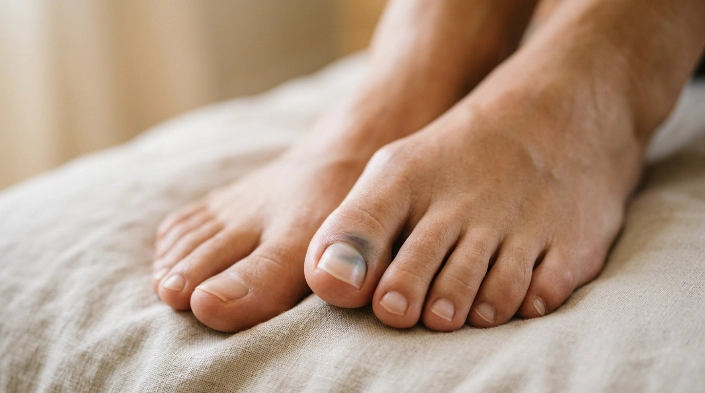
A blue toenail is a color change, not a diagnosis.
The color may be coming from blood trapped underneath the nail, reduced circulation in the toe, staining on the nail plate, or a change affecting oxygenated blood throughout the body.
The American Academy of Dermatology’s guide to nail changes notes that blue-colored nails can sometimes be associated with insufficient oxygen in the bloodstream.
That does not mean every slightly blue toenail is an emergency. A single bruised toenail after running in tight shoes is very different from suddenly developing blue nails along with blue lips or trouble breathing.
| What You Notice | Possible Explanation | Best Next Step |
|---|---|---|
| One blue-purple nail after an injury | Bruising under the nail | Reduce pressure and monitor |
| One dark nail after tight shoes or running | Repetitive nail trauma | Change footwear and monitor |
| Toes become pale, blue, and cold | Cold-related blood vessel narrowing or Raynaud’s | Warm gradually and discuss recurring episodes with a healthcare professional |
| Several toenails or toes look blue | Circulation or oxygen issue may be involved | Seek medical advice |
| Blue nails plus blue lips or breathing trouble | Possible low blood oxygen | Get urgent medical help |
| Nail looks yellow, brown, thick, or crumbly | Fungal infection may be more likely | Consider dermatology evaluation |
| Color appears mainly after removing polish | Surface staining may be involved | Leave the nail bare and monitor |
1. A Bruised Toenail After an Injury
If only one toenail looks blue, purple, or almost black, think about recent trauma first.
You may have:
- Stubbed your toe.
- Dropped something on your foot.
- Worn shoes that repeatedly hit the nail.
- Run, hiked, or exercised in footwear with too little toe room.
- Had pressure on the nail without noticing a specific injury.
Blood can collect underneath the hard nail plate after tiny blood vessels in the nail bed are damaged. This is called a subungual hematoma, or simply a bruised nail.
According to the Cleveland Clinic’s guide to subungual hematomas, a bruised toenail can look black-and-blue or black-and-purple and may feel tender or throbbing. Repetitive pressure from tight shoes can cause it too—not only a dramatic accident.
Signs That Support a Bruise
A bruise is more likely when:
- Only one nail is affected.
- You remember an impact or pressure.
- The discoloration is underneath the nail rather than on its surface.
- The nail is tender.
- The dark spot gradually moves toward the end of the toe as the nail grows.
Toenails grow slowly, so discoloration from an old injury can remain visible for months.
Do not drill, burn, puncture, or pierce your toenail at home to release trapped blood. A healthcare professional can decide whether drainage is appropriate, especially when the injury is very painful.
2. Tight Shoes and Repeated Pressure
Your shoes do not have to feel painfully tight to damage a toenail.
If your toes repeatedly hit the front of your shoes, tiny injuries can occur underneath the nail. This is common with running, hiking, long walks, sports, pointed shoes, and shoes with a short or narrow toe box.
Over time, one nail may turn:
- Blue-purple
- Dark red
- Brown
- Black
The nail can also become thicker or slightly lifted.
Check your shoe fit. Your toes should have enough room to lie naturally without being squeezed together or repeatedly hitting the front.
If the same toenail keeps bruising, replacing the polish will not solve the underlying problem. Reducing repeated pressure is more important.
3. Cold Temperatures and Raynaud’s Phenomenon
Have you noticed that your toes sometimes become pale, blue, cold, or numb when you are cold?
Blood vessels naturally narrow in cold conditions to conserve body heat. In some people, that reaction is much stronger.
Raynaud’s phenomenon causes blood vessels in the fingers or toes to narrow temporarily. The affected area can become pale or white and then blue before circulation returns.
The National Institute of Arthritis and Musculoskeletal and Skin Diseases’ explanation of Raynaud’s phenomenon describes toes becoming cold and numb and changing color during attacks, particularly after cold exposure.
If your toes repeatedly change from pale to blue and then red as they warm, mention the pattern to a healthcare professional.
Occasional cold feet are not automatically Raynaud’s, and you should not diagnose yourself from nail color alone.
4. Reduced Blood Flow to Your Feet
Blue-looking toes or toenails can sometimes reflect poor circulation.
When less blood reaches an area, you may also notice:
- Cold feet or toes
- Numbness or tingling
- Pale or bluish skin
- Swelling
- Pain during walking
- Slow-healing cuts or sores
A circulation problem is more concerning when the toe itself changes color, rather than just a small area underneath one nail.
A sudden blue or unusually cold toe without an obvious injury deserves prompt medical attention—particularly if it is painful or numb.
Do not try to solve possible circulation problems with nail products, buffing, massage tools, or aggressive pedicures.
5. Low Oxygen Levels and Cyanosis
This is the reason blue nails should not automatically be treated as a cosmetic problem.
Cyanosis means that skin, lips, or nails develop a blue or gray appearance because there is not enough oxygen reaching the tissues or because circulation is impaired.
The MedlinePlus overview of blue skin discoloration explains that blue coloring can occur when blood does not contain enough oxygen. It can sometimes be easier to notice around the nail beds, lips, or gums.
Get urgent medical help if blue nails appear together with:
- Blue or gray lips, tongue, or face
- Shortness of breath
- Difficulty breathing
- Chest pain or tightness
- Severe dizziness
- Confusion
- Fainting
- A sudden widespread color change
Blue color limited to a bruised big toenail after dropping something on it is a very different pattern.
6. Could Blue Toenails Be Nail Fungus?
Usually, blue is not the classic color of toenail fungus.
Fungal nail infections more commonly cause white, yellow, brown, orange, greenish-black, or black discoloration. The nail may also become:
- Thick
- Brittle
- Crumbly
- Ragged
- Misshapen
- Lifted from the nail bed
The American Academy of Dermatology notes that nail fungus can create several colors and textures, which is why appearance alone does not always confirm an infection.
If your nail is mainly blue-purple after trauma, fungus may be less likely.
If it is gradually becoming yellow-brown, thick, crumbly, and distorted—especially across several nails—fungus becomes more plausible.
A dermatologist can examine the nail and sometimes test a sample before recommending treatment.
Avoid starting antifungal products simply because your toenail has changed color. They will not treat bruising or circulation problems.
7. Can Nail Polish Make Toenails Look Blue?
Yes, nail products can sometimes confuse the picture.
Dark blue, purple, black, green, and strongly pigmented polishes may leave surface staining, especially when worn repeatedly without a base coat.
A simple first step is to remove all polish gently and look at the bare nail in natural light.
Surface staining usually does not cause:
- Toe numbness
- Cold skin
- Significant pain
- Swelling
- Breathing symptoms
- Blue lips
If the discoloration appears to be underneath the nail or remains unchanged as the surface grows out, do not assume polish is responsible.
How to Check a Blue Toenail Safely at Home

For a mild color change without emergency symptoms, you can gather useful clues before deciding what to do.
- Remove nail polish. Use regular remover so you can see the true nail color.
- Look at all 10 toenails. One affected nail suggests a different pattern from several blue nails.
- Check the surrounding skin. Is the toe itself blue, pale, red, swollen, cold, or unusually warm?
- Think about recent pressure. Remember workouts, long walks, tight heels, boots, running shoes, or toe injuries.
- Warm cold feet gradually. Put on dry socks and move somewhere comfortably warm rather than applying extreme heat directly.
- Take a clear photo. Comparing pictures every week or two can make progression easier to notice.
- Leave the nail alone. Avoid digging underneath it, aggressive buffing, or trying to release trapped blood yourself.
Expert Tip
Expert Tip: Compare both feet before treating the nail. A single blue-purple spot under one toenail often tells a different story from several blue toes or nails. The pattern can be more useful than the exact shade.
Safe Nail Care While You Monitor It
If there has been a mild injury and you otherwise feel well, keep your nail-care routine simple.
Trim toenails straight across when necessary. Do not cut deeply into the corners.
Use clean, sharp toenail clippers or nippers rather than forcing small fingernail clippers through a thick nail.
Stainless steel tools are practical because their smooth surfaces are easier to clean and disinfect than porous materials.
Do not share nail clippers, files, or pedicure tools. Nail infections can spread through contaminated grooming equipment.
Wear shoes with enough toe space, especially if you run or exercise.
Keep feet clean and dry, but do not aggressively scrub a bruised or damaged nail.
What About Cost?
Minor bruising may require little more than comfortable footwear and basic nail care you already own.
However, repeatedly buying antifungal treatments, nail repair products, or cosmetic cover-ups before understanding the cause can cost more without solving the problem.
When a color change is unexplained, worsening, painful, or affecting several toes, paying for an appropriate professional evaluation can be more useful than experimenting with multiple DIY products.
When to See a Nail Technician or Dermatologist
A professional nail technician can be helpful for cosmetic grooming of otherwise healthy nails, such as careful trimming, shaping, or removing polish so the nail can be inspected.
However, a nail technician should not be expected to diagnose circulation disorders, infections, or low oxygen levels.
Consider a dermatologist, podiatrist, or other healthcare professional when:
- A blue or dark nail appeared without an obvious injury.
- The discoloration is growing or changing.
- The nail becomes thick, crumbly, painful, or detached.
- There is redness, swelling, warmth, pus, or drainage.
- You have severe throbbing after an injury.
- Several toes repeatedly change color.
- The toe feels unusually cold or numb.
- You have diabetes, known circulation problems, or reduced sensation in your feet.
- The problem keeps returning.
Seek urgent medical help rather than a salon appointment if blue toenails or toes appear with blue lips, breathing difficulty, chest pain, confusion, fainting, or sudden severe symptoms.
Common Mistakes to Avoid
- Covering the nail immediately with dark polish. You may hide a color change that would be useful to monitor.
- Assuming every discolored nail is fungus. Injury and circulation problems can look very different but still change nail color.
- Trying to puncture a bruised nail yourself. Improper drainage can injure the nail bed or introduce infection.
- Aggressively buffing the discoloration. A bruise underneath the nail cannot be buffed away.
- Continuing to wear shoes that repeatedly hit the toe. Ongoing pressure can keep reinjuring the nail.
- Sharing clippers or files. Contaminated tools can spread fungal infections.
- Ignoring surrounding skin color. A blue toe plus coldness or numbness matters more than nail color alone.
- Treating emergency symptoms as a pedicure problem. Blue lips, breathing difficulty, chest pain, confusion, or sudden widespread blue coloring needs medical assessment.
FAQs
Why is only one of my toenails blue?
One blue toenail is commonly associated with an injury or repeated shoe pressure, especially if the discoloration looks blue-purple or black underneath the nail. If you cannot identify a cause, the color is worsening, or the toe is painful or numb, have it evaluated.
Why did my toenail turn blue after running?
Running shoes can repeatedly push the toe against the front of the shoe, damaging small blood vessels underneath the nail. The trapped blood can create a blue, purple, or black appearance. Check your shoe size and toe-box space before your next run.
Can poor circulation cause blue toenails?
Reduced circulation can cause bluish skin or nail beds, often together with coldness, numbness, tingling, or other color changes. Persistent or sudden blue toes should be medically evaluated rather than treated as a cosmetic nail issue.
Why are my toenails blue when I am cold?
Cold temperatures temporarily narrow blood vessels. Some people experience stronger vessel narrowing, including Raynaud’s phenomenon, which can make toes turn pale and then blue. Recurring episodes are worth discussing with a healthcare professional.
Are blue toenails a sign of low oxygen?
They can be in some situations. Blue nails occurring with blue lips, blue or gray facial coloring, shortness of breath, chest pain, dizziness, confusion, or fainting can indicate a serious oxygen or circulation problem and require urgent medical care.
Can toenail fungus look blue?
True blue is not the most typical fungal nail color. Fungus more often produces yellow, white, brown, greenish-black, or black discoloration along with thickening, crumbling, buildup, or nail lifting. A professional evaluation can help distinguish infection from injury.
How long does a bruised blue toenail take to disappear?
The tenderness from a mild injury may improve relatively quickly, but the discoloration can remain much longer because toenails grow slowly. The dark area may gradually move toward the end of the nail as new nail grows from the base.
Conclusion
If you have been wondering, “Why are my toenails blue?”, start by looking at the overall pattern.
One blue-purple nail after an injury, long walk, workout, or tight shoes often suggests bruising underneath the nail. Blue toes that appear when you are cold may involve temporary blood vessel narrowing. Several blue toenails—or blue color accompanied by coldness, numbness, breathing problems, chest discomfort, dizziness, or blue lips—deserve much more attention.
Remove polish, avoid aggressive DIY treatments, check your footwear, keep the nail clean, and monitor changes.
Most importantly, treat unusual nail color as information rather than something that simply needs to be covered with polish. When the cause is unclear or warning signs are present, choose a medical evaluation over experimenting with another nail product.

