
Are Electric Nail Files Good for Dogs? A Safe, Practical Guide

If your dog hates the sharp “clip” of traditional nail clippers, an electric file may sound like an easier solution. You may also be wondering whether the same kind of electric nail file used for manicures can safely shorten a dog’s nails.
So, are electric nail files good for dogs? They can be, but the safest option is a nail grinder specifically designed for pets. A dog nail grinder gradually sands away small amounts of nail instead of cutting through the nail in one motion.
That slower approach can give you more control, particularly if your dog has thick or dark nails. However, electric grinders also create vibration, noise, heat, and nail dust. Incorrect use can hurt your dog.
This guide explains the benefits, risks, costs, tool differences, and safest way to decide whether an electric nail grinder belongs in your dog-grooming routine.
Quick Answer
Yes, electric nail files can be good for dogs when you use a pet-safe nail grinder correctly. They remove nail gradually, smooth sharp edges, and may make it easier to avoid the quick. However, grinders can become hot, catch long fur, or frighten sensitive dogs, so short, controlled sessions are important.
What Is an Electric Nail File for Dogs?
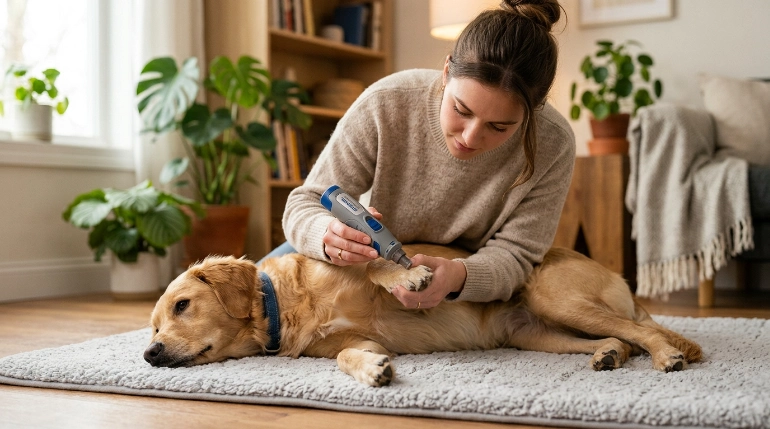
When dog owners say “electric nail file,” they usually mean a rotary nail grinder.
Instead of using two blades to cut through the nail, the device spins an abrasive sanding surface against the end of the nail. This slowly removes tiny layers.
You may see these products called:
- Dog nail grinders
- Pet nail grinders
- Rotary nail files
- Electric dog nail trimmers
- Pet grooming grinders
They are similar in basic concept to some manicure e-files, but that does not mean every human manicure drill is suitable for a dog.
The American Kennel Club’s guide to safely trimming dog nails recommends using dog-friendly clippers or grinders and removing only small amounts of nail at a time.
For home grooming, choose a tool made or clearly approved for pet nail care rather than automatically reaching for a high-speed salon nail drill.
Why Electric Nail Files Can Be Good for Dogs
The biggest advantage of a grinder is control.
Traditional clippers remove a noticeable section of nail in one squeeze. A grinder removes material more gradually. That gives you opportunities to stop and inspect the nail as you work.
They Can Help You Avoid Cutting Too Much at Once
Inside each dog nail is living tissue commonly called the quick. It contains nerves and blood vessels.
Cutting into it hurts and causes bleeding.
This can be especially stressful when trimming black or very dark nails because the quick is harder to see from outside.
Grinding still does not make hitting the quick impossible, but you can remove very small amounts and check your progress frequently.
According to VCA Animal Hospitals’ guidance on filing or grinding dog nails, grinding can leave nails smooth and may reduce the risk of damaging the quick compared with removing a larger piece suddenly.
Grinders Leave Smoother Nail Edges
Clippers sometimes leave a sharp or slightly jagged edge.
A grinder naturally rounds and smooths the end.
That can be helpful if your dog frequently scratches you while playing, jumps against furniture, or has rough nail edges after clipping.
Some Dogs Prefer Grinding to Clipping
Every dog is different.
Some dislike:
- The pressure of clippers around the nail
- The sudden clipping sound
- Having their toes held firmly
- The sensation of the nail being cut
A grinder replaces that sudden clip with vibration.
Some dogs tolerate this much better.
Other dogs hate the motor noise and vibration, which is why an electric grinder is not automatically better for every pet.
They Can Work Well on Thick Nails
Large dogs may have thick nails that require significant pressure with manual clippers.
A quality pet grinder can gradually shorten thick nails without requiring you to squeeze a heavy nail between cutting blades.
The tradeoff is that grinding usually takes longer.
Electric Nail Grinder vs. Dog Nail Clippers
Neither option is universally better.
The right choice depends on your dog’s nail thickness, temperament, coat, and your comfort level.
| Feature | Electric Nail Grinder | Dog Nail Clippers |
|---|---|---|
| Nail removal | Gradual | Removes a section at once |
| Control | High when used slowly | Requires deciding where to cut before clipping |
| Finish | Smooth, rounded | May leave sharper edges |
| Noise | Motor noise and vibration | Usually quieter |
| Speed | Often slower | Usually faster |
| Heat risk | Yes | No grinding heat |
| Long-fur risk | Fur may catch in rotating parts | Lower entanglement risk |
| Dark nails | Gradual removal may help | Quick can be difficult to judge |
| Nervous dogs | Some prefer it | Others prefer clippers |
| Learning curve | Requires grinder technique | Requires correct cutting technique |
There is no reason you must use only one tool.
Some owners clip excess length first and then use a grinder very lightly to smooth the edges. Only do this when you understand how to identify a safe stopping point.
Are Human Electric Nail Files Safe for Dogs?
This is where you should be cautious.
A human electric nail file or professional manicure e-file is designed primarily for human nail services. Depending on the device, it may have different speeds, bits, guards, ergonomics, and intended uses than a pet nail grinder.
A dog can also move a paw unexpectedly.
That makes control extremely important.
A pet-specific grinder is the safer default choice.
Look for a model intended for dogs with features such as:
- Multiple speed settings
- A protective grinding guard or opening
- Comfortable grip
- Low-vibration operation
- Appropriate sanding attachments
- Easy-to-clean grinding surfaces
A powerful tool is not automatically a better tool. For home dog grooming, control matters more than maximum speed.
The Main Risks of Electric Nail Files for Dogs
Electric grinders are useful, but they are not risk-free.
Understanding the risks before you start makes accidents less likely.
Heat Buildup
A rotating abrasive surface creates friction.
Holding the grinder against one nail for too long can produce uncomfortable heat.
Use brief touches rather than continuously grinding the same spot.
Think of it as:
touch, remove, inspect, repeat.
Never try to remove a large amount of nail in one uninterrupted grinding session.
Hair Getting Caught
Long fur around the toes can become wrapped around a rotating grinder.
This can pull the skin painfully and potentially cause injury.
VCA specifically warns that spinning nail files can become tangled in hair, so keep long fur safely away from the moving portion of the tool.
Before turning on the grinder:
- Check the hair surrounding every toe.
- Move or secure long hair away from the nail.
- Make sure you have an unobstructed view.
- Keep your fingers clear of the rotating surface.
Grinding the Skin
A spinning abrasive bit can injure skin if it slips off the nail.
Hold the toe gently but securely and use controlled movements.
Never chase a moving paw with a running grinder.
If your dog pulls away, switch the grinder off and reset.
Hitting the Quick
A grinder lowers the amount you remove with each movement, but it does not remove the quick from the equation.
Grinding too far can still reach sensitive living tissue.
Go slowly, especially on dark nails.
If you are unsure where to stop, have a veterinarian, veterinary technician, or professional dog groomer demonstrate the technique.
Stress and Fear
Noise and vibration are major disadvantages for sensitive dogs.
Warning signs that your dog needs a break can include:
- Repeatedly pulling the paw away
- Panting unrelated to heat
- Trembling
- Trying to hide
- Growling
- Lip licking
- Turning the head away repeatedly
- Attempting to bite
- Becoming increasingly restless
Do not force your dog through the session simply because you want to finish all four paws.
One successful nail is better than creating a lasting fear of nail care.
Nail Dust
Grinding produces fine nail particles.
VCA notes that grinding dust can be irritating, so good ventilation is sensible. Avoid positioning your face directly over the paw while grinding.
How to Introduce an Electric Nail File Safely
One of the biggest mistakes beginners make is turning on the grinder and immediately touching it to a dog’s nail.
Your dog has no idea what the strange buzzing object is.
Introduce it gradually.
Step 1: Let Your Dog Inspect the Grinder
Keep it switched off.
Place it nearby and reward calm behavior with praise or a favorite treat.
Do not force the grinder toward your dog’s face.
Step 2: Practice Paw Handling
Gently touch and hold your dog’s feet without doing any nail work.
Touch individual toes briefly.
Reward relaxed behavior.
If your dog already dislikes having its feet handled, solve that problem before adding a vibrating tool.
Step 3: Introduce the Sound
Turn the grinder on at a comfortable distance.
Reward calm behavior.
Then switch it off.
Repeat over several short sessions, gradually bringing the sound closer only while your dog remains comfortable.
The AKC recommends slowly introducing puppies and dogs to grinder sound and vibration before attempting a full nail trim.
Step 4: Introduce Vibration Carefully
With the grinder running, let your dog become familiar with its vibration without immediately grinding the nail.
Keep the session short and positive.
Step 5: Grind One Nail Briefly
Once your dog is comfortable, touch the grinder lightly to the end of one nail for a very short period.
Stop.
Reward your dog.
You do not need to finish the entire paw during the first real session.
Step 6: Build Up Gradually
Over time, work toward more nails per session.
Keep watching your dog’s body language.
If your dog becomes increasingly uncomfortable, return to an easier stage.
Expert Tip: When learning to grind dog nails, focus on creating calm, predictable sessions rather than perfectly shortening every nail. A dog that learns the grinder is safe will make future grooming much easier.
How to Grind a Dog’s Nails Without Overdoing It
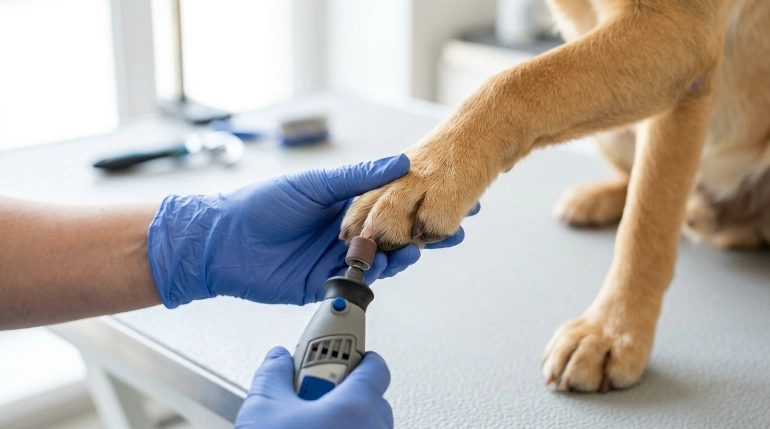
Once your dog accepts the tool, technique matters.
- Choose a well-lit location. You need a clear view of the nail and paw.
- Check for long fur. Keep all hair away from the rotating grinder.
- Hold one toe gently but securely. Do not twist the foot into an unnatural position.
- Begin at a low or manageable speed.
- Touch the grinder to the nail briefly.
- Remove only a tiny amount at a time.
- Pause frequently to inspect the nail and check for heat.
- Smooth rough edges instead of aggressively shortening the nail.
- Stop if your dog becomes frightened, struggles, or appears painful.
- Reward calm behavior when the session ends.
The goal is not to make the nails as short as possible.
The goal is to maintain a comfortable length without reaching sensitive tissue.
What Type of Electric Nail File Is Best for Dogs?
Look beyond marketing phrases such as “professional power.”
For a beginner, practical safety features are much more valuable.
Adjustable Speed
Multiple speeds give you more control.
Lower settings may be easier when introducing a nervous dog, while thicker nails may require a little more power.
Pet-Specific Guard
Some grinders have a guard with openings that expose only part of the abrasive wheel.
A guard does not eliminate every risk, but it can improve positioning and control.
Low Noise and Vibration
A quieter motor may be easier for noise-sensitive pets to tolerate.
Remember that “quiet” is relative. Your dog may hear and feel the device much more intensely than you do.
Appropriate Abrasive Material
Pet grinders commonly use sanding bands or grinding stones.
The important point is that the abrasive should remove nail predictably without forcing you to press hard.
Do not increase pressure just because progress feels slow.
Cordless vs. Corded
Cordless grinders can be easier to position around a moving dog because there is no cable near the paws.
Corded options avoid battery concerns.
Either can work safely when designed for pet grooming.
What Does a Dog Nail Grinder Cost?
Prices vary based on motor quality, speed settings, accessories, battery type, noise reduction, and brand.
A basic home-use grinder may cost only a modest amount, while more powerful rechargeable or professional-style pet grinders can cost considerably more.
You may also eventually need replacement:
- Sanding bands
- Grinding heads
- Batteries
- Charging cables or accessories
Do not choose based entirely on price.
A controllable, pet-appropriate grinder that your dog tolerates is more useful than a high-powered model that frightens your dog every time you turn it on.
Professional grooming or veterinary nail trims also remain reasonable alternatives if DIY trimming causes anxiety.
Hygiene and Cleaning Matter Too
Nail grinders create dust and make direct contact with nails, so keep the tool clean.
After use:
- Switch off and unplug the device when appropriate.
- Remove loose nail dust.
- Clean removable components according to the manufacturer’s instructions.
- Replace worn abrasive bands or heads.
- Keep the grinder dry when the manufacturer requires it.
- Do not share dirty grooming attachments between animals.
If your dog’s nail, toe, or paw is already swollen, bleeding, infected, or injured, do not simply grind through the problem.
Get veterinary advice first.
When an Electric Nail File May Not Be the Best Choice
A grinder is not automatically right for every dog.
Consider another approach when:
- Your dog panics at motor noises.
- Paw handling triggers severe fear or aggression.
- The nails are badly split or injured.
- A nail is bleeding or infected.
- Long fur cannot be safely controlled.
- Your dog cannot remain reasonably still.
- You cannot confidently identify when to stop.
- The tool becomes difficult for you to control.
A professional groomer or veterinary team can often handle difficult nails more safely.
The AKC’s at-home dog grooming guidance also recommends getting help from a veterinarian or groomer when you are uncomfortable performing nail maintenance yourself.
When to See a Nail Technician or Dermatologist
For this particular topic, a human nail technician or dermatologist is not the appropriate professional for your dog.
That advice applies to human nail concerns, not canine paws.
For your dog, contact a veterinarian if you notice:
- Persistent bleeding
- Swelling around a nail
- Pus or unusual discharge
- Significant redness
- A torn or partially detached nail
- Limping or obvious pain
- Repeated licking or chewing at one toe
- An unusual nail color or shape change
- A nail that appears infected
- An injury caused by the grinder
A professional dog groomer can help with routine nail maintenance and show you safer positioning techniques, but possible infections, injuries, or painful nail conditions should be evaluated by a veterinarian.
Common Mistakes to Avoid
Even a good grinder can cause problems when technique is poor.
Avoid these common mistakes:
- Using a human salon drill without considering whether it is appropriate for pets.
- Grinding one nail continuously until it becomes hot.
- Applying excessive pressure to make the grinder work faster.
- Ignoring long paw hair near the spinning head.
- Trying to finish every nail while your dog is frightened.
- Grinding without learning where the quick is located.
- Starting at maximum speed unnecessarily.
- Holding the paw too tightly.
- Chasing a suddenly moving paw with the grinder running.
- Using worn or damaged attachments.
- Grinding an already injured, swollen, or infected nail.
- Forgetting to clean nail dust from the device.
- Assuming a grinder makes it impossible to hit the quick.
The safest approach is slow, controlled, and boring—and that is exactly what you want when a rotating tool is close to your dog’s toes.
FAQs
Are electric nail files better than clippers for dogs?
Sometimes. Electric grinders offer gradual nail removal and a smooth finish, while clippers are faster and quieter. The better option is whichever tool you can use safely and your dog tolerates comfortably.
Can I use my regular electric manicure file on my dog?
A pet-specific nail grinder is the safer default. Human manicure e-files may have speeds, bits, and designs intended for human nail services rather than moving canine paws. Use a device specifically designed or clearly approved for pet grooming whenever possible.
Do electric dog nail files hurt?
Correct grinding should not hurt. However, grinding too far can reach the quick, prolonged contact can create uncomfortable heat, and a slipping grinder can injure surrounding skin. Short, controlled contact is important.
Are dog nail grinders safer for black nails?
They can make trimming dark nails easier because you remove nail gradually instead of making one large cut. However, you can still reach the quick, so grind only small amounts and inspect the nail frequently.
How long should I hold the grinder on one nail?
Avoid holding it continuously in one place. Use short contacts followed by pauses. This helps you monitor your progress and reduces friction-related heat buildup.
What if my dog is scared of the electric nail file?
Do not force a full nail trim. Introduce the grinder gradually using treats and praise—first while it is off, then with the sound at a distance, and finally with brief contact once your dog is comfortable.
Should I take my dog to a groomer instead?
Yes, if you feel unable to control the grinder or your dog becomes extremely frightened or difficult to handle. A veterinarian is more appropriate if the nail is injured, painful, infected, badly torn, or persistently bleeding.
Final Thoughts: Are Electric Nail Files Good for Dogs?
So, are electric nail files good for dogs? Yes, a pet-safe electric nail grinder can be an excellent option for gradual nail maintenance, especially when you want smoother edges or more control than traditional clippers provide.
But the tool does not replace good technique.
Use a grinder designed for pets, keep long hair away from rotating parts, grind in short touches, watch for heat, learn where the quick is, and pay attention to your dog’s stress signals.
Most importantly, do not turn nail care into a battle.
If your dog is frightened, painful, injured, or impossible to handle safely, stop the DIY session and get help from a professional groomer or veterinary team.
The best nail-care method is not necessarily the fastest one. It is the method that keeps your dog’s paws comfortable while allowing you to maintain the nails safely and consistently.

