
Are Nail Files Okay for Cats? A Safe, Practical Guide

If your cat’s claws feel like tiny needles, you may wonder whether you can simply smooth them with the nail file sitting in your manicure kit.
So, are nail files okay for cats? In some situations, yes. A gentle manual nail file can help smooth a freshly trimmed claw or take the sharp point off a claw when your cat tolerates handling well. However, filing is usually slower than clipping, and some human nail tools are too rough, noisy, or stressful for cats.
The biggest concern is protecting the sensitive inner part of the claw, called the quick. Filing too aggressively can make a claw sore or even reach this sensitive tissue.
Below, you’ll learn which files may be appropriate, which tools to avoid, how to file a cat’s claws safely, and when it is better to use clippers or ask a veterinarian or groomer for help.
Quick Answer
Are nail files okay for cats? Yes, but only with care. A fine manual emery board or smooth nail file can gently remove a sharp edge from a healthy cat claw. File slowly, remove only a tiny amount, and stop if your cat becomes uncomfortable. Filing should never cause heat, pain, bleeding, or splitting.
Can You Really Use a Nail File on a Cat?
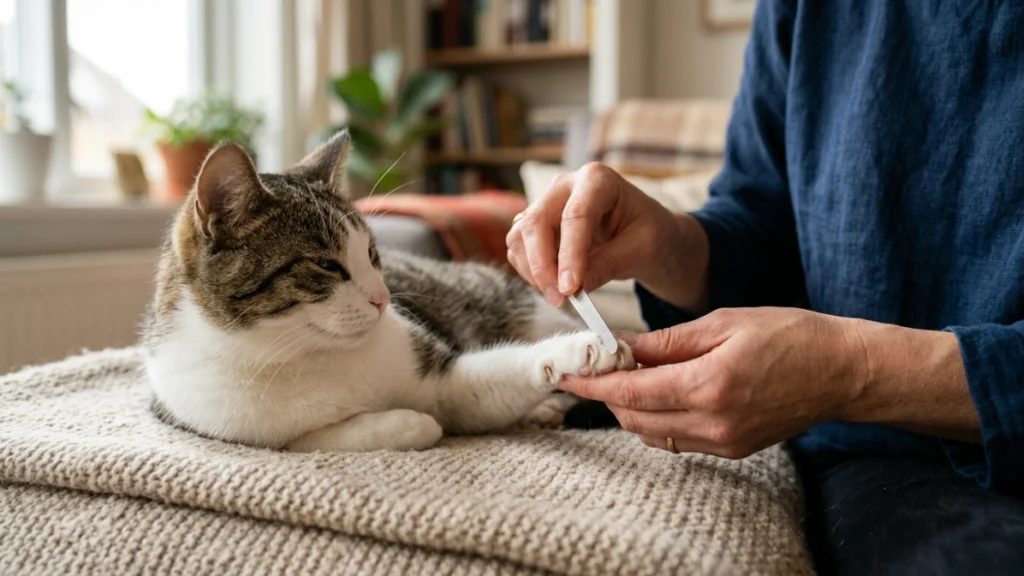
A nail file is not automatically dangerous to a cat.
The problem is how the file is used.
Cat claws are different from human fingernails. They are curved, pointed, and contain living tissue inside. A human can tell you if a file feels uncomfortable. Your cat cannot, so you have to watch body language closely.
Gentle filing can make sense when:
- Your cat has one or two unusually sharp claw tips.
- You want to smooth a rough edge after clipping.
- Your cat accepts paw handling without struggling.
- You use a fine, gentle manual file.
- The claws are otherwise healthy.
Filing becomes less practical when several claws are long. In that situation, proper cat nail clippers usually remove excess length much faster.
The ASPCA’s cat grooming guidance also emphasizes making grooming and claw care calm and comfortable rather than forcing a frightened cat through the process.
Understanding a Cat’s Claw Before You File It
Before touching a file to your cat’s paw, it helps to understand what you are working with.
A cat claw has a hard outer portion surrounding sensitive tissue. Inside is the quick, which contains nerves and blood vessels.
On a light-colored claw, you may be able to see the pink quick through the nail. Dark claws can make it harder to judge where that sensitive tissue begins.
That is why the safest approach is conservative.
You are not trying to reshape a cat claw as you might shape your own manicure. You are simply removing a very small amount from the pointed end.
Never keep filing toward the base of the claw just because the tip still looks sharp.
Removing too much can cause pain, sensitivity, or bleeding.
Cats also naturally shed the outer layers of their claws. Scratching posts help with this normal process, which is another reason regular scratching opportunities remain important even if you trim or occasionally file the claws.
What Type of Nail File Is Safest for Cats?
Not every nail file in your beauty drawer belongs near your cat.
Here is a practical comparison.
| Tool | Suitable for Cats? | Best Use | Main Concern |
|---|---|---|---|
| Fine emery board | Usually, with care | Smoothing a sharp tip | Can take time |
| Fine manual nail file | Usually, with care | Light finishing after trimming | Excess pressure |
| Coarse nail file | Generally avoid | Not necessary | Roughness and splitting |
| Metal file | Use cautiously | Very light smoothing | May feel harsh |
| Glass nail file | Use cautiously | Fine smoothing | Hard surface requires gentle handling |
| Human electric nail drill | Best avoided | None for routine cat care | Noise, heat, speed, injury risk |
| Pet nail grinder | Sometimes | Gradual claw shortening | Noise, vibration, heat, stress |
| Cat nail clippers | Yes | Routine shortening | Risk of cutting the quick if used incorrectly |
For most beginners, a fine manual emery board plus proper cat nail clippers is simpler than experimenting with powered tools.
A coarse file is unnecessary because a cat claw is small. The goal is controlled smoothing, not rapid material removal.
Nail File vs. Cat Nail Clippers
A nail file and a nail clipper do different jobs.
A nail file is useful for:
- Smoothing a freshly clipped claw.
- Removing a tiny sharp point.
- Fixing a small rough edge.
- Cats that dislike the sensation of clipping but accept gentle filing.
Nail clippers are better for:
- Claws that have become noticeably long.
- Routine nail maintenance.
- Removing more than a tiny amount.
- Cats whose claws may catch on blankets or furniture.
The main limitation of filing is time.
Imagine trying to shorten ten long, curved cat claws with an emery board. The process may become frustrating for you and stressful for the cat long before you finish.
Clipping the safe tip first and then lightly filing any rough edge is often more practical.
The Humane Society’s guidance on trimming cat claws also provides useful background for owners learning how to handle a cat’s paws during routine claw care.
How to File Your Cat’s Claws Safely
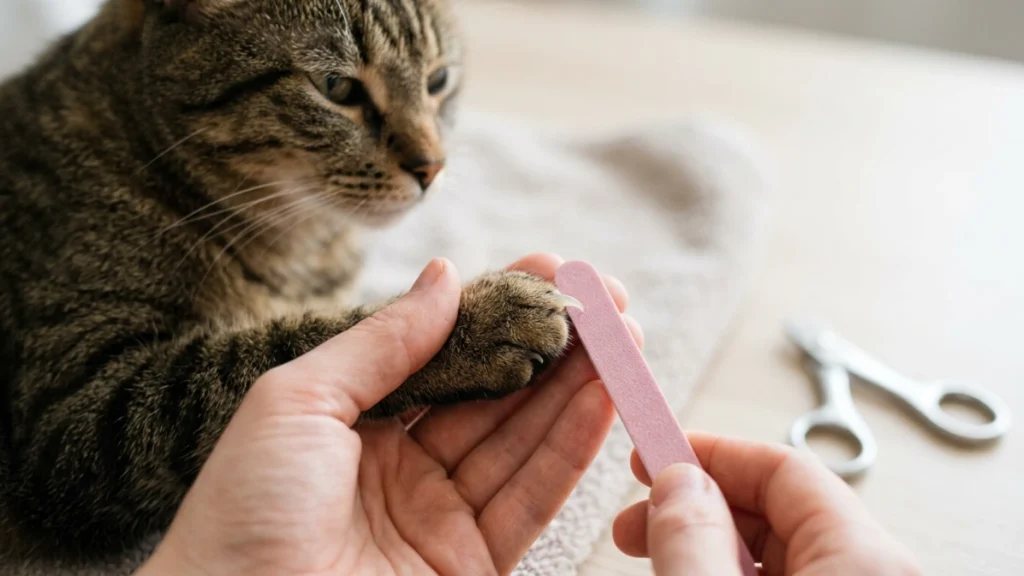
Do not begin when your cat is excited, playing, eating, or trying to escape.
Choose a quiet moment when your cat is relaxed.
1. Let Your Cat Investigate the File
Place the nail file near your cat and allow them to sniff it.
Do not immediately grab a paw and begin filing.
A gradual introduction can make an unfamiliar tool less alarming.
2. Practice Touching the Paw
Gently touch one paw.
If your cat remains comfortable, softly press a toe pad so the claw extends.
Release it and reward calm behavior.
Repeat this during several short sessions if necessary.
3. Inspect the Claw
Look for:
- Cracks
- Splitting
- Swelling
- Bleeding
- Discoloration
- Redness around the toe
- A claw curling toward the paw pad
If anything looks abnormal, do not simply file over the problem.
A damaged or unusually shaped claw may need veterinary attention.
4. Hold the File Gently
Use a fine manual file.
Keep the paw stable without squeezing tightly.
File only across the very end of the claw using light, controlled movements.
You should be removing a minimal amount.
5. Work on One Claw at a Time
There is no rule saying you need to finish every claw in one session.
If your cat allows you to smooth two claws and then becomes restless, stop.
You can continue later.
6. Watch Your Cat’s Body Language
Stop if you notice:
- Repeated paw pulling
- Tail lashing
- Flattened ears
- Growling
- Hissing
- Sudden biting attempts
- Strong struggling
- Rapid agitation
Continuing after your cat becomes frightened can turn future paw care into a much harder experience.
7. Check the Claw Again
The tip should simply feel less sharp.
It does not need to look perfectly rounded or polished.
Cat claw care is about comfort and safety, not creating a manicure-style shape.
Expert Tip
Expert Tip: Keep claw-care sessions extremely short. Smoothing one or two claws successfully is better than forcing your cat through all four paws and making them fearful of future grooming.
Can You Use a Human Nail File on a Cat?
A basic human manual file can sometimes be used, provided it is fine rather than aggressively coarse.
However, avoid assuming that every human manicure tool is appropriate.
Files designed for acrylic or artificial nails may be much rougher than necessary. Powered manicure drills are especially unsuitable for inexperienced cat owners because they can remove material rapidly.
A rotating tool can also create:
- Noise
- Vibration
- Friction
- Heat
- Sudden movement near the paw
Cats may jerk their paws unexpectedly when startled.
That combination makes precision difficult.
If you want to use a powered grinder, choose a tool specifically intended for pet nails and introduce it gradually. Even then, a grinder is not automatically better than clippers or a manual file.
Is Filing Better for Cats That Hate Nail Clippers?
Sometimes—but not always.
Some cats dislike the pressure or sound of nail clippers and tolerate a quiet manual file better.
Other cats dislike having their paw held for the additional time filing requires.
Your cat’s behavior is more important than the theoretical advantage of either tool.
You might experiment with very short sessions:
- Touch the paw.
- Extend one claw.
- File the tip once or twice.
- Release the paw.
- Reward your cat.
If your cat stays relaxed, you can slowly build from there.
If filing causes more resistance than clipping, there is little benefit to forcing it.
Should You File Before or After Clipping?
For routine maintenance, clipping first usually makes more sense.
Clippers remove the excess length efficiently. A fine file can then smooth a rough or particularly sharp edge.
You generally do not need to file every clipped claw.
If the clipped edge is clean and your cat is comfortable, you can leave it alone.
Overworking the nail adds unnecessary handling and increases the possibility of irritating the claw.
Hygiene Matters When Filing Cat Claws
Your nail-care tools can pick up dirt, oils, and biological material.
Do not casually move one nail file between your own manicure, your cat, and other pets.
A sensible routine includes:
- Keeping your cat’s claw-care tools separate.
- Cleaning reusable tools according to their material and manufacturer instructions.
- Replacing disposable emery boards when dirty or worn.
- Washing your hands before and after claw care.
- Avoiding tools previously used on an infected or injured nail.
Never file a visibly infected, bleeding, or severely cracked claw as though it were a cosmetic problem.
What If a Cat’s Claw Splits While Filing?
Stop immediately.
Do not keep filing in an attempt to smooth a significant split.
Minor superficial shedding of the outer claw layer can be part of normal feline claw maintenance, but deeper cracking, bleeding, pain, or repeated splitting deserves more attention.
Contact your veterinarian if:
- Blood is present.
- The claw appears torn near its base.
- Your cat is limping.
- The toe looks swollen.
- Your cat repeatedly licks the paw.
- There is discharge or an unusual odor.
- The claw looks embedded in the paw pad.
Trying to fix an injured claw with additional filing can make the problem worse.
What About Senior Cats?
Older cats deserve extra attention.
Some senior cats become less active and may not use scratching surfaces as vigorously as they did when younger. Their claws can become thick or overgrown and may curl significantly.
In these cases, filing the tips alone may not solve the problem.
Regularly inspect all paws, including the front dewclaws, which do not contact the ground in the same way as other claws.
A claw that is approaching or entering the paw pad needs professional attention.
If your senior cat has arthritis, pain, or strong sensitivity around the feet, ask your veterinarian about the least stressful way to maintain the claws.
DIY Filing vs. Professional Claw Care
At-home claw maintenance can be inexpensive and convenient, but professional help has advantages.
| Situation | DIY Filing | Clippers at Home | Groomer/Veterinary Help |
|---|---|---|---|
| One slightly sharp claw | Good option | Optional | Usually unnecessary |
| Several long healthy claws | Slow | Often practical | Optional |
| Cat strongly resists handling | Difficult | Difficult | Often helpful |
| Cracked or bleeding claw | Not appropriate | Not appropriate | Veterinarian recommended |
| Claw curling toward paw pad | Not enough | May be risky | Veterinarian recommended |
| Owner cannot identify the quick | Use extreme caution | Use caution | Helpful |
| Senior cat with abnormal claws | Limited | Depends on condition | Often safest |
A manual file is one of the least expensive tools you can buy for claw care. Pet clippers are also generally inexpensive.
Professional grooming and veterinary claw-trimming fees vary by location, clinic, your cat’s behavior, and whether a medical problem is involved.
Cost should never be the only consideration when a claw appears injured or infected.
Common Mistakes to Avoid
Even a gentle tool can cause trouble if used incorrectly.
Avoid these common mistakes:
- Filing too much. You only need to soften the sharp tip.
- Using a very coarse file. Aggressive grit can be unnecessarily harsh.
- Trying to create a human-style nail shape. Cat claws naturally have a pointed, curved shape.
- Restraining a terrified cat. Fear increases the chance of scratches, bites, and accidental injury.
- Filing damaged claws. Cracks, blood, swelling, or pain should not be treated cosmetically.
- Using a powerful human nail drill. High speed, noise, and heat make it a poor choice for routine cat claw care.
- Doing every claw in one sitting. Short sessions are often easier.
- Ignoring the quick. Never intentionally file toward sensitive living tissue.
- Sharing dirty nail tools. Keep grooming tools clean and preferably dedicated to your cat.
- Skipping regular paw checks. Filing a sharp tip is not a substitute for noticing an overgrown or unhealthy claw.
When to See a Nail Technician or Dermatologist
For a cat, there is an important distinction: a human nail technician or human dermatologist is not the appropriate professional for a claw problem.
A cat with an abnormal claw should generally be assessed by a veterinarian. A reputable professional pet groomer may help with routine claw trimming in a healthy cat, but medical problems belong with a veterinary professional.
Contact your veterinarian when you notice:
- Persistent bleeding
- Swelling around a toe
- Pus or discharge
- An unusual odor
- A deeply split or torn claw
- Limping
- Significant pain
- Constant paw licking
- A claw growing into the paw pad
- A sudden major change in claw appearance
Do not cover these signs with polish, glue, artificial nail products, or other human manicure treatments.
How Often Should You Check Your Cat’s Claws?
There is no single schedule that fits every cat.
Claw growth and wear vary with age, activity, scratching habits, health, and lifestyle.
Instead of waiting until claws become obviously long, get into the habit of checking your cat’s paws regularly.
Pay particular attention if your cat:
- Is older.
- Lives entirely indoors.
- Rarely uses scratching posts.
- Frequently gets claws caught in fabrics.
- Has mobility problems.
- Has had overgrown claws before.
You may discover that only occasional clipping is necessary, with filing used only for particularly sharp edges.
FAQs
Are nail files okay for cats if I only smooth the tips?
Yes. A fine manual file can be used gently on the very tip of a healthy claw. Stop after removing the sharp edge and avoid filing toward the quick.
Can I use my normal emery board on my cat?
A clean, fine emery board can work for light smoothing. Avoid very coarse files, and ideally keep a separate file specifically for your cat.
Can I file my cat’s nails instead of cutting them?
You can for very minor shortening, but filing several overgrown claws can take too long. Cat nail clippers are usually more efficient for routine length reduction.
Can I use an electric nail file on my cat?
Human electric manicure drills are best avoided. They can be fast, noisy, and difficult to control. Some cats tolerate pet-specific grinders, but they still require careful introduction and monitoring for heat and stress.
What happens if I file into the quick?
Reaching the quick can cause pain and bleeding. Stop immediately. If bleeding does not stop promptly, the claw is badly damaged, or your cat seems very painful, contact a veterinarian.
Why does my cat hate having its claws filed?
Your cat may dislike paw restraint, the scraping sensation, vibration, or simply being handled for too long. Use short sessions, rewards, and gradual paw-handling practice rather than forcing the process.
Should I file my cat’s back claws too?
Only if they actually need smoothing or maintenance. Inspect all paws, but do not file claws simply because they are there. Remove only what is necessary.
Conclusion
So, are nail files okay for cats? A fine manual nail file can be a useful tool when you need to smooth a healthy claw or soften a particularly sharp tip.
The key is restraint.
Use a gentle file, remove very little material, protect the quick, keep sessions short, and stop when your cat becomes uncomfortable. For routine shortening, proper cat nail clippers are usually faster. Powered human manicure tools are best avoided.
Most importantly, treat claw care as more than a cosmetic task. Check for cracks, swelling, pain, bleeding, and overgrowth whenever you handle your cat’s paws.
If the claws look healthy and your cat stays relaxed, gentle at-home maintenance may be all you need. If something looks wrong—or you are unsure where it is safe to trim or file—make the smarter choice and ask your veterinarian or an experienced professional groomer for help.

