
Are Nail Files Toxic to Dogs? What Pet Owners Should Know

You leave your manicure supplies on the coffee table for two minutes, come back, and find your dog happily chewing on your nail file. Now you are wondering: are nail files toxic to dogs, and should you be worried?
Most ordinary nail files are not automatically considered poisonous simply because they are nail files. However, that does not mean they are safe for dogs to chew or swallow. The bigger concerns are usually sharp edges, abrasive particles, broken pieces, coatings or adhesives, choking, and gastrointestinal blockage.
The level of risk depends on what type of nail file your dog got into, whether pieces are missing, how much may have been swallowed, and your dog’s size.
This guide explains what makes different nail files risky, what symptoms to watch for, what to do if your dog swallowed part of one, and how to keep your manicure tools safely away from curious pets.
Quick Answer
Are nail files toxic to dogs? Most standard nail files are not known as a single category of highly poisonous products, but chewing or swallowing one can still be dangerous. Broken glass, ceramic, metal, abrasive material, adhesives, or large file pieces may injure the mouth or digestive tract. Contact your veterinarian if any part may have been swallowed.
Why Nail Files Can Be Dangerous to Dogs
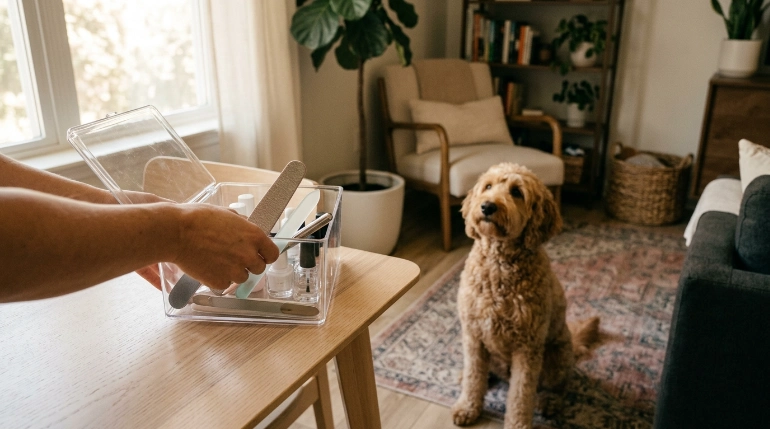
When we hear the word “toxic,” it is easy to focus only on poisoning. With nail files, physical injury may be the more immediate concern.
A dog does not need to be chemically poisoned for a nail file incident to become serious.
Dogs may:
- Bite pieces off an emery board.
- Crack a glass or crystal file.
- Swallow pieces of cardboard or abrasive coating.
- Chew plastic handles or protective sleeves.
- Damage their gums on metal or ceramic files.
- Swallow a piece large enough to become stuck.
According to the Cornell University College of Veterinary Medicine’s guidance on gastrointestinal foreign bodies, a non-digestible object can become lodged in a dog’s stomach or intestine and create a potentially serious obstruction.
Do not assume your dog is safe simply because the nail file itself is not labeled as toxic.
Are Different Types of Nail Files Equally Dangerous?
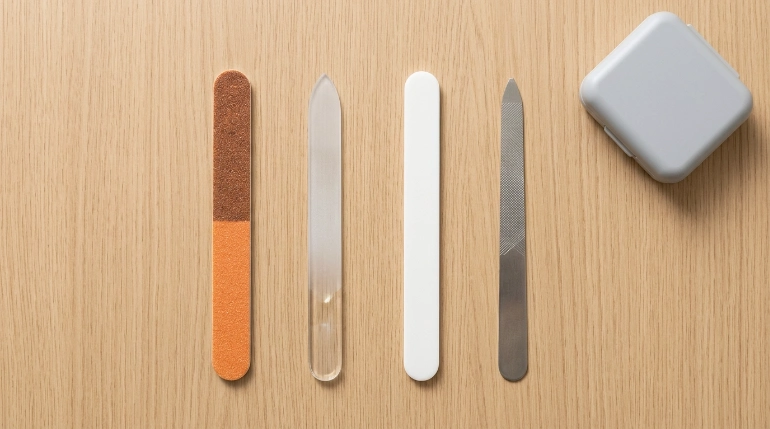
No. The material and construction of the file can change the type of risk.
| Nail File Type | Main Concern for Dogs | Risk if Chewed or Swallowed |
|---|---|---|
| Emery board | Abrasive coating, cardboard, adhesive, swallowed pieces | Irritation or foreign-body risk |
| Glass/crystal file | Sharp fragments if broken | Cuts, choking, digestive injury |
| Ceramic file | Hard or sharp broken pieces | Mouth or GI injury |
| Metal file | Hard edges and possible swallowed fragments | Tooth, gum, throat, or GI injury |
| Sapphire/diamond-style file | Abrasive surface on a rigid base | Mouth irritation and foreign-body injury |
| Foam buffer/file | Foam, adhesive, abrasive material | Pieces may be swallowed and cause obstruction |
The product’s exact coating or adhesive can also vary by manufacturer. That is why it is useful to keep the package or take a photo of the file when calling your veterinarian.
Emery Boards
Traditional emery boards may look harmless because they are lightweight and partly made from flexible backing materials.
But a determined dog can shred one quickly.
The main concern is usually not dramatic chemical poisoning. It is that your dog may swallow pieces of backing, abrasive particles, coating, or adhesive.
Small fragments may pass without causing a problem, but there is no reliable at-home way to guarantee that a swallowed piece will pass safely.
Glass and Crystal Nail Files
Glass or crystal nail files deserve extra caution.
A quality file may be fairly durable during normal manicure use, but it is not designed to withstand a dog’s teeth. If it cracks or breaks, fragments may have sharp edges.
A swallowed sharp object can potentially damage the mouth, throat, stomach, or intestine.
If your glass nail file is broken and you cannot account for every piece, contact your veterinarian rather than simply watching your dog and hoping for the best.
Ceramic Nail Files
Ceramic files are also hard and potentially breakable.
Chewing can damage the file or your dog’s teeth and gums. Broken fragments can be much more concerning than ordinary nail-file dust.
Missing ceramic pieces should be treated seriously.
Metal Nail Files
A solid metal nail file may be more difficult for a dog to break apart, but that does not make chewing one safe.
The textured filing surface can irritate the gums and tongue. A thin file may have relatively hard edges, and plastic handles or attached components can also be chewed off.
Repeated chewing on a hard metal object can potentially damage teeth as well.
What If My Dog Only Licked a Nail File?
A quick lick of a clean, ordinary nail file is generally a very different situation from chewing or swallowing it.
Start by looking at the file.
Ask yourself:
- Is the file intact?
- Are any pieces missing?
- Was it covered with nail polish remover, gel residue, acrylic product, oil, or another chemical?
- Is there blood around your dog’s mouth?
- Is your dog coughing, gagging, drooling, or acting uncomfortable?
If the file is intact and your dog simply licked the surface briefly, the foreign-body risk is much lower.
However, a file contaminated with another product creates a different question. The substance on the file—not necessarily the file itself—may require poison-control or veterinary advice.
The FDA’s pet household-hazard guidance recommends contacting a veterinarian or pet poison control service promptly when you believe a pet has eaten something potentially dangerous.
What Should You Do If Your Dog Chewed a Nail File?
Finding a chewed nail file can be stressful, but a quick, organized check gives your veterinarian much better information.
1. Take the Nail File Away
Remove the remaining file and any loose pieces your dog can still reach.
Do not chase your dog around the room if that makes them more likely to gulp down whatever is in their mouth. Calmly trade the object for a safe treat or toy when possible.
2. Check Whether Pieces Are Missing
Compare what remains with an identical file or the packaging if you have it.
Look for:
- Missing corners
- Large bites
- Broken glass
- Missing metal pieces
- Torn foam or cardboard
- Detached plastic parts
A visibly missing piece makes ingestion more likely.
3. Look at Your Dog’s Mouth Carefully
If your dog is calm and allows safe handling, look for obvious bleeding or material sitting loosely near the front of the mouth.
Do not blindly reach into the throat or force your dog to open their mouth.
A frightened or painful dog may bite, and attempting to retrieve something you cannot clearly see can push it farther back.
4. Contact Your Veterinarian
Tell the clinic:
- Your dog’s approximate weight
- Type of nail file
- File material
- Approximate amount missing
- When the incident happened
- Any symptoms you have noticed
- Whether chemicals were on the file
Keep the damaged file and packaging available.
Your vet may recommend home monitoring, an examination, diagnostic imaging, or removal depending on the situation.
5. Do Not Automatically Make Your Dog Vomit
This is especially important when a hard or sharp object may have been swallowed.
An object can potentially cause additional injury while coming back through the esophagus.
The ASPCA’s guidance on inducing vomiting in pets emphasizes that vomiting should not be attempted casually and that inappropriate techniques can injure an animal.
Only induce vomiting if a veterinarian or qualified poison-control professional specifically tells you to do so for your dog’s situation.
Expert Tip: Keep the damaged nail file instead of throwing it away. Seeing exactly what is missing can help your veterinarian estimate the size, shape, and material your dog may have swallowed.
Warning Signs After a Dog Swallows Part of a Nail File
Some dogs may look perfectly normal immediately after swallowing a foreign object.
That does not rule out a problem.
The Merck Veterinary Manual’s overview of gastrointestinal obstruction explains that obstruction symptoms vary depending on the object’s location and the degree of blockage.
Warning signs can include:
- Vomiting
- Repeated retching
- Loss of appetite
- Abdominal pain
- Unusual tiredness or lethargy
- Diarrhea
- Difficulty passing stool
- Excessive drooling
- Repeated swallowing
- Regurgitation
- Weakness
- Visible blood around the mouth
Difficulty breathing, choking, severe distress, collapse, repeated vomiting, significant bleeding, or severe abdominal pain requires urgent veterinary attention.
Do not wait for every symptom on the list to appear.
Can a Nail File Cause an Intestinal Blockage?
Yes, a swallowed piece of a nail file can potentially behave like any other non-digestible foreign object.
Whether it becomes stuck depends on factors such as:
- Size of the piece
- Shape and sharpness
- Material
- Size of the dog
- Location in the digestive tract
Cornell notes that veterinarians may use abdominal X-rays or ultrasound when evaluating a suspected foreign-body obstruction.
Treatment depends on where the object is and whether it is moving safely.
Some small foreign objects may pass under veterinary supervision. Others require endoscopic or surgical removal.
This is not something you can reliably determine by looking at your dog from the outside.
Are Nail File Chemicals Toxic to Dogs?
This question is harder to answer with a universal yes or no because nail files are not all manufactured from exactly the same materials.
A basic emery board may contain backing material, adhesive, dyes, and abrasive particles. Other files may use glass, ceramic, metal, mineral abrasives, coatings, plastic, or foam.
More importantly, a nail file may have something else on its surface after use.
For example:
- Nail polish
- Gel residue
- Acrylic product
- Nail glue
- Cuticle oil
- Nail polish remover
- Cleaning or disinfecting solution
If your dog chewed a file contaminated with a beauty product, tell your veterinarian exactly what product was present.
Do not assume the exposure is harmless because only a small amount was visible.
What About Nail Dust on a Used File?
A used nail file can collect nail dust, skin debris, oils, product residue, and environmental dirt.
A tiny accidental exposure is different from intentionally letting your dog lick or chew the file.
From a hygiene standpoint, the simplest rule is to treat manicure tools as personal-care items rather than pet toys.
After filing:
- Clean reusable files according to the manufacturer’s instructions.
- Allow washable tools to dry properly.
- Dispose of worn disposable files.
- Store every file where pets cannot reach it.
This protects your nail tools while also reducing chewing and ingestion risks.
How to Store Nail Files Safely Around Dogs
Dogs are remarkably good at turning boring household items into chew toys.
An open manicure tray on a low table is an easy target.
Safer storage options include:
- A closed manicure case
- A drawer your dog cannot open
- A lidded organizer
- A high cabinet
- A zippered cosmetic pouch stored out of reach
Do not rely only on putting the file farther back on a coffee table. Large dogs can reach surprisingly far, and smaller dogs may climb onto furniture.
Also pick up nail-file fragments immediately when replacing a worn or broken tool.
Cost and Safety: Should You Replace a Chewed Nail File?
Yes.
Even if the file still appears usable, replacing it is generally the sensible choice after a dog has chewed it.
Disposable emery boards are inexpensive and not worth trying to rescue. Reusable glass, ceramic, or metal files may cost more upfront, but damage can create uneven or sharp areas that make them unpleasant or unsafe for your own nails.
Consider replacement when:
- The surface is chipped.
- The file has cracked.
- The edge feels rough or sharp.
- Teeth have damaged the handle.
- The abrasive coating is lifting.
- The file cannot be cleaned properly.
A damaged file can snag or scrape your nail plate and surrounding skin.
When to See a Nail Technician or Dermatologist
If your dog chewed your nail file, your veterinarian is the professional who should evaluate the dog’s health.
A nail technician or dermatologist becomes relevant when the incident has affected your nail-care tool or your own nails.
Consider replacing the file or asking a nail professional for guidance if a damaged tool has started catching, tearing, or over-filing your nails.
See a dermatologist or other appropriate healthcare professional if you develop persistent nail pain, redness, swelling, drainage, significant skin injury, or signs that could suggest an infection.
Do not continue using a contaminated or badly damaged nail file simply because it was expensive.
Common Mistakes to Avoid
When your dog finds your manicure supplies, avoid these common reactions:
- Assuming “not poisonous” means safe. Physical blockage or injury can occur without poisoning.
- Making your dog vomit without professional advice. Sharp or hard material can create additional injury.
- Waiting for severe symptoms when a large piece is clearly missing. Contacting your vet early gives you more options.
- Throwing away the damaged file immediately. Your veterinarian may benefit from knowing its size and material.
- Using the chewed file again. Tooth damage can leave rough, cracked, or unhygienic surfaces.
- Leaving manicure tools on low furniture. Store them in a closed container after every use.
- Forgetting about product residue. Tell your vet if nail glue, remover, polish, gel, acrylic, or another substance was on the file.
DIY Monitoring vs. Veterinary Care
There is an important difference between monitoring a dog because your veterinarian recommended it and deciding on your own that a swallowed object will probably pass.
If the file remains completely intact and your dog merely sniffed or briefly licked it, you may have little reason for concern.
If pieces are missing, however, professional advice becomes much more important.
A veterinarian can consider your dog’s size, the likely material swallowed, symptoms, and whether imaging is appropriate. That decision cannot be safely replaced by a general rule from the internet.
Foreign-body treatment also varies substantially in cost. A simple examination is very different from diagnostic imaging, endoscopy, hospitalization, or abdominal surgery. Calling your veterinary clinic early can help you understand both the medical recommendation and likely costs before the situation progresses.
FAQs
Are emery boards poisonous to dogs?
Ordinary emery boards are not generally treated as one universally poisonous product, but their ingredients vary and swallowing pieces can still cause gastrointestinal problems. Contact your veterinarian if a noticeable portion is missing.
What happens if my dog eats part of a nail file?
The outcome depends on the file material, size of the swallowed piece, and size of your dog. Potential problems include mouth injury, choking, vomiting, digestive irritation, or gastrointestinal obstruction. Call your veterinarian for case-specific advice.
Should I make my dog throw up after swallowing a nail file?
Not unless a veterinarian or poison-control professional specifically instructs you to. Hard or sharp pieces may cause additional injury when vomited.
Is a glass nail file dangerous to dogs?
It can be. A glass or crystal nail file may crack into hard or sharp fragments when chewed. If your file broke and pieces may have been swallowed, seek veterinary advice promptly.
Is a metal nail file toxic to dogs?
The greater concern with an ordinary metal file is generally physical injury rather than assuming the metal itself will cause poisoning. Chewing can injure teeth or gums, and swallowed components may create a foreign-body problem.
How long should I watch my dog after chewing a nail file?
Do not rely on a fixed observation period to decide whether a swallowed file fragment is safe. Symptoms of foreign-body problems can vary, and a dog can initially appear normal. If material is missing or ingestion is suspected, contact your veterinarian rather than waiting for symptoms.
Can I keep using a nail file my dog chewed?
It is better to replace it. Bite marks can damage the abrasive surface, create sharp edges, introduce contamination, and make the file less predictable when shaping your nails.
Conclusion
So, are nail files toxic to dogs? Most ordinary nail files should not be viewed as a single category of poisonous products, but they are still unsafe for dogs to chew or swallow.
The biggest concerns are often broken or abrasive pieces, mouth injuries, choking, foreign-body obstruction, and any nail-care chemicals left on the file.
If your dog only briefly licked an intact, clean file, the situation is very different from finding half of a glass, ceramic, foam, or emery file missing. When any piece may have been swallowed, contact your veterinarian and describe exactly what happened.
For prevention, keep nail files, buffers, polish, glue, remover, and other manicure supplies inside a closed container that your dog cannot reach.
Your manicure tools belong in your beauty kit—not in your dog’s toy collection.

