
What Are the Best Nail Files to Buy? A Simple Buying Guide

If you have ever stood in the nail-care aisle wondering why there are glass files, emery boards, metal files, buffers, and several different grit numbers, you are definitely not alone.
Choosing the wrong file can leave your nails rough, thin, or more likely to split. Choosing the right one can make shaping your nails much easier and help you create a smoother, cleaner-looking manicure at home.
So, what are the best nail files to buy?
For most people with natural nails, a fine glass or crystal nail file is one of the easiest and gentlest choices. However, the best option depends on your nail strength, whether you wear gel or acrylic enhancements, how much shaping you need, and how often you file.
This guide explains the main nail file types, grit levels, materials, hygiene considerations, and common mistakes so you can choose a file that actually fits your nails.
Quick Answer
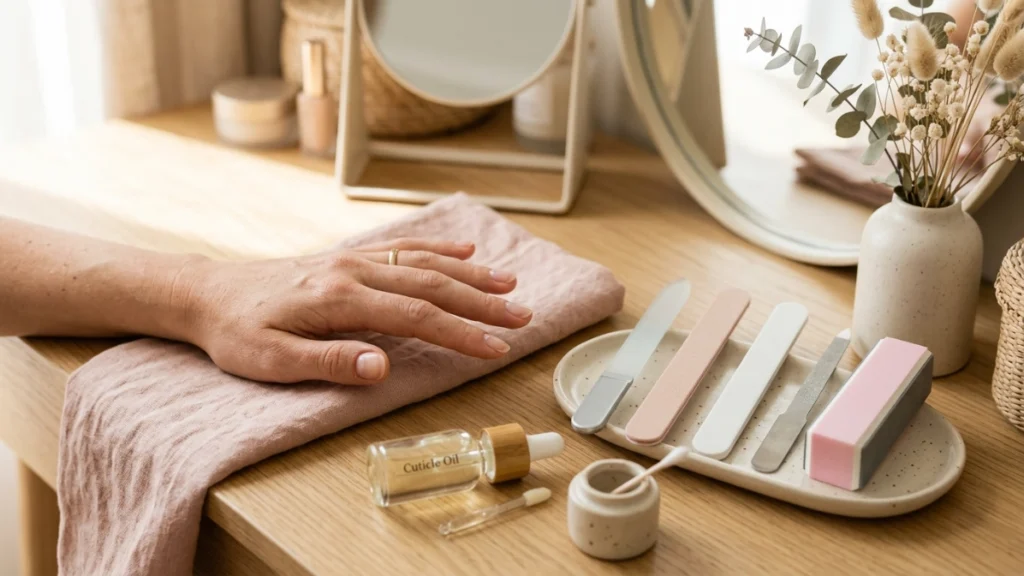
The best nail files to buy are usually fine glass or crystal files for natural nails, quality emery boards for affordable everyday shaping, and professional abrasive files for gel or acrylic enhancements. Choose a finer grit for natural or fragile nails and a coarser grit only when you need to remove or reshape harder enhancement material.
What Makes a Nail File Good?
A nail file may look like a very simple beauty tool, but several details affect how comfortable and useful it is.
The biggest factors are:
- File material
- Grit level
- Nail type
- Durability
- Ease of cleaning
- Shape and size
- How much material you need to remove
A file that works beautifully on acrylic nails could be much too aggressive for thin natural nails.
Likewise, a very fine natural-nail file may take forever to reshape a thick acrylic extension.
Material Matters
Nail files are commonly made from:
- Glass or crystal
- Emery-coated cardboard
- Ceramic
- Metal
- Foam or sponge
- Professional abrasive material
Each has advantages and limitations.
The goal is not to find the roughest or most powerful file. You want enough filing power to shape your nail without unnecessarily thinning or damaging it.
Grit Matters Even More
“Grit” describes how coarse or fine the abrasive surface is.
As a general rule:
Lower grit number = coarser file
Higher grit number = finer file
A coarse file removes material quickly. A fine file removes less material and is better for smoothing and finishing.
For beginners, this distinction is especially important because using an unnecessarily coarse file on natural nails can make filing difficult to control.
Best Types of Nail Files to Buy
Here is a simple comparison.
| Nail File Type | Best For | Main Benefit | Main Limitation |
|---|---|---|---|
| Glass or crystal | Natural nails | Smooth, controlled filing | Usually costs more than disposable files |
| Emery board | Everyday shaping | Affordable and easy to find | Wears down and is harder to thoroughly clean |
| Ceramic | Natural nails and detail work | Gentle, precise feel | Can break if dropped |
| Metal | Thick or strong nails | Durable and washable | Some versions feel too aggressive |
| Foam buffer | Finishing and smoothing | Flexible and comfortable | Not ideal for removing much length |
| Professional abrasive file | Gel and acrylic enhancements | Fast, efficient shaping | Coarse grits can damage natural nails |
Glass or Crystal Nail Files: Best Overall for Natural Nails
If you mainly maintain your natural fingernails, a quality glass or crystal file is an excellent place to start.
Its abrasive surface tends to feel fine and consistent, which gives you good control when smoothing rough edges or making small changes to nail shape.
Glass files also have another practical benefit: many can be washed and reused.
That makes them convenient if you want one dependable personal file instead of constantly replacing disposable boards.
A glass file is especially useful for:
- Short natural nails
- Medium-length natural nails
- Thin nails
- Nails that snag easily
- Routine manicure maintenance
The biggest drawback is breakability. Keep a glass file in a protective sleeve or case rather than tossing it loose into your makeup bag.
Emery Boards: Best Budget Option
Classic emery boards remain useful because they are inexpensive, lightweight, and available in many grit levels.
They work well for basic shaping and quick touch-ups.
They are also convenient for travel because you do not have to worry much about breaking or losing an expensive tool.
The disadvantage is durability.
Once an emery board becomes worn, bent, dirty, or clogged with nail dust, replacing it is usually more practical than trying to keep using it.
Disposable files can also make sense when hygiene is especially important.
Ceramic Nail Files: Best for Controlled Detail Work
Ceramic nail files provide another good reusable option.
They can feel gentle while still giving you enough control to refine corners and edges.
They are particularly helpful if you like doing frequent, small touch-ups instead of waiting until your nails need major reshaping.
Like glass, ceramic can break, so storage matters.
Metal Nail Files: Durable but Not for Everyone
Metal nail files are strong, thin, and easy to carry.
They can work well on thicker nails when used gently.
However, not every metal file has the same surface. Some inexpensive versions are quite aggressive and may feel uncomfortable on thin or peeling nails.
If your nails are fragile, a fine glass file is generally easier to control.
Foam Buffers: Best for Finishing
A foam buffer is not really a replacement for your main shaping file.
Instead, think of it as a finishing tool.
Its flexible surface can help soften minor roughness or prepare enhancement material during certain manicure processes.
Do not repeatedly buff the top surface of healthy natural nails just because you want them to look smoother.
Removing too much nail plate can make the nail thinner.
The American Academy of Dermatology notes that filing the natural nail surface for artificial nail application can thin and weaken the nail when done repeatedly.
Professional Abrasive Files: Best for Gel and Acrylic
Gel extensions, builder gel, acrylics, and similar nail enhancements are much harder than natural nails.
For those materials, stronger abrasive files are often needed.
A dual-sided professional file can be convenient because one side handles shaping while the finer side helps refine the result.
However, this does not mean the coarser side should automatically be used on the exposed natural nail.
When you get close to your natural nail plate, slow down and switch to a gentler method.
What Nail File Grit Should You Buy?
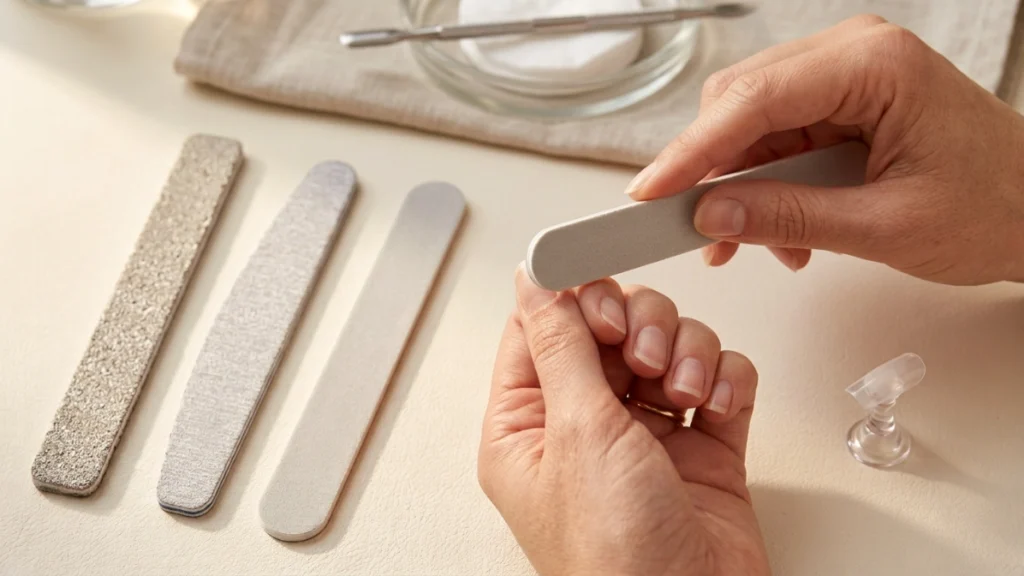
Grit is one of the easiest ways to accidentally buy the wrong file.
Here is a beginner-friendly guide.
| Grit Range | Typical Use |
|---|---|
| Around 80–100 | Heavy enhancement shaping or bulk reduction |
| Around 150 | Strong enhancement shaping |
| Around 180 | General enhancement shaping; sometimes strong natural nails with caution |
| Around 220–240 | Gentler natural-nail shaping and finishing |
| 240+ | Fine smoothing and finishing |
These ranges are practical guidelines rather than universal rules. Different manufacturers may make their abrasives feel slightly different.
For Natural Nails
Choose a fine file.
A fine glass file or an abrasive around the finer end of the scale gives you more control.
The American Academy of Dermatology recommends smoothing rough nail edges with a nail file or emery board and advises filing in one direction rather than aggressively sawing back and forth.
For Thin or Peeling Nails
Use an especially gentle approach.
Avoid aggressive grit and heavy pressure.
You are trying to smooth the edge—not grind away large amounts of nail.
If your nails repeatedly peel, split, or change texture without an obvious reason, filing harder is not the solution.
For Gel or Acrylic Nails
You can use a coarser professional file on the enhancement material because it is harder than your natural nail.
The important part is knowing when to stop.
As you reach the natural nail, reduce pressure and switch to a finer abrasive.
Which Nail File Is Best for Your Nail Type?
The easiest way to choose is to start with your actual nails rather than whatever file happens to be trending.
Healthy Natural Nails
Try:
- Fine glass file
- Fine crystal file
- Fine emery board
These provide enough shaping power for normal maintenance without making the process unnecessarily aggressive.
Brittle or Fragile Nails
Choose:
- Fine glass file
- Fine ceramic file
- Very fine emery board
Use light pressure and make small adjustments.
Avoid trying to shorten a long nail entirely through aggressive filing if clipping some length first would require less repeated abrasion.
Thick Natural Nails
A slightly stronger file may save time, but you still want control.
You may prefer:
- Medium-fine abrasive file
- Ceramic file
- Fine metal file
If a nail has become unusually thick, yellow, painful, crumbly, or distorted, do not assume it simply needs a stronger file. Changes like these can sometimes require professional evaluation.
Acrylic and Gel Enhancements
A professional abrasive file usually makes more sense.
You may want more than one grit so you can move from shaping to refining without using the same coarse surface throughout the manicure.
How to File Your Nails Safely
You do not need complicated technique for basic natural-nail filing.
Follow these steps.
- Start with clean nails. Remove dirt and inspect each nail for cracks, painful areas, or unusual changes.
- Choose an appropriate grit. Natural nails usually need a fine file rather than a coarse enhancement file.
- Hold the file lightly. A death grip does not give you better control.
- File the free edge rather than the surrounding skin. Avoid rubbing the file into your sidewalls or cuticle area.
- Use gentle, controlled strokes. The American Academy of Dermatology recommends filing in one direction because repeated back-and-forth filing can weaken nails.
- Check your shape frequently. Stop every few strokes and look at your nail straight on.
- Stop when the edge feels smooth. More filing is not automatically better.
- Moisturize afterward. Hand cream or cuticle oil can help keep the skin surrounding your nails comfortable.
Expert Tip
Expert Tip: Keep one fine file specifically for quick edge repairs. Smoothing a tiny snag as soon as you notice it can prevent you from picking at it or accidentally tearing more of the nail.
Nail File Hygiene: What Should You Know?
Nail tools come into contact with your nails, surrounding skin, and nail debris, so hygiene matters.
Reusable glass, ceramic, and some metal files are generally easier to wash than cardboard-style files.
Disposable files should be replaced when they become dirty, damaged, or heavily worn.
Most importantly, do not casually share personal nail files between people, especially when someone has a suspected nail or skin infection.
The American Academy of Dermatology recommends regularly disinfecting nail grooming tools such as clippers and nail scissors and emphasizes the importance of clean tools in nail care.
At a salon, hygiene standards matter even more because tools may otherwise move between many clients.
If you regularly wear gel manicures, the AAD recommends paying attention to whether salon tools are properly cleaned and disinfected between clients.
Should You Buy a Manual File or Electric Nail File?
For routine natural-nail care, a manual file is usually all you need.
An electric nail file, sometimes called an e-file or nail drill, can remove enhancement material much faster.
That speed is useful for trained nail professionals.
It also makes mistakes happen faster.
Using the wrong bit, speed, pressure, or angle can remove too much product or contact the natural nail.
For beginners who simply want to shape natural nails, a quality manual file is cheaper, easier to control, and generally the more sensible choice.
An e-file makes more sense when you regularly work with harder enhancement systems and understand how to use the machine safely.
DIY Filing vs. Going to a Nail Salon
At-home filing works well for normal grooming.
You can easily handle:
- Small shape changes
- Rough free edges
- Minor shortening
- Simple manicure maintenance
A professional nail technician becomes more useful when you have:
- Thick enhancement material
- Complicated acrylic or gel removal
- Lifting extensions
- Difficult nail architecture
- Damage caused by an enhancement
- A technique you are unsure how to perform safely
A licensed nail technician can help with cosmetic nail services, but remember that nail technicians do not replace dermatologists or healthcare professionals.
If the problem looks medical rather than cosmetic, seek appropriate medical care.
Common Mistakes to Avoid
Even a great nail file can cause problems when used incorrectly.
Avoid these common mistakes:
- Using very coarse grit on natural nails. Faster is not always safer.
- Filing with too much pressure. Let the abrasive surface do the work.
- Continuing after the shape is finished. Repeated filing removes more nail than necessary.
- Aggressively filing the top of your natural nail. Excessive surface filing can thin the nail plate.
- Using an old, worn-out file. A dull file may encourage you to use unnecessary pressure.
- Sharing used files. Personal nail tools are better kept personal.
- Ignoring pain. Normal filing should not hurt.
- Filing irritated or infected-looking skin. Filing is cosmetic maintenance, not a treatment for infection.
- Using enhancement techniques on damaged natural nails. Covering a problem does not necessarily solve it.
The FDA advises consumers to follow nail-product instructions and warnings carefully and notes that nail products can sometimes cause irritation, allergic reactions, or other problems.
When to See a Nail Technician or Dermatologist
A nail file is useful for cosmetic maintenance. It cannot diagnose or treat nail disease.
A nail technician may be helpful when you need professional shaping, enhancement maintenance, or careful gel/acrylic removal.
Consider seeing a dermatologist or healthcare professional if you notice:
- Persistent nail pain
- Swelling or warmth
- Pus or drainage
- Bleeding without an obvious minor injury
- Significant nail lifting
- Green, black, yellow, or unusual discoloration
- Thickening or crumbling that continues
- A dark streak or spot that is new or changing
- Ongoing redness around the nail
- Nail changes that do not improve
Dermatologists specifically recommend getting unusual changes in nail color, texture, or shape evaluated rather than assuming every change is simply cosmetic.
Do not aggressively file away a suspicious nail change in an attempt to make it look normal.
That can irritate the area and may hide information that could help a healthcare professional evaluate it.
FAQs
What are the best nail files to buy for natural nails?
A fine glass or crystal nail file is an excellent choice for most natural nails. Fine emery boards also work well if you prefer an inexpensive disposable option. Avoid unnecessarily coarse files because natural nails usually do not need aggressive abrasion.
Is a glass nail file better than an emery board?
Neither is automatically best for everyone. Glass files are reusable, easy to wash, and provide controlled filing. Emery boards are inexpensive, lightweight, and convenient. For regular natural-nail maintenance, many people prefer the smooth feel and durability of glass.
What nail file grit should I use on natural nails?
Natural nails generally do better with finer grit rather than the very coarse grits used for acrylic or other hard enhancements. Around 220–240 or finer is a practical starting point for many natural nails, although the exact feel varies by manufacturer.
Can I use an acrylic nail file on natural nails?
You can use the finer side of some professional files if the grit is suitable, but avoid using extremely coarse enhancement grits directly on natural nails. They may remove nail material too quickly.
Are metal nail files bad for your nails?
Not necessarily. A fine, well-made metal file can work for some people. The problem is that certain metal files feel quite coarse. If your nails are thin, brittle, or peeling, a fine glass or ceramic file may offer easier control.
How often should I replace a nail file?
Replace disposable files when their abrasive surface becomes worn, dirty, damaged, or difficult to use. Reusable glass, ceramic, and washable metal files can last much longer when they remain intact and are properly cleaned.
Should I file nails when they are wet or dry?
For basic filing, dry nails give you a clear sense of how much material you are removing. If your nails are very soft after prolonged water exposure, be especially gentle. For trimming, the AAD notes that nails are easier to cut after bathing or briefly soaking them.
Conclusion
So, what are the best nail files to buy?
For most natural-nail routines, start with a fine glass or crystal file. It offers good control, lasts a long time, and works well for regular shaping.
Choose an emery board if you want something inexpensive or disposable. Consider ceramic for gentle detail work. Save coarse professional files for harder materials such as gel or acrylic enhancements rather than routinely using them on your natural nail plate.
Most importantly, match the file to your nails.
Use light pressure, choose an appropriate grit, keep your tools clean, and stop filing when the nail is smooth and properly shaped.
And if a nail is painful, swollen, badly discolored, lifting, or otherwise changing in an unusual way, put the file down and get professional advice instead of trying to file the problem away.

