
Can a Toenail Grow Back After Falling Off?

Losing a toenail can look alarming, especially when the nail separates completely and leaves the sensitive skin underneath exposed. Whether it happened after stubbing your toe, wearing tight shoes, running, a pedicure injury, or a nail condition, your first question is probably: Can a toenail grow back after falling off?
In most cases, yes. A toenail can grow back as long as the nail-growing area at the base of the nail has not been permanently damaged. The difficult part is patience. Toenails grow slowly, so a completely new nail may take a year or longer to replace the one you lost.
While you wait, protecting the exposed nail bed, watching for infection, wearing comfortable shoes, and avoiding aggressive nail treatments can help the new nail grow with fewer problems.
Quick Answer
Yes, a toenail can usually grow back after falling off. Toenails grow very slowly, and complete regrowth commonly takes about 12–18 months. The new nail may initially look uneven or ridged. If the nail-growing tissue was badly injured or you develop pain, swelling, drainage, or unusual discoloration, see a healthcare professional.
Why Do Toenails Fall Off?
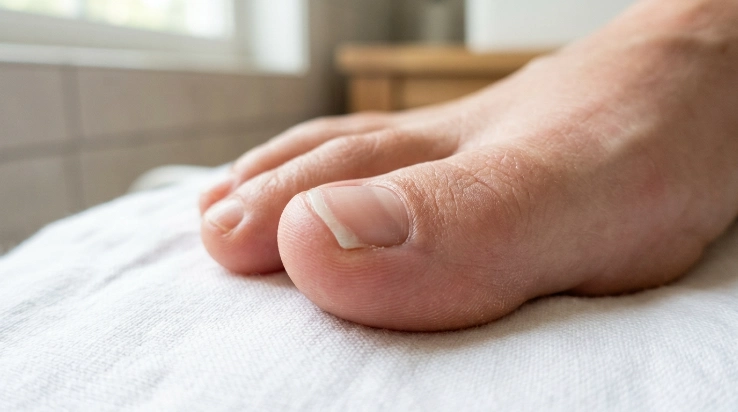
Toenails do not normally detach without a reason. Usually, something damages the nail or causes it to separate from the skin underneath.
Common causes include:
- Stubbing your toe
- Dropping something heavy on the toe
- Repeated pressure from tight shoes
- Running or other repetitive sports
- A fungal nail infection
- Aggressive pedicures
- Picking underneath a lifted nail
- Repeated trauma from footwear
- Certain skin or health conditions
After an injury, a toenail may first turn dark purple, red, brown, or black because blood has collected beneath it. In other situations, the nail gradually becomes loose before separating.
The NHS notes that nails can become loose and eventually fall off after an injury and that toenails may take up to 18 months to grow back. You can read its general guidance on common nail problems and nail care.
How Does a Toenail Grow Back?
Understanding what happens underneath your toenail makes the long recovery time easier to understand.
The hard part you see is called the nail plate. Underneath it is the nail bed, the skin the nail normally rests on.
Near the base of the nail is the nail matrix. This is the growth center that produces new nail cells.
When your toenail falls off but the matrix remains healthy, new nail material can gradually grow forward from the base.
Because toenails grow slowly, you may see only a small amount of progress each month.
Will the New Toenail Look Normal?
Often, yes—but not immediately.
A new toenail may temporarily look:
- Thin
- Ridged
- Wavy
- Slightly discolored
- Uneven
- Softer than your other nails
These changes do not automatically mean something is wrong.
If the original injury damaged the matrix, however, the new nail may grow with persistent ridges, splitting, thickness, or a different shape. Severe matrix damage can occasionally prevent normal regrowth.
How Long Does It Take for a Toenail to Grow Back?
Toenails require much more patience than fingernails.
The American Academy of Dermatology notes that a toenail may take approximately 12–18 months to grow back after nail removal, while the NHS says a toenail lost after an injury can take up to 18 months.
Your personal timeline can vary depending on:
- Which toenail was lost
- How severe the injury was
- Whether the nail matrix was damaged
- Repeated pressure from shoes
- Infection
- Overall foot health
- Age
- Circulation
- Additional trauma while the nail is growing
Do not expect the entire nail to appear within a few weeks. New growth begins at the base and gradually moves toward the tip.
Toenail Regrowth Timeline
| Stage | What You May Notice | Best Approach |
|---|---|---|
| Immediately after loss | Tender or exposed nail bed | Protect and keep clean |
| First few weeks | Skin begins settling and healing | Avoid pressure and picking |
| Early regrowth | Thin nail appears near the base | Leave it alone and protect it |
| Several months | Nail gradually moves forward | Trim or file only loose rough edges |
| 12–18 months | Much or all of the nail may be replaced | Continue normal gentle nail care |
This is only a general timeline. An injured toe should be judged by how it is healing rather than by a strict calendar.
What Should You Do After a Toenail Falls Off?
Your priority is not making the toe look pretty again immediately.
Your priority is protecting the tissue underneath while it heals.
1. Wash Your Hands First
Clean hands before touching the damaged toe.
This simple step helps reduce the chance of introducing bacteria into irritated or exposed skin.
2. Clean the Area Gently
If the skin is exposed, gently rinse it with clean water.
Avoid aggressive scrubbing.
Mayo Clinic’s basic wound-care guidance for cuts and scrapes recommends keeping wounds clean and covered while watching for increasing pain, drainage, warmth, swelling, or spreading color changes that could indicate infection.
3. Do Not Rip Off Nail That Is Still Attached
Sometimes part of a damaged nail falls away while another section remains connected.
Do not pull it off.
The American Academy of Dermatology advises that with a mild nail injury, a hanging portion that is no longer connected to the skin can be gently trimmed. Its guidance for caring for an injured nail also recommends professional evaluation for particularly painful or significant injuries.
If you cannot clearly tell which section is safely detached, leave it alone.
4. Protect the Sensitive Area
A clean, non-stick dressing can help protect exposed tissue from:
- Dirt
- Friction
- Socks
- Shoe pressure
- Accidental bumps
Change a dressing if it becomes dirty or wet.
5. Wear Roomy Shoes
A narrow toe box can repeatedly press against the healing nail.
Choose shoes that give your toes enough room to move without rubbing the damaged area.
At home, comfortable open footwear may feel better when appropriate and safe.
Should You File a Toenail While It Is Growing Back?
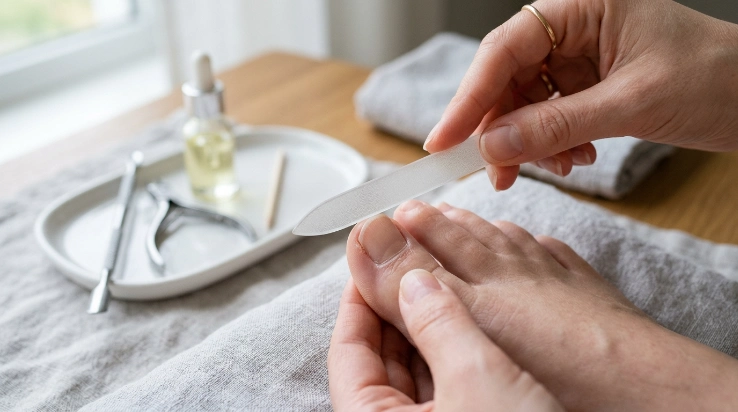
A nail file can be useful—but only after there is enough new nail to file safely.
Do not file exposed skin or the tender nail bed.
Once the new toenail extends far enough to develop a rough or snagging free edge, you can gently smooth that edge with a fine nail file.
Use very light pressure.
For a fragile new natural nail, avoid extremely coarse files because they remove nail material quickly and can leave a thin edge even weaker.
Choosing a Nail File
| Nail File Type | Best Use | Caution |
|---|---|---|
| Fine emery board | Gentle smoothing | Replace when worn or dirty |
| Glass file | Controlled shaping of natural nail | Use gently on thin new growth |
| Metal file | Durable general filing | May feel aggressive on fragile nails |
| Coarse file | Thick artificial or very heavy nail material | Usually unnecessary for delicate regrowth |
| Buffer block | Light surface smoothing | Over-buffing can thin the nail |
Never use a nail file to scrape underneath the new toenail.
That area is delicate, and aggressive cleaning or filing can irritate the skin or interfere with the growing nail.
How to Care for a Growing Toenail
Once the immediate injury has settled, simple protection is more useful than complicated treatments.
Keep the Toe Clean and Dry
Normal foot hygiene helps reduce the conditions that allow bacteria and fungi to thrive.
Dry carefully between your toes after bathing.
You do not need to repeatedly soak the nail unless a healthcare professional specifically recommends it for your situation.
Protect the New Nail From Pressure
Repeated trauma can damage new growth before it has a chance to strengthen.
Pay particular attention to:
- Running shoes
- Hiking boots
- Pointed-toe shoes
- High heels
- Tight socks
- Work shoes
Your toes should not repeatedly hit the end of the shoe.
Moisturize Dry Surrounding Skin
If the surrounding skin becomes dry, a gentle moisturizer can make it more comfortable.
However, avoid packing creams, oils, or cosmetic products into an open wound.
Leave the Cuticle Alone
The cuticle is the thin protective seal where the nail meets the skin.
Do not aggressively cut, scrape, or push it back while the toenail is recovering.
Avoid Cosmetic Cover-Ups Too Soon
You may understandably want to hide a missing or uneven toenail with polish, gel, acrylic, press-ons, or another enhancement.
But applying cosmetic products over irritated or injured tissue can make monitoring the area more difficult.
If the nail bed is still open, sore, swollen, or draining, focus on healing rather than appearance.
What Can Prevent a Toenail From Growing Back Normally?
Most toenails eventually regrow, but several issues can interfere.
Damage to the Nail Matrix
A deep injury near the base of the toenail may damage the matrix.
Because the matrix produces the nail, significant damage can result in:
- Permanent ridges
- Splitting
- Abnormal thickness
- Crooked growth
- Partial regrowth
This is one reason severe crush injuries deserve medical assessment.
Fungal Infection
Fungal infections can make toenails thick, brittle, discolored, crumbly, or lifted.
The American Academy of Dermatology notes that fungal infections can sometimes cause a nail to lift, become misshapen, or fall off.
If your toenail fell off without a memorable injury and the surrounding nails are also yellow, thick, brittle, or crumbling, do not assume trauma is the cause.
Continued Shoe Trauma
Even a healthy new nail can struggle if it repeatedly hits the front of your shoe.
The problem is common among runners, hikers, and people who wear shoes that are slightly too small.
Infection Around the Nail
Increasing redness, warmth, swelling, drainage, or worsening pain can indicate infection.
Do not try to cover these symptoms with polish or continue a home pedicure.
Expert Tip
Expert Tip: Take a clear photo of the toenail every four weeks under similar lighting. Because toenails grow so slowly, progress can be difficult to notice day to day. Monthly photos make it easier to see whether healthy new nail is actually moving forward from the base.
Can You Make a Toenail Grow Back Faster?
There is no reliable beauty treatment that suddenly turns slow toenail growth into rapid growth.
Instead, concentrate on protecting the growth you already have.
Helpful habits include:
- Eating a balanced diet
- Preventing repeated toe injuries
- Wearing properly fitted shoes
- Keeping feet clean
- Avoiding unnecessary aggressive filing
- Managing suspected nail problems appropriately
- Keeping nail tools clean
- Not picking at the growing nail
Products marketed as nail-growth accelerators may improve how dry nails feel, but they cannot repair a severely damaged nail matrix.
DIY Care vs. Professional Care
A missing toenail is sometimes manageable at home, but not every nail injury is a DIY beauty problem.
| Situation | DIY Care May Be Reasonable | Professional Care Is Better |
|---|---|---|
| Nail fell off after a minor old injury | Often | If symptoms worsen |
| Small rough edge during regrowth | Gentle filing | If filing causes pain |
| Mild dry surrounding skin | Moisturizer may help | If skin is cracked or infected |
| Significant bleeding | No | Yes |
| Severe or persistent pain | No | Yes |
| Pus or spreading inflammation | No | Yes |
| Nail repeatedly grows abnormally | Limited | Yes |
| Unexplained dark streak | No | Dermatologist evaluation |
Cost Considerations
Simple home care may require only inexpensive supplies such as clean dressings and a gentle nail file.
A salon pedicure or nail technician appointment adds a service cost, while dermatologist, podiatrist, urgent-care, testing, or prescription treatment costs vary widely depending on location and insurance.
Do not choose DIY treatment simply because it is cheaper when infection, significant injury, or abnormal nail changes are involved.
When to See a Nail Technician or Dermatologist
A nail technician can help with cosmetic maintenance once the toe is healthy, but nail technicians do not replace medical professionals.
Consider professional medical evaluation if you notice:
- Severe or increasing pain
- Significant swelling
- Pus or unusual drainage
- Increasing warmth around the toe
- Spreading inflammation
- Persistent bleeding
- A deep wound
- Difficulty walking
- A toe that looks deformed after injury
- A nail that repeatedly fails to grow normally
- Unexplained lifting
- Significant thickening or crumbling
- A new or changing dark streak
The American Academy of Dermatology recommends having certain changes—including unexplained nail lifting and new or changing dark streaks—examined by a dermatologist. Its guide to nail changes a dermatologist should examine explains several important warning signs.
A significant crush injury may also involve the toe itself, not only the nail. Mayo Clinic advises medical assessment when pain, swelling, or discoloration following a toe injury lasts more than a few days or affects walking or wearing shoes.
If you have diabetes, poor circulation, reduced sensation in your feet, or another condition that makes foot injuries more complicated, get individualized medical advice rather than experimenting with aggressive DIY nail care.
Common Mistakes to Avoid
When you are waiting for a toenail to grow back, avoid these common mistakes:
- Pulling off a partially attached nail. You may tear living tissue underneath.
- Filing exposed skin. A nail file is for nail material, not the nail bed.
- Using very coarse files on delicate new growth. This can remove too much nail quickly.
- Digging underneath the growing nail. Sharp tools can injure sensitive tissue.
- Wearing tight shoes. Constant pressure can repeatedly traumatize the toe.
- Picking at scabs or peeling skin. Let healing tissue separate naturally.
- Covering suspicious changes with polish. You need to be able to monitor color, swelling, and drainage.
- Sharing nail tools. Personal tools are easier to keep hygienic.
- Ignoring worsening pain or infection signs. A medical problem should not be treated like a cosmetic flaw.
- Expecting rapid regrowth. Toenails need many months to completely replace themselves.
FAQs
Can a toenail grow back after completely falling off?
Usually, yes. If the nail matrix at the base remains healthy, a new toenail can grow from it. Complete replacement commonly takes around 12–18 months.
What does a toenail look like when it starts growing back?
You may first see a thin strip of new nail emerging near the cuticle area. It can initially look uneven, soft, ridged, or slightly different in color from your other toenails.
Why isn’t my toenail growing back?
Toenails grow slowly, so progress can be difficult to notice. Previous matrix damage, repeated trauma, infection, or another nail condition can also affect growth. Seek professional advice if you see no apparent progress over time or the nail looks increasingly abnormal.
Can I put nail polish on a toenail that is growing back?
Wait until the skin has healed and there is a stable nail surface. Avoid applying polish, gel, glue, or enhancements over an open, painful, swollen, or draining area.
Should I cover a missing toenail?
During the tender healing stage, a clean protective dressing can reduce friction and contamination. Change it when it becomes wet or dirty, and follow medical advice for significant wounds.
Can toenail fungus cause the nail to fall off?
Yes. Fungal nail infections can cause discoloration, thickening, crumbling, lifting, and sometimes loss of the nail.
Will my new toenail always look different?
Not necessarily. Temporary unevenness is common during regrowth. However, a serious injury to the nail matrix can sometimes cause lasting changes in thickness, texture, or shape.
Conclusion
So, can a toenail grow back after falling off? In most situations, the answer is yes—as long as the nail’s growth center has not been permanently damaged.
The biggest challenge is time. Complete toenail regrowth can take around 12–18 months, which means gentle care and protection matter more than quick cosmetic fixes.
Keep the area clean, protect delicate new growth, wear shoes with enough toe room, use nail files only on actual nail material, and avoid picking or aggressive pedicure work.
Most importantly, pay attention to what your toe is telling you. Increasing pain, swelling, drainage, unusual discoloration, or abnormal regrowth should be assessed rather than hidden with polish.
Give your new toenail the time and protection it needs—and choose professional care whenever the problem goes beyond routine beauty maintenance.

