
Can Cats Play With Nail Files? What Nail Lovers Should Know

If your cat has ever knocked a nail file off your vanity, grabbed an emery board, or tried to chew one while you were doing your nails, you are not alone. Nail files are light, textured, and easy to bat around, so they can look surprisingly tempting to a curious cat.
But can cats play with nail files safely? In most cases, it is better not to let them. A nail file is a grooming tool, not a cat toy. Chewing, biting, or rough play can create risks from sharp edges, broken pieces, abrasive surfaces, and swallowed material.
The good news is that you do not need to panic if your cat briefly paws at a nail file. What matters is the type of file, whether it has been damaged, and whether your cat chewed or swallowed any part of it.
This guide explains the risks, what to do if your cat grabs your file, safer alternatives, hygiene concerns, and the warning signs that mean it is time to call a veterinarian.
Quick Answer
Cats should not regularly play with nail files. A quick supervised sniff or paw is unlikely to cause a problem, but chewing or biting can damage the mouth or break off pieces that may be swallowed. Store nail files away after use and give your cat a proper toy or scratching surface instead.
Why Are Cats Interested in Nail Files?
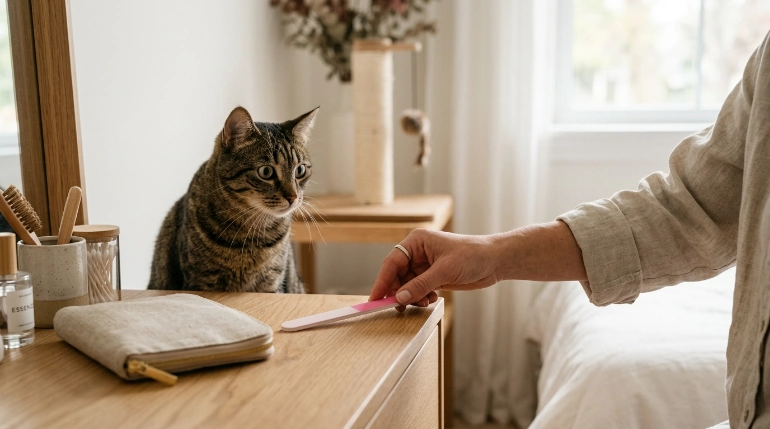
A nail file probably does not look interesting to us once a manicure is finished. To a cat, however, it can behave like a tiny toy.
An emery board is light enough to slide across a table or floor when your cat bats it. It may also have a rough texture that feels different from ordinary household objects.
Cats naturally investigate objects with their paws and mouths. A file that moves when touched can quickly become part of a play session.
Your cat may be especially interested if the file:
- Slides easily across a smooth surface
- Has a textured or rough surface
- Dangles from the edge of a table
- Smells like your hands, lotion, or nail products
- Is small enough to pick up in the mouth
- Makes a scraping sound when moved
That interest does not make a nail file a suitable toy.
Cats need opportunities to scratch and play, but those needs are better met with cat-safe objects. The ASPCA’s general cat-care guidance recommends providing a sturdy scratching post and notes that scratching is a normal part of feline behavior.
Can Cats Play With Nail Files Safely?
The safest answer is no—not as a regular toy.
If your cat touches an intact nail file once or knocks it onto the floor, there is usually a big difference between that and sitting down to chew it.
The risk increases when your cat:
- Bites the file
- Tears pieces from an emery board
- Carries it around in the mouth
- Licks residue from the surface
- Plays with a cracked glass file
- Bends or damages a thin metal file
- Swallows part of the file
A nail file was designed to remove tiny amounts of fingernail material through abrasion. That same rough surface is unnecessary around a cat’s mouth, gums, tongue, and digestive system.
The main rule is simple: if your cat starts chewing the file, take it away and replace it with a cat-safe toy.
Nail File Types and Their Risks Around Cats
Different nail files create different concerns.
| Nail file type | Main concern around cats | Best approach |
|---|---|---|
| Emery board | Can be chewed, shredded, or swallowed | Keep out of reach |
| Glass file | Can crack or break if dropped or bitten | Store in a protective case |
| Metal file | Hard edges may injure the mouth during rough chewing | Do not use as a toy |
| Foam/buffer file | Soft enough to tear into pieces | Prevent chewing |
| Electric nail file | Moving parts, cord, noise, and attachments | Unplug and store securely |
Emery Boards
Disposable emery boards may look fairly harmless because they are lightweight and inexpensive.
The problem is that they can also be easier to chew apart. Once the board becomes shredded, you may not know whether your cat merely spat out the fragments or swallowed some.
If an emery board is visibly chewed, I would discard it rather than putting it back into my manicure kit.
Glass Nail Files
Glass files are smooth, washable, and popular for natural nails, but they are a particularly poor choice for cat play.
Even tempered glass can become damaged after an impact. A cracked file should not be used on your nails or left where a cat can continue batting it around.
Keep glass files in their sleeve or protective case when you are finished.
Metal Nail Files
A metal file will not tear apart like an emery board, but that does not make it a safe cat toy.
A cat that bites or wrestles with a hard metal object could hurt the mouth or gums. Narrow or pointed ends can also become hazardous during energetic play.
Foam Buffers and Disposable Files
Foam buffers are easy to grip and chew. A determined cat may remove pieces quickly.
Because these files are often porous, cleaning a file that has been thoroughly chewed or covered in saliva is usually less practical than replacing it.
Expert Tip: Keep one small closed container or manicure pouch specifically for nail files and buffers. Putting tools away immediately is easier than repeatedly taking them away from a curious cat.
What If My Cat Chewed a Nail File?
First, remove the nail file and look at it closely.
Do not simply assume that every missing mark was swallowed. Compare the damaged area with any pieces you can find nearby.
Then follow these steps.
1. Check How Much Is Missing
Look for shredded paper, foam, abrasive coating, or broken sections on the floor.
If the file is intact and only has a few tooth marks, the situation is very different from discovering that a large section has disappeared.
2. Look at Your Cat’s Mouth If It Is Safe
You can briefly check for obvious bleeding, excessive drooling, or a loose piece near the front of the mouth.
Do not force your cat’s mouth open or reach deep into the throat.
If your cat is distressed or resisting strongly, stop.
3. Watch for Changes in Behavior
A cat that returns to normal eating, drinking, playing, and resting is reassuring, but it does not prove that nothing was swallowed.
Pay closer attention if part of the nail file is missing.
4. Contact Your Veterinarian If Material May Have Been Swallowed
Foreign objects can become stuck in a cat’s digestive tract. According to VCA’s guidance on foreign-body ingestion in cats, warning signs may include vomiting, reduced appetite, abdominal discomfort, diarrhea, difficulty passing stool, lethargy, and behavior changes.
If a meaningful piece is missing, contacting your veterinarian is safer than waiting for symptoms to become severe.
Do not try to make your cat vomit at home unless a veterinary professional specifically instructs you to do so.
Warning Signs After Chewing or Swallowing Part of a File
Take possible ingestion more seriously if you notice:
- Repeated vomiting
- Gagging or retching
- Excessive drooling
- Refusing food
- Trouble swallowing
- Unusual tiredness
- Hiding more than normal
- Abdominal pain or sensitivity
- Straining to pass stool
- Very little stool
- Blood from the mouth
- Persistent pawing at the mouth
These signs are not specific to nail-file ingestion, which is one reason professional evaluation matters.
A swallowed non-digestible object can sometimes cause an obstruction. VCA notes that foreign-body obstructions may require diagnostic imaging and, in some cases, removal.
What If the Nail File Cuts or Damages Your Cat’s Claw?
Playing with a human nail file is different from intentionally grooming a cat’s claws.
If your cat catches a claw on a file, tears a nail, or starts bleeding, stop the play immediately.
Broken claws can be painful. VCA’s guidance on broken nails in cats explains that the damaged portion may sometimes need veterinary attention so the nail can heal properly.
Seek veterinary advice if you notice:
- Continued bleeding
- A claw hanging at an unusual angle
- Limping
- Swelling around the toe
- Persistent licking of one paw
- Obvious pain when the paw is touched
- A nail broken close to its base
Do not aggressively file a damaged claw yourself in an attempt to make it smooth.
Can You Use a Nail File to Groom a Cat’s Claws?
This is slightly different from allowing a cat to play with a nail file.
Some pet owners may carefully smooth a freshly trimmed claw with an appropriate grooming file. However, many cats dislike the sensation, and filing should never involve wrestling, force, or heavy pressure.
The ASPCA’s cat grooming tips recommend gradually getting cats comfortable with paw handling and trimming only the sharp tip of the claw. The guidance also emphasizes keeping early sessions short and rewarding the cat afterward.
For most people, a proper cat nail clipper and calm handling are more practical than trying to substantially shorten claws with a human file.
If you do smooth a rough tip:
- Wait until your cat is calm.
- Handle the paw gently.
- Extend one claw at a time.
- Use very light pressure.
- Stop immediately if the cat pulls away or becomes stressed.
- Never file into living tissue.
If you are unsure where the safe portion of the claw ends, ask a veterinarian or experienced pet groomer to demonstrate.
Better Alternatives to Nail Files for Cat Play
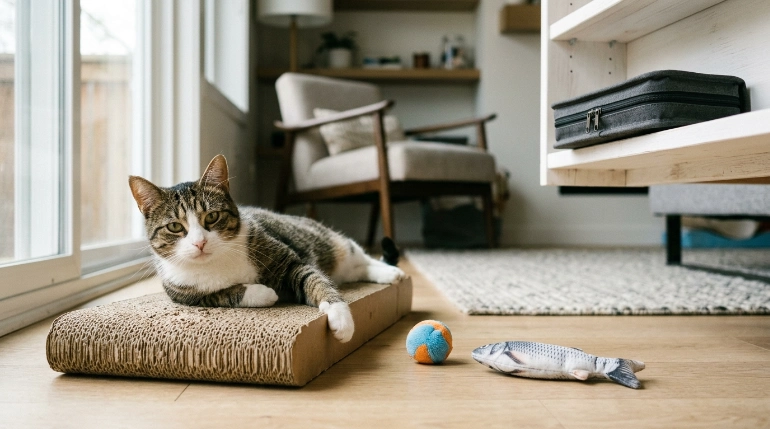
A cat does not need your manicure tools to satisfy the urge to scratch, chase, chew, or bat objects around.
Choose something designed for feline play instead.
Good alternatives include:
- Sturdy scratching posts
- Horizontal cardboard scratchers
- Cat-safe balls
- Wand toys used with supervision
- Kicker toys
- Lightweight cat toys too large to swallow
- Puzzle toys designed for cats
A scratching surface is particularly useful because it addresses a normal feline behavior rather than simply distracting the cat.
Choose toys without easily detachable pieces. Replace anything that becomes badly damaged.
Nail File Hygiene After a Cat Touches or Chews It
Your cat may walk through litter, groom its body, eat, and then decide your manicure file looks interesting.
That is enough reason to think about hygiene before using the tool again.
For a disposable emery board or porous foam buffer, replacing a saliva-soaked or visibly dirty file is generally the simplest approach.
With a reusable glass or metal file, follow the manufacturer’s cleaning instructions and make sure the tool is fully dry before storing it.
The American Academy of Dermatology’s nail-tool hygiene guidance stresses the importance of properly cleaning reusable nail-grooming tools to help reduce infection risk.
Do not continue filing if you have broken skin around a nail and the tool has just been in your cat’s mouth.
Does Cost Change What You Should Do?
Not really.
Disposable emery boards are inexpensive, so there is little reason to save one that has been chewed, shredded, or heavily soiled.
Glass and quality metal files can cost more and last longer, which makes protective storage worthwhile. Still, keeping an expensive file is not worth using a cracked, bent, or contaminated tool.
Safety and condition matter more than the original price.
How to Stop Your Cat From Stealing Nail Files
The easiest strategy is changing your nail-care routine slightly.
Store Files Immediately
Do not leave an emery board on the couch, bathroom counter, or edge of your vanity after a manicure.
Put it in a drawer, closed cosmetics case, or manicure pouch.
Keep Your Manicure Area Clear
Cats are often attracted to several manicure items, not just files.
Cotton pads, packaging, small caps, strings, and other loose objects can also become tempting playthings.
Clean the area when you finish.
Redirect Instead of Chasing
If your cat steals the file, calmly exchange it for an appropriate toy.
Turning retrieval into an exciting chase can accidentally make stealing manicure tools more entertaining.
Give Your Cat a Scratching Option Nearby
If your cat frequently visits you while you do your nails, place a scratcher or favorite toy nearby.
The goal is to make the approved option more interesting than your nail tools.
Common Mistakes to Avoid
A few simple mistakes can turn a harmless moment of curiosity into a bigger problem.
- Letting a cat chew an emery board because it seems soft. Soft material can still break into pieces.
- Ignoring a missing section of a file. If you cannot find the piece, consider the possibility that it was swallowed.
- Using a cracked glass file again. Damage can make the tool unsafe for both you and your cat.
- Trying to force open your cat’s mouth. A frightened cat can struggle, scratch, or bite.
- Trying to induce vomiting yourself. Call a veterinarian for instructions if ingestion is suspected.
- Returning a chewed disposable file to your manicure kit. Replace porous tools that are badly contaminated.
- Using rough filing to shorten a cat’s claws. Human manicure habits do not automatically translate to safe pet grooming.
- Punishing curiosity. Secure the object and redirect your cat instead.
When to See a Veterinarian
A veterinarian is the main professional to contact when the concern involves your cat.
Call promptly if a piece of nail file appears to be missing or your cat has swallowed any fragment and you are unsure whether it can pass safely.
Veterinary help is also appropriate if your cat develops vomiting, appetite loss, lethargy, abdominal pain, trouble passing stool, mouth bleeding, or difficulty swallowing after chewing a file. These can occur with swallowed foreign material and should not be diagnosed at home.
For a damaged claw, seek help when bleeding will not stop, the claw is badly torn, or your cat appears painful.
When to See a Nail Technician or Dermatologist
A nail technician cannot assess whether your cat has swallowed something. That is a veterinary question.
A nail technician can, however, help you choose replacement manicure tools or explain which reusable files can be cleaned according to their manufacturer instructions.
For your own hands or nails, consider a dermatologist rather than trying to cover a problem with polish if you develop persistent redness, swelling, pain, discoloration, nail lifting, or another change that looks like an infection.
The American Academy of Dermatology notes that some nail conditions can resemble one another and may require professional diagnosis.
If your cat has contaminated a tool that touched broken skin, clean the area and avoid continuing the manicure until the skin is healthy.
DIY Nail Care vs. Professional Help
| Situation | DIY response | Better professional |
|---|---|---|
| Cat briefly paws at intact file | Put file away | Usually none |
| Cat chews file but nothing is missing | Remove file and monitor | Vet if symptoms appear |
| Part of file is missing | Do not guess | Veterinarian |
| Cat’s claw is badly torn | Avoid aggressive DIY filing | Veterinarian |
| Human file is chewed/dirty | Replace or clean if appropriate | Nail tech for tool advice |
| Human nail/skin shows infection signs | Stop cosmetic treatment | Dermatologist |
The key is knowing where DIY care ends.
Putting away a nail file or replacing a dirty emery board is an easy home decision. Suspected ingestion, significant claw injury, or persistent infection symptoms are different.
FAQs
Can cats play with emery boards?
It is better not to use an emery board as a cat toy. Cats may chew or shred the board, creating small pieces that could be swallowed. Store the board after your manicure and offer a cat-safe toy instead.
Is a nail file toxic to cats?
A plain nail file is not automatically a poison, but materials and coatings vary between products. The larger practical concerns are chewing, mouth injury, breakage, and swallowing non-food material. If your cat ingests part of a coated product or you are worried about an ingredient, contact your veterinarian.
What should I do if my cat licks my nail file?
Remove the file and check whether other manicure products are on its surface. A brief lick of a plain, clean file is different from licking polish remover, gel residue, glue, or another chemical. Contact a veterinarian if chemical exposure may have occurred.
What if my cat swallowed a small piece of an emery board?
Call your veterinarian and explain the approximate size, material, and amount that may have been swallowed. Do not assume that a small piece will definitely pass. Watch for vomiting, appetite changes, abdominal pain, lethargy, or trouble passing stool.
Can I file my cat’s claws with a human nail file?
Light smoothing may be possible with appropriate technique, but it should not become a stressful filing session. Many owners find cat nail clippers more practical. If you are unsure how to trim or smooth feline claws safely, ask your veterinary team to demonstrate.
Should I throw away a nail file after my cat chews it?
For a disposable emery board or foam file, usually yes. If it is shredded, wet with saliva, or heavily soiled, replacement is simple. A reusable glass or metal file may be cleanable if it is completely undamaged and its manufacturer allows proper washing or disinfection.
Why does my cat keep stealing my nail file?
The file may slide, scrape, smell like you, or simply be a new object to investigate. Instead of allowing repeated play, keep manicure tools in a closed container and redirect your cat toward a scratcher or suitable toy.
Final Thoughts
So, can cats play with nail files? They can certainly become interested in them, but nail files should not be treated as cat toys.
Briefly pawing at an intact file is usually far less concerning than biting, chewing, breaking, or swallowing it. The safest habit is to put manicure tools away as soon as you finish using them.
Discard badly chewed disposable files, protect glass and metal files from damage, and keep your manicure kit clean. Give your cat a scratching post or proper toy instead.
Most importantly, if part of a nail file disappears or your cat develops vomiting, appetite changes, pain, unusual tiredness, mouth injury, or trouble passing stool, contact your veterinarian rather than trying to solve the problem with DIY care.
A closed manicure pouch and a good cat toy are simple changes, but they can keep both your nails and your curious cat much safer.

