
Can Nail Primer Replace Dehydrator? What to Use and Why

Quick Answer
Nail primer generally cannot replace nail dehydrator because the two products do different jobs. Dehydrator temporarily removes surface oil and moisture, while primer promotes adhesion between the prepared nail and an enhancement product; the FDA’s nail-care guidance also notes that some nail primers contain methacrylic acid and require careful handling.
What this means for your nail prep
- Different jobs: Dehydrator removes temporary surface contaminants, while primer improves bonding.
- Correct order: Apply dehydrator first, let it evaporate, then apply primer if your nail system calls for it.
- Primer alone: It may work in systems that specifically say dehydrator is optional, but it does not perform the same drying step.
- Gel and acrylic: Requirements vary, so follow the instructions for your exact base, builder, acrylic, or tip system.
- More isn’t better: Adding extra prep chemicals can cause problems when the products are incompatible.
Best rule
- Follow your system: Use primer without dehydrator only when the manufacturer specifically supports that preparation method.
If you’re wondering whether nail primer can replace dehydrator, the short answer is usually no. The bottles may sit beside each other in a nail-prep kit, but they aren’t interchangeable.
I find the easiest way to understand them is to separate cleaning and drying from bonding. Once you know which product handles each job, choosing your prep routine becomes much simpler.
In This Guide
- What Is the Difference Between Nail Primer and Dehydrator?
- Can You Use Nail Primer Instead of Dehydrator?
- Do You Need Both Nail Dehydrator and Primer?
- Which Comes First: Dehydrator or Primer?
- Do Gel, Acrylic, Builder Gel, and Press-Ons Need Both?
- What Can You Use Instead of Nail Dehydrator?
- Why Are My Nails Still Lifting After Primer?
- How Can You Use Primer and Dehydrator Safely?
- Frequently Asked Questions
- Final Takeaway
What Is the Difference Between Nail Primer and Dehydrator?
A nail dehydrator is a prep liquid designed to temporarily remove surface moisture and oils from the natural nail plate. A primer has a different purpose: it helps the next compatible nail product adhere to that prepared surface.
Think of painting a wall. Dehydrator is like preparing the surface, while primer helps create the foundation for what comes next.
What nail dehydrator does
Natural nails can carry tiny amounts of water, skin oils, lotion, and other residue. Those contaminants may interfere with adhesion.
A dehydrator is normally applied after shaping and basic nail preparation. It then evaporates quickly.
- Reduces surface moisture: It temporarily dries the upper surface of the nail.
- Removes oils: It helps clear natural oils that can weaken adhesion.
- Leaves little behind: Most dehydrators are designed to flash off rather than form a coating.
- Prepares for bonding: The dry surface is ready for the next compatible prep product.
The effect isn’t permanent. Your nails can pick up moisture and oils again, especially if you touch them after preparation.
What nail primer does
Nail primer is an adhesion-promoting product. It is applied after the nail surface has already been prepared according to the nail system’s directions.
Some primers are acid-based, while others are marketed as acid-free or non-acid formulas. Their chemistry and directions can differ considerably.
| Feature | Nail Dehydrator | Nail Primer |
|---|---|---|
| Main job | Reduce surface oil and moisture | Promote adhesion |
| When used | Before primer | After dehydrator when required |
| Typical behavior | Evaporates quickly | Leaves an adhesion-promoting surface |
| Interchangeable? | No | No |
The important point is simple. Cleaning and bonding aren’t the same process.
Can You Use Nail Primer Instead of Dehydrator?
Usually, nail primer should not be used as a direct replacement for dehydrator. Primer cannot reliably perform the dehydrator’s job of removing surface oil and moisture.
Imagine putting an adhesion product over an oily nail plate. The primer may be excellent, yet the contamination underneath can still interfere with retention.
When primer alone might be acceptable
There is one major exception: your specific nail system may tell you to use primer without a separate dehydrator. In that case, follow the manufacturer’s preparation instructions.
Modern nail systems aren’t chemically identical. Some have their own prep liquids, bonders, base products, or combination formulas.
- Check the label: Look for the manufacturer’s exact preparation sequence.
- Stay within the system: Avoid mixing multiple brands unless their instructions allow it.
- Don’t assume: A product called “prep,” “bond,” or “primer” may work differently from another brand’s product with the same name.
As of 2026, product names still aren’t a reliable way to determine exact chemistry. The bottle instructions matter more than the marketing term on the front.
When skipping dehydrator is more likely to cause trouble
Skipping it may be more noticeable when the nail plate becomes oily quickly. It can also matter when lotion, cuticle oil, or repeated touching has contaminated the prepared nail.
- Hands were washed immediately before application.
- Cuticle oil was used during prep.
- Lotion remains around the nail plate.
- The client naturally has oily nail plates.
- The prepared nails were touched with fingertips.
- The enhancement system specifically calls for dehydration.
Primer doesn’t automatically correct these issues. Good adhesion starts with an appropriately prepared surface.
Do You Need Both Nail Dehydrator and Primer?
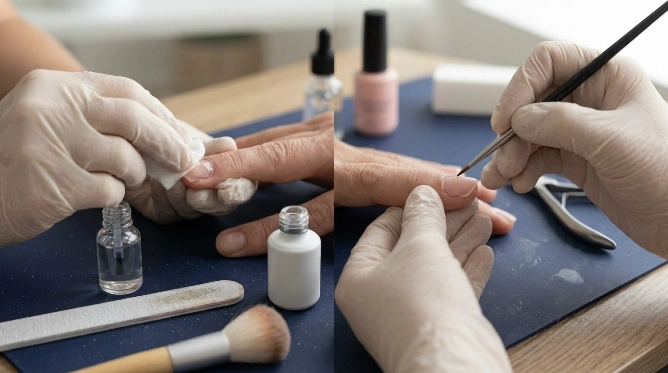
Some nail systems perform best with both, while others need only one or neither. There isn’t a universal rule that every manicure requires two prep liquids.
This is where people often overcomplicate nail preparation. Using more products doesn’t always produce longer wear.
You may need both when:
- Your gel, builder, acrylic, or extension system explicitly instructs you to use both.
- You experience lifting despite correct mechanical preparation and application.
- Your natural nail surface becomes oily quickly.
- Your chosen primer is designed to follow the brand’s dehydrator.
You may not need both when:
- Your base product is designed for primer-free application.
- The manufacturer says its prep solution performs the required preparation step.
- You are using regular nail polish rather than an enhancement system.
- Your press-on adhesive provides its own preparation instructions.
The safest approach is to treat your gel, acrylic, adhesive, and prep products as one system. Follow that system instead of building a routine from random online steps.
Which Comes First: Dehydrator or Primer?
When your system requires both, nail dehydrator normally comes first and primer comes second. The dehydrator prepares the surface so the primer can contact the nail properly.
Applying them backward can defeat the purpose of the preparation process. A dehydrating solvent shouldn’t usually be placed over a primer layer meant to support adhesion.
A typical nail-prep sequence
- Remove old product safely. Don’t peel enhancements from the natural nail.
- Shape the free edge. File the nail into the desired shape.
- Prepare the cuticle area. Remove non-living tissue from the nail plate without damaging living skin.
- Remove surface shine if required. Use the grit and technique recommended for your nail system.
- Remove dust. Keep lint and filing debris off the nail.
- Apply dehydrator. Use a thin application and allow it to evaporate.
- Apply primer if required. Avoid flooding the surrounding skin.
- Apply the next product. Follow your system’s directions for base, builder, gel, acrylic, or adhesive.
Don’t touch the prepared nail plate between these steps. A single fingertip can put skin oils back onto the surface.
Do Gel, Acrylic, Builder Gel, and Press-Ons Need Both?
The answer depends more on the product system than the manicure name. Two builder gels, for example, may have different preparation requirements.
Use this chart as a starting point, not as a replacement for your product instructions.
| Nail Service | Dehydrator | Primer | Best Approach |
|---|---|---|---|
| Gel polish | Often used | System-dependent | Follow the base-coat brand |
| Builder gel / BIAB-style systems | Common | Often system-dependent | Use the brand’s complete prep sequence |
| Acrylic | Common | Common in many systems | Use only compatible acrylic prep products |
| Soft-gel tips | Varies | Varies | Follow the tip and adhesive system |
| Press-on nails | Sometimes unnecessary | Usually unnecessary unless specified | Follow the nail-glue instructions |
| Regular polish | Usually not required | Usually not required | Clean nails and use an appropriate base coat |
Don’t automatically copy an acrylic-prep routine for gel polish. Products that look similar can depend on different adhesion chemistry.
What Can You Use Instead of Nail Dehydrator?
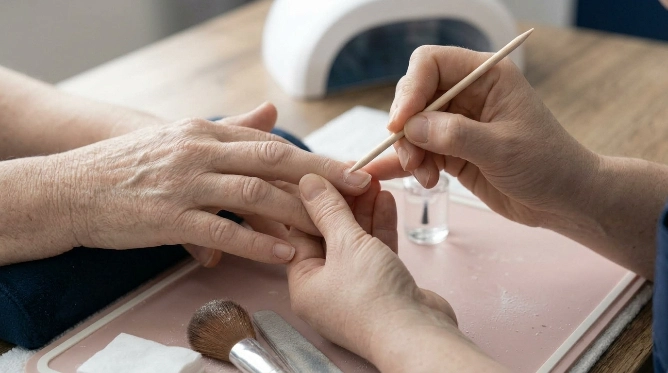
A dedicated dehydrator is the most predictable choice when your nail system requires one. Don’t substitute another chemical unless the manufacturer confirms that it is suitable.
You may see alcohol or acetone suggested online. Both are solvents, but that doesn’t mean every household or cosmetic version is an approved replacement for every nail system.
Why improvised substitutes can be unreliable
- Concentration varies: Some products contain significant water or other additives.
- Residue varies: Fragrances, oils, or conditioning ingredients may remain on the nail.
- Compatibility varies: Your base or adhesive may require a specific preparation product.
- Application differs: A solvent that’s appropriate for removal isn’t automatically appropriate for preparation.
For the same reason, don’t use hand sanitizer, perfume, household cleaner, or skin-care toner as nail dehydrator. Their formulas weren’t designed for this job.
If you don’t have the recommended prep product, check your nail system’s instructions before improvising. That approach is safer than assuming every fast-drying liquid works the same way.
Why Are My Nails Still Lifting After Primer?
Primer cannot fix every cause of lifting. If retention is poor even with primer, examine the entire preparation and application process.
I like to troubleshoot from the nail plate upward. That prevents the common mistake of adding stronger prep chemicals when the real issue is somewhere else.
Common reasons for lifting
- Invisible cuticle remains: Non-living tissue on the nail plate can interfere with adhesion.
- Dust remains: Filing residue creates a barrier beneath the product.
- The nail was touched: Skin oil can return after dehydration.
- Product touched skin: Gel or acrylic attached to skin can lift as the nail grows.
- Coats are too thick: Thick gel layers may not cure as the manufacturer intended.
- Curing is incorrect: Lamp compatibility, placement, and cure time matter for light-cured products.
- Products are incompatible: Mixing prep, base, and enhancement systems can create unpredictable results.
- The free edge is stressed: Length or structure may not suit the wearer’s daily use.
Look at where the lifting begins. Cuticle-area lifting suggests different problems from separation at the free edge.
Don’t keep increasing primer simply because retention is poor. Too much product can create its own application problems.
How Can You Use Primer and Dehydrator Safely?
Keep nail-prep products on the nail plate and away from surrounding skin whenever the instructions require it. Nail primers and enhancement chemicals can irritate skin or trigger allergic reactions in some people.
The OSHA nail-salon chemical guidance specifically lists methacrylic acid in nail primer as a potential chemical hazard. Ventilation and careful handling are important, especially with frequent exposure.
Use these basic precautions
- Read the label before applying a new prep product.
- Keep liquids away from the cuticle and sidewalls.
- Use small amounts rather than flooding the nail.
- Keep bottles closed when they aren’t being used.
- Work in a ventilated area.
- Don’t intentionally apply nail products to irritated or broken skin.
- Stop using a product if you develop a persistent reaction.
The American Academy of Dermatology’s manicure safety guidance notes that substances used with artificial nails can cause allergic reactions in some people. A rash, itching, swelling, or ongoing irritation shouldn’t be treated as normal nail prep.
Artificial nail products themselves can also irritate surrounding skin. The AAD’s artificial-nail guidance recommends taking nail problems seriously rather than covering damaged nails with enhancements.
Health note: If you develop significant redness, swelling, blistering, pain, nail separation, or a persistent rash, stop using the suspected product and seek advice from a qualified healthcare professional or dermatologist.
Frequently Asked Questions
Can I use primer without dehydrator?
Yes, but only when your nail system allows it. Primer improves adhesion, while dehydrator removes surface oil and moisture, so using primer alone doesn’t automatically perform both functions.
Can I use dehydrator without primer?
Sometimes. Certain gel-polish, base-coat, adhesive, or enhancement systems may require dehydration without a separate primer, so follow the directions for the product applied after preparation.
Is nail primer the same as dehydrator?
No. Nail dehydrator temporarily removes surface moisture and oils, while nail primer promotes adhesion between the prepared natural nail and a compatible enhancement product.
What happens if I put primer before dehydrator?
You may interfere with the primer layer by applying a solvent over it. When both are required, the usual sequence is nail preparation, dehydrator, primer, and then the compatible base or enhancement product.
Should nail dehydrator dry completely before primer?
Yes, a standard dehydrator is generally allowed to flash off before the next preparation step. Follow the bottle directions because exact application instructions can vary between products.
Do I need primer and dehydrator for gel nails?
Not every gel system requires both. Some use dehydrator and primer, while others specify only a prep solution, bonder, or base coat, so the manufacturer’s instructions should determine your routine.
Does using more primer prevent lifting?
No. Excess primer isn’t a reliable fix for lifting and may interfere with correct application. Check nail preparation, contamination, product placement, compatibility, structure, and curing before adding more primer.
Final Takeaway
Nail primer does not normally replace nail dehydrator. Dehydrator prepares the nail by reducing surface moisture and oils, while primer performs a separate adhesion-promoting role.
If your system needs both, use dehydrator first and primer second. If it specifies only one preparation product, follow those instructions rather than adding extra chemicals automatically.
Good retention doesn’t come from the largest number of prep bottles. It comes from clean preparation, compatible products, careful application, and the correct sequence.

