
Can Rubbing Alcohol Be Used as Nail Dehydrator? A Safe Nail Prep Guide

If you are doing gel nails, acrylics, press-ons, or another at-home manicure, you may have wondered whether the rubbing alcohol already in your bathroom cabinet can replace a bottle of nail dehydrator.
The short answer is yes—rubbing alcohol can be used as a temporary nail dehydrator because it helps remove surface oils and evaporates quickly. However, the concentration matters, and it is not always a perfect substitute for a product specifically formulated for nail prep.
Understanding the difference can help you avoid lifting, poor adhesion, irritated skin, and unnecessarily dried-out nails. Here is what rubbing alcohol actually does, which strength works best, how to use it correctly, and when a real nail dehydrator is the smarter choice.
Quick Answer
Can rubbing alcohol be used as nail dehydrator? Yes. Isopropyl rubbing alcohol can remove surface oil and moisture before gel, acrylic, or press-on application. A higher concentration, such as 91%, generally works better than 70% because it contains less water. However, a professional nail dehydrator may provide more consistent adhesion.
What Does a Nail Dehydrator Actually Do?
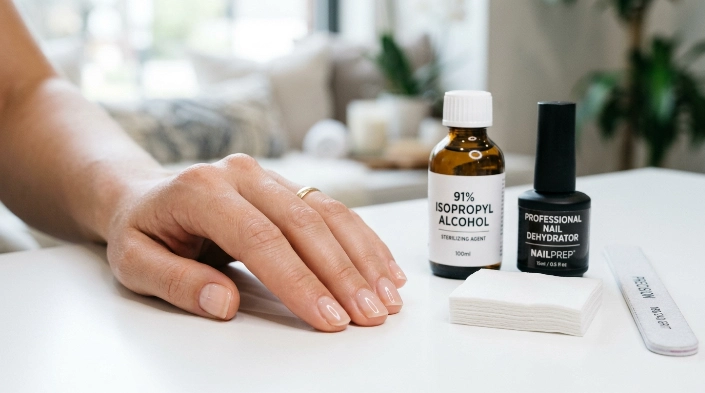
A nail dehydrator is a nail-prep liquid designed to temporarily remove excess moisture and natural oils from the surface of the natural nail.
Your nail plate may look completely clean while still carrying tiny amounts of skin oil, moisturizer, soap residue, or moisture. These can interfere with the way gel base coat, acrylic, nail glue, or other products bond to your nail.
A dehydrator helps create a cleaner, drier surface for adhesion.
It is normally used after shaping and basic nail prep but before primer, base coat, acrylic, builder gel, or nail glue.
A dehydrator is different from a primer. A dehydrator mainly cleans and dries the nail surface, while a nail primer is formulated to help the enhancement product bond to the nail.
This difference is important because rubbing alcohol may perform part of the dehydrator’s job, but it does not automatically replace every prep product in your nail system.
How Rubbing Alcohol Works on Nails
Rubbing alcohol usually contains isopropyl alcohol mixed with water. When you wipe it across a natural nail, the alcohol helps dissolve and lift away oils before quickly evaporating.
That is why the nail often looks temporarily matte and feels less oily afterward.
The commonly available 70% formula contains more water than higher-strength versions. Poison Control notes that household rubbing alcohol is commonly around 70% isopropyl alcohol and also warns that the product can cause dryness or minor irritation with skin exposure. Poison Control’s rubbing alcohol safety guidance
For occasional nail prep on healthy, intact nails, a small amount can be useful. But repeatedly soaking the nails and surrounding skin in alcohol is unnecessary and can make them feel overly dry.
Is 70% or 91% Rubbing Alcohol Better for Nail Prep?
If you have a choice, 91% isopropyl alcohol is usually the better DIY option for nail dehydration.
Why?
A bottle labeled 70% contains approximately 30% water, while 91% contains much less water. Since your goal before applying an enhancement is to reduce moisture and oil, the higher-alcohol formula usually evaporates faster and leaves less water behind.
That does not make 70% alcohol useless. It can still remove surface oils and residue. It is simply not as efficient for dehydration.
| Nail Prep Option | What It Does | Best Use | Main Limitation |
|---|---|---|---|
| 70% rubbing alcohol | Cleans and removes some oil | Basic cleaning and occasional DIY prep | Contains more water |
| 91% rubbing alcohol | Degreases and evaporates quickly | Better DIY dehydrator substitute | Can dry or irritate skin |
| Pure acetone | Strongly removes oil and residue | Occasional nail prep/removal | Can be very drying |
| Professional nail dehydrator | Designed specifically for nail preparation | Gel, acrylic, extensions, long-wear manicures | Extra product to purchase |
| Nail primer | Improves product bonding | After dehydration when required | Not the same as a dehydrator |
Do not assume that stronger always means safer or better. Use only the small amount necessary to wipe the nail plate.
Rubbing Alcohol vs. Professional Nail Dehydrator
Rubbing alcohol and professional dehydrator overlap in purpose, but they are not necessarily identical.
Rubbing Alcohol
Rubbing alcohol is inexpensive, widely available, and useful when you need basic surface cleaning before a manicure.
It may work well for:
- Press-on nail preparation
- Regular polish preparation
- Some gel manicures
- Removing dust or light oily residue
- Occasional emergency substitution
Professional Nail Dehydrator
A dedicated nail dehydrator is formulated specifically for manicure preparation. Depending on the brand, formulas can contain combinations of solvents designed to evaporate quickly and remove oil from the nail surface.
A professional product is usually the more predictable option for:
- Acrylic nails
- Hard gel
- Builder gel
- Gel extensions
- Long-wear press-ons
- Clients or DIY users who repeatedly struggle with lifting
The FDA recommends reading nail-product labels carefully, following directions, paying attention to warnings, and maintaining good ventilation when using nail products. FDA guidance on using nail care products safely
If your gel, acrylic, or extension system specifically tells you to use its dehydrator or primer, following that system is usually safer than improvising.
How to Use Rubbing Alcohol as a Nail Dehydrator
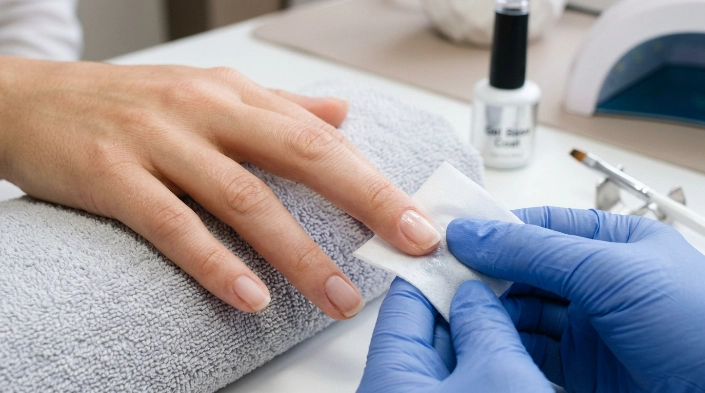
Using more alcohol does not make your manicure adhere better. A light, controlled wipe is all you need.
Here is a simple at-home method.
- Clean your hands first.
Wash away visible dirt, oils, and product residue. Make sure your hands and nails are completely dry before continuing. - Shape the nails.
File the free edge into your desired shape using an appropriate nail file. Avoid aggressively filing the top of your natural nail. - Do your cuticle-area prep gently.
Remove loose dead tissue from the nail plate if needed, but do not cut healthy living skin. The American Academy of Dermatology recommends avoiding cutting or forcefully pushing back cuticles because cuticles help protect against infection. American Academy of Dermatology manicure safety advice - Remove filing dust.
Brush away dust with a clean, dry nail brush. - Apply rubbing alcohol to a lint-free wipe.
You do not need to soak your fingers. Lightly dampen the wipe instead. - Wipe each nail thoroughly.
Pay attention to the sidewalls and areas close to the cuticle without rubbing alcohol excessively onto the skin. - Allow the nails to air-dry.
Alcohol should evaporate quickly. Do not blow on your nails because this can introduce moisture or contamination. - Do not touch the nail surface afterward.
Touching your nails with your fingertips immediately transfers natural skin oils back onto them. - Continue with your manicure system.
Apply primer, base coat, glue, gel, acrylic, or another product according to its manufacturer’s instructions.
Expert Tip: After dehydrating your nails, treat the nail plate like a freshly cleaned surface. Avoid touching your hair, face, phone, or fingertips before applying your base product because even a small amount of oil can work against good adhesion.
Can You Use Rubbing Alcohol Before Gel Polish?
In many cases, yes.
Removing oil from the natural nail before applying gel can help create a cleaner surface. However, gel brands have different prep systems, so the manufacturer’s directions should come first.
There is also an important distinction between using alcohol before the manicure and using alcohol after curing gel.
Some gel systems produce a sticky inhibition layer after curing. Alcohol may be used to remove that tacky residue at the appropriate stage. That does not automatically mean the same alcohol concentration is the manufacturer’s recommended nail dehydrator before application.
If your gel repeatedly lifts around the cuticle or sidewalls, rubbing alcohol alone may not solve the problem. Lifting can also come from:
- Product touching the skin
- Incomplete cuticle-area prep
- Under-curing
- Using an incompatible lamp
- Applying excessively thick coats
- Poorly capped free edges
- Touching the nail after preparation
- Naturally oily nails
- Mixing incompatible product systems
Treat dehydration as one part of good manicure preparation rather than the only factor.
Can You Use Rubbing Alcohol Before Acrylic Nails?
You can use it to clean and degrease the natural nail, but a dedicated dehydrator and the appropriate acrylic primer generally offer more predictable results.
Acrylic adhesion can be demanding. If moisture or oil remains on the nail—or the product is applied improperly—lifting may occur.
Trying to compensate by aggressively buffing the natural nail is not a good solution. Excessive filing can thin the nail plate and leave it sore or sensitive.
The FDA notes that some ingredients used in artificial-nail systems may irritate the skin or cause allergic reactions, particularly when uncured product repeatedly touches the surrounding skin.
For frequent acrylic use, investing in the prep products designed for your acrylic system is generally more sensible than depending entirely on household rubbing alcohol.
What About Press-On Nails?
Rubbing alcohol can be especially useful before press-ons.
Press-on glue and adhesive tabs generally perform better on a surface that is free from hand cream, cuticle oil, soap residue, and natural skin oils.
After sizing and shaping your press-ons:
- Clean the natural nail.
- Lightly wipe it with alcohol.
- Let it completely evaporate.
- Avoid touching the nail plate.
- Apply glue or an adhesive tab immediately afterward.
For many people, this simple step improves adhesion without requiring a complicated manicure-prep routine.
If you use press-ons frequently, give your natural nails breaks when they become thin, sore, peeling, or irritated.
Is Rubbing Alcohol Bad for Your Nails?
Used occasionally and sparingly on healthy nails, rubbing alcohol is unlikely to be a major problem for most people.
The bigger issue is dryness and irritation from repeated or excessive exposure.
Alcohol removes oils effectively—which is exactly why it works for nail prep. But those natural oils also help keep the surrounding skin comfortable.
Frequent exposure may leave the skin around your nails feeling:
- Dry
- Tight
- Rough
- Flaky
- Burning or stinging
- Red or irritated
Avoid applying rubbing alcohol to broken, cracked, inflamed, or freshly cut skin.
After your manicure is completely finished, applying cuticle oil or hand moisturizer can help restore comfort to the surrounding skin. Keep oil away from the nail plate before applying your manicure products because it can interfere with adhesion.
Safety and Hygiene Considerations
Rubbing alcohol is familiar, but it still deserves careful handling.
First, it is flammable. Keep the bottle away from candles, cigarettes, open flames, heating tools, and other ignition sources.
Work in an area with reasonable ventilation, especially when alcohol is being used alongside acetone, gel products, acrylic liquids, or other manicure chemicals.
Keep the original container closed when you are not using it and store it safely away from children.
For hygienic application, pour or dispense a small amount onto a clean lint-free pad rather than repeatedly contaminating the bottle with used tools.
If you share manicure supplies with other people, avoid sharing used files, buffers, or other porous items that cannot be adequately cleaned.
When Rubbing Alcohol Is Not the Best Choice
A household substitute is convenient, but there are situations where a proper nail product makes more sense.
Choose a professional dehydrator when:
- You regularly wear acrylic or hard gel.
- Your manicures frequently lift.
- Your nail system specifically requires one.
- You have naturally oily nail plates.
- You are preparing extensions that need maximum adhesion.
- You want consistent results across repeated manicures.
Rubbing alcohol is most useful as a simple DIY backup, not necessarily a permanent replacement for every professional prep system.
Cost matters too. Household alcohol is generally inexpensive and can serve multiple purposes, while buying another nail product adds to your manicure budget. If you only wear occasional press-ons, alcohol may be sufficient. If you spend money on professional-quality gel or acrylic products, the matching dehydrator is usually a small investment compared with having an entire set lift early.
Common Mistakes to Avoid
- Using hand sanitizer instead of rubbing alcohol. Sanitizers may contain moisturizers, fragrances, or other ingredients that can leave residue behind.
- Using 70% alcohol and immediately applying product while the nail is still damp. Let it fully evaporate.
- Touching nails after dehydration. Your fingertips can put oil straight back onto the nail.
- Soaking the fingers in alcohol. A light wipe is enough.
- Applying alcohol over cuts or irritated skin. This can sting and worsen irritation.
- Assuming dehydrator and primer are the same thing. They perform different jobs.
- Over-filing because your manicure keeps lifting. Thinning the natural nail is not a safe fix for poor adhesion.
- Ignoring manufacturer instructions. Gel, acrylic, dip, and extension systems can have very different preparation requirements.
- Working near an open flame. Isopropyl alcohol is flammable.
When to See a Nail Technician or Dermatologist
A DIY prep problem and a nail-health problem are not the same thing.
If your only issue is manicure lifting, a qualified nail technician may be able to evaluate your prep technique, nail condition, product compatibility, and application method.
However, stop applying cosmetic nail products and consider seeing a dermatologist if you notice persistent:
- Redness or swelling around a nail
- Significant pain or tenderness
- Pus or drainage
- Green, yellow, brown, or unusual discoloration
- Nail separation from the nail bed
- Itching, blistering, or burning after nail products
- Thickening or crumbling
- A new or changing dark streak
The American Academy of Dermatology notes that changes such as nail lifting, redness and swelling, or unusual discoloration can sometimes indicate infection or another condition that deserves professional evaluation. AAD guidance on nail changes that need attention
Do not try to treat a suspected infection simply by wiping the nail with rubbing alcohol. A dehydrator or disinfectant is not a substitute for diagnosis or medical treatment.
FAQs
Can I use 70% rubbing alcohol instead of nail dehydrator?
Yes, 70% rubbing alcohol can remove surface oils and help clean the nail before a manicure. However, it contains more water than higher concentrations, so 91% isopropyl alcohol is generally a better choice when your main goal is nail dehydration.
Is 91% alcohol good for nail prep?
Yes. A small amount of 91% isopropyl alcohol on a lint-free wipe can be useful for removing oils before gel, press-ons, or other nail products. Allow it to evaporate completely before applying anything else.
Can hand sanitizer work as a nail dehydrator?
It is not a good substitute. Hand sanitizer may contain moisturizers, aloe, thickeners, fragrances, or other ingredients that can leave residue on your nails and interfere with adhesion.
Can I use acetone instead of rubbing alcohol?
Pure acetone can remove oil and moisture very effectively, but it is also quite drying. Use it sparingly and avoid irritated or damaged skin. If your nail system includes a dedicated dehydrator, that product is usually the more predictable option.
Do I need both dehydrator and primer?
Not every manicure system requires both. Dehydrator removes moisture and oil, while primer improves bonding between the natural nail and enhancement product. Follow the instructions provided with your gel, acrylic, or extension system.
Does rubbing alcohol make press-on nails last longer?
It may help. Removing oil from the natural nail gives glue or adhesive tabs a cleaner surface to bond to. Proper sizing, adequate glue coverage, avoiding water immediately after application, and good prep technique also affect wear time.
Can rubbing alcohol treat nail fungus?
No. Rubbing alcohol used for manicure prep should not be considered a treatment for nail fungus. If you have persistent discoloration, thickening, crumbling, separation, pain, or other suspicious nail changes, see a healthcare professional for an accurate diagnosis.
Conclusion
So, can rubbing alcohol be used as nail dehydrator? Yes—especially as an occasional at-home substitute. Isopropyl alcohol removes surface oils and evaporates quickly, making it useful before press-ons, gel, polish, and some other manicure applications.
If possible, choose a higher concentration such as 91% rather than 70%, use only a small amount, let it evaporate completely, and avoid getting it repeatedly on irritated skin.
For acrylics, extensions, persistent lifting, or product systems that specify dedicated prep liquids, a professional nail dehydrator remains the more reliable choice.
Most importantly, never solve an adhesion problem by aggressively filing or repeatedly exposing unhealthy nails to strong chemicals. Clean gently, follow your product instructions, protect the surrounding skin, and give damaged or irritated nails the professional attention they need.

