Can You Use a Nail File on a Baby? Safe Baby Nail Care Guide

If your baby has tiny, sharp fingernails, trimming them can feel harder than it looks. Those nails grow fast, babies move without warning, and ordinary nail clippers can feel much too close to delicate skin.
So, can you use a nail file on a baby? Yes. In fact, a soft nail file or fine emery board can be one of the easiest ways to shorten and smooth a baby’s nails. The key is using a gentle file, working slowly, and never filing the surrounding skin.
This guide explains which nail files are suitable, how to file baby nails safely, what to avoid, and when a nail problem needs medical attention.
Quick Answer
Yes, you can use a nail file on a baby. Choose a soft, fine emery board or nail file made for babies and use light, slow strokes. Filing can be especially useful for newborns because their nails are thin and soft. Avoid coarse adult files, aggressive pressure, and filing irritated skin.
Is It Safe to Use a Nail File on a Baby?
For most healthy babies, gentle nail filing is a practical nail-care option.
The American Academy of Pediatrics’ HealthyChildren.org nail-care guidance says a soft emery board can be used for children’s nails, along with baby nail clippers or blunt-nosed scissors.
The MedlinePlus guide to newborn nail care also recommends using a nail file or emery board to shorten and smooth a baby’s nails and describes filing as a particularly safe method.
A nail file has one big advantage: it does not have a sharp cutting edge. That can make it less intimidating when caring for a newborn who may suddenly move a hand or foot.
Still, a file can irritate skin if it is too rough or used with too much pressure. Gentle technique matters just as much as the tool itself.
Why Baby Nails Need Regular Care
Baby fingernails can become surprisingly sharp.
Newborns have limited control over their hands. Long or jagged nails can therefore scratch the face or other areas of skin. HealthyChildren.org notes that newborn nails may need trimming or filing regularly because they can grow quickly and lead to scratches.
You do not need to make every nail extremely short. The goal is simply to:
- Remove sharp edges.
- Keep nails comfortably short.
- Prevent snagging.
- Reduce accidental scratching.
- Avoid damaging the surrounding skin.
Toenails may need attention less often than fingernails.
What Kind of Nail File Can You Use on a Baby?
Not every nail file is equally suitable for baby nails.
Soft Emery Board
A fine, soft emery board is one of the simplest choices.
The UK’s NHS guidance for caring for a newborn specifically suggests a fine emery board as an alternative to cutting baby nails.
Choose one that feels smooth rather than coarse.
A very rough board can remove too much nail quickly and may scrape nearby skin.
Baby Nail File
Some files are specifically designed for infants. They usually have a much finer surface than heavy adult manicure files.
A baby-specific file can be easier to control because its size and abrasive surface are intended for small, thin nails.
Electric Baby Nail File
Electric baby nail files use rotating or vibrating filing pads rather than cutting blades.
They may be convenient when:
- You dislike using clippers.
- Your baby’s nails grow quickly.
- You want consistent filing pressure.
- Your baby stays calm during gentle filing.
However, an electric file is not automatically safer just because it is marketed for babies.
Use only the pad intended for your baby’s age, select the lowest appropriate setting, and follow the manufacturer’s instructions. Stop immediately if the skin becomes red or irritated.
Adult Metal or Very Coarse Files
These are generally poor choices for a baby’s thin nails.
A coarse file can remove nail material too quickly. Metal files may also have edges or abrasive surfaces that are harder to control around tiny fingertips.
A soft, fine file is the safer practical choice.
Baby Nail File Options Compared
| Tool | Best Use | Ease of Control | Relative Cost | Durability | Main Limitation |
|---|---|---|---|---|---|
| Fine emery board | Newborn nail smoothing | Very easy | Low | Low to moderate | Wears out |
| Baby nail file | Routine filing | Easy | Low | Moderate | Takes time |
| Electric baby file | Frequent nail care | Easy once learned | Higher | High | Pads need replacing |
| Baby nail clippers | Faster trimming | Moderate | Low | High | Can cut skin |
| Baby safety scissors | Controlled trimming | Moderate | Low | High | Requires a steady hand |
| Coarse adult file | Not recommended for routine baby use | Poor | Low | High | Can be too abrasive |
For many parents, a simple fine emery board is enough. More expensive equipment is not necessary for healthy baby nails.
How to File a Baby’s Nails Safely
The safest routine is simple.
1. Choose a Calm Time
Do not try to file nails while your baby is waving or kicking.
Good times may include:
- While the baby is sleeping.
- When the baby is relaxed.
- After feeding when the baby is calm.
- With another adult gently holding the hand.
Both NHS and MedlinePlus guidance suggest caring for baby nails when the baby is asleep or relaxed because reduced movement makes the process easier and safer.
2. Wash Your Hands
Clean hands reduce the chance of transferring dirt or germs around the baby’s nails.
Make sure the nail file is also clean and in good condition.
Do not use an old file that has been shared with other people.
3. Hold One Finger Securely
Support the baby’s finger between your fingers without squeezing it.
Try to separate the fingertip slightly from the nail edge. This helps you see where the nail ends and the skin begins.
4. Use Very Light Pressure
Gently file the sharp part of the nail.
You do not need to press hard.
A baby’s nail is much thinner than an adult nail, so a few gentle passes may be enough.
5. Smooth the Corners
Look for sharp corners that could scratch the baby’s face.
Round off rough fingernail edges gently rather than trying to create a perfect manicure shape.
For toenails, avoid aggressively rounding or digging into the corners.
6. Stop Before the Nail Becomes Too Short
You only need to remove the sharp free edge.
Do not file down into the pink attached part of the nail.
If the fingertip starts looking red, stop.
7. Check the Skin
After filing, run your fingertip very gently across the nail edge.
It should feel smooth without obvious sharp points.
Also check that the skin surrounding the nail has not been scraped.
Should You File Newborn Nails Instead of Cutting Them?
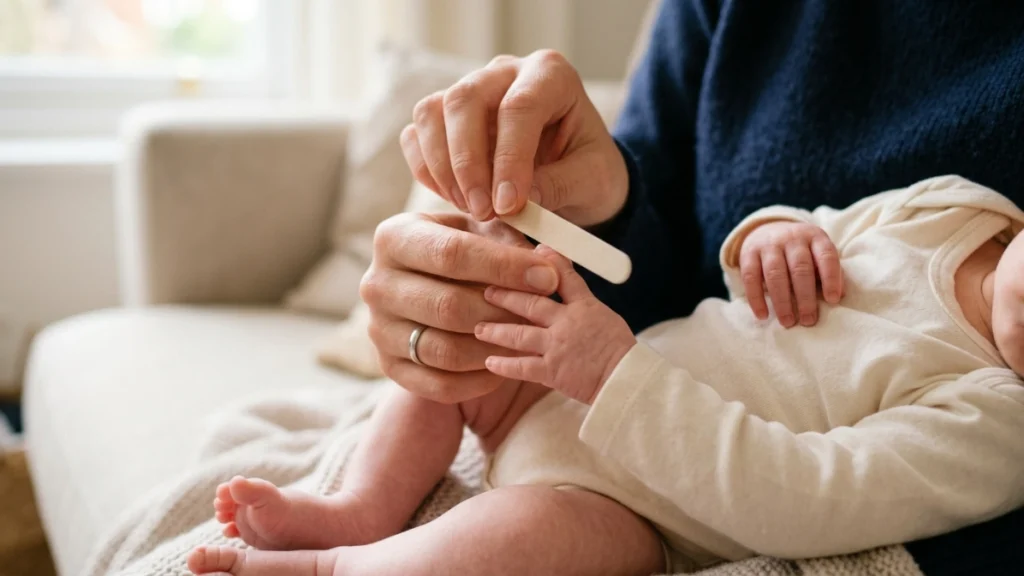
Filing can be an excellent option for newborns.
Newborn nails tend to be soft and small. It can be difficult to see exactly where the nail ends and the fingertip begins.
That makes some parents uncomfortable using clippers.
A soft file removes the sharp edge gradually instead of cutting through the nail in one motion.
Filing May Be Better When:
- Your baby moves suddenly.
- You are nervous about clippers.
- Only the nail corners are sharp.
- The nails are thin and soft.
- You only need minor smoothing.
Clippers May Be More Practical When:
- Nails have become fairly long.
- Filing every nail takes too much time.
- You can clearly see the nail edge.
- Your baby stays very still.
You can also combine the methods. Trim a long nail carefully with baby clippers and then use a soft file to remove sharp edges.
Can You File a Baby’s Nails Every Day?
There is usually no reason to follow a strict daily schedule.
Check the nails regularly and smooth them whenever they become sharp enough to scratch.
Some babies need more frequent fingernail care than others.
Do not keep filing a nail simply because you can see a white edge. Over-filing may leave the nail or surrounding skin sensitive.
File only as much as necessary.
Expert Tip: Use your fingertip to feel the baby’s nail edge before filing. If it already feels smooth and is not catching or scratching, leave it alone. More filing does not make the nail healthier.
Can a Nail File Hurt a Baby?
Yes, if it is used incorrectly.
A soft file is low risk, but it is still an abrasive surface.
Problems can occur if you:
- Rub the skin repeatedly.
- Use a very coarse file.
- Apply heavy pressure.
- File the nail extremely short.
- Continue after redness appears.
- Use a damaged or dirty file.
- File when the baby is moving excessively.
Stop immediately if your baby appears uncomfortable or you notice skin irritation.
What If You Accidentally File the Skin?
Minor surface irritation can happen, especially when a baby suddenly moves.
Stop filing and inspect the area.
If the skin is only mildly pink and unbroken, avoid further filing until it has returned to normal.
If you accidentally cause a cut or bleeding, apply gentle direct pressure with clean gauze or cloth. HealthyChildren.org advises direct pressure for minor cuts and recommends keeping the pressure in place rather than repeatedly lifting the cloth to check the wound.
If the injury is deep, continues bleeding, involves the nail bed, or you are unsure about its severity, contact your baby’s healthcare professional.
Manual Nail File vs Electric Baby Nail File
Both can work, but neither is necessary in every household.
Manual Files
Manual files are:
- Inexpensive.
- Quiet.
- Easy to carry.
- Simple to replace.
- Easy to control stroke by stroke.
The main disadvantage is time. Filing several nails can take longer than trimming them.
Electric Files
Electric files may make routine care faster once you become comfortable using one.
However, they also:
- Cost more.
- Require charging or batteries.
- Need replacement filing pads.
- Can remove nail faster than expected.
- Depend on correct speed and pad selection.
For a newborn, simplicity can be a benefit. A fine manual emery board gives you direct control over every movement.
Hygiene Matters When Filing Baby Nails
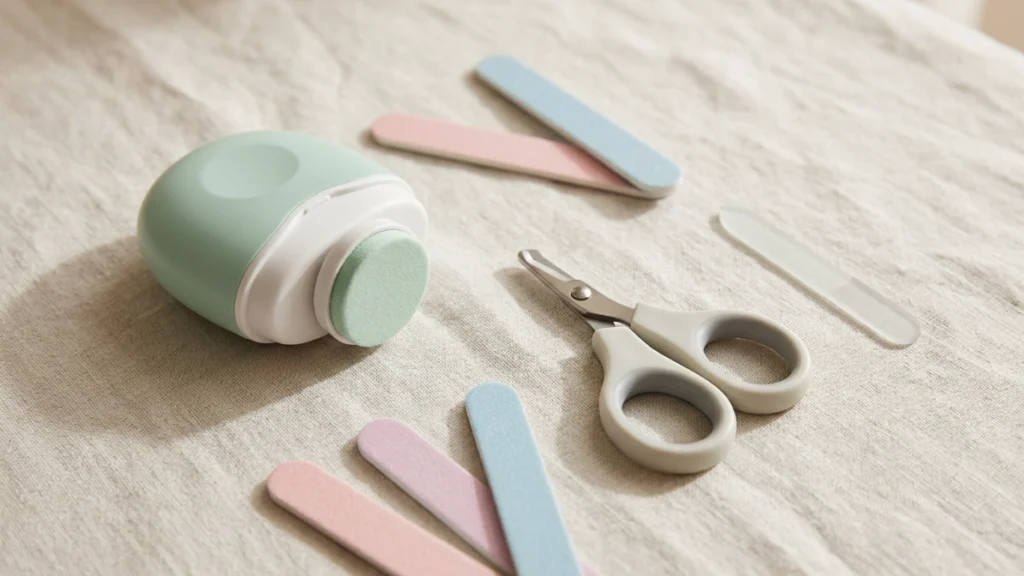
Baby nail-care tools should be kept clean.
Do not casually share files between family members, especially if someone has a nail or skin infection.
Disposable emery boards are inexpensive enough to replace when they become dirty, damaged, or worn.
For reusable tools:
- Follow the manufacturer’s cleaning directions.
- Let the tool dry completely.
- Store it somewhere clean and dry.
- Replace damaged filing surfaces.
- Keep the baby’s grooming tools separate when possible.
This is particularly important if anyone in the household has an active nail infection.
Common Mistakes to Avoid
Baby nail care does not need to be complicated. Most problems come from trying to do too much.
Avoid these common mistakes:
- Using a coarse adult file. Baby nails need very gentle abrasion.
- Filing quickly. Slow movements offer better control.
- Filing while the baby is actively moving. Wait for a calmer moment.
- Applying heavy pressure. Baby nails are thin.
- Trying to remove every white part of the nail. Shorter is not always better.
- Filing surrounding skin. Keep the abrasive surface on the nail.
- Using damaged files. Rough or broken edges can scratch skin.
- Sharing nail tools. Keep the baby’s tools clean.
- Ignoring redness or swelling. These may indicate more than a grooming problem.
- Trying to treat an abnormal nail with filing alone. Nail changes sometimes need medical assessment.
Warning Signs to Watch Around Baby Nails
Normal baby nails can look thin and flexible. But certain changes deserve closer attention.
Watch for:
- Increasing redness around a nail.
- Swelling.
- Warm skin.
- Pus or drainage.
- Significant tenderness.
- Persistent bleeding.
- A nail lifting away from the nail bed.
- A deeper cut around the fingertip.
- Redness that keeps spreading.
A painful, red, swollen area around a nail can be a sign of paronychia, an infection of the tissue surrounding the nail. MedlinePlus information on paronychia notes that pus can also occur with bacterial infection.
Do not try to file, cut, drain, or treat an infected-looking area as if it were a normal manicure problem.
When to See a Nail Technician or Dermatologist
For a baby, a nail technician is generally not the right person to assess redness, swelling, bleeding, unusual nail changes, or possible infection.
Routine baby nail grooming can normally be handled at home.
If something looks medically abnormal, contact the baby’s pediatrician or other healthcare professional. A dermatologist may be appropriate if the pediatrician believes the nail or surrounding skin needs specialist evaluation.
Seek medical advice when:
- Redness is getting worse.
- The fingertip becomes swollen.
- Pus appears.
- The area seems painful.
- The nail is damaged or partly detached.
- A cut looks deep.
- Bleeding will not stop with appropriate pressure.
- Nail changes continue without a clear reason.
A salon should not be used as a substitute for medical care.
Is a Baby Nail File Worth Buying?
Usually, you do not need an expensive nail-care system.
A basic soft emery board can work very well.
Consider spending more on a baby-specific or electric nail file only if it makes regular care easier for you.
Think about:
Safety: Can you control the tool easily?
Quality: Is the abrasive surface smooth and appropriate for baby nails?
Durability: Disposable boards wear out quickly, while reusable systems last longer.
Cost: Manual files generally have the lowest upfront cost. Electric systems cost more and may need replacement attachments.
Convenience: The best tool is the one you can use calmly and correctly.
A premium device does not compensate for aggressive filing or poor technique.
FAQs
Can you use nail file on baby nails from birth?
A soft, fine emery board can be used to gently smooth newborn nails. Work slowly and only remove sharp edges. MedlinePlus and NHS guidance both recognize filing as an option for newborn nail care.
What nail file is safest for babies?
A soft, fine emery board or baby-specific nail file is a good choice. Avoid very coarse files because newborn nails are thin and delicate.
Is filing baby nails better than clipping?
Neither method is always better. Filing gives you gradual control and avoids a cutting blade. Clippers are faster when nails become longer. Many parents use both methods depending on the situation.
Can I use my own nail file on my baby?
It is better to use a clean, fine file reserved for your baby. Adult files may be too coarse, and sharing personal grooming tools is not ideal from a hygiene standpoint.
Can I use an electric nail file on a newborn?
A baby-specific electric file may be used if its manufacturer says it is suitable for newborns. Use the correct attachment, a gentle setting, and minimal pressure. Stop if the surrounding skin becomes irritated.
How often should I file my baby’s nails?
Check them regularly and file when they become long, rough, or sharp. There is no need to file healthy nails every day if they are already smooth.
What should I do if my baby’s nail becomes red after filing?
Stop filing and monitor the area. Mild surface irritation may settle, but worsening redness, swelling, warmth, pain, drainage, or pus should be assessed by a healthcare professional.
Conclusion
So, can you use a nail file on a baby? Yes. A soft, fine nail file or emery board is a practical way to shorten sharp baby nails without using a cutting blade.
Keep the process simple. Choose a gentle file, wait until your baby is calm, support each finger carefully, and use very light pressure. Stop once the nail feels smooth rather than trying to make it as short as possible.
Avoid coarse adult files, aggressive filing, shared tools, and filing irritated or infected-looking skin. If you notice persistent redness, swelling, pus, significant bleeding, or unusual nail changes, skip the DIY grooming and contact your baby’s healthcare professional.
Choose the nail-care method that gives you the most control, and make gentle, regular care your priority.