
Can You Use Nail Files on Cats? A Safe Guide to Filing Cat Claws

If your cat’s claws feel extra sharp, you may wonder whether the nail file sitting in your manicure kit could solve the problem. Can you use nail files on cats, or could filing hurt their claws?
The short answer is yes, in some situations. A fine nail file can gently smooth a sharp claw tip, especially after trimming. However, filing usually is not the easiest or fastest way to shorten a cat’s claws.
Cats have sensitive living tissue called the quick inside each claw. Any trimming or filing needs to stay safely away from it. Your cat’s comfort matters too.
This guide explains when filing can work, which tools are safer, how to file a claw carefully, and when you should leave nail care to a veterinarian or professional pet groomer.
Quick Answer
Yes, you can use nail files on cats, but filing works best for gently smoothing sharp edges rather than shortening long claws. Use a fine, clean file and work only on the clear pointed tip. Never file near the pink quick, and stop immediately if your cat becomes stressed, struggles, or shows pain.
Can You Really Use a Nail File on a Cat?
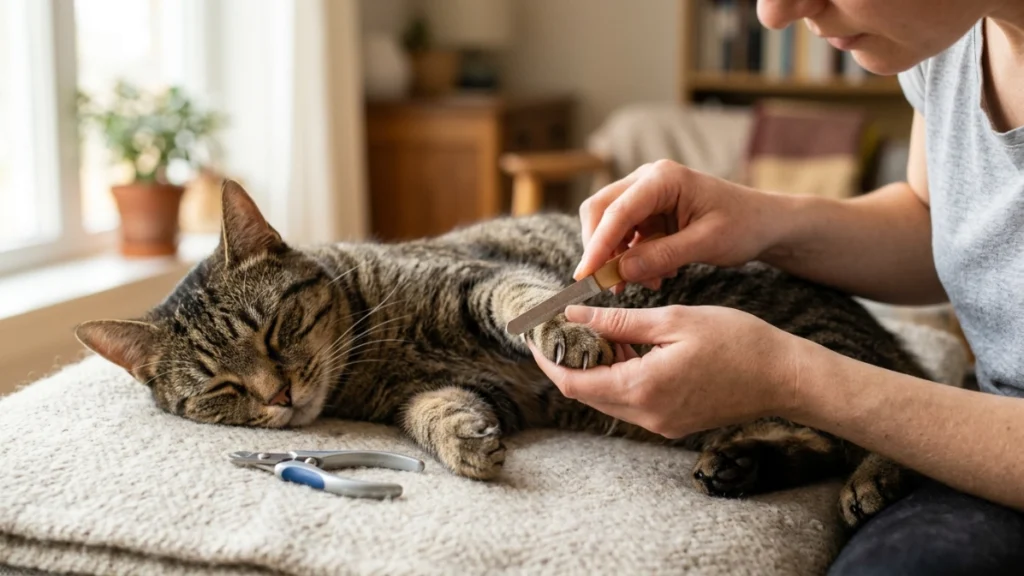
A nail file can be used carefully on the hard outer portion of a healthy cat claw.
The important distinction is that you are filing the dead keratin at the claw tip, not the living tissue farther inside the nail. The quick contains nerves and blood vessels, so getting too close can cause pain and bleeding.
Veterinary guidance normally focuses on cat nail clippers rather than ordinary manicure files. The VCA guide to trimming a cat’s nails recommends extending the claw carefully so you can see where you are working and removing only the appropriate tip.
A manual file can still be useful when:
- One claw has a rough edge after trimming.
- You want to take the sharpest point off a claw.
- Your cat tolerates gentle filing better than clipping.
- You need to smooth a small snag on an otherwise healthy claw.
- You want more gradual control than one quick clip provides.
However, if several claws are long, ordinary filing can take too much time. Your cat may become impatient long before you finish.
Nail File vs. Clippers vs. Grinder for Cats
Different tools serve slightly different purposes.
| Tool | Best For | Speed | Noise | Main Limitation |
|---|---|---|---|---|
| Fine manual nail file | Smoothing sharp or rough tips | Slow | Silent | Takes time to shorten claws |
| Cat nail clippers | Regular claw trimming | Fast | Very quiet | Requires careful positioning |
| Pet nail grinder | Gradual shortening and smoothing | Moderate | Makes sound/vibration | Some cats dislike the sensation |
| Scratching post | Natural scratching behavior | Ongoing | Silent | Does not replace nail checks or trimming when needed |
For routine maintenance, cat-specific clippers are often the simplest choice. The ASPCA’s cat grooming guidance advises trimming only the sharp tip and introducing the process gradually so the cat remains comfortable.
A pet nail grinder is another option. It works more like an electric nail file, gradually wearing the claw down rather than cutting through it at once. Some cats tolerate this well, while others are frightened by the sound or vibration. PetMD notes that grinders can gradually file a cat’s nails, although noise may be stressful for some cats.
Is a Human Nail File Safe for Cats?
A simple fine-grit emery board may be suitable for lightly smoothing a healthy claw tip.
That does not mean every human manicure tool is appropriate.
Avoid using a very coarse or aggressive file. You do not need to grind through a large portion of the claw. Filing should be gentle and limited to the sharp, clear tip.
Also avoid files covered in nail polish residue, acetone, oils, creams, or other cosmetic products.
If you regularly plan to maintain your cat’s claws, a tool designed specifically for pets is generally more practical.
Can You Use a Metal Nail File?
A metal file is harder and less forgiving than a soft emery board. It can also feel awkward around a tiny moving paw.
For a quick touch-up, a fine disposable emery board gives you more gentle control. If you have only a coarse metal file available, it is better to wait and use an appropriate grooming tool rather than trying to force the process.
Why the Quick Matters
Before doing anything to your cat’s claws, learn what the quick looks like.
A cat claw contains an outer keratin layer surrounding sensitive tissue. On many light-colored claws, you can see a pink area inside. That is the quick.
According to the Cornell Feline Health Center’s claw-trimming guidance, the quick contains blood vessels and nerve endings and should be avoided during trimming.
Only work on the pointed portion beyond the quick.
Filing too far can cause:
- Pain
- Bleeding
- Paw sensitivity
- Fear of future grooming
- Struggling or defensive behavior
If you cannot confidently identify where it is safe to stop, have your veterinarian demonstrate claw trimming before attempting more at home.
How to File a Cat’s Claws Safely
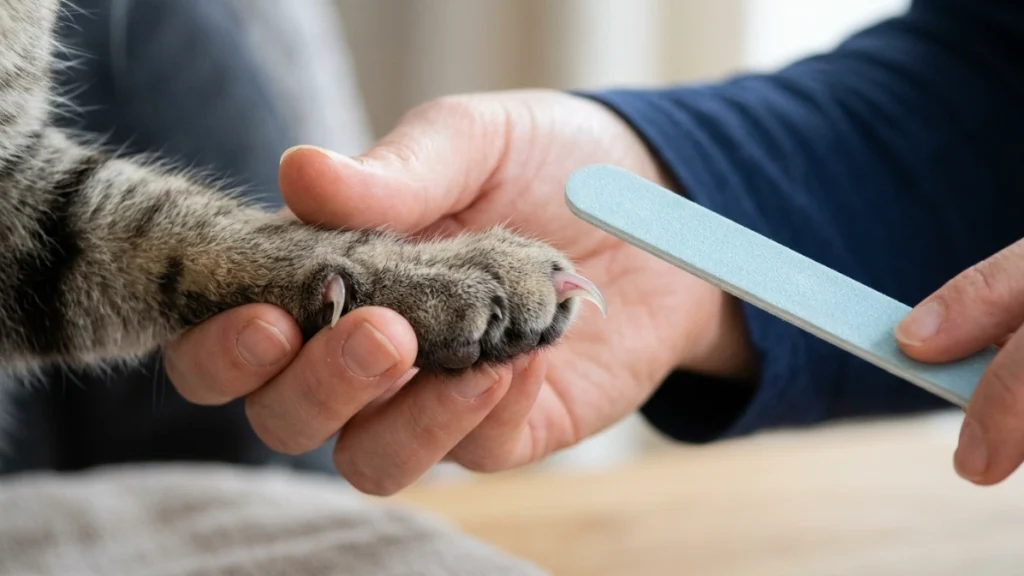
The goal is not to give your cat a miniature human manicure. You are simply smoothing a small amount from the sharp tip.
1. Choose a Calm Time
Wait until your cat is relaxed.
Good opportunities may include after a meal, during a quiet cuddle session, or when your cat is sleepy.
Do not chase your cat around the house with a nail file. Starting with stress makes the entire experience harder.
2. Let Your Cat Investigate the File
Place the file nearby and allow your cat to sniff it.
Touch the file briefly while giving a favorite treat. This can help make the object less unusual.
With grooming, gradual familiarity is often more useful than restraint.
3. Handle the Paw First
Before filing anything, gently touch and massage your cat’s paw.
Press lightly on the paw pad so one claw extends.
If your cat immediately pulls away, do not squeeze harder.
Practice paw handling for a few seconds at a time over several sessions if necessary.
4. Find the Quick
Look carefully at the extended claw in good light.
The transparent, narrow hook at the end is the area you want to work on. Stay well away from the pink living tissue.
If you cannot see the quick clearly, be especially conservative.
5. File Only the Sharp Tip
Hold the paw steadily without squeezing.
Use a fine file and make a few gentle strokes across the pointed end. Remove only enough material to soften the needle-like tip or smooth a rough edge.
There is no need to create a perfectly rounded manicure shape.
6. Stop After One or Two Claws if Needed
Your cat does not need to finish a complete “manicure” in one session.
The ASPCA specifically recommends starting slowly with claw trimming rather than expecting a cat to tolerate every claw immediately.
If your cat becomes restless, stop.
You can always continue another day.
7. Reward Your Cat
Finish with praise, a treat, playtime, or another reward your cat enjoys.
This helps build a more positive association with future paw handling.
Expert Tip
Expert Tip: If your cat’s claws are already the right length but feel sharp after clipping, use the file only as a finishing tool. Two or three gentle strokes may be enough. Trying to file every claw significantly shorter can make the session unnecessarily long and stressful.
When Filing Makes More Sense Than Clipping
Although clippers are usually faster, a file can be useful in a few specific situations.
Smoothing a Jagged Edge
Sometimes a clip leaves a slightly rough or uneven edge.
A few gentle passes with a fine file can smooth it so the claw is less likely to catch on fabric.
Removing Only a Tiny Amount
If a claw does not really need shortening but has a needle-sharp point, filing gives you gradual control.
Helping an Owner Who Feels Nervous About Clippers
Some people worry about removing too much claw in one cut.
A file removes material more slowly. That can make the process feel easier to control, provided your cat tolerates the extra handling time.
However, filing slowly does not eliminate the quick. You still need to know where to stop.
When a Nail File Is Not the Right Tool
A nail file should not be used to solve every claw problem.
Very Long or Overgrown Claws
Trying to shorten severely overgrown claws with a small manicure file can take far too long.
Older cats deserve special attention because they may scratch less frequently and can develop overgrown claws. Cornell recommends checking senior cats’ nails regularly and trimming when necessary.
A Claw Growing Into the Paw Pad
Do not try to file an embedded claw yourself.
A claw that has curled into the paw pad may cause pain, wounds, inflammation, or infection. Veterinary care is the safer choice.
Broken or Torn Claws
A cracked, bleeding, partially detached, or badly damaged claw is not a cosmetic problem.
Trying to file it may increase pain or worsen the injury.
Swollen or Painful Toes
Stop home grooming if you notice:
- Redness
- Swelling
- Discharge
- Bad odor
- Bleeding
- Limping
- Constant licking of one paw
- A claw sitting at an unusual angle
- Obvious pain when the toe is touched
Those signs deserve veterinary attention.
What If You Accidentally Hit the Quick?
Even careful owners can make mistakes.
If you accidentally reach the quick, the claw may bleed and your cat may suddenly pull away.
Stay calm.
For minor bleeding from a claw, pressure can help. VCA’s veterinary first-aid guidance also notes that styptic products may be used for bleeding from a broken nail.
If bleeding is heavy, continues despite pressure, or the claw appears torn or badly injured, contact your veterinarian.
Do not immediately continue filing the remaining claws. Your cat has already had an unpleasant experience and needs a break.
Hygiene Matters When Using Nail Files on Cats
A nail file touches your cat’s claws and potentially the skin around the paw, so basic hygiene matters.
Use a clean tool.
If you use a reusable file, clean it according to its material and manufacturer instructions. Disposable emery boards are inexpensive enough that using a fresh one can be easier.
Do not share a visibly dirty file between animals.
Wash your hands after handling your cat, especially if you have been dealing with a damaged claw, wound, or discharge. The CDC’s healthy pet guidance for cats recommends handwashing after handling and caring for cats as a basic hygiene measure.
Never apply human nail polish, remover, acetone, gel products, or manicure chemicals to your cat’s claws as part of filing.
Does a Scratching Post Replace Nail Filing?
No.
Scratching is natural and important for cats. It allows them to stretch, mark their environment, and shed older outer claw layers.
Providing sturdy scratching surfaces can support healthy natural claw behavior.
But scratching does not guarantee that every claw stays at a safe length. Some cats still need periodic trimming, particularly indoor cats, senior cats, and cats whose claws frequently snag.
ASPCA guidance recommends regular claw trimming alongside appropriate scratching opportunities.
Give your cat scratching posts even if you trim or file the claws.
Cost and Tool Considerations
You do not need an elaborate grooming setup to maintain healthy cat claws.
A basic manual file is generally the simplest type of tool and has no motor, charging requirement, noise, or vibration.
Cat nail clippers are also relatively simple and are faster when actual shortening is needed.
A pet nail grinder costs more than a basic manual tool and requires power or charging, but it gives gradual control and can both shorten and smooth the claw.
When choosing between them, think about more than price.
Consider:
- Your cat’s temperament: Does noise or vibration cause fear?
- Your confidence: Are you comfortable making one precise cut?
- Claw condition: Are you smoothing a tip or shortening significant length?
- Handling tolerance: Will your cat calmly allow enough time for filing?
- Visibility: Can you clearly see the quick?
- Hygiene: Can the tool be kept clean?
- Noise: Would a silent manual option be easier for your cat?
The best tool is the one that lets you work safely without turning routine grooming into a struggle.
Common Mistakes to Avoid
Using a file sounds simple, but a few mistakes can make claw care harder.
- Filing too close to the quick. Stay on the clear pointed tip.
- Trying to shorten very long claws with a tiny file. Use appropriate cat clippers or professional help instead.
- Holding the cat down forcefully. Struggling increases the chance of accidental injury.
- Using a dirty manicure file. Keep grooming tools clean.
- Using a very coarse file aggressively. Gentle filing is enough.
- Finishing every claw at all costs. One or two claws per session is fine.
- Ignoring your cat’s body language. Tail lashing, repeated pulling away, growling, flattened ears, or attempts to escape mean it is time to stop.
- Filing damaged or infected-looking claws. These need professional evaluation.
- Assuming scratching posts eliminate the need for claw checks. Continue inspecting your cat’s nails regularly.
When to See a Nail Technician or Dermatologist
For a human nail concern, a licensed nail technician or dermatologist may be appropriate. For your cat, however, neither should be treating the claws.
A veterinarian is the correct professional for painful, injured, infected, abnormal, or severely overgrown cat claws.
An experienced pet groomer may be able to perform routine claw trimming for a healthy cat, depending on the cat’s temperament and local services.
Contact your veterinarian if:
- A claw is growing into a paw pad.
- A nail is split deeply or partially torn off.
- Bleeding will not stop.
- The paw is swollen.
- You notice pus or discharge.
- Your cat is limping.
- The claw or surrounding tissue smells unusual.
- Your cat cries or reacts strongly when a toe is touched.
- Your cat becomes impossible to handle safely for claw maintenance.
If your cat strongly resists nail care, do not turn it into a wrestling match. VCA recommends stopping when a cat resists restraint and asking a veterinarian for help or an in-person demonstration.
FAQs
Can I use a regular human nail file on my cat?
Yes, a clean, fine human nail file can be used to gently smooth the clear sharp tip of a healthy claw. It is less practical for shortening several long claws.
Is it better to file or clip cat nails?
Clippers are generally faster for shortening claws. Filing is useful for tiny adjustments or smoothing rough edges. The better option depends on how much claw needs removing and what your cat tolerates.
Can I use an electric nail file on my cat?
A pet nail grinder can gradually file down cat claws. However, the sound and vibration may frighten some cats, so introduce the tool slowly and never force your cat to tolerate it.
Will filing a cat’s nails hurt?
Filing only the hard outer tip should not hurt. Filing into the quick can be painful and may cause bleeding, so always keep a safe distance from the sensitive inner tissue.
How often should a cat’s claws be checked?
Check them regularly rather than waiting until they become extremely long. Individual needs vary with age, activity, scratching habits, and lifestyle. Senior cats may require closer monitoring because they can scratch less frequently.
Can scratching posts keep my cat’s nails short?
Scratching helps maintain natural claw condition and sheds outer claw layers, but it may not keep every claw sufficiently short. Regular inspection and occasional trimming may still be necessary.
What should I do if my cat hates having its paws touched?
Start with very short paw-handling sessions and pair them with treats or another reward. Do not begin clipping or filing until your cat can tolerate basic paw handling. If your cat becomes highly distressed or aggressive, ask your veterinarian for help.
Conclusion
So, can you use nail files on cats? Yes—but think of a manual nail file as a gentle finishing tool rather than the best method for every claw-trimming job.
A clean, fine file can soften a sharp point or smooth a rough edge. For significantly long claws, cat-specific clippers or a suitable pet grinder are usually more practical.
Whatever tool you choose, the same rules matter: identify the quick, remove only a small amount, keep the experience calm, and never force a struggling cat.
Check your cat’s paws regularly, provide good scratching surfaces, and pay attention to swelling, bleeding, broken claws, pain, or other changes. If something looks wrong—or you simply do not feel confident doing the job safely—ask your veterinarian to examine the paw or demonstrate proper claw care.
A few careful minutes of safe maintenance are far better than turning nail care into a stressful battle for you and your cat.

