What Are the Most Common Toenail Trimming Mistakes?

Toenail trimming sounds like one of the easiest parts of a beauty routine. Yet a small mistake—cutting too short, rounding the corners, using dull clippers, or digging at the sides—can leave you with tenderness, jagged edges, or an ingrown toenail.
So, what are the most common toenail trimming mistakes? Most problems come from removing too much nail, using the wrong technique, or trying to fix a nail problem with aggressive DIY trimming.
The good news is that healthy toenail maintenance does not need to be complicated. Below, you’ll learn which trimming habits to avoid, how to choose safer tools, how to file toenails properly, and when a nail needs professional attention instead of another cut.
Quick Answer
The most common toenail trimming mistakes are cutting nails too short, rounding or digging into the corners, using dull or dirty tools, forcing clippers through thick nails, and over-filing rough edges. For routine care, trim toenails mostly straight across, leave a small visible edge, smooth sharp spots gently, and stop if you notice pain, swelling, bleeding, or infection.
Why Toenail Trimming Technique Matters
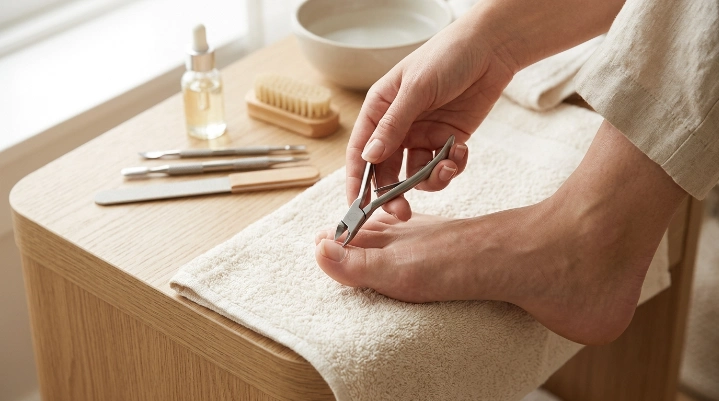
A neat pedicure is not only about how polished your toes look. The way you trim the nail can affect the skin around it and the direction in which the nail grows.
The American Academy of Dermatology’s nail-trimming guidance recommends cutting toenails straight across to help reduce the risk of ingrown nails. It also recommends smoothing rough edges with a nail file rather than leaving them jagged.
Your toenail includes an attached nail plate and a free edge—the lighter portion extending beyond the skin. Ideally, routine trimming removes excess free edge without cutting deeply into the attached nail or surrounding skin.
Overly aggressive trimming can cause:
- Tender or exposed skin
- Sharp nail corners
- Splitting or peeling
- Bleeding
- Irritation along the nail sides
- Increased risk of an ingrown edge
- More opportunity for germs to enter broken skin
The goal is therefore controlled maintenance, not cutting away as much nail as possible.
The Most Common Toenail Trimming Mistakes
1. Cutting Toenails Too Short
This is probably the classic toenail-trimming mistake.
A very short nail may look tidy immediately after your pedicure, but removing too much can leave the skin at the tip of the toe unprotected. Pressure from socks and shoes can then push against the growing nail.
The Mayo Clinic’s guidance on ingrown toenails lists cutting toenails too short as one habit that can contribute to ingrown nails. Mayo Clinic recommends keeping toenails at a moderate length rather than trimming them extremely close.
A safer approach: Leave a small visible free edge instead of trying to make the nail completely flush with the skin.
2. Rounding the Corners Too Deeply
Rounded toenails can look pretty, particularly if you like a softly curved pedicure shape. But toenails should not be shaped exactly like fingernails.
Cutting deeply down the corners can remove the nail edge that would normally grow forward over the skin. As the nail grows back, the corner may press into the side of the toe.
You do not have to leave painfully sharp square corners. Trim mostly straight across, then lightly file a sharp point if it catches on socks.
Avoid digging your clipper into the nail groove just to create a more rounded look.
3. Trying to Cut the Entire Nail in One Big Clip
If your toenail is wide or thick, positioning a clipper across most of the nail and squeezing hard can be tempting.
That big cut gives you less control.
Instead, make several smaller cuts from one side toward the other. Small cuts are especially useful on thick toenails because they require less force and make it easier to see exactly where the blades are going.
The same principle applies to nail nippers: controlled bites are safer than forcing the tool through the entire nail.
4. Forcing Clippers Through a Thick or Hard Toenail
Some toenails are naturally thicker than others. Nails can also become harder with age, repeated pressure from shoes, trauma, or certain nail conditions.
If the clipper will not close comfortably, do not keep squeezing harder.
The Mayo Clinic’s guide to trimming thickened toenails recommends softening thick nails first and making small straight cuts. It also notes that nail nippers can offer better control for thickened nails.
Trimming after a shower can make a hard nail easier to manage. If a nail is extremely thick, painful, crumbling, or difficult to cut safely, professional evaluation is smarter than forcing the tool.
5. Using Dull, Rusty, or Poorly Aligned Clippers
A good toenail clipper should cut the nail cleanly.
If the blades are dull or misaligned, you may notice that the clipper:
- Crushes instead of cuts
- Leaves shredded edges
- Requires excessive pressure
- Slips sideways
- Leaves part of the nail attached
- Feels unstable in your hand
Stainless-steel clippers are popular because they are durable and relatively easy to clean, but material alone does not guarantee quality. Blade alignment and sharpness matter just as much.
Replace a tool that has become rusty, damaged, loose, or difficult to control.
6. Using Fingernail Clippers on Thick Toenails
A small fingernail clipper may work on thin toenails, but it is often too narrow or lightly built for thick big-toe nails.
Trying to compensate by squeezing harder can reduce control.
A dedicated toenail clipper generally has a larger cutting jaw and more leverage. For particularly thick nails, a well-controlled toenail nipper may be easier.
Choose the tool based on the thickness and shape of your nail, not simply what happens to be in your manicure bag.
7. Tearing or Picking Off the Nail Instead of Cutting It
A cracked corner can be annoying, especially when it keeps catching on a sock.
But pulling or tearing that loose section may rip farther into the nail than you intended.
Instead:
- Use clean clippers to remove only the clearly loose free edge.
- Smooth the remaining rough spot gently.
- Stop if the split extends into attached nail or causes pain.
If you see bleeding or a deep crack, treat it as an injury rather than a cosmetic shaping problem.
8. Filing Too Aggressively
A nail file is useful after trimming, but more filing is not automatically better.
Aggressive back-and-forth filing with a very coarse surface can leave the edge rough or thin. A file should smooth the edge—not grind deeply into the side of the toe or drastically thin the nail plate.
For routine natural toenails, use controlled pressure and stop when the edge feels smooth.
Expert Tip: If a toenail corner feels sharp after a straight-across trim, gently smooth that point with a nail file instead of cutting deeper down the side of the nail.
9. Cutting the Cuticle or Surrounding Skin
The cuticle is the thin protective seal of skin near the base of the nail. It helps protect the area where new nail grows.
Toenail trimming should focus on the nail’s free edge—not removing healthy skin around it.
The American Academy of Dermatology advises leaving cuticles alone because damaging this protective area can make it easier for germs to enter.
If you have dry skin around your toenails, moisturizer is generally a gentler cosmetic option than clipping away healthy skin.
10. Using Dirty or Shared Nail Tools
Even perfect trimming technique can become less hygienic if the tools are dirty.
Nail debris and skin material can collect around clipper blades and files. Clean reusable tools according to their material and dry them thoroughly before storage.
The American Academy of Dermatology’s nail-fungus prevention advice also recommends not sharing personal nail-grooming tools such as clippers.
Disposable porous emery boards are more difficult to thoroughly clean than washable glass or certain reusable files. Replace them when they become dirty, damaged, or excessively worn.
Choosing the Right Toenail Trimming Tools
You do not need an expensive professional pedicure kit. You need tools that match your nails and that you can control comfortably.
| Tool | Best For | What to Look For | Cost Level | Main Caution |
|---|---|---|---|---|
| Standard toenail clipper | Normal everyday toenails | Sharp, aligned stainless-steel blades and secure lever | Low | Avoid forcing it through thick nails |
| Wide-jaw clipper | Thicker toenails | Wider opening and comfortable grip | Low to moderate | Large jaws require careful positioning |
| Nail nipper | Very thick or hard nails | Strong blades, spring action, non-slip handles | Moderate | Sharp tips can injure skin if poorly controlled |
| Fine nail file | Smoothing edges | Comfortable grit and washable material if reusable | Low | Do not aggressively thin the nail |
| Glass or crystal file | Gentle finishing | Smooth abrasive surface and easy cleaning | Moderate | Can break if dropped |
More expensive does not automatically mean safer. Control, sharpness, fit, and cleanliness matter more than luxury packaging.
People with sensitive skin should also be careful with rough abrasive files around the surrounding skin. If filing causes burning, tenderness, or visible irritation, stop.
How to Trim Toenails More Safely
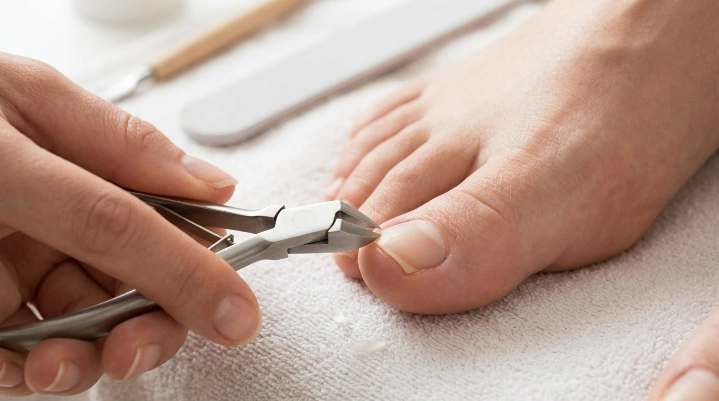
For ordinary, healthy toenails, a simple routine is usually enough.
Step 1: Clean Your Feet and Tools
Wash your feet and make sure your clipper or nipper is clean.
Toenails that are particularly hard may be easier to trim after bathing or showering.
Step 2: Inspect the Nail First
Before clipping, check for:
- Significant redness
- Swelling
- Bleeding
- Pus or drainage
- Severe tenderness
- Deep cracks
- Nail separation
- New unexplained discoloration
These are reasons to slow down rather than trying to make the nail cosmetically perfect.
Step 3: Position the Clipper Across the Free Edge
Aim to remove excess nail extending beyond the toe.
Do not slide the clipper deeply down either side.
Step 4: Make Small, Controlled Cuts
Work gradually across the nail rather than making one aggressive cut.
Keep the overall edge mostly straight.
Step 5: Check the Length
A very close trim is unnecessary. Leave enough nail to protect the skin underneath.
Step 6: File Only What Needs Smoothing
Use a nail file to soften jagged or sharp areas.
Do not keep filing simply because the nail is not perfectly symmetrical.
Step 7: Clean and Dry Your Tools
Remove nail debris, clean reusable tools appropriately, dry them completely, and store them somewhere dry.
A clean kit makes your next pedicure easier too.
DIY Toenail Care vs. a Salon Visit
For healthy nails, home trimming is inexpensive, convenient, and usually easy to learn.
A professional pedicure can be helpful when you have difficulty reaching your feet or simply want cosmetic shaping and polish application. A licensed nail technician may also have better tools for thick but otherwise healthy nails.
However, a nail salon is not a substitute for medical care.
A nail technician should not be expected to diagnose a fungal infection, treat a badly ingrown nail, or manage unexplained swelling, drainage, or significant pain.
If you do visit a salon, speak up about how you want your toenails trimmed. Ask for a mostly straight-across shape rather than deeply rounded corners.
Common Mistakes to Avoid
Keep this quick checklist in mind before your next at-home pedicure:
- Don’t cut toenails extremely short.
- Don’t carve deeply into the corners.
- Don’t tear a broken nail with your fingers.
- Don’t force dull clippers through a thick nail.
- Don’t use excessive pressure with a nail file.
- Don’t cut healthy cuticle or surrounding skin.
- Don’t share personal clippers or nail files.
- Don’t continue trimming when the area starts bleeding.
- Don’t try to disguise a painful or infected nail with aggressive filing.
- Don’t assume every thick or discolored toenail is only a cosmetic issue.
A good trim should leave your toes feeling comfortable—not sore afterward.
When to See a Nail Technician or Dermatologist
A nail technician can be useful when the issue is primarily cosmetic: routine shaping, polish application, or general maintenance of otherwise healthy nails.
For a painful or abnormal toenail, a dermatologist, podiatrist, or other healthcare professional is the more appropriate choice.
Consider getting medical advice if you notice:
- Increasing redness or swelling
- Pus or other drainage
- Severe or worsening pain
- Skin that feels increasingly inflamed around the nail
- A toenail repeatedly growing into the skin
- Significant thickening or crumbling
- Persistent yellow, green, brown, or black discoloration
- A nail lifting substantially from the nail bed
- Bleeding that does not settle
- A wound that is not healing
Mayo Clinic recommends seeking medical care for severe toe discomfort, pus, or inflammation that appears to be spreading.
If you have diabetes, poor circulation, reduced sensation in your feet, or another condition that makes foot injuries harder to detect or heal, get professional guidance before trying to cut a problem toenail yourself.
DIY grooming has limits. When a nail hurts, looks infected, or has changed significantly, identifying the cause is more important than making it look prettier.
FAQs
Should toenails be cut straight across?
Generally, yes. A mostly straight-across cut helps preserve the nail corners and may reduce the chance of an ingrown edge. You can gently file a sharp point afterward without carving deeply into the side.
How short should I cut my toenails?
Avoid cutting them completely flush with the skin. Leave a small visible free edge so the nail continues growing forward rather than exposing tender skin at the toe tip.
Is it better to cut toenails wet or dry?
Normal toenails can often be trimmed dry, but hard or thick toenails may be easier to cut after a bath or shower when they have softened slightly. Always make controlled cuts.
Can I use a nail file instead of toenail clippers?
Yes, particularly for small amounts of maintenance or smoothing. Filing can give you excellent control, but removing a large amount of length may take longer. Avoid aggressive filing against sensitive skin.
Why do my toenails hurt after I cut them?
You may have trimmed them too short, cut into the side, irritated the skin, or created a sharp edge. Mild tenderness should improve, but increasing pain, redness, swelling, or drainage needs closer attention.
How often should I trim my toenails?
There is no perfect schedule for everyone because toenails grow at different speeds. Trim when the free edge becomes long enough to catch, press against shoes, or become uncomfortable. Avoid trimming simply because a calendar says it is time.
What should I do if I accidentally cut my toenail too deep?
Stop trimming. Clean the area gently and protect any broken skin. Avoid cutting more nail to “even it out.” Seek medical advice if there is significant bleeding, worsening pain, swelling, pus, or other signs of infection.
Conclusion
Most toenail problems caused by grooming come from doing too much, not too little. Cutting nails excessively short, rounding the corners deeply, forcing unsuitable tools, over-filing, and ignoring hygiene are among the most common toenail trimming mistakes.
For everyday care, keep it simple: use clean, sharp tools, make small controlled cuts, trim mostly straight across, leave a little free edge, and gently file any rough spots.
Most importantly, know when to stop. A painful, swollen, infected, unusually thick, or significantly discolored toenail deserves more than another DIY pedicure.
Use your next trim as maintenance rather than a makeover—protect the nail first, then perfect the appearance.