
How Long Does It Take for a Damaged Toenail to Grow Out?

A damaged toenail can be frustrating, especially when the bruise, split, ridge, or discolored area seems to stay in the same place for weeks. You may be wondering, how long does it take for a damaged toenail to grow out?
For most people, the answer is measured in months rather than weeks. Toenails grow much more slowly than fingernails, and replacing an entire toenail may take around 12 to 18 months. A smaller damaged area can disappear sooner if it is already closer to the tip.
The important part is knowing what normal regrowth looks like, how to protect the new nail, and when a damaged-looking toenail may actually be showing signs of infection or a deeper nail injury.
Quick Answer
A damaged toenail may take a few months to grow out if the damage is near the tip, while damage close to the base can take much longer. A completely replaced toenail generally needs about 12 to 18 months to grow from the base to the tip.
How Long Does a Damaged Toenail Usually Take to Grow Out?
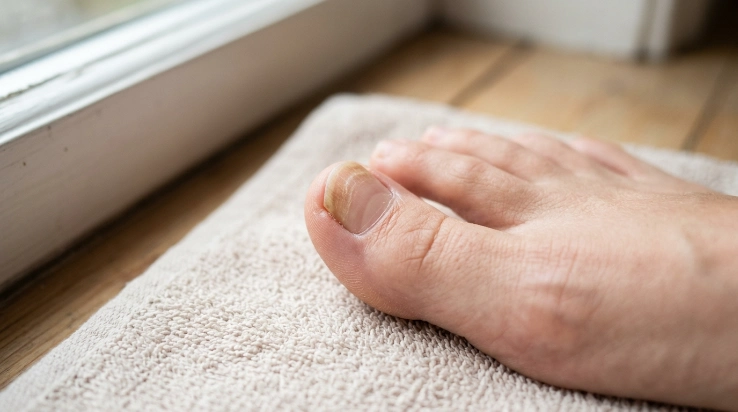
Toenails typically grow around 1.5 millimeters per month, although the exact speed varies from person to person. Cleveland Clinic notes that full toenail regrowth generally takes about 12 to 18 months. Cleveland Clinic’s guide to nail anatomy and growth
That does not mean every damaged toenail will look damaged for a year and a half.
The timeline depends heavily on where the damage is located.
| Where the Damage Is | What You May Notice | Approximate Outlook |
|---|---|---|
| Near the free edge or tip | Small chip, peeling, roughness | Often grows out relatively quickly |
| Middle of the toenail | Ridge, bruise, discoloration | May take several months |
| Near the base | Deep ridge, discoloration, distorted growth | Can take many months |
| Entire nail lost | New nail must replace the full plate | Often around 12–18 months |
| Nail matrix injured | Nail may grow unevenly or slowly | Timeline and appearance can vary |
These are general expectations, not deadlines. Toenail growth varies with age, health, circulation, repeated pressure, the type of injury, and whether the nail-producing area was damaged.
The NHS similarly explains that a toenail lost after an injury may take up to 18 months to grow back fully. NHS guidance on common nail problems
Why Does Toenail Damage Take So Long to Disappear?
The damaged part of a toenail does not repair itself the way a small cut in your skin does.
Your visible toenail is the nail plate. New nail cells are produced mainly in an area underneath the skin at the base of the nail called the nail matrix.
As the matrix produces new nail, the existing nail plate gradually moves forward. That means a bruise, ridge, or damaged section usually has to physically travel toward the end of your toe before you can safely trim or file it away.
Cleveland Clinic describes the nail matrix as the structure responsible for producing the nail plate. Injuries to this area can interfere with normal nail growth and may cause ridges, splitting, discoloration, soreness, or texture changes. Cleveland Clinic’s explanation of the nail matrix
Damage Near the Tip Usually Grows Out Faster
If you chipped the edge of your toenail or damaged it during a pedicure, you may only need to wait for a small amount of new growth.
Once the damaged portion extends beyond the end of the toe, you can gradually trim and smooth it.
Damage Near the Base Takes Much Longer
A dark spot, dent, or ridge beginning close to the cuticle has almost the entire length of the toenail to travel.
This is why a toenail injury from months ago can still be visible even after the toe itself feels completely normal.
What Kind of Toenail Damage Do You Have?
“Damaged toenail” can describe several different problems.
Common examples include:
- A chipped or split nail
- A toenail bruised after being stubbed
- Black or dark discoloration after trauma
- A nail partially lifting from the nail bed
- Damage caused by tight shoes
- Over-filing during a pedicure
- Cutting the toenail too short
- Repeated pressure from running or sports
- Surface damage after polish removal
- A nail that fell off after an injury
A minor surface problem is very different from an injury involving the nail bed or matrix.
If the nail was crushed, deeply torn, severely lifted, or lost completely, the recovery process deserves more caution.
What Affects How Fast a Damaged Toenail Grows Out?
Two people can injure their toenails on the same day and see very different regrowth timelines.
1. Location of the Damage
Damage near the tip has less distance to travel.
Damage near the cuticle or matrix must move almost the entire length of the toenail before disappearing.
2. Severity of the Injury
A small chip may have little effect on new nail production.
A crushing injury can affect the tissue underneath the nail and potentially interfere with how smoothly the new nail forms.
3. Nail Matrix Damage
The matrix is especially important because it produces the nail plate.
Minor matrix damage may cause temporary ridges or unevenness. More significant injuries can cause longer-lasting changes.
4. Repeated Shoe Pressure
A toenail cannot recover easily if it keeps hitting the front of a shoe.
Check whether your everyday shoes, heels, running shoes, or work footwear press against the affected toe.
5. Your General Health
Nail growth can vary with age and health. Certain illnesses, medications, infections, and circulation problems may also affect how nails look or grow.
If your toenail seems to have stopped growing or has developed an unexplained change, avoid assuming that it simply needs more time.
How to Care for a Damaged Toenail While It Grows Out
You cannot safely force a toenail to grow dramatically faster, but you can protect the new growth.
1. Stop Picking at the Damaged Area
A peeling or lifted section can be tempting to pull.
Do not rip it off.
Pulling on an attached piece of nail may tear healthy nail or injure the skin underneath.
If a loose edge is catching on socks, carefully trim only what is clearly free and painless to remove.
2. Keep the Nail at a Comfortable Length
Extremely long damaged toenails are more likely to catch or experience additional pressure.
However, do not cut deeply into the corners or trim the nail painfully short.
The American Academy of Dermatology recommends trimming toenails straight across to help reduce the chance of an ingrown toenail. American Academy of Dermatology nail-trimming guidance
3. Smooth Rough Edges With a Nail File
A nail file is useful when the damaged edge is jagged but does not need major trimming.
Use a gentle file and remove only enough material to smooth the snag.
Do not aggressively file the top of a bruised, lifted, unusually thick, painful, or discolored toenail just to make it look normal.
Filing cannot repair damage underneath the nail plate.
4. Wear Shoes With Enough Toe Room
Your toes should not repeatedly hit the front of your shoes.
If the affected nail becomes sore after walking, exercising, or wearing a particular pair of shoes, additional pressure may be slowing your progress or causing repeated trauma.
5. Keep Nail Tools Clean
Toenail clippers, nippers, and reusable files should be kept clean and dry.
AAD guidance also recommends disinfecting nail trimming tools and avoiding shared grooming equipment.
Do not share toenail tools between family members if someone has a suspected fungal nail infection.
6. Watch the New Growth at the Base
Instead of checking whether the damaged spot has disappeared, look at the base of the nail.
A gradually widening band of healthier-looking nail behind the damaged area can be a reassuring sign that the old damage is moving outward.
What Nail File Is Best for a Damaged Toenail?

For a mildly damaged natural toenail, the goal is smoothing, not aggressive removal.
A fine or medium-fine manual file is usually easier to control than a very coarse file.
Glass or Crystal File
A good-quality glass file can work well for gently smoothing small rough edges.
It is reusable and can usually be cleaned more easily than a disposable emery board.
Emery Board
An emery board is affordable and convenient.
Choose a relatively gentle surface for a natural toenail rather than an extremely coarse file intended for artificial nail enhancements.
Replace it when it becomes worn, dirty, or difficult to clean.
Metal File
Metal files are durable, but some can feel harsh on thin, peeling, or already damaged natural nails.
Use light pressure if you choose one.
Electric Nail File
An electric file can remove nail material very quickly.
That speed is exactly why beginners should be cautious. Excessive pressure, inappropriate bits, or staying in one spot too long can thin the nail and potentially create heat or discomfort.
For a straightforward damaged natural toenail, a simple manual file is often easier to control.
Expert Tip: If the nail is painful, lifting, bleeding, or changing color for an unclear reason, stop thinking about which file will make it look better. Protect the toe first and determine why the nail is damaged.
DIY Care vs. Professional Help
| Situation | DIY Nail Care | Nail Technician | Healthcare Professional |
|---|---|---|---|
| Small rough edge | Usually reasonable | Optional | Usually unnecessary |
| Minor cosmetic unevenness | Gentle filing may help | Can help cosmetically | Usually unnecessary |
| Thick nail that is hard to cut | Use caution | May help if otherwise healthy | Consider a podiatrist if difficult or abnormal |
| Painful or swollen skin | Do not aggressively file | Not appropriate for treatment | Recommended |
| Pus or worsening redness | No cosmetic treatment | Avoid salon service | Medical evaluation |
| Deep injury or major nail lifting | Protect rather than reshape | Not a cosmetic issue | Seek professional guidance |
| Unexplained dark change | Do not file it away | Not appropriate to diagnose | Dermatologist evaluation |
Basic home care has a relatively low tool cost because you may only need a suitable clipper and file.
Professional pedicure costs vary by location and service level, while healthcare costs depend on the provider, insurance, testing, and treatment required. Do not choose a salon instead of medical evaluation simply because it costs less when the problem looks infected or medically abnormal.
Common Mistakes to Avoid
While waiting for a damaged toenail to grow out, avoid these common mistakes:
- Filing aggressively to remove discoloration. The discoloration may be underneath the surface.
- Pulling off a partially attached nail. This can injure sensitive tissue.
- Cutting deeply into the corners. This may increase irritation or ingrown-nail risk.
- Using an e-file at high speed on a natural nail. It is easy to remove too much nail.
- Sharing nail files and clippers. This can spread organisms associated with nail infections.
- Covering every abnormal nail with polish and ignoring it. Cosmetic coverage can make changes harder to monitor.
- Expecting results in a few weeks. Toenail growth is naturally slow.
- Continuing to wear shoes that repeatedly hit the damaged toe.
The best strategy is usually boring but effective: protect the nail, keep the edge smooth, prevent repeated injury, and give healthy new growth time to move forward.
When to See a Nail Technician or Dermatologist
A nail technician can help with cosmetic shaping and routine grooming of an otherwise healthy toenail.
A nail technician should not be expected to diagnose or treat an infection, serious injury, or unexplained nail abnormality.
Consider professional medical advice if:
- Pain is severe or getting worse.
- Redness or swelling is spreading.
- The toe feels unusually warm.
- Pus or other drainage appears.
- Bleeding will not stop.
- Much of the nail has torn away.
- The toe was crushed or may be broken.
- The nail becomes very thick or crumbly.
- You develop an unexplained dark streak or color change.
- The nail repeatedly grows back distorted.
- The nail stops showing normal new growth.
- You are unsure whether the problem is trauma or infection.
MedlinePlus advises seeking care for concerning nail injuries and lists increasing redness, pain, swelling, pus, fever, and bleeding that does not stop among reasons to contact a healthcare provider. MedlinePlus guidance on nail injuries
The NHS also advises medical evaluation when surrounding skin becomes sore, red, swollen, and warm or when a nail changes shape or color without a clear explanation.
FAQs
How long does it take for a damaged big toenail to grow out?
A big toenail may need roughly 12 to 18 months for complete replacement. A damaged section can disappear sooner if it is already partway toward the tip.
How do I know if my damaged toenail is growing normally?
Look for fresh nail gradually appearing from the base. The damaged section should slowly move toward the tip over time. If growth seems to stop completely or the new nail becomes increasingly painful, thick, discolored, or distorted, consider professional evaluation.
Can I file a damaged toenail until the damage disappears?
You can gently smooth a rough free edge, but you should not aggressively thin the nail to remove a bruise, discoloration, or deeper damage. Filing removes nail material; it does not heal injured tissue underneath.
Will a black toenail grow out?
A dark area caused by trauma may gradually move toward the end as the nail grows. However, not every dark toenail is simply a bruise. An unexplained dark spot or streak should be evaluated rather than filed or covered indefinitely.
Can a damaged toenail grow back differently?
Yes. Damage involving the nail matrix can lead to ridges, splitting, thickness changes, or altered nail shape. Minor changes may improve as the matrix recovers, while some significant injuries may cause longer-lasting changes.
Should I put nail polish over a damaged toenail?
If the nail only has a minor cosmetic imperfection and the surrounding skin is healthy, polish may be reasonable. Avoid covering a nail that is painful, draining, badly lifted, or showing unexplained changes that you need to monitor.
Can I make my damaged toenail grow faster?
There is no reliable cosmetic trick that can turn normal slow toenail growth into rapid regrowth. Focus on preventing repeated injury, using comfortable footwear, trimming carefully, and protecting the healthy nail growing from the base.
Conclusion
So, how long does it take for a damaged toenail to grow out? Minor damage near the tip may disappear within a relatively short part of the nail-growth cycle, but deeper damage near the base can remain visible for many months. Replacing an entire toenail commonly takes around 12 to 18 months.
During that time, keep the nail comfortably trimmed, gently smooth rough edges, use clean nail tools, and protect your toe from repeated shoe pressure.
Most importantly, do not treat pain, swelling, drainage, unexplained discoloration, or a serious nail injury as a simple beauty problem. When something does not look or feel right, get the toe checked instead of trying to file the problem away.

