
Do Cats Like Nail Files? Why Cats Are Drawn to Them and What’s Safe

If your cat runs over the moment you start filing your nails, you are not imagining it. Some cats sniff nail files, rub their faces against them, paw at them, or even try to bite and chew them.
So, do cats like nail files? Some cats clearly seem interested in them, but that does not mean a nail file is a safe cat toy. The rough texture, movement, unfamiliar smell, and simple curiosity can all make a nail file interesting.
The important part is knowing when harmless curiosity turns into chewing, swallowing, or another behavior that could cause trouble.
This guide explains why cats may be attracted to nail files, whether different types are safe, what to do if your cat chews one, and how to keep both your nail tools and your cat protected.
Quick Answer
Yes, some cats seem to like nail files because of their rough texture, smell, movement, or simple curiosity. However, nail files are not designed as cat toys. Letting a cat lick, bite, or chew one can create risks from rough edges, broken pieces, coatings, or swallowed material.
Why Do Cats Like Nail Files?
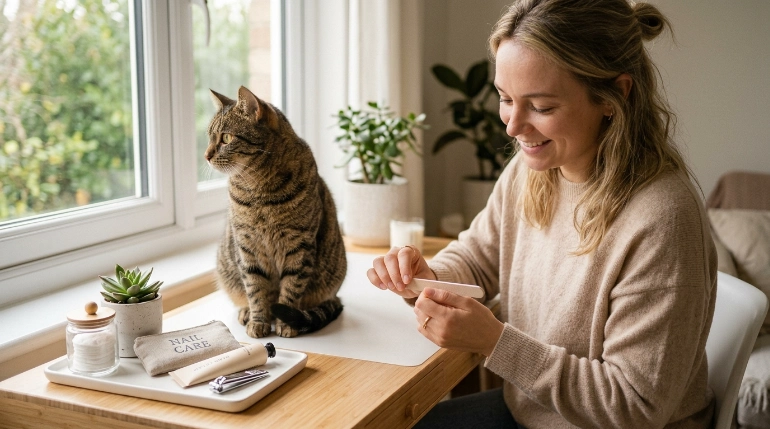
There is no single reason every cat becomes interested in a nail file.
One cat may sniff it once and walk away. Another may hear you filing your nails from across the room and immediately come running.
Cats naturally investigate objects using their nose, paws, mouth, and whiskers. A nail file gives them several unusual sensations at once.
The Rough Texture May Feel Interesting
The surface of an emery board or textured nail file feels very different from most household items.
Cats already have a natural interest in textured surfaces.
According to the Cornell Feline Health Center’s guide to destructive behavior, scratching is a normal feline behavior, and individual cats can have preferences for particular materials and orientations.
That does not mean your cat thinks your nail file is a scratching post. But its gritty surface may simply feel interesting enough to investigate.
Your Cat May Be Curious About the Smell
A used nail file can carry tiny amounts of nail dust, skin oils, lotion, polish residue, or other scents from your hands.
Cats have a very different sense of smell from us.
Something that seems completely odorless to you may still be worth investigating to your cat. If your cat sniffs your file right after you use it, scent may be part of the attraction.
That still does not make licking it a good idea.
The Movement Looks Like a Toy
Think about how you use a nail file.
It moves quickly back and forth. Your fingers move with it. Sometimes the end of the file sticks out from your hand and wiggles.
To a playful cat, that can look much more like a moving toy than a beauty tool.
A kitten may be especially likely to reach for it with a paw.
Stop filing before allowing your cat to approach your hands. A sudden grab could scratch you, damage a nail, or put the file near the cat’s eyes or mouth.
Your Attention Can Make It More Interesting
Cats often become interested in whatever has their person’s attention.
If you are holding an object, looking closely at your hands, and moving it repeatedly, your cat may decide that the object deserves investigation too.
The nail file may not be fascinating on its own.
You may be what makes it fascinating.
Some Cats Simply Like Unusual Objects
Cats can have surprisingly specific preferences.
One may love cardboard.
Another prefers paper bags.
Another steals hair ties.
And yours may apparently have decided that an emery board is the most exciting thing on your vanity.
Individual preferences are normal. What matters is whether your cat is simply sniffing the object or actually trying to chew and swallow it.
Do Cats Like the Texture of Nail Files?
They can.
The scratchy surface of an emery board provides a strong texture that a cat can easily feel against its nose, lips, tongue, or teeth.
You might notice your cat:
- rubbing its cheek against the file
- sniffing the rough side
- licking it
- pawing at it
- biting the end
- trying to carry it away
Rubbing or sniffing is very different from chewing.
Chewing is where I would stop the interaction.
A nail file is made for shaping human nails. It is not manufactured or tested as a chew toy for pets.
Are Nail Files Safe for Cats?
The safest answer is not as toys.
A cat briefly sniffing a clean file is unlikely to be the same concern as a cat aggressively chewing one. Still, I would store nail files where your cat cannot freely play with them.
Different nail file materials also create different concerns.
| Nail File Type | What May Attract a Cat | Main Concern | Best Choice Around Cats |
|---|---|---|---|
| Emery board | Rough texture, light weight, movement | Pieces may tear or be swallowed | Store after use |
| Glass/crystal file | Smooth shape and movement | Can break if dropped or bitten | Keep securely stored |
| Metal file | Texture, smell, cool surface | Hard edges can hurt the mouth | Do not use as a toy |
| Foam/buffer block | Soft, chewable feel | Foam or coating may tear off | Keep out of reach |
| Electric nail file | Sound, vibration, movement | Moving bit, cord, and small parts | Keep cat away during use |
Emery Boards
Emery boards may be especially tempting because they are lightweight and easy for a cat to grab.
But they can wear down, bend, peel, or break.
If pieces start separating, throw the file away rather than leaving it somewhere your cat can find it.
Glass or Crystal Nail Files
Glass files are reusable and usually much harder than disposable emery boards.
They are still not cat toys.
A file could fall from a counter and break. A cat could also knock it onto a hard floor while playing.
Store glass files in their protective case when possible.
Metal Nail Files
A metal file may survive chewing better than cardboard, but that does not make chewing safe.
Its rigid edges and abrasive surface are not intended for a cat’s teeth, gums, or tongue.
Keep it inside your manicure kit when you are finished.
Foam Buffers
Buffer blocks can look surprisingly toy-like.
They are light, easy to carry, and sometimes soft enough for a cat to bite.
The problem is that foam and surface material may come apart.
If your cat likes chewing soft household objects, these deserve extra attention.
Electric Nail Files
An electric file deserves the strictest rule.
Keep your cat away while it is running.
A moving bit can catch fur or contact the nose, paw, tongue, or skin. The cord can also become something a playful cat wants to attack.
Turn the unit off before putting it down.
Why Chewing a Nail File Is Different From Sniffing One
Sniffing is investigation.
Chewing introduces the possibility of swallowing material.
VCA describes pica as persistent ingestion of non-food objects and notes that behavioral and medical factors can contribute to the condition. Their guide to pica in cats lists examples such as plastic, paper, fabric, string, and thread.
One playful bite does not automatically mean your cat has pica.
However, repeated attempts to eat nail files or other non-food objects deserve more attention.
Watch for behavior such as:
- tearing pieces off the file
- swallowing pieces instead of spitting them out
- regularly eating cardboard, plastic, fabric, or paper
- aggressively searching for non-food items
- vomiting after chewing objects
- reduced appetite
- unusual tiredness
- trouble passing stool
- repeated gagging or retching
If you think material has actually been swallowed, contact your veterinarian rather than trying to diagnose the situation at home.
What Should I Do If My Cat Chews a Nail File?
First, remove the nail file.
Then inspect it.
1. See Whether Anything Is Missing
Look at both ends and the abrasive surface.
If a large section, strip, coating, foam piece, or other material is missing, do not assume it was simply dropped somewhere.
Check the surrounding area.
2. Check Your Cat’s Mouth Only If It Is Safe
If your cat is calm, you can look for an obvious loose piece around the front of the mouth.
Do not put your fingers deep into a frightened cat’s mouth.
Do not pull on anything that appears stuck in the throat.
3. Watch Your Cat Closely
Pay attention to behavior, appetite, drinking, vomiting, drooling, and litter box habits.
A cat that swallowed an unknown piece of an object should be discussed with a veterinarian.
4. Save the Damaged File
Do not immediately throw it away if you think something was swallowed.
The remaining file can help you explain its size and material to your veterinary team.
If you still have the packaging, keep that too.
5. Contact a Veterinarian When You Are Concerned
Seek veterinary guidance promptly if your cat swallowed a noticeable piece or develops symptoms afterward.
Do not try to make a cat vomit unless a veterinary professional specifically tells you to do so.
Is It Okay for My Cat to Rub Against a Nail File?
A quick cheek rub is less concerning than chewing, but I still would not deliberately give a nail file to a cat for rubbing.
Cats commonly use rubbing and scratching behaviors as part of scent marking.
Cornell explains that cats deposit scent from glands associated with their paws when scratching, and scratching also helps remove the outer claw sheath.
If your cat seems to love rough textures, give it something designed for feline use instead.
Try:
- a horizontal cardboard scratcher
- a sisal scratching post
- a textured scratching mat
- a sturdy cat tree
- safe interactive toys
- food puzzles
- supervised play
The AVMA’s discussion of indoor cat wellbeing also emphasizes the importance of environmental enrichment for indoor cats.
A proper scratching surface is much easier to replace than a trip to the veterinarian.
Why Does My Cat Lick My Nail File?
Licking may be simple investigation.
Your cat could be responding to scent, texture, or something left on the surface.
However, I would gently take the file away.
A used manicure tool is not something I want repeatedly passing between a person’s nails and a pet’s mouth.
This is partly a hygiene issue and partly a safety issue.
If the file has been exposed to polish, gel dust, acrylic residue, remover, lotion, cuticle products, or other manicure materials, there is even less reason to let a cat lick it.
Keep cosmetic tools and pet toys separate.
Hygiene Matters for You Too
A nail file is a personal-care tool.
Keeping that tool clean matters even without a cat in the picture.
The American Academy of Dermatology recommends keeping nails clean and dry and using appropriate nail-care practices in its healthy nail tips.
If your cat has licked or chewed a disposable emery board, replacing it is usually the simplest option.
For reusable glass or metal files, follow the manufacturer’s cleaning instructions.
Avoid using a pet-contaminated tool on broken skin, irritated cuticles, or an injured nail.
Expert Tip
Expert Tip: Keep one closed manicure pouch or drawer for files, buffers, clippers, and small nail accessories. This protects your tools from pet hair and saliva while also preventing your cat from turning small manicure items into toys.
How to Stop Your Cat From Playing With Nail Files
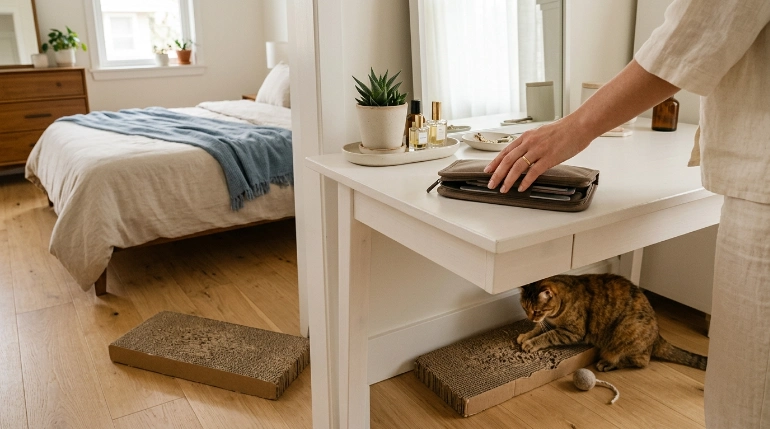
You do not need to punish your cat.
Instead, make the nail file boring and give the cat something better to do.
1. Put the File Away Immediately
Do not leave it on:
- a bedside table
- bathroom counter
- sofa
- floor
- open vanity
- manicure tray
A closed drawer, pouch, or storage box works better.
2. Do Not Turn It Into a Game
It can be tempting to wiggle a nail file when your cat reaches for it.
That teaches the cat something important:
When I attack this object, my person plays with me.
Instead, stop moving the file and put it away.
3. Redirect the Behavior
Offer a real toy.
If your cat likes chasing the moving file, try a wand-style toy.
If it likes the rough texture, try a cardboard or sisal scratcher.
If it likes chewing objects, discuss safe chew-friendly alternatives with your veterinarian.
4. Add More Daily Enrichment
A bored cat may investigate almost everything you touch.
Short play sessions, climbing areas, scratching surfaces, hiding spots, puzzle feeders, and window perches can give curious cats more appropriate outlets.
5. Keep Small Manicure Items Together
Nail files are not the only concern.
Also store away:
- cuticle sticks
- nail tips
- cotton pieces
- toe separators
- small buffer blocks
- nail art decorations
- loose caps
- manicure tool attachments
If an item is small enough to disappear into a cat’s mouth, it should not be left unattended.
Can I Use a Human Nail File on My Cat’s Claws?
I would not make a human nail file your default cat-claw grooming tool without guidance.
Cats normally maintain part of their claw condition through scratching, while trimming may sometimes be needed.
Cornell notes that regular nail trimming can reduce damage from sharp claws and lower the chance of a claw growing into the foot pad. Their cat care guidance recommends asking a veterinarian to demonstrate safe clipping.
For normal claw care, proper cat nail clippers are usually a more straightforward tool.
If your cat’s claws are unusually thick, brittle, overgrown, split, or painful, have your veterinarian examine them before trying to reshape them aggressively at home.
When to See a Nail Technician or Dermatologist
Because this topic involves both human nail tools and cats, it helps to separate who treats what.
A nail technician can help with cosmetic nail shaping when your nail and surrounding skin are healthy.
A dermatologist or other medical professional is more appropriate if your nail has become painful, swollen, badly injured, discolored, infected-looking, or separated from the nail bed.
The American Academy of Dermatology advises dermatologic evaluation for concerning changes such as nail lifting or redness and swelling around a nail.
If your concern is your cat, however, neither a nail technician nor a dermatologist is the right professional.
Contact a veterinarian if your cat:
- swallowed part of a nail file
- keeps eating non-food objects
- has mouth bleeding or obvious pain
- repeatedly vomits after chewing objects
- stops eating
- becomes unusually quiet
- has trouble passing stool
- develops unusual claw or paw problems
DIY nail care should stop when health, injury, or ingestion becomes the main concern.
Common Mistakes to Avoid
A little prevention makes this issue much easier.
Avoid these common mistakes:
- Letting the cat chew a file because it looks funny. Curiosity can turn into swallowing pieces.
- Wiggling the file like a toy. This can teach the cat to chase your manicure tools.
- Leaving buffer blocks on the floor or sofa. Soft materials can be easy to bite.
- Using an electric file with the cat beside you. Moving bits and cords create unnecessary risk.
- Reusing a heavily chewed disposable file. Replace it.
- Assuming repeated object-eating is always a quirky habit. Persistent ingestion of non-food objects deserves veterinary attention.
- Trying to treat your cat’s abnormal claws aggressively at home. Painful, thickened, damaged, or overgrown claws may need professional evaluation.
- Ignoring hygiene. Nail tools belong with your personal-care products, not in your cat’s toy basket.
FAQs
Do cats like nail files because they smell like nails?
Possibly. Used files may carry nail dust, skin oils, lotion, or other scents. Cats may investigate these smells, but there is no reason to encourage licking or chewing.
Why does my cat rub its face on my nail file?
The texture and scent may interest your cat. Cats also commonly rub on objects as part of scent-related behavior. A brief rub is different from biting or swallowing the file.
Is an emery board toxic to cats?
An emery board should not be treated as something safe to eat. Materials and coatings vary between products. The more immediate concern is that a cat could tear off and swallow pieces. Contact a veterinarian if that happens.
Can cats chew cardboard nail files?
They physically can, but they should not be encouraged to do it. A disposable file can fray or break apart. Give your cat a cardboard scratching product made for cats instead.
Why does my cat try to steal my nail file?
Movement, texture, smell, attention, and play behavior can all make the file interesting. Store it away and redirect your cat to a safe toy rather than turning the theft into a game.
Should I worry if my cat licked a nail file once?
A brief lick of a plain file is different from swallowing pieces. Remove the file and watch your cat. If the file had chemical residue on it, was damaged, or your cat develops symptoms, contact your veterinarian for advice.
Can I let my cat play with a clean nail file?
I would not. Even a clean file was designed to shape human nails, not withstand feline chewing and play. A proper cat toy or scratching surface is the safer choice.
Conclusion
So, do cats like nail files? Some certainly seem to.
A nail file can combine several things cats find interesting: texture, movement, scent, and your attention. Sniffing or investigating one does not automatically mean anything is wrong.
The safest approach, however, is simple.
Treat your nail file as a grooming tool, not a cat toy.
Put files and buffers away after your manicure. Redirect playful cats toward scratching posts and proper toys. If your cat repeatedly chews or swallows non-food objects, talk with your veterinarian rather than assuming it is just a strange habit.
Your manicure tools will last longer, and your curious cat will have something much safer to play with.

